Wollastonite is easy to walk past in a shop full of coloured stones. It is white, or nearly white, with no bright band and no sudden flash, only fine blades and silky strands lying together like combed hair.
A quiet day is the right company for a stone like this. The hours are unhurried and nothing on the list needs doing in a rush. A pale mineral fits that pace.
This guide covers the mineral itself, the white stones it is most often confused with, how to spot a good piece, and the dry corner it calls home. It is there to be looked at, held briefly, and set back down — nothing more than that. It cures nothing and promises nothing.
Key Takeaways
- Wollastonite is a clear white calcium silicate, grown in fibrous blades.
- Its pale look suits quiet days, pale light, and plain rooms.
- A display piece to look at and hold briefly; it cures nothing.
- It rests dry beside its glass, never in it.
- Clean your hands after you handle it, and store it out of children's and pets' reach.
What Wollastonite Is
Wollastonite is a calcium silicate, a mineral built from calcium, silicon and oxygen, which chemists write as CaSiO3. It grows where limestone has been baked by hot rock nearby. The crystals are long and flat, or thin and needle-like, gathering in bundles like a sheaf of pale straw.
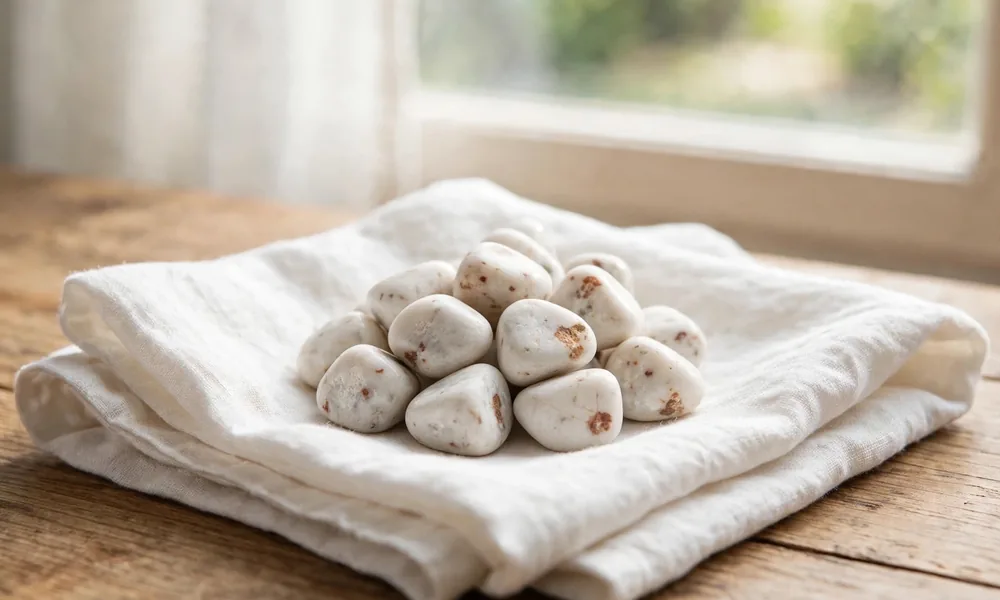
The colour runs from snow white to cream, and a fresh surface has a pearly shine rather than a glassy gleam. It is fairly soft, near five on the hardness scale, so a piece needs a gentle hand. Tumbled pieces lose the sharp blades and turn smooth and rounded, soft to the touch and easy to carry in a pocket.
The mineral was named for William Hyde Wollaston, an English chemist who studied it in the early eighteen hundreds. Industry uses the ground mineral in ceramics and paints. Shops sell it as a rough cluster, a tumbled pebble, or a single upright blade. It belongs to the same broad family as bustamite and rhodonite, pale and pink cousins that share its chain-like build, yet wollastonite keeps its own white character and never takes on their rose colour.
Why Clear White Suits Quiet Days
Clear white is the colour of an empty page, and it asks the eye to slow down. On a quiet day a pale stone keeps the calm instead of breaking it. Wollastonite lets the light do the work, catching a faint pearly sheen as the sun moves.
Other white stones in this journal share the colour but not the build. Barite is a clear white barium sulfate that grows in heavy bladed fans. Magnesite is a soft white carbonate, most often a smooth tumbled piece the shade of new chalk. White jade is a milky nephrite, polished to a buttery glow, with no fibres at all. Wollastonite sits between them: lighter than barite, silkier than magnesite, rougher than white jade.
Wollastonite and Anglesite: White Fibres Beside White Points
Anglesite vs Cerussite: What Makes It Different follows a clear white lead mineral that grows as sharp, glassy points, bright as a windowpane in winter. It is lead sulfate, heavy for its size, and it belongs on display only.
Wollastonite could hardly be built more differently. Where anglesite grows in sharp single points, wollastonite grows in soft bundles of blades; where anglesite is heavy and glassy, wollastonite is light and pearly. Both wear clear white, yet one is a lead mineral to admire from a distance, while the other is a pale silicate for a brief look.
Choosing a Wollastonite Piece
Study the piece by the brightest window, since warm shop bulbs flatter every white stone and hide its flaws. A good piece shows one even white, with firm whole blades, no grey crust, and no loose fibres shedding. It should sit flat without rocking.
Pick a piece about the size of a walnut, and ask the seller where it was found. Walk away from anyone who promises health benefits. A plain, honest cluster with a soft pearly sheen is the one worth taking home.
A Quiet Morning with Wollastonite
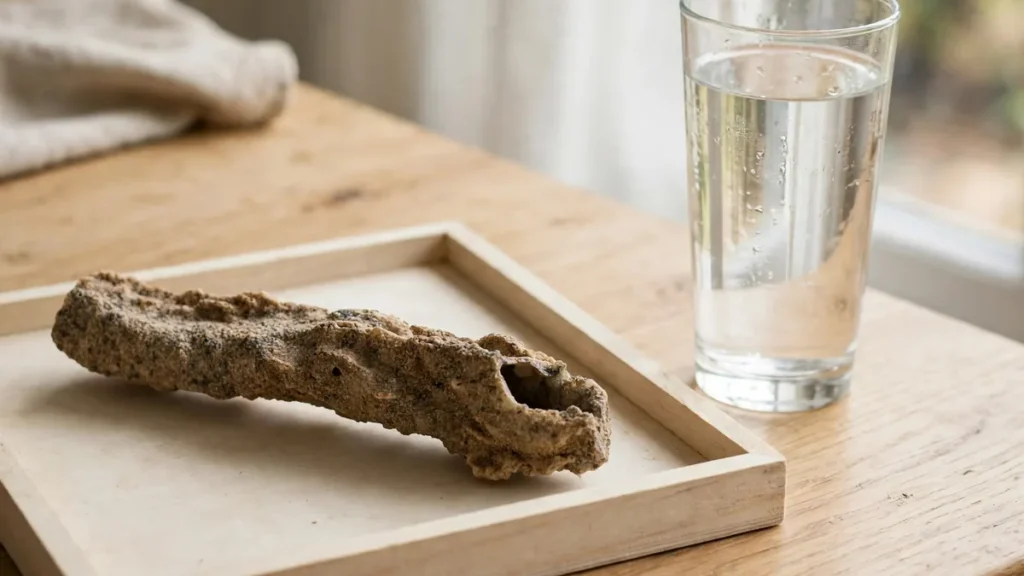
Pour the water first, and set the glass at one end of a folded white cloth on the side table. Put the wollastonite at the other end, where the blades catch the window light, leaving a clear stretch of cloth between the two. Then sit with a book and drink the water slowly while the light moves across the tray. The glass is for drinking, the stone is for looking at, and the morning stays slow because neither one asks for more. Ten minutes is enough.
Wollastonite Beside Water
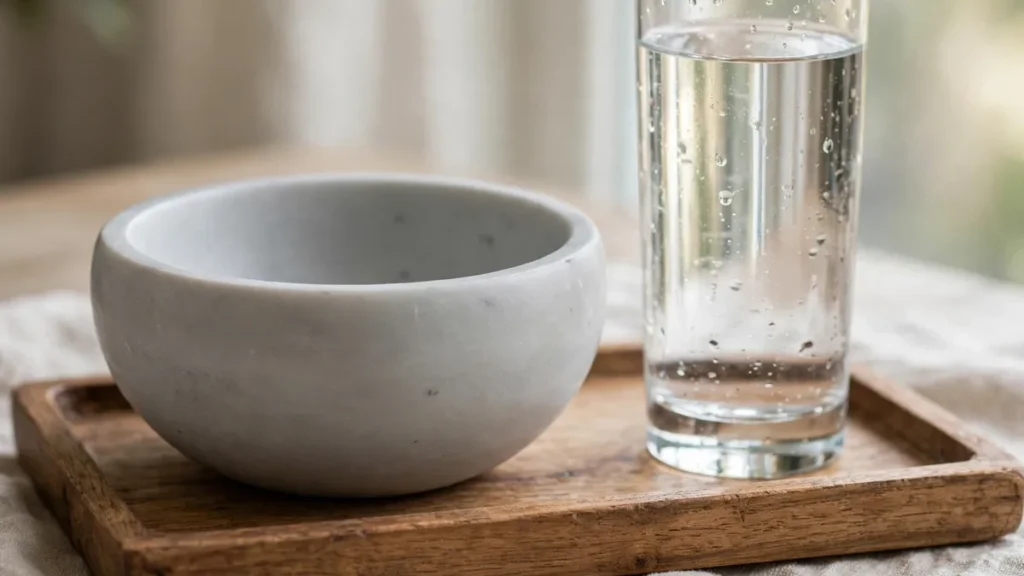
A glass and a stone can share one tray, so long as a clear stretch of bare wood stays between them. Stand the glass at one edge, rest the stone at the other, and keep splashes away from the blades. Never run the stone under a tap, and never drop it into a drink.
Dust it weekly with a soft dry cloth. A dry cloth is the only cleaning the stone ever needs. If it falls into a glass, tip the water away and wash the glass.
Wollastonite at a Glance
| White fibrous blades | Pale tray, window | Dry hands only |
|---|---|---|
| Calcium silicate, soft | Quiet days, pale light | Glass kept apart |
| Light, pearly shine | One small piece | Wash hands after |
| Walnut-sized piece | Wood, cloth, daylight | Keep it dry |
Wollastonite and Hambergite: Fibres Beside Clear Prisms
Is Hambergite Worth It for Quiet Days? follows a clear white beryllium borate that grows in flat-sided prisms, water-clear in fine pieces and milky white in plainer ones. It is fairly hard, near seven and a half on the scale, so it keeps its edges well.
Hambergite is a single clear crystal with flat glassy faces, while wollastonite is a bundle of many thin blades pressed together. Hambergite is harder, its shine the shine of still water; wollastonite is softer, its shine the shine of silk. Both are clear white, yet one is a prism to peer through, and the other is a sheaf of fibres.
Wollastonite and Sillimanite: Fibres Beside Silk Threads
Sillimanite Clear White for Quiet Days follows a clear white aluminium silicate that grows in fine silky fibres, pale as frost on a windowpane. It shares its chemistry with andalusite and kyanite, yet forms only where old rocks grew hottest.
The two stones are easy to confuse at a glance. Sillimanite threads are finer than a hair and lie in one direction like combed hair, while wollastonite blades are broader and flatter, with a pearly edge you can see plainly. Sillimanite is harder, near seven on the scale; wollastonite is softer, near five. Both stay dry beside the glass, yet one is silk and the other is straw.
Wollastonite Among the Other Stones in This Batch
Wollastonite is not alone in this batch — four more stones and five water guides arrived with it. Wavellite comes first, green and radial, a cluster of small spheres. Sulphur follows, bright yellow and sharp-smelling. Nosean is next, deep blue-grey, and lemurian quartz closes the set, clear and finely ridged.
The water guides take a different kind of rest: one lights a lantern as the evening turns blue, one strings fairy lights along a branch, one pulls on gloves for cold water, one opens a sun hat against bright light, and one carries a parasol for shade.
Where Wollastonite Rests at Home
A good home is a shelf nobody brushes past: the far end of a dresser, a ledge clear of the sink, or the top of a tall cupboard. Keep the spot free of splashes, steam, and small hands, and keep pets away from the tray.
Tuck the piece into a soft cloth bag of its own when it travels, away from harder stones, and rest the bag on a shelf where nothing can fall on it. Once a week, lift it by its base and look for loose fibres underneath.

Stones That Must Never Touch Water
Water ruins certain minerals outright, and the damage shows up too late to fix. Pyrite dulls when it stays damp, and angelite clouds after a single soak. Apatite falls apart when left in water, while lepidolite carries lithium in its flakes, so keep every cup well away from both.
Amber is old tree resin turned hard, and a soak leaves it cloudy for good, so it never goes into drinking water or a bath. Malachite holds copper in its green bands, and copper has no business near anything you might drink. Wollastonite gets the same dry treatment as every stone above: keep water away, wipe it only with a dry cloth, and clean your hands after you have held it.
Your Quiet Days Checklist
- Set the wollastonite on a folded white cloth, keeping the glass a hand-span away.
- Drink the water slowly while the light moves.
- Turn the piece over once and look at the blades from the other side.
- Set the stone back, then rinse your hands with soap and water.
- Buy only from a seller who tells you plainly where the piece was found.
- When a health worry lingers, ask a doctor — a white mineral holds no answers.
Tray, glass, stone: nothing else is needed.

Frequently Asked Questions
What is wollastonite, in plain words?
Wollastonite is a clear white calcium silicate, formed where limestone was baked by hot rock, and grown as bundles of flat blades and silky strands.
Why does wollastonite stay out of water?
Wet wollastonite loosens along its fibres, so keep it out of every drink and soak. If it drops into a glass, tip the water away and wash the glass.
How can I tell wollastonite from sillimanite?
Sillimanite grows in threads finer than a hair, lying in one direction like combed hair, while wollastonite grows in broader, flatter blades, and it is softer.
How do I pick a good wollastonite piece?
Look for one even white in daylight, with firm whole blades and no grey crust, on a walnut-sized piece that sits flat.
Is it all right to hold wollastonite for a short while?
Yes, for a brief look: lift a small dry piece, turn it once in the light, set it down, and wash your hands afterwards.
Where should wollastonite live at home?
A high shelf in a dry room suits it best, where no glass ever stands beside it.

The Bottom Line
Dry stone, a full glass at a distance, and a slow afternoon: that is all wollastonite asks.
A Note for Quiet Days
A pale stone, a full glass, and an afternoon with nowhere to be.