Some minerals announce themselves from across the room, all colour and flash. Anglesite does the opposite. It sits quietly on the tray, clear and white as a windowpane in winter, and you have to lean in close before you notice how much light it is holding.
The first time you pick up a piece, the surprise is the weight. A cluster no bigger than a plum feels heavier than it looks, cool and dense in the palm,.
This guide sets anglesite beside its famous look-alike, cerussite, and walks through the differences in plain language: what each mineral is made of, how their crystals grow, how to choose a sound piece, and the firm rule that keeps both of them dry, on the tray, and well away from any drink.
Key Takeaways
- Anglesite is a clear white lead sulfate mineral, often found as sharp, glassy crystals.
- Cerussite looks similar but is lead carbonate, a different mineral with twinned crystals.
- Both minerals hold lead, so both are for looking at only, never for water or food.
- A good anglesite piece is bright, clean, and firm, with points that end neatly.
- Wash your hands after handling it, and keep the stone dry beside its glass.
What Anglesite Is
Anglesite is lead sulfate, a mineral that forms when older lead ores weather and change near the surface of the earth. The lead stays, the sulfur joins it, and the result is a pale crystal that can be colourless, white, or faintly grey,.
Its crystals grow in the orthorhombic pattern, often as sharp, flat-sided points or as blocky tablets, and a fine piece has a bright, glassy shine that collectors call adamantine. The stone feels heavy for its size because lead is dense, and it feels cool to the touch even on a warm afternoon.
Why Clear White Suits Bright Days
White light is the hardest light to dress a room in, because anything coloured looks louder than it should and anything dark looks like a smudge. A clear white stone solves the problem by disappearing into the light itself, throwing it back without adding a colour of its own.
On a bright morning, anglesite on a pale tray looks like a piece of the window light that stayed behind. It asks for nothing except dry air and a little space.
Anglesite and Cerussite: Close Cousins, Different Salts
Cerussite clear white for bright days is the mineral most people confuse with anglesite, and the confusion is easy to understand. Both are clear white lead minerals, both grow in old lead country, both feel heavy and cool, and both throw back bright flashes of daylight.
The chemistry tells them apart. Cerussite is lead carbonate, built from lead and carbonate, while anglesite is lead sulfate, built from lead and sulfate. Their crystals differ too: cerussite often grows in twinned pairs that mirror each other, sometimes forming little white stars, while anglesite grows as sharp single points and blocky tablets with a brighter, almost diamond-like shine.
The safety rule, though, is exactly the same for both. Each holds lead, so each is a display piece only. Neither one goes near water, food, or skin worn all day, and both ask for washed hands after a brief look.
Choosing an Anglesite Piece
Shop for anglesite in plain daylight, away from the yellow lamps of a shop counter, because white stones hide their flaws under warm light. In daylight the white should read clean, without brown staining or a chalky crust.
The points should end cleanly and feel solid, not loose or gritty, and the base should sit flat on a table without rocking. Ask the seller where the piece was found and whether they will say, without being pressed, that the stone contains lead. A seller who volunteers that fact is a seller worth trusting, and a seller who promises the stone can change your health, your sleep, or your luck is a seller to walk away from.
A Bright Morning with Anglesite
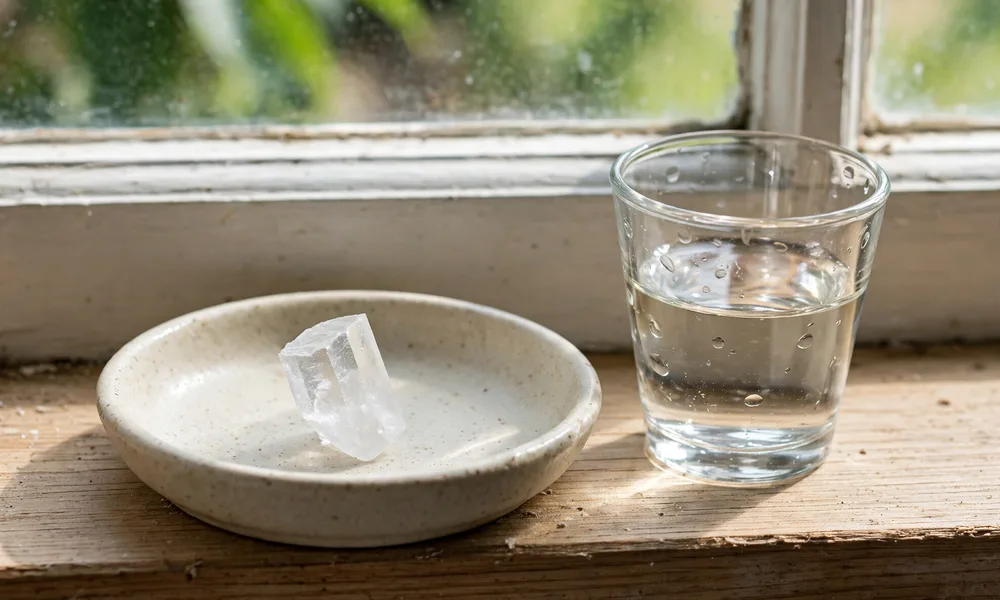
Give anglesite the first bright hour of the day. Spread a pale cloth over the side table, set the cluster at one end with its sharpest faces toward the window, and stand a tall glass of water at the far end, with a wide stretch of dry cloth between the two. Sip the water slowly while the stone gathers the light and throws small white flashes across the fabric.
Lift the stone once for a closer look, notice how cool and heavy it feels, set it back down, and wash your hands before you touch food or your face.
Anglesite Beside Water
Water and anglesite look fresh together on one tray, yet the two must never meet. Set the glass down on the left side and the crystal on the right, leaving a broad band of dry wood showing between them, so your drink stays clean and the stone never feels a drop. Rinse your hands with soap before you reach for the glass, and again after you have set the stone down.
The stone belongs nowhere near a drink. It does not go into a glass, a jug, a bath, or a soak, and it never gets rinsed under a tap, because lead has no place in anything you might swallow.

Anglesite at a Glance
| Clear white points | Pale tray, window | Look, never soak |
|---|---|---|
| Lead sulfate, heavy | Bright days, white light | Glass kept apart |
| Glassy, sharp shine | One tray, one glass | Wash hands after |
| Walnut-sized cluster | Wood, cloth, daylight | Dust dry weekly |
Anglesite and Pyromorphite
Pyromorphite warm green for bright days is another lead mineral from the same old mining country, yet it could hardly look less like anglesite. Pyromorphite grows in warm green barrels and rounded clusters, bright as new leaves after rain, and its colour is the first thing anyone notices from the doorway.
Anglesite is its pale opposite: colourless and white, glassy and quiet, its sparkle white rather than green. The two share the same warning, though, because pyromorphite also holds lead.
Anglesite and Mimetite
Mimetite warm yellow for bright days rounds out the lead family with a sunny yellow, its crystals gathered in small bright balls and botryoidal clusters. Where anglesite is sharp and clear, mimetite is soft and rounded, and where anglesite throws white flashes, mimetite glows like late afternoon sun on a wall.
The family resemblance is in the chemistry, not the colour: mimetite, like anglesite and cerussite, carries lead, so it follows the same strict rule. Look, enjoy, wash your hands, and leave the stone beside the glass rather than in it.
Anglesite Among the Other Stones in This Batch
This batch holds four more minerals beside anglesite, and each one wears its own character. Sinhalite is a warm brown stone, earthy and steady, where anglesite is pale and bright. Pezzottaite is a soft pink gem, tender in tone, and its colour could not be further from anglesite's clear white. Magnetite is a deep black stone, dark and heavy, the night to anglesite's morning. Hambergite is clear white too, yet it differs sharply: it is a beryllium borate with no lead at all, lighter in the hand and safe to handle in the ordinary way, while anglesite is a dense lead sulfate that stays a display piece only.
Where Anglesite Rests at Home
Choose a spot the household walks past but never bumps into: the end of a worktop, a high ledge, or the top of a cabinet near the morning window. The perch needs to stay clear of taps, kettles, and steamy air, and well out of reach of small children and pets, who put things in their mouths without thinking.
When the piece travels, wrap it in a soft cloth and give it its own padded pouch, kept apart from keys, coins, and anything harder that could scratch it. A little care keeps the white bright for years.
Stones That Must Stay Away from Water
A few other minerals deserve an even stricter warning than anglesite, and learning their names makes the whole display safer. Malachite is green because of the copper locked in its bands, and copper is not something to swallow, so keep that stone well away from every cup and jug.
A soak breaks apatite down until it softens and falls apart, and angelite turns dull and cloudy after a wetting, so both want a dry shelf. Lepidolite hides lithium inside its pale flakes, which is reason enough to keep every drink far away from it. Amber, old tree sap grown hard, goes milky after a long dip. Treat anglesite the same way: admire it beside the glass, never inside it, and keep every stone named here far from food and drink.
Your Bright Days Checklist
- Set the anglesite on a dry cloth, with the tumbler well clear of it.
- Sip the water slowly, a mouthful at a time.
- Hold the stone up once so its sharpest faces catch the light.
- Set the piece back down, then clean your hands with soap.
- Choose a seller who tells you, unprompted, where the piece came from.
- If a health question is on your mind, take it to a doctor — no stone can answer it.

Frequently Asked Questions
What exactly is anglesite?
Anglesite is lead sulfate, PbSO4, in sharp, glassy crystals, clear white or faintly grey, and heavy for its size because lead is dense.
How is anglesite different from cerussite?
Both are clear white lead minerals, yet cerussite is lead carbonate with twinned crystals that often form little white stars, while anglesite is lead sulfate with sharp single points and a brighter, harder sparkle.
Can I put anglesite in water?
No. Anglesite must stay out of drinking water, out of soaks, and out of baths, because it holds lead, so let it rest next to the glass instead of inside it.
How do I spot a good anglesite piece?
Look for bright, clean white in daylight, firm points, no brown staining, and a seller who volunteers that the stone contains lead.
Can I pick anglesite up for a quick look?
Yes, for a short look with dry hands. Set the piece down straight away and clean your hands with soap before you eat, drink, or touch your face.
Where should anglesite live at home?
Place it on a dry ledge in soft light, like a desk end or a tall shelf near the morning window, clear of water, steam, children, and pets.

The Bottom Line
For a bright day, anglesite is enough: one pale crystal resting dry on its tray, and a glass of water standing on its own.
A Note for Bright Days
Pale crystal on the tray, water in the glass, and the stone kept dry — and when the garden needs attention, Water and a Compost Bin: When to Water It Right walks through the heap, the can, and the right moment to water.