
Quiet arrives in small ways: the postman has already been, the washing turns slowly on the line, and the hall clock ticks louder than the traffic outside. A clear white stone suits this kind of morning, adding almost nothing to the scene yet giving the eye somewhere gentle to rest.
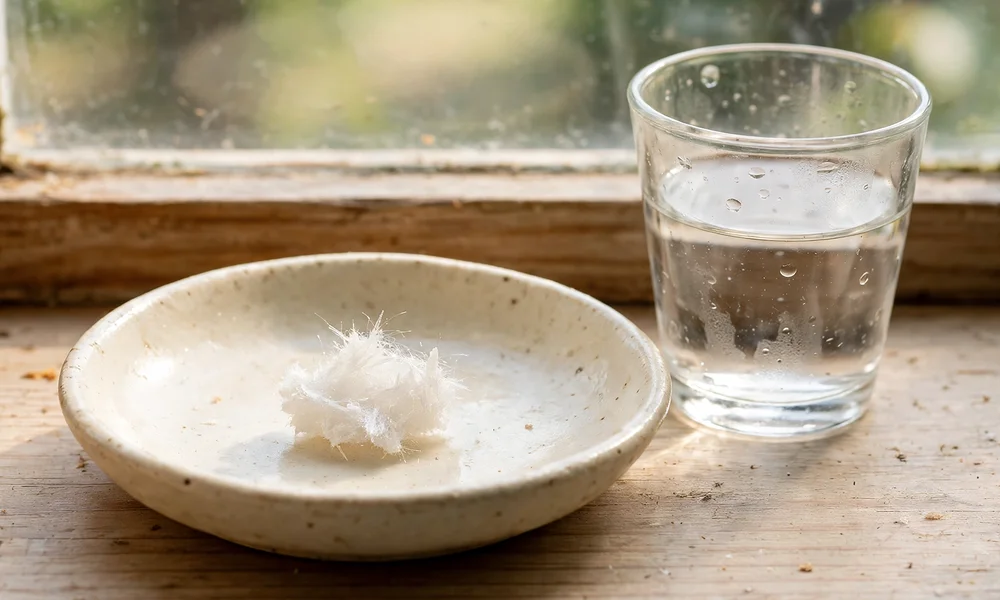
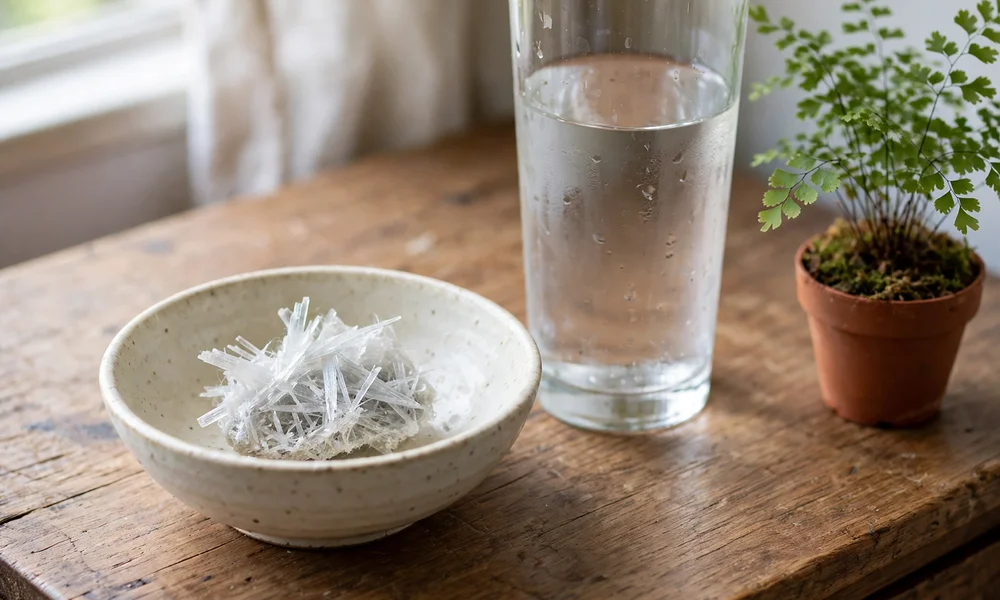
Sillimanite is that stone: fine silky threads, pale as frost on a windowpane, like a tuft of white hair caught in rock, with no bright colour and no glitter, only a soft sheen that shifts as the light moves.
This guide takes sillimanite on its own terms: what the mineral is, why collectors pair it with its two chemical twins, how to pick a piece worth a shelf, and how to keep it dry by a glass of water. It is a thing to look at and hold for a minute, and it will not mend anything at all.
Key Takeaways
- Sillimanite is a clear white aluminium silicate that often grows in fine silky fibres.
- It shares its chemistry with andalusite and kyanite, yet forms only where rocks grew hottest.
- Its pale fibrous look suits quiet days, pale light, and rooms kept deliberately plain.
- Sillimanite is a display piece to look at and hold briefly; it treats nothing.
- The stone rests beside the glass, never dropped into it, and stays dry at all times.
What Sillimanite Is
Sillimanite is a mineral of aluminium and silicon, built from the same ingredients as andalusite and kyanite. The three share one formula, Al2SiO5, and differ only in how their atoms are arranged, which depends on the heat and pressure of the rocks where they grew; sillimanite is the one that appears when the rock grew hottest. It turns up in gneiss and schist, banded and flaky rocks once buried deep and baked over millions of years.
Most shop pieces are the fibrous kind, once called fibrolite: bundles of fine white needles pressed together. Some are compact and grey-white, with a pearly gleam along the fibres; others are loose and silky, almost like spun glass. It is fairly hard, 6.5 to 7.5 on the Mohs scale, and heat-proof enough that industry uses it in furnace linings. It was named for Benjamin Silliman, the Yale professor who first described it in the early eighteen hundreds.
Why Clear White Fits Quiet Days
Clear white is the colour of an empty page and a freshly made bed, and it asks the eye to slow down. On a quiet day the room is already calm, and a pale stone keeps that calm instead of breaking it. A red or violet stone would pull the gaze toward itself all morning, while sillimanite lets the light do the work, catching a faint sheen as the sun moves.
The fibres add a second quiet: too fine to follow one by one, they simply give the eye somewhere soft to rest.
Picking a Sillimanite Piece
Look for sillimanite in daylight, by a window rather than under shop spotlights. A good piece shows clean white or pale grey fibres, tightly packed, with a soft silky shine when you turn it, lying in one direction like combed hair, and feeling cool and a little rough, never sticky or waxy. Walk away from any piece that looks dyed, any fibres that crumble at a touch, and any seller who claims the stone will change your sleep or your health.
A walnut-sized piece is plenty for a tray and easier to keep safe than a large spray of loose fibres. Ask the seller where the stone was found and whether the fibres sit firmly in the matrix; neat, tight fibres outlast a showy piece that sheds.
A Quiet Day with Sillimanite
Begin by setting a pale cloth over the side table, the sillimanite toward the front where the light reaches it, and a glass of water at the far end, with a handspan of bare cloth between them. Drink the water in unhurried sips while the fibres catch the light, then leave the stone where it is.
Glance at the piece when you pass, move it to the windowsill for an hour if you like, and put it back before evening.
Sillimanite Beside Water
Water and sillimanite look natural together on a tray, yet their places must never be exchanged. Put the tumbler at one end and the stone at the other, with dry cloth or bare wood between them, so the drink stays clear and the fibres stay untouched by damp. Wash your hands with soap after setting the stone down, before lifting the glass.
Keep it out of glasses, jugs, and baths alike, and never run it under a tap — moisture loosens the fibres, so only a dry cloth ever touches it.

Sillimanite at a Glance
| Fibrous white threads | Pale tray, shelf | Dry hands only |
|---|---|---|
| Silky needle clusters | Quiet days, light | Glass kept apart |
| Hard, heat-born mineral | One accent, plain | Never in drinks |
| Small piece, neat | Window light, calm | Dust dry weekly |
Sillimanite and Andalusite
Andalusite for steady days is an earthy brown mineral, the shade of autumn leaves and tilled soil, smooth to the touch, and a few pieces show a dark cross at their centre.
The twins could hardly look less alike: andalusite is brown, smooth, and solid, often cross-marked, while sillimanite is white, fibrous, and silky, with no cross at all. Andalusite formed under lower pressure; sillimanite where rocks grew hotter — the same ingredients turned into two very different stones.
Sillimanite and Magnesite
Magnesite for quiet days is a soft white carbonate stone, usually a smooth tumbled piece the colour of fresh chalk, sometimes faintly marbled.
Sillimanite shares the pale colour and the quiet mood, yet the two stones part in the hand. Magnesite is smooth, chalky, and matte, warming quickly in the palm, while sillimanite is fibrous and silky, its fine threads catching the light as it turns. Magnesite is a soft carbonate that scratches easily; sillimanite a harder silicate that holds its fibres.
Sillimanite and Goshenite
Goshenite for quiet days is the colourless variety of beryl, plain, clear and uncoloured, like still water turned to stone.
Sillimanite and goshenite are both pale and both quiet, yet they differ in the way light moves through them. Goshenite is clear and glassy, one transparent crystal you can almost see through, while sillimanite is opaque and fibrous, its light scattered across thousands of fine threads.
Sillimanite Among the Other Stones in This Batch
This batch holds four more stones beside sillimanite, each wearing a different colour. Marcasite is a warm gold mineral with a bright metallic flash, where sillimanite is pale and matte. Pyromorphite is a warm green stone, bright as new leaves, while sillimanite keeps the colour of frost. Taaffeite is a soft violet gem, rare and richly coloured, far from sillimanite's plain white, and serendibite is a deep blue stone, dark and calm, while sillimanite stays light and airy.
Kyanite, the third twin of the Al2SiO5 family, grows in long blue blades, and its hardness changes with direction, softer along the blade and harder across it. Sillimanite shares kyanite's chemistry, yet it grew hotter, paler, and fibrous: blue blades mean kyanite, white threads mean sillimanite.
Where Sillimanite Rests at Home
A good home for sillimanite is a spot you pass each day without knocking against it: a desk end, a waist-high shelf, or a chest of drawers top. It likes gentle morning light, and it belongs away from taps, kettles, and steamy air, where small children cannot reach to tug the fibres.
Once a week, brush dust away with a soft dry brush, working along the fibres rather than across them. Off its tray, keep it alone in a small lined box, away from keys and harder gems.
Stones That Must Stay Away from Water
Some stones carry a sharper warning than sillimanite, and their names are worth learning before any tray is set. Malachite holds copper inside its green bands, and copper has no business near a mouth, so that stone stays well away from every jug and tumbler. Hematite turns rusty when left damp, and the rust can stain skin and cloth, so it stays out of drinking water too.
Apatite softens and breaks apart when soaked, and pyrite falls to pieces in damp air, so both belong on dry shelves. Lepidolite hides lithium in its pale flakes, so no drink should ever touch it. Angelite goes dull and cloudy after a wetting, and amber, old tree sap grown hard, turns milky in a soak.
Your Quiet Days Checklist
- Lay a pale cloth over the table and place the stone at one end, the glass at the other.
- Sip the water slowly while the morning light moves across the fibres.
- Raise the stone, turn it once in the light, and set it back down.
- Wash your hands after handling the stone, before touching food or drink.
- Buy from a seller who names the quarry or region without being pressed.
- If a health worry stays with you, speak to a doctor — no stone holds an answer.
Cloth down, glass filled, stone in place: the morning set-up takes under a minute.
Frequently Asked Questions
What exactly is sillimanite?
Sillimanite is a clear white aluminium silicate, Al2SiO5, that often grows in fine silky fibres, formed where old rocks were baked at very high temperatures deep underground.
How does sillimanite differ from andalusite?
Both share the formula Al2SiO5, yet andalusite is warm brown, smooth, and sometimes cross-marked, forming at lower pressure, while sillimanite is white and fibrous, forming where rock grew hotter.
How does sillimanite differ from kyanite?
Kyanite is the third Al2SiO5 twin, growing in long blue blades whose hardness changes with direction, while sillimanite grows in pale white fibres at one steady hardness.
Can sillimanite go in water?
No — keep water away from it entirely, and never ever hold it under a running tap. Damp loosens the fibres, so always wipe it dry instead.
Is sillimanite safe to hold briefly?
A short hold of a small firm piece suits most adults, as long as you wash your hands after putting it down and keep loose fibres away from children.
Where should sillimanite rest at home?
Put it somewhere dry with gentle light — a desk corner, a shelf near the morning window, or a drawer top — far from taps, steam, and little hands.

The Bottom Line
For quiet days, sillimanite is enough: one pale fibrous stone, a glass of water at the far end of the tray, fibres dry in the morning light.
A Note for Quiet Days
White threads, a full glass, a dry tray — that is all a quiet day needs.


