Some stones arrive with a story, and hambergite is one of them. It is colourless, almost shy in the hand, and easy to walk past in a shop of brighter minerals. Yet collectors tend to keep the same small clear piece for years.
Hold it up to a window and it behaves like a drop of still water that has learned to keep its shape.
This guide asks the question in the title plainly and answers it in plain words too: what hambergite is, why a clear white stone suits a slow day, how to tell it apart from the pale minerals it resembles, and the dry shelf where it lives beside a glass of water.
Key Takeaways
- Hambergite is a clear white beryllium borate, glassy and colourless, with flat faces that catch the light.
- Its pale, uncoloured look suits quiet days, pale light, and rooms kept deliberately plain.
- It is harder than many pale stones, yet still a display piece to admire rather than a tool.
- Hambergite is worth having only if you like clear stones; it treats nothing.
- The stone stays dry beside a glass of water, never dropped into it, and needs only a dry wipe.
What Hambergite Is
Hambergite is a mineral built from beryllium, boron, oxygen and a little hydroxyl, a combination chemists write as Be2BO3(OH). It was named for Axel Hamberg, a Swedish mineralogist, and first described from Madagascar, where the finest clear crystals still come from pegmatite pockets. Other pieces turn up in Norway, Russia and the United States.
The crystals grow in the orthorhombic pattern, forming flat-sided prisms with neat ends. A fine piece is water-clear; plainer pieces run milky white, like frosted glass. It is fairly hard, about 7.5 on the Mohs scale, and it feels cool in the palm.
Why Clear White Suits Quiet Days
A quiet day has pale, unhurried light through the window, settling on the table without fuss. On a day like that a loud or fussy object jars, and the gaze searches for something unadorned instead. A clear stone fits the hour, catching the light without throwing it back.
Hambergite adds almost nothing to a room, and that is the point. There is no colour to argue with the curtains and no glitter to chase across the table. The eye rests on it the way it rests on an empty page, and the room stays as calm as it was before the stone arrived.
Hambergite and Sillimanite
Sillimanite for quiet days is a clear white aluminium silicate that grows in fine silky fibres, with a soft sheen that shifts as the light moves. Its fibres lie in one direction like combed hair.
Hambergite shares the pale colour and the quiet mood, yet the two stones part the moment you look closely. Sillimanite is fibrous and silky, its fine threads catching the light as it turns, while hambergite is glassy and clear, with flat faces and clean edges like a cut piece of ice. Sillimanite formed where rocks grew hottest; hambergite grew in pegmatite pockets. One is a bundle of threads, the other a block of glass.
Choosing a Hambergite Piece
Shop for hambergite in daylight, by a window rather than under bright spotlights. A good piece shows clean, water-clear faces, or an even milky white if you prefer the frosted kind, with no grey crust and no cloudy patches. The edges should feel firm and sharp, not crumbly.
Take a piece that rests easily in the hand, no bigger than a walnut, or a touch smaller. Ask the seller where the piece was found, and walk away from any piece that looks dyed and any claim that the stone can improve health, sleep or luck. A plain honest piece is worth more than a large cloudy one.
A Quiet Morning with Hambergite
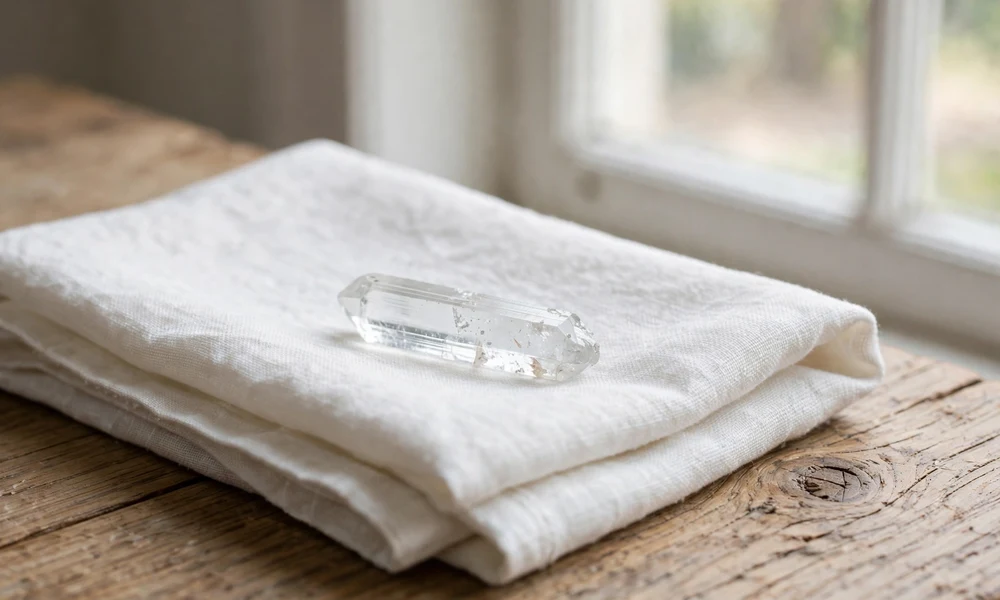
The first hour shapes the rest, so lend the stone a corner of it. Lay a folded white cloth on the side table, set the hambergite at one end, and put a tall glass of water at the far end, with a handspan of bare cloth between the two. Drink the water in unhurried sips.
There is no task to finish and no order of steps to remember. When the glass is empty, the morning's work is done.
Hambergite Beside Water
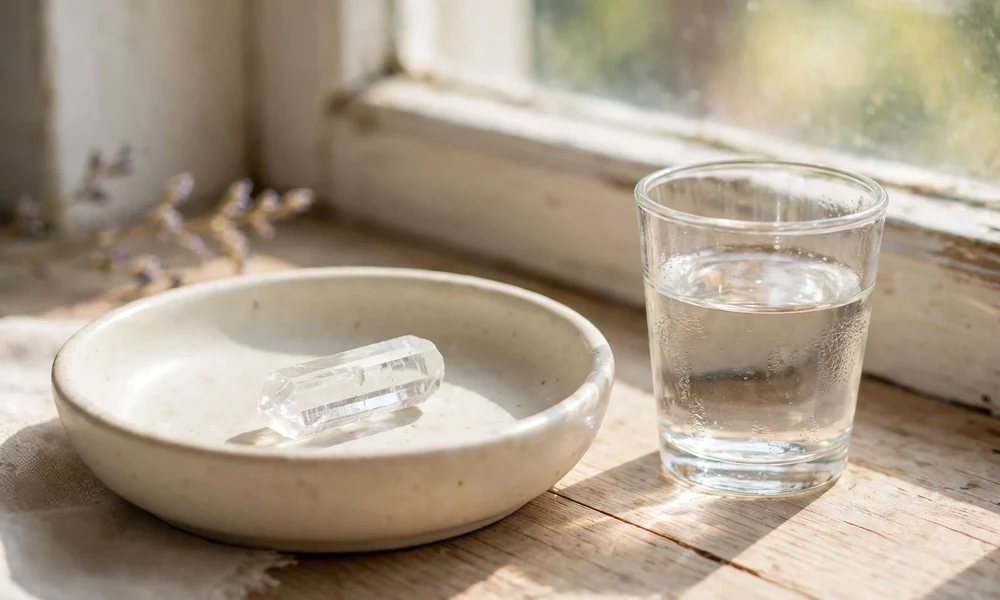
Water and hambergite look natural together on one tray, yet their places must never be swapped. Set the tumbler at one end and the stone at the other, a stretch of dry cloth lying between them, so the drink stays clear and the crystal stays untouched. Wash your hands before you lift the glass to drink.
Do not drop it into a glass, a jug, a bath or a bowl, and never rinse it under a running tap. A soft dry cloth drawn gently across its faces once a week is the only cleaning it ever needs. Keep every drink far from the stone, and let the glass do the drinking.
Hambergite at a Glance
| Clear glassy white | Tray, shelf, desk | Dry hands only |
|---|---|---|
| Flat-sided clear prisms | Quiet days, pale light | Glass kept apart |
| Beryllium borate stone | One clear accent | Never in drinks |
| Walnut-sized piece | Wood, cloth, daylight | Wipe dry weekly |
Hambergite and Barite
Barite for quiet days is a clear white barium sulfate mineral, found as glassy bladed crystals or as smooth tumbled pieces, and the first thing most people notice about it is not its colour at all, but its weight. It weighs far more than its size suggests, because barite ranks among the densest common minerals.
Hambergite could hardly feel more different in the hand. Barite is heavy for its size, its flat blades stacked in fans, while hambergite is light, its prisms clean and glassy. Barite looks like frozen daylight; hambergite looks like a drop of still water. Both are clear white and both suit a quiet day, yet one announces itself by weight and the other by light.
Hambergite and Magnesite
Magnesite for quiet days is a gentle white carbonate stone, most often a smooth tumbled piece the shade of new chalk, now and then faintly veined like thin lines in pale marble. Its surface is matte rather than glassy, like chalk polished by hand.
Hambergite shares the pale colour and the quiet mood, yet the two part in the hand and in the light. Magnesite is soft, chalky and matte, while hambergite is hard and glassy, cool to the touch. Magnesite sits on the light softly instead of sparkling; hambergite lets the light pass straight through. One is a piece of chalk, the other a piece of glass.
Hambergite Among the Other Stones in This Batch
This batch holds four more minerals beside hambergite, and each one wears a colour far from clear. Sinhalite is a warm brown stone, the colour of polished wood. Pezzottaite is a soft pink gem, gentle as a rose petal. Magnetite is a deep black iron stone, dark and heavy, and it pulls a compass needle. Anglesite is a clear white lead mineral, yet it carries lead and belongs on display only, far from food, drink and small hands. Hambergite holds the clear middle of the tray among them. The water article beside it in this batch, the complete guide to water and a vision board, pairs a glass of water with pictures of the days ahead.
Where Hambergite Rests at Home
Pick a nook the household passes daily yet never bumps: the end of a worktop or a shelf by the morning window. Morning sun through the window suits it, and the spot must stay away from taps, kettles and steamy air, and beyond the reach of little fingers.
Once a week, sweep the dust away with a dry soft cloth and look over the faces for grey film or tiny chips. When the piece travels, wrap it in a soft cloth inside a small padded pouch of its own.
Stones That Must Stay Away from Water
A few minerals carry a sterner warning than hambergite, and learning their names makes every shelf safer. Malachite carries copper in its green bands, and copper must never come near a mouth. Hematite left damp can rust and mark skin and cloth, so keep it out of drinking water as well.
Water softens apatite until it falls apart in your hands, and a wet angelite turns dull and cloudy. Lepidolite hides lithium inside its pale flakes, which is one more reason to keep every drink well away from it. Amber, old tree sap grown hard over long ages, goes milky when it is soaked. Admire hambergite next to the glass, never within it, and keep all of these stones well away from food and drink.
Your Quiet Days Checklist
- Set the hambergite on a dry cloth, the tumbler a good distance away.
- Sip the water slowly, a mouthful at a time, before the day hurries.
- Raise the stone and angle its clearest faces toward the window.
- Return the piece to its tray, then wash your hands.
- Pick a seller who can tell you plainly where the stone came from.
- If a health worry stays, see a doctor — a clear stone holds no cure.
A tray, a glass, a dry cloth and one clear stone: that is the whole arrangement.

Frequently Asked Questions
What exactly is hambergite?
Hambergite is a mineral of beryllium, boron, oxygen and hydroxyl, Be2BO3(OH), that grows in clear flat-sided prisms, colourless or milky white, named for the Swedish mineralogist Axel Hamberg.
Is hambergite worth buying for quiet days?
It is worth buying only if you like clear stones and want a small glassy piece for a plain shelf; it treats nothing and promises nothing.
How is hambergite different from sillimanite?
Both are clear white stones, yet sillimanite grows in fine silky fibres, while hambergite grows in flat-sided glassy prisms from pegmatite pockets.
Can I put hambergite in water?
No. Hambergite must stay out of drinking water, soaks and baths; it belongs on a dry tray beside the glass.
Can I hold hambergite for a moment?
A short hold of a small dry piece suits most adults, if you wash your hands once you have set it down.
Where should hambergite live at home?
Leave it on a dry shelf in gentle morning light, close to the window yet well far from water, steam, pets, and curious little hands.

The Bottom Line
For a quiet day, hambergite is enough when you love clear stones: one glassy piece resting dry on its tray, while water remains in its own glass.
A Note for Quiet Days
Clear stone on the tray, water in the glass, and nothing wet near the crystal — a quiet day asks for little more than that.