Lightning can turn sand into glass. When a bolt strikes dry sand, the heat fuses the grains in a second, and the ground keeps a hollow tube where the bolt passed through. That tube is fulgurite: rough outside, glassy inside, and shaped like a crooked root.
People buy fulgurite because it holds a storm in a small object. It sits on a desk or a shelf as a talking point, a piece of weather you can hold. The tube is fragile, though, and a careless knock can snap it, so it suits a quiet corner better than a busy pocket.
This guide gives plain facts for a buyer: what fulgurite is, how lightning makes it, how to tell a true tube from a fake, and how to keep it safe beside water. Take it as plain facts, nothing more. A stone cannot treat illness, and any health worry is a matter for a doctor, not for a display shelf.
Key Takeaways
- Fulgurite is glass made when lightning strikes sand.
- The tube is hollow, rough outside and glassy inside.
- Buy a piece you can see clearly before you pay.
- Keep it dry on its dish, beside water, never in it.
- Fulgurite is a display piece, not a treatment or a charm.
What Fulgurite Is
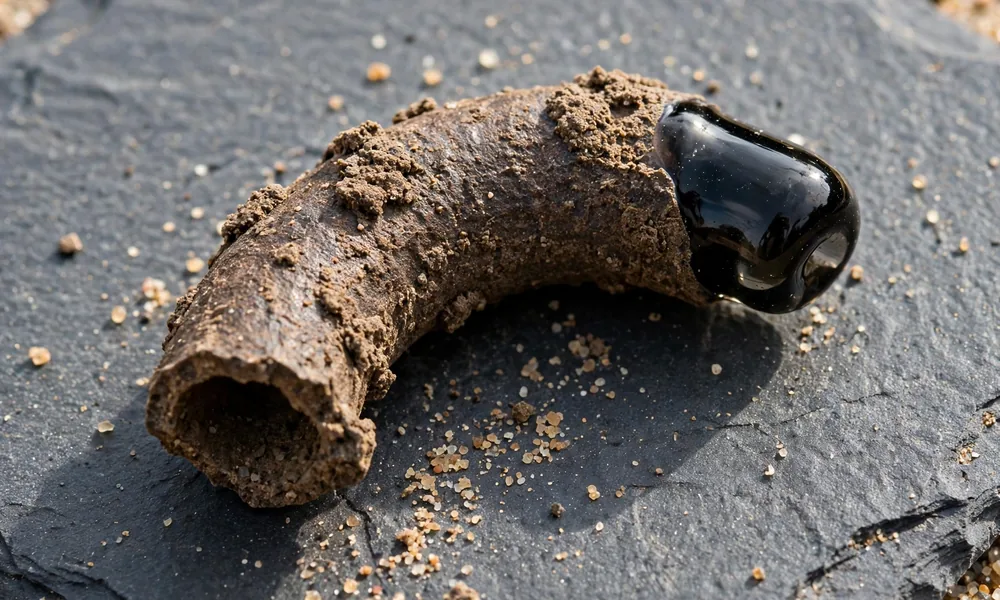
Fulgurite is a natural glass tube formed by lightning. A bolt carries fierce heat down into sand or soil, melts the grains along its path, and leaves a hollow channel when the glass cools. The outside keeps a crust of sand stuck to it, while the inside shines smooth and dark.
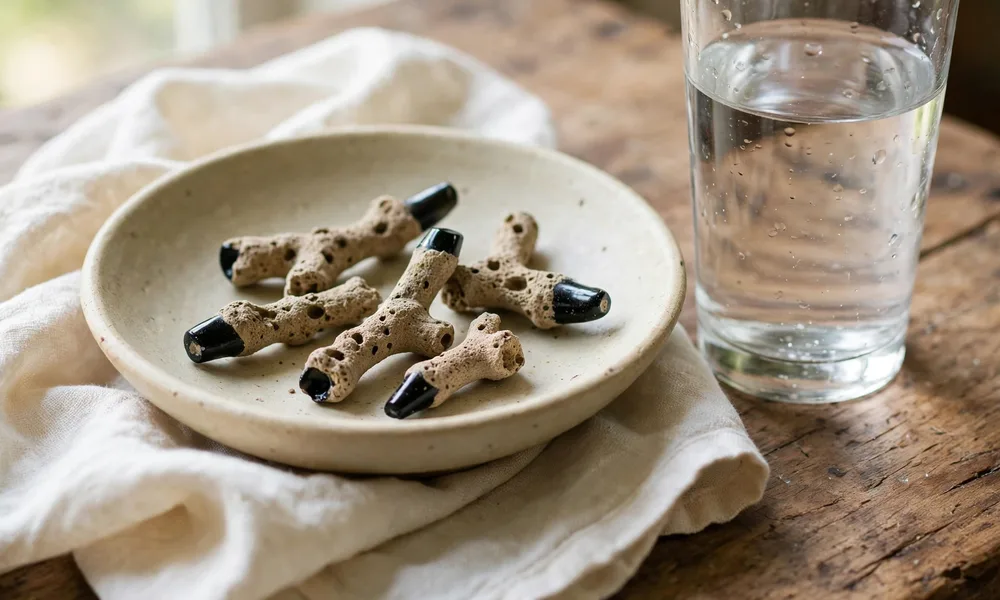
Most pieces are brown, grey or sandy gold, and no two share the same bends. Some run straight for a handspan, and others twist like a root, with branches that broke off long ago. Hold one to a lamp and the thinner walls may glow faintly brown at the edge, where the glass is at its thinnest. Longer pieces often show a bend where the bolt changed direction, and a broken end may reveal the glass wall at its thinnest.
How Lightning Makes Glass from Sand
A lightning bolt is hotter than a furnace for a split second. When it hits dry sand, the grains along its path melt at once, and the melted sand cools into glass before it can run away. The bolt itself leaves a hollow core, because the charge passes down the middle and the glass sets around it.
Rain and wind do the rest over time. The crust of loose sand stays stuck to the outside, giving the tube its rough skin, while the inner glass stays smooth and dark. Diggers find these tubes in deserts and sandy fields, sometimes after a storm season, and a fresh tube may still hold sand in its hollow end.
Fulgurite Beside Water, Never in It
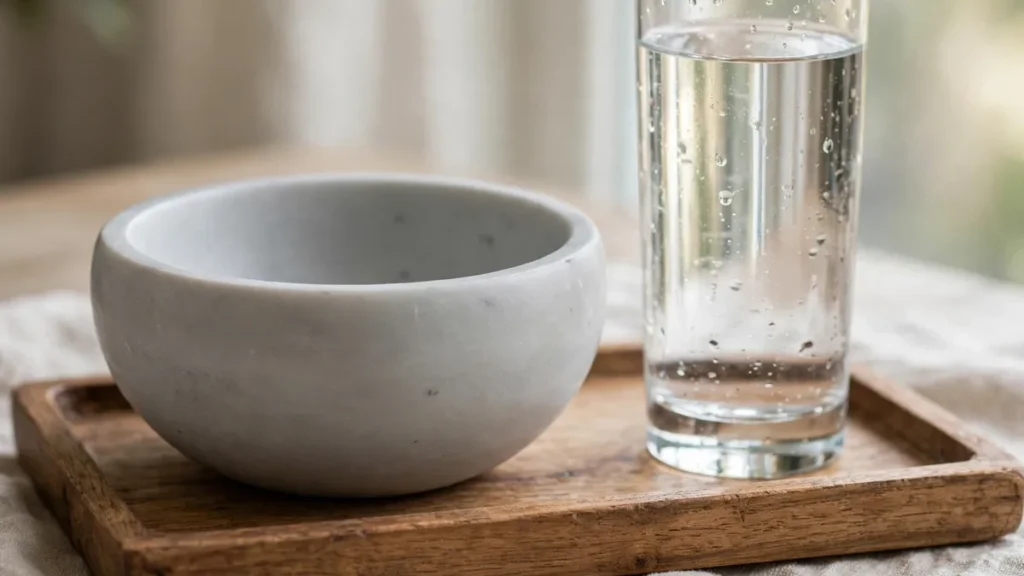
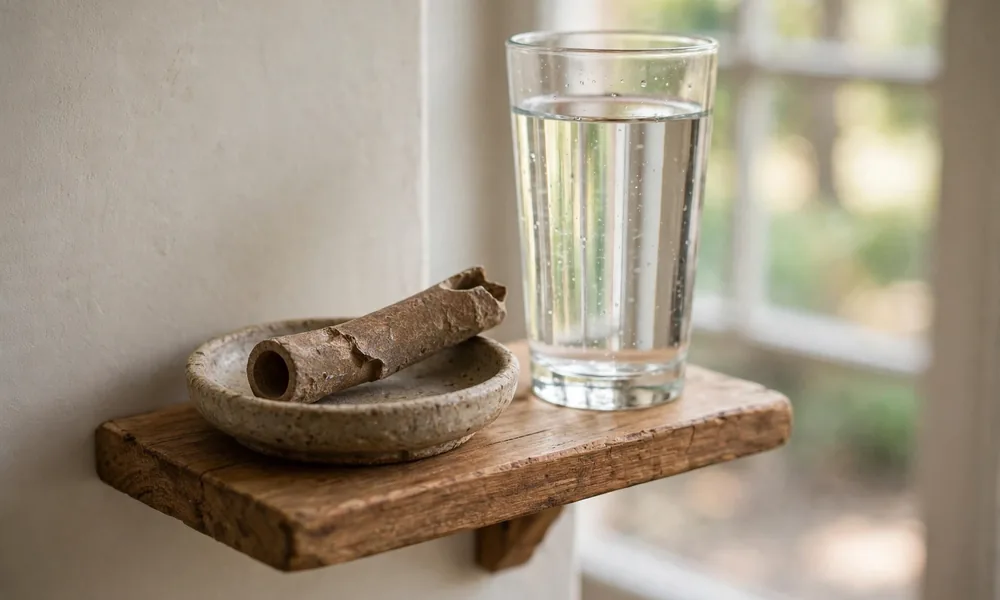
A glass of water belongs beside the fulgurite, on the same shelf, where both can be seen at once. The stone rests dry on its dish, the glass stands full next to it, and the two never touch. That distance keeps the water plain and the tube safe.
Water inside the tube would be a poor idea. A hollow glass tube can trap damp, hold dust in its ridges, and chip at the rim if it is knocked while wet. A stone dropped into a drink can also be swallowed by mistake if it is small. Keep the pair as neighbours on the shelf, and let the water stay a drink and the stone stay a display. A dry cloth once a week keeps the dust off both.
Choosing a Fulgurite Piece
Look at the piece in daylight before you buy it, and turn it slowly in your hand. A true tube shows a hollow opening at one end, a rough crust of sand on the outside, and a smooth glassy lining when you peer inside. The colour should look like earth and sand, not paint, and the surface should feel gritty, not slick like plastic.
Pick a piece that fits your palm and has no loose cracks running through it. Ask the seller where the piece came from and how it was found, and buy from one who answers plainly. A piece with a little sand still clinging to its crust is a good sign, since a washed-clean tube may hide its rough skin. Walk away from any seller who promises the stone will heal you, change your luck, or fix a health trouble, because no honest seller makes such claims.
Fulgurite at a Glance
| Hollow glass tube | Rough sandy crust | Warm brown tones |
|---|---|---|
| Lightning made it | Sand grains stuck | Glassy inner shine |
| Fits in palm | Dish beside glass | Dry shelf only |
| Check hollow end | Turn in daylight | Trusted seller first |
Fulgurite and Tektite
For dark glass made by a meteorite strike, see the tektite guide.
The piece in that guide is a lump of night-coloured glass, dimpled all over, kept for evenings that call for quiet confidence. Its birth was a collision: a rock from space hit the ground, the ground stone melted, and the melt cooled in the air into dark lumps.
Fulgurite comes from a different sky. It is glass made by lightning striking sand on earth, not by a rock falling from space, and it grows as a hollow tube rather than a solid lump. One fell from the sky as glass, and the other was struck into glass where it lay.
Fulgurite and Moldavite
For green glass that marks new chapters, see the moldavite guide.
The piece in that guide is a moss-green lump of glass, uneven and dimpled, kept for mornings when life turns a page. It began the same way tektite did, when a space rock fused ground stone into glass that fell back as green pieces.
Fulgurite differs in colour, shape and birth. It is warm brown, not forest green, it is a hollow tube, not a solid lump, and lightning made it in sand, not a meteorite in rock. Both are natural glass, and both stay dry beside water, but only one carries a storm inside it.
Fulgurite and Meteorite
For a rock that fell from space, see the meteorite guide.
That guide follows a heavy piece of iron and stone that crossed the sky and landed on earth, pitted and dark, a visitor from far above. A meteorite is a rock, solid through and through, and its story begins in space, not in a field.
A fulgurite never left the ground at all. Lightning came down to the sand, the sand turned to glass where the bolt passed, and the tube stayed where it was made. One is a traveller that fell, and the other is a place where the sky touched the earth.
Nine Neighbours in This Batch
This batch pairs the fulgurite with a hallway holding morning light, while wurtzite keeps its deep brown on a shelf nearby. A staircase climbs past pyrolusite, dark and still, and the attic above stores quiet boxes under its roof. Cinnabar waits behind glass, the freezer hums with cold food, soapstone rests soft and grey, and the oven alone turns heat into dinner.
Stones That Must Never Touch Water
Some stones and water never mix, and the list is worth knowing by heart. Apatite turns soft and flakes when damp air reaches it, and lepidolite carries lithium in its pale layers, which is reason enough to keep it far from any drink. Pyrite loses its gold shine in damp air and grows rust-coloured marks that will not wash off.
Angelite clouds after a single wetting and never clears again, while amber, old tree resin turned hard, goes milky when it soaks. Fulgurite itself needs no soaking either, and a damp tube can trap moisture in its hollow core. Keep every stone on the dry side of the glass, and let the water stay plain.
Your Fulgurite Checklist
- Look for a hollow opening and a rough sandy crust.
- Turn the piece in daylight and peer inside the tube.
- Ask the seller where it came from and how it was found.
- Set it on its own dish beside a glass of water.
- Wipe it with a dry soft cloth, never soak it.
- If a seller promises healing or luck, walk away and buy elsewhere.
Frequently Asked Questions
What exactly is fulgurite?
Fulgurite is a natural glass tube formed when lightning strikes dry sand or soil. The heat melts the grains along the bolt's path, the glass cools into a hollow tube, and the outside keeps a rough crust of sand stuck to it.
Did lightning really make this tube?
Yes, if the piece is genuine. A real fulgurite shows a hollow core, a gritty sandy crust outside, and a smooth glassy lining inside, which no workshop can copy cheaply. Ask the seller where it was found, and walk away from a piece that looks too smooth or too perfect.
Can fulgurite go in my drinking water?
No, fulgurite should never go into drinking water. Keep the stone on its dish beside the glass, never in it, because a hollow tube can trap damp and dust, and a small piece can be swallowed by mistake.
How can I tell a real fulgurite from a fake?
Look for a hollow opening, a rough crust of sand on the outside, and a glassy shine inside the tube. A fake is often solid, too smooth, too even in colour, or made of plastic, so hold it in daylight and check the hollow end first.
What is the safest way to clean it?
Wipe it gently with a dry soft cloth, and use a soft brush for dust caught in the ridges. Never soak it, never use vinegar or harsh chemicals, and dry it at once if it ever gets splashed.
Will fulgurite bring me luck?
No, fulgurite will not bring luck, heal illness, or change your life. It is a beautiful piece of lightning glass, and its value is the pleasure of looking at it and the story of the storm that made it.

The Bottom Line
Fulgurite is lightning glass in a hollow tube: check the hollow end, buy from an honest seller, and keep it dry on its dish beside a glass of water.
A Note for Steady Days
A storm caught in glass, a glass of water beside it, and a shelf that stays dry — that is all a steady day needs.