
A doorstep is the first thing your feet meet when you come home and the last thing they leave when you go out. It is a single step of stone or wood, worn smooth in the middle by years of shoes, sitting exactly where the house meets the street.
Water belongs beside a doorstep, not on it in a puddle. A glass drunk slowly before you step out sets the pace for the morning, and a bucket of plain water, used with a brush and a cloth, keeps the step clean. The water stays in its glass or its bucket, and the step stays dry under your feet.
This guide is for a beginner, and it keeps everything simple: what a doorstep is, how to tell it from a doormat, and how to wash it. It is gentle general information only, and a clean step is a small pleasure, not a remedy — it will not heal anything.
Key Takeaways
- The doorstep is the stone or wood step at the door itself, where house meets street.
- A doorstep is not a doormat: the step is hard and fixed, the mat is soft and laid on it.
- Keep the step clean with plain water, a brush and a cloth, and no harsh chemicals.
- Drink a glass of water before you step out, and keep the glass off the step.
- A tidy doorstep is a pleasure, not a remedy; it will not heal anything.
What a Doorstep Is
A doorstep is the step at the very front of a house, the one you stand on while you turn the key. Most are cut from a single slab of stone, grey and cool under the hand, though some are made of wood, worn smooth and dark by rain and shoes. It is wider than the door by a little on each side, and it is fixed in place: it does not move, fold or roll away.
The step has a simple job. It lifts you the last few inches into the house, keeps rain from running under the door, and gives visitors a place to stand while they wait. Over the years its middle grows smoother than its edges, because every foot lands in the same place.
Why Water Sits Beside a Doorstep
Water earns its place beside a doorstep in two ways: the glass you drink, and the bucket you clean with. The glass comes first. Fill it in the kitchen, carry it to the door, and drink it slowly while you look at the morning. When the glass is empty, you are ready to step out.
The bucket comes second, and only once or twice a week. Fill it with plain water, carry it to the step, and set it down beside the door, never on the step itself where it could tip. Dip the brush, sweep the dust away, and wipe the stone with a damp cloth. Ten minutes is enough for most steps.
Two waters, two jobs, one small habit at the door.
A Doorstep Is Not a Doormat
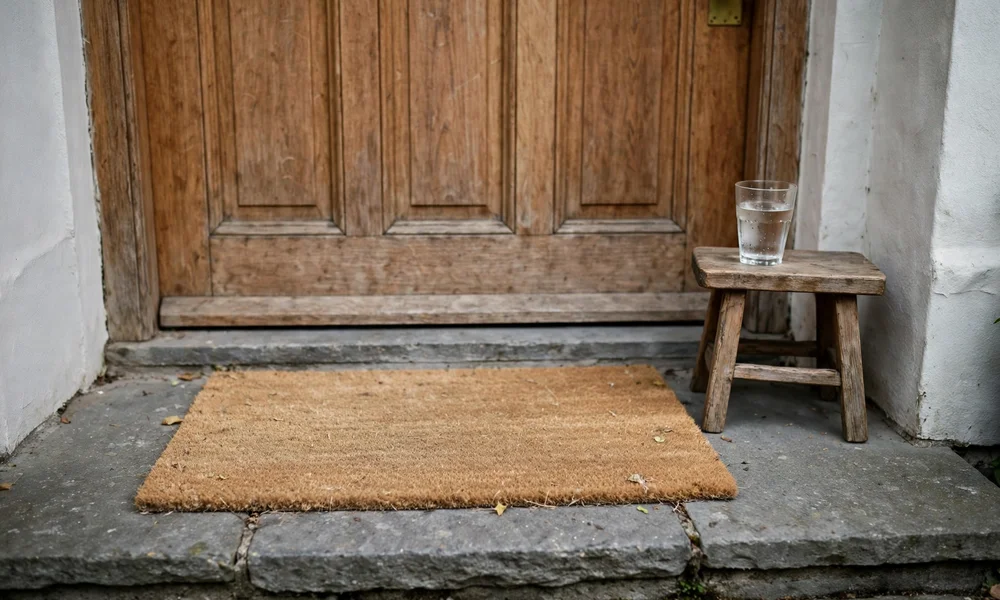
On the step lies the mat; the step itself is stone. Wiped on the mat are shoes; stood on by visitors is the step beneath it. Not a soft thing to be shaken out is the doorstep, but the hard, fixed step that the mat rests upon. Laid flat on the stone or just inside the door is the doormat, a woven or rubber mat whose whole purpose is wiping shoes. Built into the house, and never picked up, is the doorstep, a slab of stone or wood that stays where it was laid.
The two always appear together, and from a distance they look like one thing. Up close, though, they do different jobs: the mat catches mud so the house stays clean, while the step holds the mat up and keeps the rain out.
This guide is about the step, not the mat. The mat will have its own guide, and when it comes it will cover shaking, beating and drying. Here the work is the stone itself: sweeping it, washing it, and keeping it safe underfoot.
Choosing a Doorstep That Lasts
Choose by stone before colour, because a doorstep is walked on every day. Granite and sandstone hold their surface for decades, while soft limestone wears down quickly and turns slippery when wet. Run your hand across the stone: a good step feels rough enough to grip a shoe, not polished smooth like a kitchen counter.
Look at the edges before you buy or repair one. A step with a rounded front edge sheds rain, while a sharp square edge chips and catches toes. The step should slope slightly away from the door, so rain runs off instead of pooling against the wood.

A Quiet Morning at the Doorstep
Begin with the glass, not the step. Fill a tumbler in the kitchen, carry it to the door, and set it on the stool beside the door, never on the step. Drink half the glass slowly, looking out at the street.
Then pick up the brush and sweep the step from the door outward, so the dust falls onto the path and not back into the house. If the step is only dusty, sweeping is enough, and the bucket can stay in the cupboard.
Finish the glass before you leave. Wipe your shoes on the mat, step down onto the path, and close the door behind you.
Water and a Doorstep at a Glance
| Sweep first | Glass apart | Step dry |
|---|---|---|
| Brush dust out | Drink before leaving | Wipe after washing |
| Mat stays flat | Glass on stool | Shoes wiped clean |
Water and a Fresh Porch
For the whole porch around the step, see the fresh porch guide.
That guide covers the porch as one place: the doormat, the chairs, the railings and the pots by the door, all kept fresh with plain water and ten quiet minutes.
This guide is narrower: it looks at one part of that porch only, the doorstep itself. The porch guide sweeps a whole space; this guide studies a single step, its stone, its edge and its morning habit.
Water and a Neighbour Visit
For a short call across the gate, see the neighbour visit guide.
That guide plans a visit of twenty minutes: a knock, a smile, a small jug of water, and a kind goodbye before the visit grows long.
This guide stays at your own door. The neighbour guide walks across to someone else's house; this guide stands on your own step, glass in hand, before the day begins.
Water and a Tote Bag
For a bag to carry out of the door, see the tote bag guide.
That guide fills an open-top canvas bag: books and the bottle low down, keys tucked in one small pouch, and the bottle standing upright.
This guide is about what the bag steps over on its way out. The tote bag carries the day; the doorstep is the step it crosses, swept clean and dry, with a glass of water drunk before the journey starts.
Nine Neighbours in This Batch
In this batch, the doorstep keeps company with nine others. A compass points the way north, brochantite brings a fresh green for calm days, and a torch lights the dark evenings. A geode opens to clear light, a fireplace warms the room, and soft pink piemontite suits tender days. A meteorite rests dark and grey, a doormat lies ready for wiping shoes, and warm red realgar closes the set. Among them all, the doorstep alone is the step where the house meets the street.
Stones That Must Never Touch Water
A doorstep sometimes holds a stone in a pot by the door, so the water rules matter here too. Apatite, soft and pale, flakes and crumbles once it has been wet, and lepidolite, gentle in its lilac flakes, holds lithium inside it, which has no place near a drink. Pyrite turns dull and rusty when damp, and it can stain pale cloth and pale stone alike, while angelite clouds over after one soaking and never clears again. Amber, old tree resin grown hard, goes milky in water. Drop no stone into a glass, and let the glass hold water only.
Your Doorstep Checklist
- Sweep the step from the door outward, and shake the mat beside it.
- Drink a glass of water before stepping out, with the glass on a stool.
- Wipe the step with a damp cloth once a week, and let it dry.
- Check the step for loose stones or slippery moss after rain.
- Keep the bucket beside the door, never on the step where it can tip.
- If a step leaves you unsteady, or a rash appears where you patch-test a new stone, ease off and ask a doctor; a step is a threshold, not a treatment.

Frequently Asked Questions
How often should I wash a doorstep?
Sweep it two or three times a week, and wash it with plain water once a week. A step under a tree may need sweeping more often.
Can I use soap on a stone doorstep?
Plain water and a brush are enough for most steps. A little mild soap helps with grime, but rinse it well, because soap left on stone turns slippery.
Is a wooden doorstep as good as a stone one?
Wood is warmer underfoot and easier to replace, but it needs oiling and can rot if water pools on it. Stone lasts longer, though it is harder to repair.
What should I do about moss on a doorstep?
Scrub moss off with a stiff brush and plain water, and keep the step dry afterwards. Moss grows where shade and damp meet.
Where should I put my glass of water at the door?
Set it on a stool or a shelf beside the door, never on the step itself. A glass on the step can be knocked over, and a wet step is a slippery step.
Can a tidy doorstep help me feel calmer in the morning?
A swept step and a slow glass of water can make the morning feel steadier, because the day begins in good order. It cannot mend health. When low feelings linger for weeks, a doctor is the one to ask.

The Bottom Line
A doorstep serves well when swept clean and kept dry: brush the dust out, drink a glass of water before you leave, and let the step do its quiet work.
A Note for Calm Arrivals
A glass of water, a swept step, and a door that opens onto a clean morning — that is all a calm arrival needs.


