
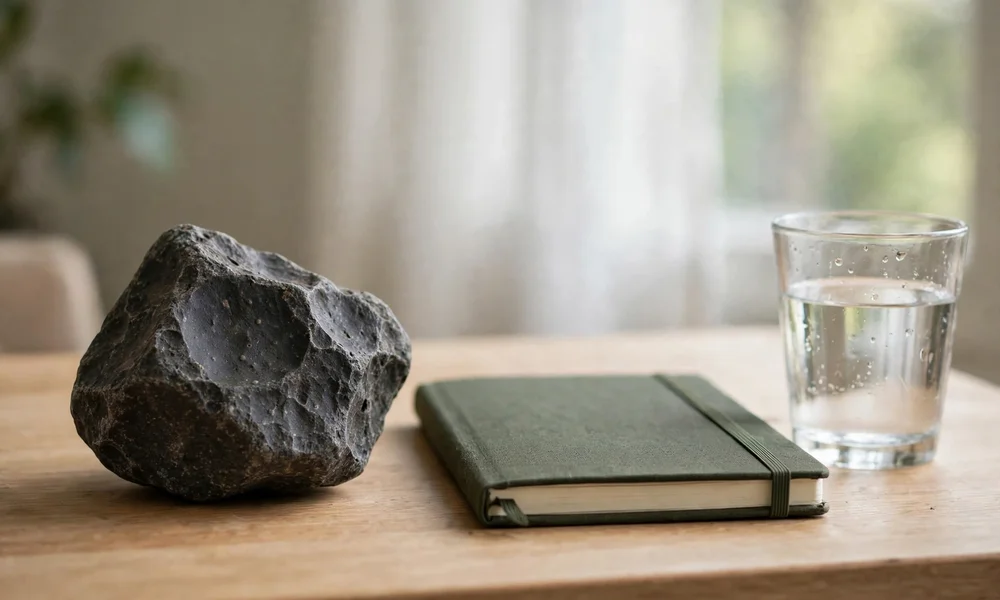
A meteorite is a stone that fell from the sky. Long ago it broke away from an asteroid and burned through the air before landing on the earth. What you hold is the part that survived: a dark grey lump of iron and nickel, heavy for its size, pitted like the surface of the moon.
A quiet day suits a meteorite well. The stone asks for almost nothing: a dry tray, a little space, and a glass of water beside it. It does not shine or sparkle, and it does not need to. Its colour is a deep, honest grey, and its surface tells a story of a very long fall.
This guide gives care tips for a meteorite on quiet days: what it is, how to choose a sound piece, how to keep it dry, and how to tell it apart from the stones people mix it with. It is gentle general information only, and a stone on a tray is a companion, not a cure — it will not heal anything.
Key Takeaways
- A meteorite is iron-nickel stone that fell from the sky, dark grey and heavy.
- Keep it dry on a tray beside a glass of water, never in water.
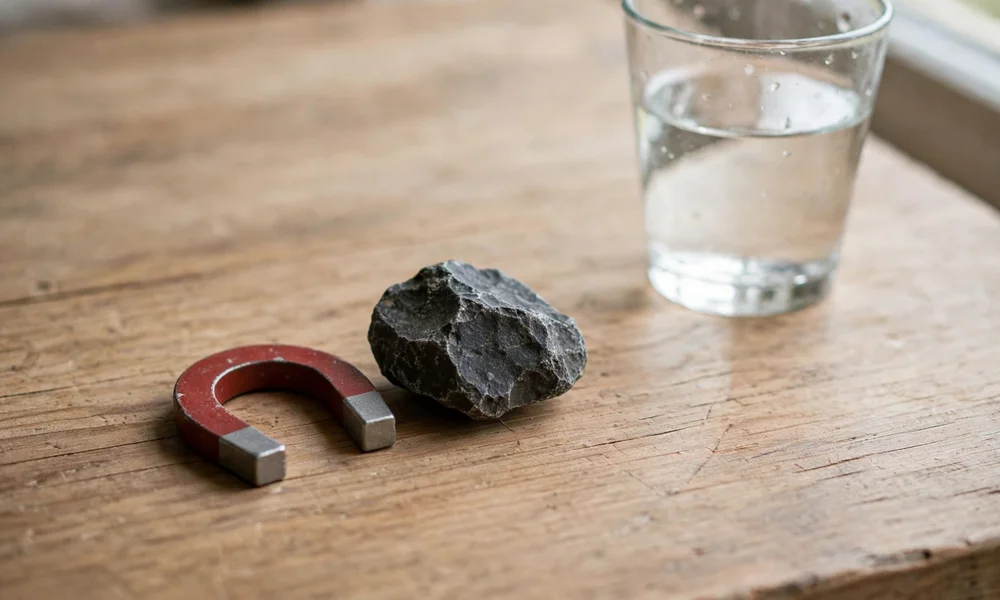
- A magnet will tug at most meteorites, because iron runs through them.
- A meteorite is not magnetite, ironstone or tektite, though all share iron or the sky.
- A dark stone on a quiet day is a comfort, not a cure; it will not heal anything.
What a Meteorite Is
A meteorite is a piece of rock or metal from space that reached the ground. Most sold for display are iron meteorites, mostly iron with a good share of nickel, heavier than earth stone of the same size. The outside is dark grey, covered in shallow thumbprint hollows called regmaglypts.
Cut and polished, an iron meteorite shows a pattern no earth stone can copy: fine lines crossing in a criss-cross weave, the Widmanstätten pattern, formed as the metal cooled over millions of years in space. A small polished window on one side is the surest sign of a real meteorite.
Why Deep Grey Fits Quiet Days
Grey suits a quiet day because it never shouts. A bright room is already full of colour, so a dark stone adds calm without adding noise. Grey is the colour of early morning and of rain on stone.
Grey also suits a quiet day because it feels honest. The hours pass slowly — toast, a short walk, a desk kept tidy — and a dark stone beside the water glass fits that pace without asking for attention.
Choosing a Meteorite Piece
Choose a piece you can see before you buy it, and look first at the surface. A real iron meteorite is dark grey or brown-black, pitted with shallow hollows, and heavy in the hand. If the seller offers a polished window, look for the criss-cross Widmanstätten lines inside it.
Check the weight next. An iron meteorite should feel heavy for its size, because iron is dense, and a light piece is probably slag from a furnace, not a stone from the sky. Ask the seller which fall it comes from, and be wary of any seller who cannot answer.
Look at the edges last. A sound piece has no cracks, and its surface is dry and stable, not flaking or powdery. Start small: one modest piece on a plain tray is enough for a whole quiet day.

Meteorite and Magnetite: Not the Same Stone
Magnetite is a deep black iron mineral from the earth, and its guide, What Is Magnetite? A Deep Black Stone Guide, describes octahedral crystals that pull a paper clip. A meteorite is different in its birth: it fell from the sky as iron-nickel metal, not as an oxide grown in earth rock. Magnetite is Fe3O4, an iron oxide; a meteorite is iron alloyed with nickel, and its proof is the Widmanstätten weave inside.
The two stones can look alike on a desk, both dark, both heavy, both tugging at a magnet. The difference shows in the details. Magnetite grows in sharp eight-sided crystals and leaves a black streak; a meteorite is pitted with thumbprint hollows and shows a criss-cross pattern when cut.
Keep both stones dry, and keep both beside water, never in it. A magnetite piece can rust at its edges if left damp, and a meteorite rusts faster still. Dry trays suit them both.
Meteorite, Ironstone and Tektite
Ironstone is earth rock, not a stone from the sky. Boulder opal grows inside dark ironstone in Queensland, warm brown rock threaded with bright veins, and tiger iron is a banded ironstone built up in layers. A meteorite shares iron with ironstone, yet the two could not be further apart: one is a rock the earth laid down, the other is metal that fell through the air.
Tektite is closer to a meteorite, and the confusion is honest. It began as glass, born when a falling stone hit the ground and the heat fused the rock below into a dark, pitted skin. The meteorite is the stone that struck; tektite is the glass the strike left behind.
A meteorite is metal from the sky, ironstone is rock from the earth, and tektite is glass from the meeting of the two.
A Quiet Day with a Meteorite
Begin the day with the glass, not the stone. Fill a tumbler, set it beside the tray, and sit down slowly. Drink half the glass before you touch the meteorite.
Then pick the stone up. Feel its weight, turn it over, and look at the hollows on its surface. Set it back on the tray gently, and wipe the tray with a dry cloth if any dust has gathered.
Leave the stone where it is for the rest of the day. A meteorite needs no more than a dry tray.
Meteorite Care at a Glance
| Keep it dry | Magnet test | Glass beside |
|---|---|---|
| Tray stays dry | Magnet tugs gently | Sip water slowly |
| Cloth wipes dust | Nickel proves sky | Stone never soaked |
Tektite Dark Glass
For the glass a meteorite strike made, see the tektite guide.
That guide follows a dark natural glass, black or deep brown, through bold evenings of low light and quiet confidence. It explains how a meteorite strike melted earth rock and threw the molten glass into the air.
This guide is about the stone that did the striking. The tektite guide studies the glass that resulted; this guide studies the iron-nickel stone that fell, and how to keep it dry.
Moldavite Green Glass
For a green glass from the same kind of sky-fall, see the moldavite guide.
That guide follows a rough, pitted green glass, the colour of deep forest leaves after rain, through new chapters that begin slowly. It tells how a meteorite strike melted rock long ago.
This guide stays with the metal, not the glass. The moldavite guide marks a beginning with a green stone; this guide keeps a dark grey piece of the sky itself on a dry tray.
What Is Magnetite?
For the deep black iron mineral of the earth, see the magnetite guide.
That guide describes a deep black stone that tugs at a paper clip and grows in eight-sided crystals. It is an iron oxide from the earth.
This guide is about a stone from further away. The magnetite guide studies an earth mineral that pulls; this guide studies a sky metal that fell, pitted and heavy.
Nine Neighbours in This Batch
Beside the meteorite on its tray, nine batch companions wait. The compass and the torch guide the way, one by daylight and one after dark, while the doorstep and the doormat stand together at the front door, the step below and the mat above. The geode and the fireplace warm the room, one with light and one with fire, and brochantite, piemontite and realgar bring their colours: fresh green for calm days, soft pink for tender days, and warm red for bold days. Around them all, the meteorite alone fell from the sky.
Stones That Must Never Touch Water
Some stones must never touch water at all. Apatite softens in water. It flakes. It crumbles in the hand. Lepidolite holds lithium in its pale flakes, and lithium has no place near a drink. Pyrite turns rusty when damp, and it stains cloth and stone alike. Angelite clouds over after one soaking, and it never clears again. Amber goes milky in water. It is old tree resin, grown hard, and a soak ruins it. Let the glass hold water alone, with the stone resting dry beside it.
Your Meteorite Checklist
- Keep the meteorite on a dry tray, wiped with a dry cloth.
- Drink a glass of water beside the stone, never over it.
- Test a new piece with a magnet, and look for the Widmanstätten weave.
- Oil the surface lightly if rust spots appear.
- Keep it away from phones and cards, because its iron tugs at them.
- If a rash appears where you handled a new stone, or a cut turns sore after touching it, ease off and ask a doctor; a stone is a companion, not a treatment.
Frequently Asked Questions
How do I keep a meteorite from rusting?
Keep it dry, on a tray away from damp air. A light wipe of mineral oil stops rust before it starts, and a dry cloth after handling does the rest.
Will a magnet stick to a meteorite?
Most iron meteorites tug at a magnet, because iron runs through them. A strong pull is a good sign, but a weak pull does not prove it fake.
Can I put a meteorite in water?
No, never soak a meteorite or drop it into a glass. Water brings rust to iron fast, and a meteorite kept wet will spot and flake.
How can I tell a real meteorite from slag?
A real iron meteorite is heavy, pitted with thumbprint hollows, and shows a criss-cross pattern when polished. Slag is light, glassy and full of bubbles, and it shows no such weave.
Where is the best place to keep a meteorite at home?
Keep it on a dry wooden tray on a desk or a shelf, away from damp and from phones and cards. One small piece is enough for a whole quiet day.
Can a meteorite help me feel calmer on a quiet day?
Holding a heavy, dark stone for a moment can make a quiet day feel steadier. It cannot mend health. If low feelings stay for weeks, ask a doctor.

The Bottom Line
A meteorite keeps well when kept dry: a tray, a dry cloth, a glass of water beside it, and no soaking, ever.
A Note for Quiet Days
A dark grey stone, a glass of water, and an afternoon with nowhere to be — that is all a quiet day needs.


