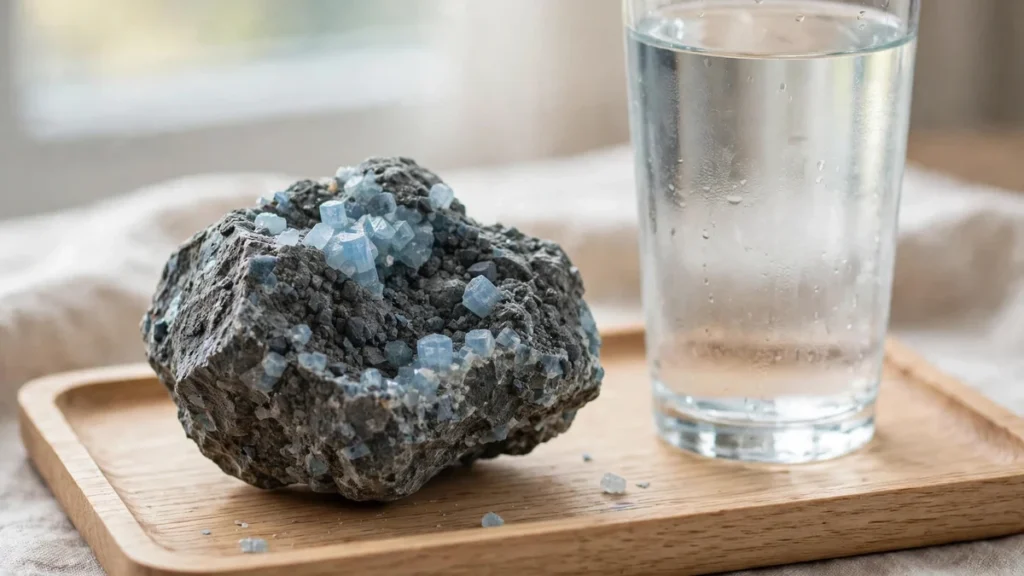
Vivianite is a stone that asks to be kept in the shade. Fresh from the ground it can be a startling deep blue-green, yet that colour is fragile: leave the stone in bright light and it slowly turns dull, and leave it in water and it softens at the edges.
Vivianite is not a stone for a sunny windowsill or a bathroom shelf. Its beauty comes with a warning built in: light steals its colour, and damp ruins its surface. Once you accept those two limits, the stone is easy company. It needs a dark corner, a dry tray, and a glass of water kept well apart from it.
This guide covers what the stone is, how it differs from the deep blue stones already in this journal, how to choose a piece, and how to give it a home where its colour lasts. The stone is for looking at and holding briefly, and nothing more. It will not heal anything, and no claim about it should be believed over a doctor.
Key Takeaways
- Vivianite is a deep blue-green iron phosphate that fades in bright light.
- Keep it dry and out of sun, in a shaded corner away from taps and steam.
- Its colour is deepest when fresh, so buy a piece that still holds its blue.
- The stone rests beside a glass of water, never inside any water at all.
- Handle it gently with clean dry hands, then wash your hands afterwards.
What Vivianite Is
Vivianite is a hydrated iron phosphate, a mineral that forms where iron-rich water has seeped through soil, peat bogs and the weathered tops of old mine workings. It grows in thin flat blades, in fans and sprays, sometimes standing out of a pale clay matrix.
A new piece runs from a clear pale blue-green to a deep teal, almost navy at the thickest part of the blade, and the surface carries a soft glassy shine. In light, the iron inside slowly oxidises, and the blue-green drifts toward grey-green, then brown. It is dug from clay pockets and old workings in Bolivia, Brazil, Germany and the United States.
Why Deep Blue-Green Suits Quiet Days
A quiet day is a day spent mostly indoors, and that is exactly what vivianite needs. The stone cannot stand a sunny sill, so it belongs in the shaded part of a room, where a quiet day gives you time to turn the piece and watch the blue shift.
Deep blue-green is a restful colour, like still water under trees after rain. On a day with no appointments and no hurry, a stone of that colour fits the mood, because it asks for nothing but a little shade and a little attention.
Vivianite and Hauyne: Two Deep Blues
Hauyne deep blue for calm days describes a rare deep blue feldspathoid, coloured by sulfur held inside volcanic rock, a small polished stone with a clear, even royal blue. It comes from old lava flows in Germany, Italy and the Canary Islands.
Vivianite parts company with hauyne at once. Hauyne is a hard volcanic mineral that keeps its blue in daylight, while vivianite is a soft iron phosphate that loses its colour in bright light. Hauyne is sold polished and smooth, while vivianite is sold as rough blades on matrix, too fragile to polish. One is a gem for the light; the other is a guest that hides from it.
Choosing a Vivianite Piece
Study the piece in dim indoor light, away from the shop window, before anything else. A piece worth keeping shows a deep, even blue-green across the widest blades, with crisp flat faces and no grey or brown patches creeping in from the edges. Run a fingertip lightly along one blade: it should feel firm, and nothing should flake away.
Choose a spray about the size of a plum, fixed firmly to its matrix, and check the blades do not wobble when you tilt it. Ask the seller where it was dug, and walk away if the answer turns into a promise about health.
Vivianite Beside Water
A glass of water and a vivianite spray can share a table, but only if the table is wide and the two sit at opposite ends. Put the stone on a dark wooden board at one end and the glass at the other, with a broad strip of bare board between them, so no splash can reach the blades. Never rinse the stone, and never wipe it with a damp cloth.
Dust is the only cleaning the stone ever needs, and a soft dry brush once a week lifts it without touching the surface. If a drop lands on a blade, blot it at once with dry tissue.

Vivianite at a Glance
| Deep blue-green blades | Shaded tray, shelf | Dry brush only |
|---|---|---|
| Iron phosphate, fragile | Quiet days, dim rooms | Glass kept apart |
| Fades in bright light | One small spray | Wash hands after |
| Plum-sized, on matrix | Dark wood, cloth | Never soak it |
Vivianite and Lapis Lazuli: Blades Beside Gold Flecks
Lapis lazuli deep blue for quiet evenings describes lapis as a blue rock rather than one mineral, a blend whose main part is lazurite, dotted with gold-coloured pyrite and threaded with pale calcite, cool and smooth to hold. It has been cut and polished for thousands of years.
Lapis is a solid, polished rock, heavy for its size, its blue scattered with gold like a night sky, while vivianite is a cluster of thin blades, light and fragile, its blue-green running clear through each crystal. One is built to be handled and admired in the open, and the other is built to be sheltered.
Vivianite and Sodalite: Blades Beside White Veins
Sodalite deep blue for quiet study describes a deep blue stone crossed by fine white veins of calcite, usually sold as a tumbled stone or a palm stone, fairly hard at around 6 on the Mohs scale, and suited to silent evening reading with a notebook on the desk.
Vivianite shares the deep blue and nothing else. Sodalite is hard, smooth and veined, while vivianite is soft, blade-like and unmarked by veins, a stone that chips if it is knocked and fades if it is left in the light.
Vivianite Among the Other Stones in This Batch
Five other stones share this batch with vivianite. Afghanite is a soft blue mineral for calm days. Beryllonite is a clear white stone for bright days, glassy and colourless where vivianite is deeply coloured. Enhydro quartz is a clear crystal carrying tiny pockets of water inside it. Faden quartz is a clear crystal threaded with a fine white line, and the water guides fill the rest of the batch: a soup pot simmering on the stove, a watering can for the plants, a rain barrel catching water outside, an aquarium glowing in a living room, and a swimming pool for staying fresh in the heat.
Keeping Vivianite Out of Bright Light
Light changes vivianite fastest, so its care begins with shade. A north-facing shelf, the back of a bookcase, or a drawer opened only when you want to look will keep the colour longer than any sunny spot. If the room has a bright window, turn the piece so the blades face away from it.
Check the colour every few weeks in the same dim light, and move the piece deeper into shade if a blade has gone grey at the tip. Never try to restore the colour with oils, sprays or polishes, since anything wet or greasy only damages the surface further.
Where Vivianite Rests at Home
The best home for vivianite is a shaded corner the household walks past without knocking into: the far end of a sideboard away from the window, a shelf inside a cabinet, or the top drawer of a desk. Keep it far from taps, kettles, cooking steam, small hands and pets.
For carrying it anywhere, wrap the spray in tissue, nestle it in its own padded box, and keep the box shut until you reach a shaded table. The method is simple: tissue, box, shade, and no hurry.

Stones That Must Never Touch Water
Some minerals turn to trouble the moment they meet water. Apatite goes soft and flakes after a soak. Lepidolite holds lithium in its pale flakes, and anything carrying lithium has no place near a cup. Pyrite is another dry-only stone: it rusts, dulls and starts to smell stale when it stays damp.
Angelite is a soft blue stone that loses its polish and turns cloudy after even one bath, and amber, which is old tree resin set hard, clouds over in water and never clears again, so it never goes near drinking water or a soak. Malachite carries copper in its green bands, which belongs nowhere near a drink. Vivianite joins them: no soaking, no rinsing, no damp cloths.
Your Quiet Days Checklist
- Set the vivianite spray on a dark board in the shade, with the glass a full hand-span away.
- Drink your water slowly in the dim light.
- Lift the piece once, look at it, then set it back down.
- Put the spray back in its padded box before you rinse your hands with soap.
- Buy only from a seller who says plainly where the stone was dug.
- A health worry that will not go away belongs with a doctor, not with a stone.

Frequently Asked Questions
What exactly is vivianite?
Vivianite is a hydrated iron phosphate mineral that grows in thin flat blades and sprays, coloured a deep blue-green when fresh.
Why does vivianite fade in the light?
The iron inside slowly oxidises in bright light, so the blue-green drifts toward grey-green and then brown, and the change cannot be reversed.
How is vivianite different from hauyne?
Hauyne is a hard volcanic feldspathoid whose clear royal blue keeps its colour in daylight, while vivianite is a soft iron phosphate whose blades fade in bright light.
Can I hold vivianite in my hand?
A grown person may lift a small dry piece briefly with clean dry hands, then set it back in the shade and wash their hands with soap and water.
Where should vivianite live at home?
Give it a shaded shelf, a cabinet with a glass door, or a padded box in a drawer, far from windows, taps, steam, small hands and pets.
Does vivianite need any water at all?
No, water harms it, so keep it dry and every glass well away.

The Bottom Line
Shade, dry hands and a glass kept apart: that is the whole of vivianite care, and a quiet day is the best day to give it.
A Note for Quiet Days
A deep blue-green spray in the shade, a glass of water at the far end of the board, and an unhurried afternoon: vivianite asks for little, and a quiet day gives it gladly.