
Some days ask for nothing loud. The morning is slow, the light comes in softly through the window, and the best plan is a quiet room, a glass of water, and one beautiful object to look at while the day finds its pace. A deep blue stone fits that kind of morning, because deep blue asks nothing of the eye.
Hauyne is one of the rarest deep blue stones a collector can hold. It is a feldspathoid mineral that grows in volcanic rock, and its rich blue comes from tiny amounts of sulfur held inside the crystal. Most pieces are small, and a clean thumbnail-sized piece is already a find.
This guide looks at hauyne on its own terms: what the stone is, how to pick a good piece, how to keep it safe beside a glass of water, and how to build a calm day around it. The stone is a joy to look at and to carry briefly, and nothing else. It cannot shift your mood, your sleep, or your health, and drinking water must stay far from it.
Key Takeaways
- Hauyne is a rare deep blue feldspathoid mineral, coloured by sulfur inside volcanic rock.
- Its deep blue suits calm days: slow mornings, quiet reading, and unhurried hours at home.
- Hauyne is a different mineral from sodalite, with a brighter, clearer blue and no white veins.
- Keep the stone beside a glass of water, never in drinking water.
- Hauyne is a stone to admire and hold briefly, while the drinking glass stays separate.
What Hauyne Is
Hauyne is a feldspathoid mineral, a cousin of sodalite and lazurite that forms in volcanic rocks low in silica. It was named for the French mineralogist Rene Just Hauy, and it turns up in small crystals where old lava cooled slowly, including Germany, Italy, and the Canary Islands.
Picking a Hauyne Piece
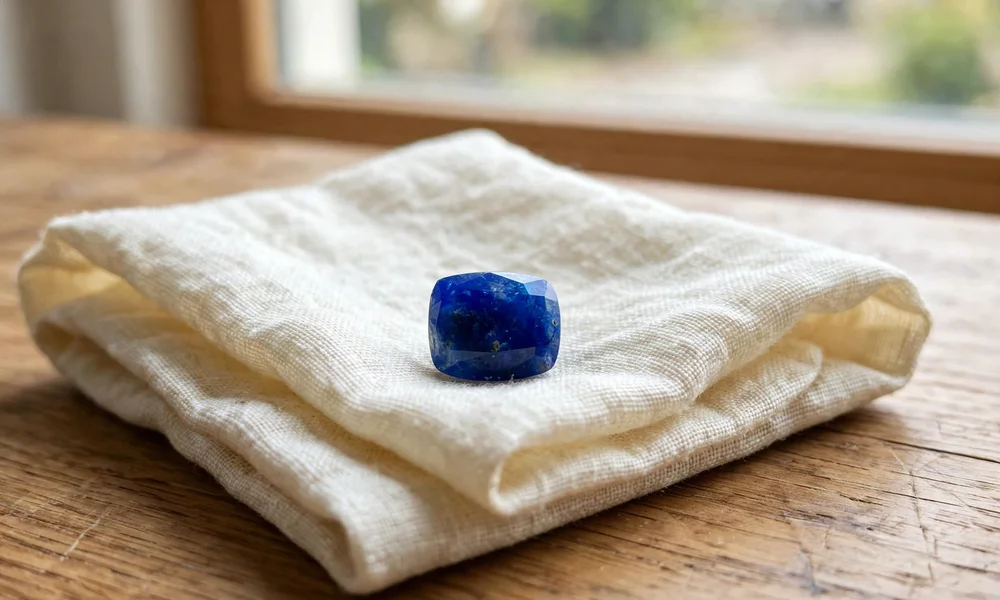
Choose a hauyne piece in plain daylight, away from shop lamps that flatter every blue. Hold the stone flat and look straight down at its face: the blue should run deep and even, a royal blue rather than a grey-blue. Turn it under the light, since a good blue keeps its depth while a weak one fades.
A Calm Day with Hauyne
A calm day with hauyne begins when the stone takes its place where you can see it. Spread a pale cloth over the dressing table, put the stone toward the front, and set your drinking glass at the opposite end, leaving empty cloth in between. Sip the water slowly as morning light crosses the blue, then read a few pages or sit by the window doing nothing at all.
Hauyne Beside Water
Hauyne and water look lovely as neighbours, but neighbours is all they should be. Put the drinking glass on one side of the tray and the stone on the other, with bare cloth between them. Once you have handled the stone, wash your hands before you lift your drink. Keep the stone out of every vessel of water — glasses, jugs, and baths alike — and never rinse water over its face.
Hauyne at a Glance
| Deep royal blue | Calm tray, desk | Dry hands only |
|---|---|---|
| Sulfur-coloured blue | Slow mornings, light | Glass kept apart |
| Smooth, cool, small | One accent, plain | Never in drinks |
| Volcanic feldspathoid | Clear window light | Never soak stone |
| Rare, thumbnail-sized | Tidy shelf, tray | Dust dry weekly |

Hauyne and Sodalite
Sodalite is the blue stone most people meet first, and this journal already carries two guides to it: Sodalite Deep Blue for Quiet Study, which pairs the stone with silent evening reading, and Sodalite Focus Stones for Study and Work, which builds a timed desk ritual around it. Both describe a deep blue stone crossed by fine white calcite veins.
Hauyne is a different mineral from sodalite, not the same stone under another name. The two share a family — both are feldspathoids — but hauyne grows in volcanic rock with sulfur giving its colour, while sodalite carries its white veins as its signature. Hauyne has no white veining at all: its blue is clearer and brighter, where sodalite is a night-sky blue threaded with pale lines.
The uses differ too. Sodalite suits study and timed work blocks, with a notebook and a timer on the desk, while hauyne suits a calm day with no task at all, a slow morning with a glass of water and a book.
Hauyne and Covellite
Covellite for quiet days is another deep blue stone in this journal, but it looks nothing like hauyne. Covellite wears a dark, metallic blue with a coppery sheen, and its surface flashes as it turns. Hauyne is a clear, glassy blue, smooth and even, with no metallic flash: one is a dusk blue, the other a daylight blue.
Hauyne and Benitoite
Benitoite for calm days is a deep blue stone with a sharp, glassy sparkle, and one of the rarest blue gems in the world. It is usually cut as a small faceted gem, and its blue leans toward sapphire, with a bright, almost electric edge. Hauyne is softer in character: a small polished stone rather than a faceted gem, with a rounder, quieter blue and no sharp sparkle.
Hauyne and Dumortierite
Dumortierite for quiet days is a deep blue stone with a matte, almost dusty surface, often speckled with paler blue patches. It looks like a piece of denim, soft and workaday, and it is usually sold as a tumbled stone. Hauyne is smoother and glossier, with a single even blue that holds its depth in lamplight: one is a dusty, everyday blue, the other a clear, jewel-like blue.
Hauyne and the Other Blue Stones
The rest of the blue family is large, and each member is easy to tell apart from hauyne. Euclase is a soft, pale blue, while blue pearl is a round bead with a quiet shine. Blue amber is a warm blue resin, and blue obsidian is usually man-made glass, so it should be described honestly as glass. Blue jasper and blue agate are banded stones, and neither holds the single even blue of hauyne. Cobalt spinel is a vivid, glassy blue, teal sapphire leans green at the edges, and maxixe beryl is a pale, almost icy blue.
Shattuckite is a dusty turquoise-blue, blue coral is a pale, chalky blue, and blue jade is a smooth blue-green. Blue sapphire and blue spinel are faceted gems, gem silica is a blue-green stone with a glassy shine, and blue onyx is a pale, banded blue. Star sapphire carries a six-ray star, blue fluorite is a fresh blue mineral with faint stripes, and blue zircon is bright and fiery. Paraiba tourmaline is a vivid blue-green, blue tigers eye wears golden-brown bands, and turquoise is a bright blue-green with dark veins.
Lapis lazuli is a deep blue scattered with gold flecks, indicolite is a steady blue tourmaline, and blue topaz is a clear, cool blue. Blue quartz is a soft, milky blue, abalone is a shell with a blue-green shimmer, and cavansite wears bright blue bursts. Peruvian opal is a soft, milky blue, amazonite is a blue-green stone with a pale pattern, and blue kyanite is a clear blue with long, blade-like crystals. Iolite is a violet-blue stone that changes shade as it turns, azurite-malachite pairs deep blue with green bands, and hemimorphite is a light, watery blue. Chrysocolla is a blue-green stone with a soft feel, blue goldstone is a dark blue glass scattered with copper sparkles, and blue aventurine is a deep blue stone with a fine glitter. Blue chalcedony, blue opal, blue calcite, azurite, and blue lace agate close the list: a soft blue, a pale shimmer, a milky blue, a velvety blue, and a banded blue like quiet water. None of them is hauyne, and hauyne is none of them.
Keeping Hauyne at Home
Hauyne is happiest in a bright, orderly spot: a shelf near the morning window, an open stretch of desk, or a little dish on the drawers, somewhere visible and safe from knocks. Keep its tray clear of taps and steam, and beyond the reach of small children. A weekly wipe with a soft dry cloth is enough; skip soap and sprays.

Stones That Must Stay Away from Water
A few minerals hold substances that belong nowhere near a drink, so enjoy these stones dry and keep every glass at a distance. The green bands of malachite hold copper, and copper has no place in anything you swallow, so malachite must never sit in water or in any stone drink. Hematite must stay out of drinking water as well, and so must apatite, lepidolite, which carries lithium, and pyrite. Angelite dulls in water, and amber, tree sap set hard over long ages, clouds over after any soaking.
Your Calm Days Checklist
- Lay the stone on dry cloth, keeping the drinking glass a little distance away.
- Drink your water unhurriedly, one slow sip at a time.
- Lift the stone, enjoy its cool blue, then set it back down.
- Put the stone in its dish before rinsing your hands.
- Choose a seller who tells you honestly where the stone came from.
- For any health concern, speak to your own doctor — a stone is not the place to ask.

Frequently Asked Questions
What is hauyne?
Hauyne is a rare deep blue feldspathoid mineral that grows in volcanic rock, coloured by sulfur inside the crystal. Its blue is clear and even, with no white veins.
Where does hauyne come from?
Hauyne forms in volcanic rocks low in silica, where old lava cooled slowly, including Germany, Italy, and the Canary Islands. Clean pieces are scarce.
How is hauyne different from sodalite?
Sodalite is a deep blue stone crossed by fine white calcite veins, while hauyne is a different mineral with a clearer, brighter blue and no veining at all.
Is hauyne safe to hold?
Holding a small polished piece briefly is fine for almost everyone. Put it down when you are finished, then wash your hands.
Where should I keep hauyne at home?
A bright, dry shelf, an open desk corner, or a little dish on the drawers all work well. Keep it separate from the glass, safe from knocks, and away from steamy rooms.
Why is hauyne so rare?
Hauyne grows only in certain volcanic rocks, and clean, well-coloured crystals are uncommon. Most pieces are small, and large pieces are almost unheard of.
The Bottom Line
Hauyne suits calm days: a rare, deep blue stone to admire, water in its own glass close by, and the stone always dry.
A Note for Calm Days
A deep blue stone, a full glass, a slow morning — that is all a calm day needs.


