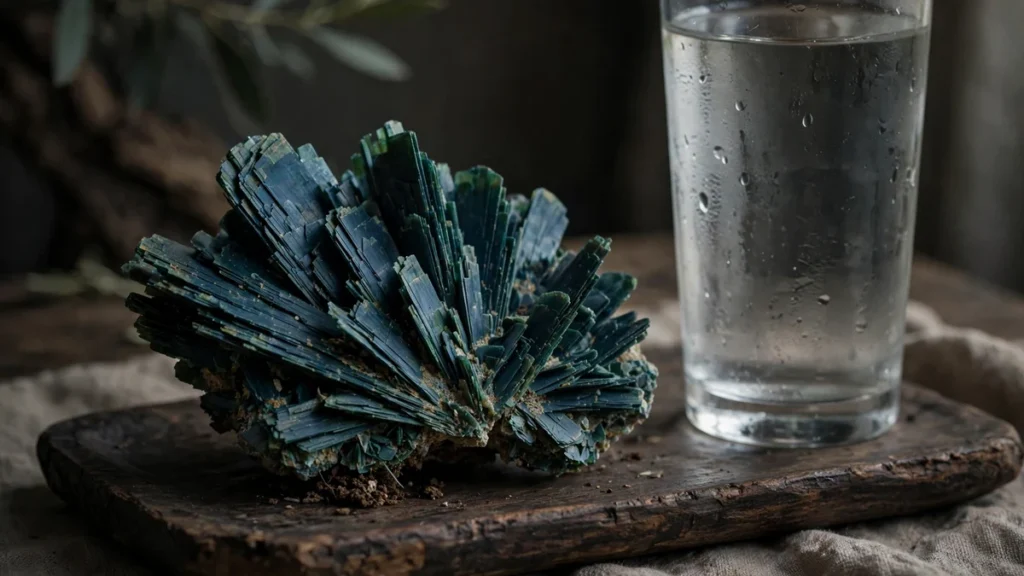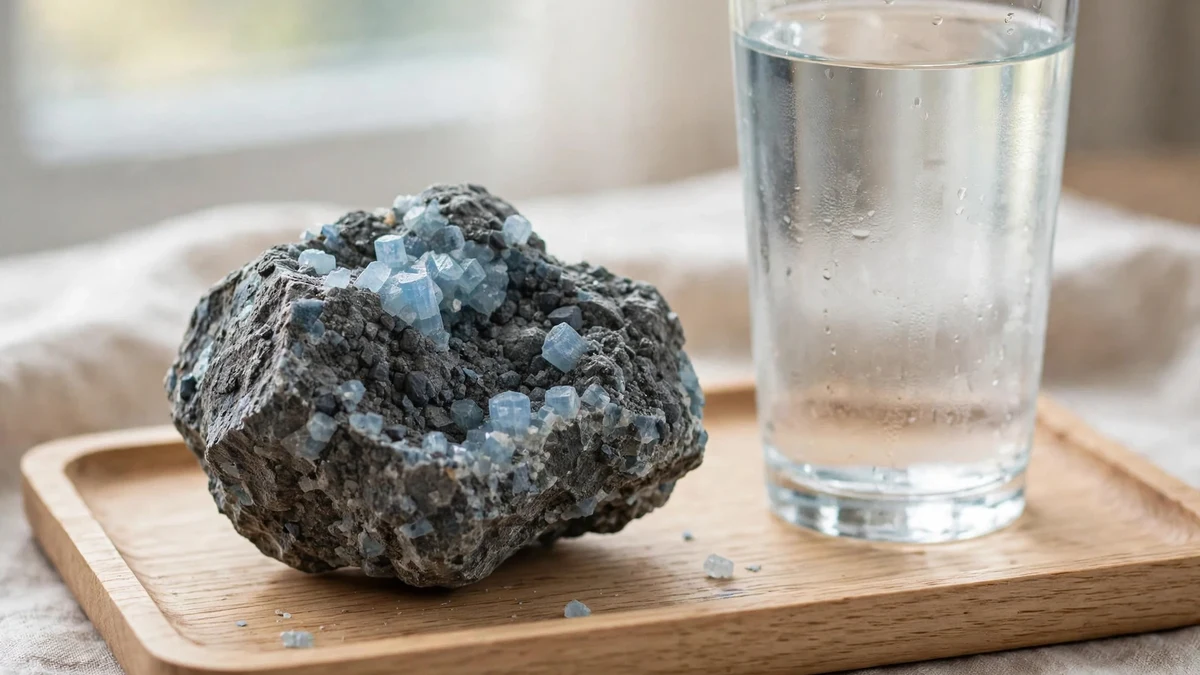
Afghanite is a stone most people have never held. It comes from one far valley in Afghanistan, it grows in pale blue prisms tucked into dark rock, and the pieces that reach a shop are usually small, rough, and quietly beautiful, with a soft blue like a piece of morning sky caught in stone.
A calm day gives a rare stone the attention it deserves. When the house is quiet and the hours are unhurried, there is time to look closely at a small thing and to notice how the blue deepens in one corner and pales in another. Afghanite suits that kind of looking, because it does not offer its colour all at once.
This guide covers afghanite from the ground up: the mineral itself and the valley it comes from, the ways it stands apart from its blue cousins already in this journal, the marks of a piece worth keeping, and the dry corner where it rests best at home. It is a companion for slow hours, and it will not heal anything, change your health, or do any work that belongs to a doctor.
Key Takeaways
- Afghanite is a soft blue feldspathoid, grown as pale blue prisms in dark rock.
- Its quiet blue suits calm days, slow afternoons and unhurried looking.
- Afghanite stays dry at all times, resting beside its glass and never inside it.
- A good piece shows even blue prisms with clean edges and no chalky patches.
- Handle it with clean, dry hands, and keep it where children and pets cannot reach it.
What Afghanite Is
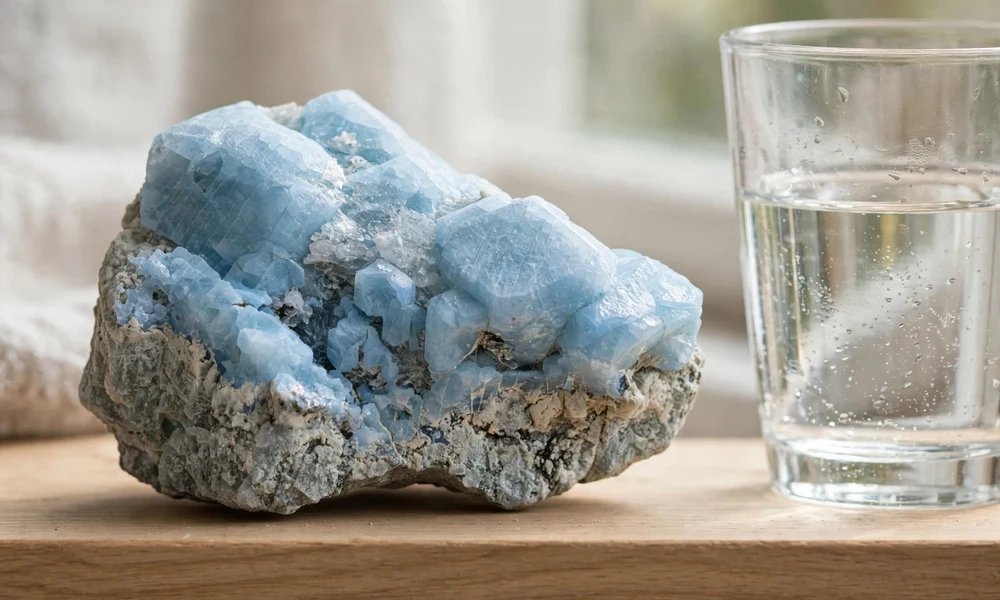
Afghanite is a feldspathoid mineral, one of a family that forms in rocks low in silica, where there is not enough of that element to make quartz. Its crystals are usually hexagonal prisms, six-sided columns, and they sit sprinkled through dark matrix rock like pale blue salt. The colour runs from a near-white icy blue through a clear sky blue to a deeper cornflower shade, and a fresh face has a soft, glassy gleam.
The mineral was named for Afghanistan, where its best-known home is the Koksha Valley in Badakhshan, a remote valley famous for blue stones. Afghanite is scarce, so most pieces are small, and a specimen the size of a plum is already a good one.
Why Soft Blue Fits Calm Days
Soft blue is the colour of things that ask nothing of you: a clear sky at mid-morning, a stretch of still water, the pale light that falls through a north-facing window. A soft blue stone on the tray matches that mood, because it seems content to sit there, changing almost nothing about the room.
Afghanite wears its blue gently. There is no dark band to puzzle over and no sudden flash to catch the eye, only a pale, even blue that lets the gaze settle and wander. On a day when nothing is urgent, that gentleness is a pleasure in itself.
Afghanite and Sodalite: Blue Cousins, Different Stones
The journal already holds a famous blue cousin. Sodalite Deep Blue for Quiet Study is the deep blue stone of quiet study evenings, a polished desk piece whose royal blue is crossed by pale calcite lines. It is cut smooth, sold as palm stones and tumbled pieces, and it marks the start of a silent hour of reading.
Both minerals sit in the sodalite group, yet they could hardly look less alike. Sodalite is deep royal blue threaded with white lines, afghanite is pale sky blue with no veining at all, and where sodalite is sold polished and smooth, afghanite usually stays rough, its prisms still set in dark matrix rock. Sodalite suits study and timed work, while afghanite suits a slow afternoon of looking.
Afghanite and Nosean: Two Quiet Blues
The Complete Guide to Nosean follows a soft blue-grey feldspathoid that grows as tiny twelve-sided crystals in volcanic rock, a rare mineral that asks to be looked at closely in good light. Its colour is misty and smoky, like a sky before rain, and its crystals are so small that a lens helps to admire them.
Afghanite shares that volcanic family and that quiet temper, yet the two minerals read differently in the hand. Nosean is blue-grey and muted, with crystals you can barely see, while afghanite is a clearer sky blue, with prisms large enough to pick out one by one. Nosean hides in its rock, and afghanite shows itself.
Afghanite and Hauyne: A Paler Blue Beside a Bright One
The journal's hauyne guide, Hauyne Deep Blue for Calm Days, is about a vivid blue cousin that grows in the same silica-poor volcanic ground. Its colour is bright and electric, its clean pieces are scarce, and most are no bigger than a thumbnail.
Afghanite stands at the softer end of the same family. Where hauyne flashes bright and clear, afghanite rests pale and quiet, and where hauyne is a prize for a collector's cabinet, afghanite is a companion for a tray in daylight. The two share a home in silica-poor rock, yet their blues could not be further apart.
Choosing an Afghanite Piece
Take the piece to a window and let plain daylight fall across it before you decide anything, turning it slowly so each crystal face catches the light in turn. A good piece shows prisms of one even blue, with clean edges and no pale chalky patches where the surface has begun to wear. The crystals should sit firmly in their matrix, and none should wobble at a light touch.
Pick a piece about the size of a plum that sits flat without rocking. Ask where it was collected, and leave it if the seller begins promising health benefits or cures.
A Slow Afternoon with Afghanite
First, clear one corner of the side table and lay down a folded pale cloth. Put the afghanite where its bluest prisms catch the window light, and stand a tall glass of water well away from it, leaving bare cloth in between.
Fill the glass, take slow sips, and let the stone stay where it is until evening.
Afghanite Beside Water
Water and afghanite can share one tray if they never touch. Keep the glass at one end and the stone at the other, with empty wood or cloth between them to catch any splash. Never run the stone under a tap: once wet, afghanite loses its soft gleam. Dust it with a dry brush each week, and that is all it needs.

Afghanite at a Glance
| Sky blue prisms | Wooden tray, shelf | Hands washed after |
|---|---|---|
| Feldspathoid family | Slow afternoons | Glass kept separate |
| Six-sided crystals | Single small piece | Rinse hands after |
| Koksha Valley | Cloth, wood, daylight | Always kept dry |
Afghanite Among the Other Stones in This Batch
Nine other guides share this batch with afghanite, and each one rests differently. Vivianite is a deep blue that fades in light, so it stays out of the sun. Beryllonite is clear white and bright, a stone for bright days. Enhydro quartz is clear quartz holding tiny bubbles of ancient water inside, and faden quartz is clear and lined, with fine thread-like lines through it.
The water guides in this batch take other shapes too: a swimming pool guide that keeps skin fresh through seven small habits, an aquarium guide for beginners watching fish, a rain barrel guide for storing garden water, a watering can guide for plants, and a soup pot guide about simmering. Afghanite's own guide is the only one of the ten about a blue stone from Afghanistan.
Where Afghanite Rests at Home
A quiet corner suits it best: the far end of a sideboard, a high shelf, or the top of a tall cupboard, well away from steam. Keep it clear of taps, kettles, damp cloths, small hands and pets.
For a journey, nestle it in soft cloth inside a hard box of its own.

Stones That Should Stay Dry
Water ruins some stones in different ways, and the list is worth knowing before any stone comes near a glass. A long damp spell can rust pyrite until it dulls. A soak leaves amber cloudy for good, since amber is old tree resin and never clears again. Lepidolite holds lithium in its flakes, so it stays far from every cup and jug. Apatite wears thin and flakes when left in water, while angelite turns milky after even a short dip.
Afghanite takes the same treatment: it lives on a dry shelf, never in a glass, never in a soak, and hands get washed after handling it.
Your Calm Days Checklist
- Set the afghanite on a dry plate of pale wood, and stand the glass a hand's breadth away.
- Drink the water slowly, a mouthful now and then, while the afternoon light moves.
- Turn the piece over once and look at the prisms from below.
- Put it back where it was, then wash your hands with soap.
- Pick a shop that names the valley or mine where the stone was found.
- For any health question, ask a doctor — a stone is for looking at, not for answers.
Frequently Asked Questions
What exactly is afghanite?
Afghanite is a soft blue feldspathoid mineral, grown as pale blue hexagonal prisms in dark rock low in silica, and named for Afghanistan, where its best-known home is the Koksha Valley in Badakhshan.
How does afghanite differ from sodalite?
Sodalite is deep royal blue with pale veins running through it, and shops sell it polished and smooth. Afghanite is pale sky blue without veins, and it usually stays rough, its prisms still set in dark rock.
Can afghanite go into drinking water?
No, never. Afghanite should never go into drinking water, a soak, or a bath. Keep it on its tray beside a glass, using the dry-beside method only.
What marks a good afghanite piece?
Look for prisms of one even blue in daylight, with clean edges, no chalky patches, and crystals that sit firmly in their matrix.
Is it safe to hold afghanite?
A grown person may lift a small dry piece briefly, study the prisms, then place it back and rinse their hands with soap and water.
Where should afghanite live at home?
Give it a dry place in soft daylight, far from taps, steam, small hands and pets.

The Bottom Line
Pale blue, kept dry, and a glass standing clear of it — afghanite asks for little else on a calm day.
A Note for Calm Days
A small blue stone from a far valley, a glass of clear water, and an afternoon with nowhere to be: that is the whole of it, and it is enough.