
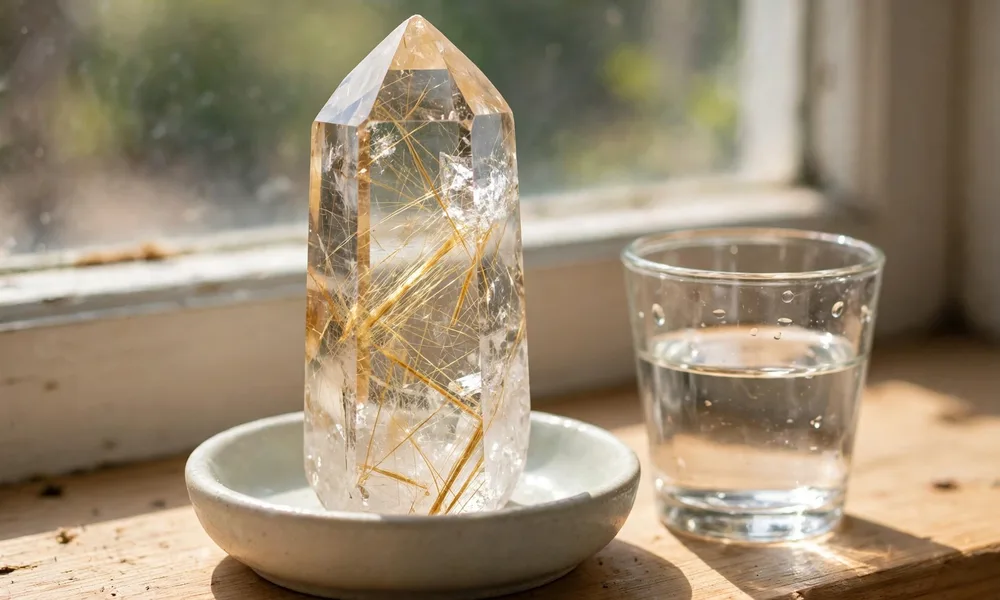
Gold usually reaches us as metal: a coin, a ring, a thin leaf pressed onto a cake. Rutile brings gold in a different shape altogether, as hair. It is a mineral of fine golden needles, titanium dioxide in its natural form, and it grows in thin threads that catch the light like strands of warm straw. Most people first meet it sealed inside clear quartz, where the needles shine through the glass, but the mineral itself is the needle, not the quartz around it.
A bright day suits a mineral with gold in it. Rutile does not shout; it glints. Hold a piece up in the morning and the needles pick up the sun one by one, a quiet little show that asks for nothing more than a window and a minute of attention.
This guide stays with what can be checked by eye and by hand: what rutile is, how the bare mineral differs from the quartz stones that carry it, the signs of a genuine piece, and the plainest way to keep it at home. It treats nothing and promises nothing.
Key Takeaways
- Rutile is the golden needle mineral itself, titanium dioxide, not the quartz around it.
- Its needles are usually gold, coppery or reddish-brown, and no two pieces ever match.
- Rutilated quartz is clear quartz holding rutile needles; rutile alone is the needle.
- Keep rutile beside the glass, never inside it, and rinse your hands once you have handled it.
- It is a thing to look at and keep, and it heals nothing at all.
What Rutile Is
Rutile is titanium dioxide, a mineral that grows as slender, needle-like crystals. The needles are most often golden, though they can run coppery, reddish-brown or even near-black, and they are thin as hairs, sometimes finer.
The mineral matters beyond the display shelf, too. Rutile is the main natural source of titanium, the light, strong metal used in aircraft and in white pigment for paint. In a crystal shop, though, nobody buys rutile for aeroplanes. They buy it for the needles: a spray of gold threads frozen inside clear stone, each piece arranged differently, like a sketch no one else owns.
Rutile and Rutilated Quartz
Rutilated quartz golden threads for focused days is a desk guide about a clear quartz stone threaded with golden rutile needles, built around a short pause before work begins. The stone in that guide is quartz first: a clear crystal, and the rutile is the guest living inside it.
Rutile on its own is the other half of that pair. Take the quartz away and the needles remain: the golden mineral itself, with no glass around it, no host stone, nothing but the threads. Rutilated quartz is a clear stone you look into; rutile is the gold you find when you look.
Rutile and Rutilated Smoky Quartz
Rutilated smoky quartz golden threads for calm work covers a smoky grey-brown quartz threaded with the same golden needles, a slower, quieter stone for steady work.
The needles in that stone are rutile, exactly the same mineral as in this guide. What changes is the host: clear quartz lets the gold shine brightly, while smoky quartz dims it to a warm glow. Rutile itself does not change between the two. It is the same golden thread, seen through different glass, and this guide is about the thread, not the glass.
Rutile and Clear Quartz
Clear quartz: a study in light keeps a plain point by a window for the way daylight moves through clean glass and sharp edges, with no threads, no pockets and nothing held inside.
Rutile is the opposite kind of beauty. Where clear quartz is empty glass, rutile fills the glass with gold. A clear quartz point shows you the light itself; a rutilated piece shows you what the light catches on its way through. If you want a plain, quiet stone, choose clear quartz. If you want gold threads, you want rutile, whether bare or sealed in quartz.
Rutile in Other Stones
Rutile does quiet work inside stones that never mention its name. Star sapphire owes its star to rutile: millions of tiny rutile needles lie inside the stone in three directions, and when light falls on the domed surface, the needles throw it back as three bright lines crossing. Star ruby works the same way, its red surface carrying a pale star made of rutile.
Super seven quartz holds rutile as one of seven minerals in a single stone, alongside amethyst, cacoxenite, goethite, lepidocrocite, smoky quartz and clear quartz, and the rutile adds fine golden threads among the deep purple, red and brown.
How to Spot Real Rutile Needles
Look at the piece in plain daylight first, at arm's length, then bring it close to the window. Real rutile needles show as fine golden lines running through the stone, visible from more than one angle, and they stay put as you turn the piece.
Feel the surface with a fingertip: a genuine piece is smooth where the needles run, because they are inside the stone, and the colour should vary from gold to coppery to reddish-brown along the spray. Ask the seller where the piece was found and to show the actual piece, not a photograph of a different one. Walk away from any seller who starts promising health benefits.
A Bright Morning with Rutile
Set a dark slate tile on the desk by the window, where the morning sun comes in sideways, and lay a folded linen cloth across one corner of it. Put the rutile piece in the middle of the tile, needles facing the light, and set the glass of water up on the sill, a full arm away from the stone, so the two never meet.
Pour the water, drink it slowly, and look at the needles now and then while the morning settles.
Rutile Beside Water
Water and rutile share a room, never a glass. The tumbler lives on the sill, the stone lives on the slate, and the space between them is the rule. Never hold the piece under a tap, and never drop it into a drink: wet stone is slippery, and a dropped piece chips. Dust comes off with a dry, soft cloth wiped over it once a week, and the cloth stays dry, because no water touches the stone at all.

Rutile at a Glance
| Golden needles | Slate, desk, sill | Hands rinsed after |
|---|---|---|
| Titanium dioxide | Bright days, mornings | Glass kept apart |
| Gold, copper, red-brown | One small piece | Keep it dry |
Rutile Among the Other Stones in This Batch
Rutile keeps company here with nine other guides in this batch: four stones and five water guides. The stones run from pale to dark — lithium quartz, soft violet for quiet days; tugtupite, soft pink for tender days; triphane, warm yellow for bright days; and chloritoid, the deepest grey of the whole set, also made for quiet days.
Among the water guides, the car wash is a beginner's guide to washing a car outdoors, the linen spray is a simple guide to misting linen, the scalp rinse is a set of top tips for rinsing hair, the hand soak is a gentle guide to soaking hands, and the silver polish is a five-way guide to polishing silver objects. One washes a car, one mists linen, one rinses hair, one soaks hands, one polishes silver, and rutile stays dry on its slate beside a glass.
Where Rutile Rests at Home
Give the piece a shelf that nobody brushes past: the far end of a desk, a high shelf nowhere near the sink, or the top of a bookcase where the light reaches it.
For a journey, settle it in a small cloth bag with a twist of paper around it, then into a box where nothing hard can knock against it, so it arrives in one piece.
Stones That Must Never Touch Water
Water ruins some minerals outright and turns others into something you should never drink near, so the dry shelf is their only home. Angelite soaks up water and turns cloudy for good; apatite loses its smooth face and stays rough; lepidolite carries lithium in its flakes, which has no business near a drink; pyrite darkens and rusts in damp air; amber, tree resin rather than stone, goes milky in a soak and never clears; malachite must never touch water or elixirs at all; and hematite never belongs in drinking water either.
Rutile itself gets gentler treatment: kept dry, kept away from damp cloths, hands rinsed after handling. If a piece ever falls into a glass by accident, tip the water away, wash the glass, and wash your hands.
Your Bright Days Checklist
- Set the rutile on a dry slate tile by the window, with the glass up on the sill.
- Drink the water slowly, a mouthful at a time.
- Pick the piece up once and turn it slowly.
- Set it back on the tile, then wash your hands with soap and water.
- Buy only from a seller who shows the actual piece.
- If a health worry stays with you, ask a doctor — no stone can answer it.

Frequently Asked Questions
What is rutile, in simple terms?
Rutile is a natural mineral, titanium dioxide, that grows in fine golden needles, and it is the golden thread inside rutilated quartz rather than the quartz around it.
How is rutile different from rutilated quartz?
Rutilated quartz is clear quartz with rutile needles sealed inside it, while rutile is the needle mineral itself, usually a small spray or cluster with no quartz around it.
Can I put rutile in my drinking water?
No. Keep rutile beside the glass, never inside it, because wet stone is slippery, a dropped piece chips, and a drinking glass is no place for a mineral.
Is it safe to pick rutile up and hold it?
Yes, with clean, dry hands, for a short look — then put the piece down and wash your hands before eating or drinking anything.
Where is the best place to keep rutile at home?
Give it a dry shelf in soft daylight, well away from taps and steam, where it cannot be knocked off and small hands cannot reach it.
How do I know my rutile is real?
Real needles show as fine golden lines inside the stone from more than one angle, in colours from gold to reddish-brown.

The Bottom Line
Rutile is the gold thread itself, not the glass that holds it — keep it dry, keep it lit, and let the needles do the shining.
A Note for Bright Days
Gold as hair, light as morning: a dry shelf, a little sun, and the needles will catch both.


