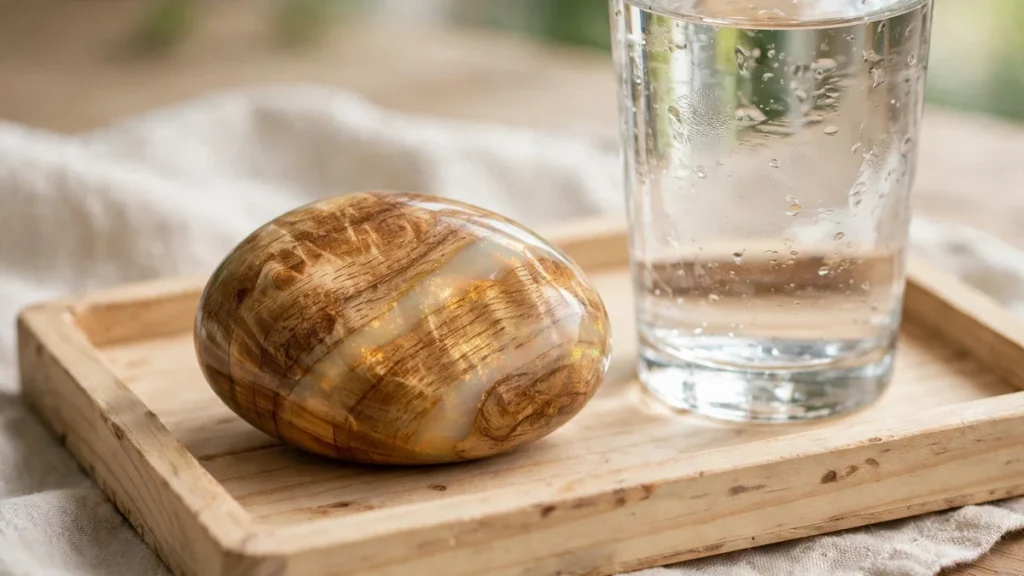
Some mornings feel flat before they have properly started. The sky is pale, the room is still, and the day ahead looks plain and grey. Then one pale stone on the tray catches the light, flashing green, blue, and orange.
Australian opal is the stone for mornings like these. It is a classic precious opal from the dry opal fields of Australia, pale and milky at its base, with bright rainbow flashes that wake up the moment daylight touches it.
Below, Australian opal gets a close look: its bright flash, what sets it apart, what to look for, and how to show it beside water. It is a beautiful object only; it cures nothing.
Key Takeaways
- Australian opal is a classic precious opal from Australia, pale and milky with a bright rainbow flash.
- Its bright flash suits fresh days, clean starts, open windows, and slow bright mornings.
- Australian opal is for looking and holding only: dry on a tray, near water, never inside it.
- Tiny silica spheres inside the stone split daylight into colour.
- One small bright stone is enough for a whole fresh day.
What Australian Opal Is
Australian opal is precious opal dug from the dry ground of Australia, from famous fields like Coober Pedy, Lightning Ridge, and the Queensland country around Yowah. A polished piece feels cool and smooth in the hand, with a soft waxy shine rather than a hard glassy glitter.
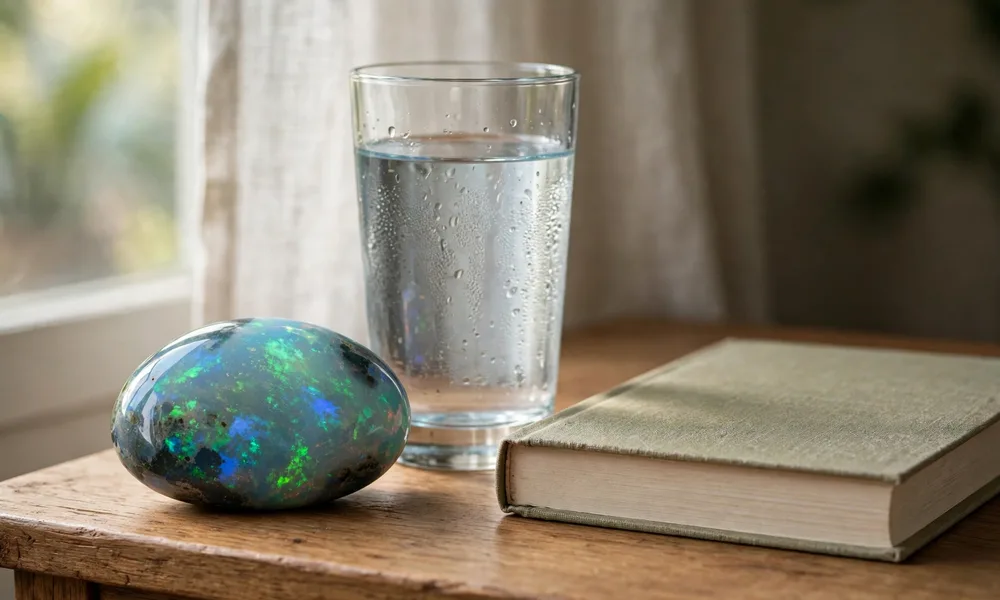
The stone is usually pale at its base, milky white or faintly cream, and inside it, tiny spheres of silica sit in neat rows. Daylight hitting those rows splits into rainbow colours, so green, blue, and orange flashes appear and vanish as the stone turns. That moving colour is called play of colour, and in Australian opal it is strong and bright.
Why Bright Flash Suits Fresh Days
A fresh day is a day that starts clean. The windows are open, the air smells new, the glass of water on the tray is cool, and nothing has gone wrong yet. A stone that flashes bright in morning light fits that feeling exactly: it is awake, lively, and full of colour, without being loud or heavy.
The stone does not make the day fresh; the water, the light, and the slow start do that.
Choosing an Australian Opal Piece
Look for a flash that is bright and easy to see in ordinary daylight, not only under a shop lamp. Tilt the stone slowly and watch the colours move: green and blue should come through clearly, with orange or red showing now and then. The pale body should look even from edge to edge, with no grey patches, no dark cracks, and no dull cloudy corners.
Ask the seller to name the field it came from, and walk away from any piece sold merely as a bright opal at a steep price.

A Fresh Day with Australian Opal
Begin by setting the Australian opal on a light wooden board near the window, with a tall glass of chilled water placed well away from it. Drink the water in unhurried sips and watch the daylight dance across the flashing colours.
The stone itself achieves nothing; the fresh day belongs to you, and the bright flash stays beside you while it passes.
Australian Opal Beside Water
A glass of water and an Australian opal make a bright pair on one tray, yet the tray is the only thing they ever share. Place the glass at one end and the stone at the other, leaving plain wood open between them, so the drink remains pure and the opal remains dry in the morning light.
Rinse your hands once you have put it down, and never allow it to fall into a glass, a jug, or a bath. The pair shares a bright scene while always staying apart.
Australian Opal at a Glance
| Pale milky body | Bright flash | Display only |
|---|---|---|
| Rainbow green, blue | Tray, shelf, windowsill | Wash hands after |
| Small gem, soft stone | Morning light, open windows | Never in water |
| Cool, smooth, waxy shine | Sun, fresh air, rest | Dry cloth wipe |

Australian Opal and Ethiopian Opal
Ethiopian opal is the closest rival Australian opal has, and the two are easy to confuse until you know where each one comes from. Ethiopian opal for fresh days covers a bright, fiery opal from the volcanic hills of northern Ethiopia, pale and clear at its base, with vivid flashes that are sudden and lively.
Ethiopian opal is pale and clear, almost glassy, and it can drink in water and change its look, so it needs extra care to stay dry. Australian opal is milky at its base, steadier in the hand, and it does not soak up water the same way. Both flash brightly, but the Australian stone is the classic field opal.
Australian Opal and Black Opal
Black opal is the dramatic member of the Australian family, and it makes a dark contrast with the pale Australian opal of this guide. Black opal for bold evenings covers a dusky opal whose body is charcoal dark, carrying vivid sparks of blue, green, and violet that stir in dim evening light.
The pale stone in this guide is the daylight one. Its milky body shows the flash best in bright morning sun, while black opal needs dim light and a dark body to make its colours stand out. Both come from Australian ground, yet they belong to different hours of the day.
Australian Opal, Crystal Opal, Jelly Opal and Wood Opal
Three further opals arrive in this same batch, and each one stands a little apart from the classic Australian opal of this guide. Crystal opal, the sibling stone numbered 750, is a clear, glassy opal you can almost see through, with its flash shining through a transparent body. Jelly opal, the sibling numbered 752, is soft and translucent like set jelly, glowing gently rather than flashing hard. Wood opal, the sibling numbered 754, is opal that took the place of old wood, keeping the grain and rings of the tree inside the stone.
Australian opal is the classic one between them. It is the pale milky field stone with a strong bright flash, and that is what makes it the standard other opals are measured against.
Australian Opal and the Other Opals
Beyond the closest cousins, the opal family still keeps more colour. White opal for bright days covers a soft milky white stone whose flash is gentle and slow, far quieter than the bright flash here. Common opal is the plain member of the family, milky white with no flash at all, while opalite is man-made glass, not a stone from the earth, glowing pale blue in the light.
Boulder opal, matrix opal, and yowah opal all carry their opal in dark ironstone rock, while peruvian opal, blue opal, pink opal, and dendritic opal hold one soft even colour each, with no fiery flash. None of these is the classic pale Australian opal.

Caring for Australian Opal
Australian opal is a tender stone, so it prefers a soft touch and a peaceful home. Keep it in a dry, cool place, within a padded case that shuts tight, or on a shelf where nothing weighty can ever tumble onto it.
Brush dust off with a dry gentle cloth, sweeping softly across the rounded top instead of pressing hard. Leave soap, sprays, and shining pastes in the cupboard, and never place the stone in an ultrasonic cleaner. Put the tray where elbows or books cannot bump the stone, and leave it a little quiet room of its very own on the shelf every single day.
Stones That Must Never Touch Water
Some minerals have no place anywhere near a drink, so keep this short warning in mind whenever you set a tray out. Malachite leads the list: never drop it into a cup, a jug, or a glass, and never stir it through water you plan to drink. Hematite stays on that same do-not-touch list, held well away from drinking water even for one brief quick dip.
Pyrite, angelite, and amber sit on that dry list. Apatite and lepidolite also stay out of the water, and lepidolite keeps lithium locked inside its pale flakes. Australian opal rests dry beside the glass too.
Your Fresh Days Checklist
- Rest the Australian opal on a dry tray, with a full glass close beside it.
- Sip the water slowly in the bright morning light.
- Rinse your hands with soap after you have put the stone down.
- Choose a seller who can name the field.
- Keep it dry, cool, and away from little hands.
- If a health worry keeps nagging, see a doctor; a stone holds no answers for you.
Frequently Asked Questions
What is Australian opal?
Australian opal is precious opal from the dry opal fields of Australia, pale and milky at its base, with bright rainbow flashes of green, blue, and orange. Tiny silica spheres inside split daylight into colour.
How is Australian opal different from Ethiopian opal?
Both flash brightly, but Ethiopian opal is pale and clear, almost glassy, and comes from volcanic hills in northern Ethiopia. Australian opal is milky at its base and comes from the classic Australian fields.
Is Australian opal the same as white opal?
No, although both can look pale at first glance. White opal is a soft milky white stone whose flash is gentle and slow. Australian opal carries a stronger, brighter flash.
Is Australian opal safe to hold?
Touching it briefly is safe, if you clean your hands with soap at once after you lay it down, and store it far from young children and from food.
Why must Australian opal never go in water?
The stone stays next to the glass, while the water stays in the glass. Never drop it into a cup or a bath, and never swirl it through a drink.
Where should I keep Australian opal at home?
Choose a bright, dry spot — a tray, a shelf, a windowsill — with the glass close by but apart.
The Bottom Line
Australian opal gives fresh days a bright rainbow flash: one small soft pale stone in morning light, placed on a wooden tray beside a glass of water, admired, never swallowed.
A Note for Fresh Days
Let the sun in and the stone stay dry. One small bright opal, one glass of water, and a few fresh hours are all you need.