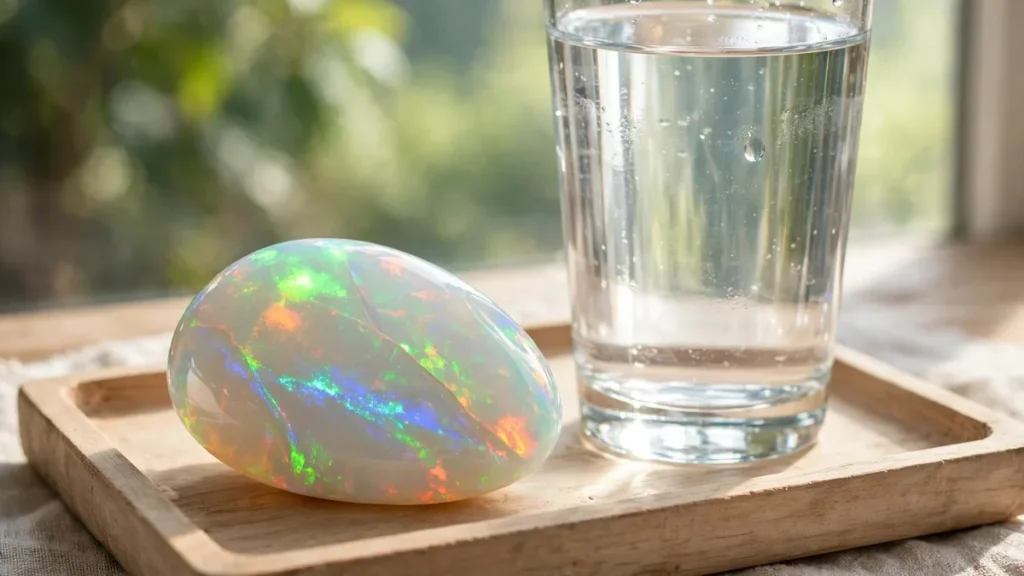
Some days move slowly from the first hour, with no list pressing and no clock shouting. The kettle boils, the chair by the window waits. A quiet day asks for very little: warm light, a drink of water, and one small thing on the table worth looking at.
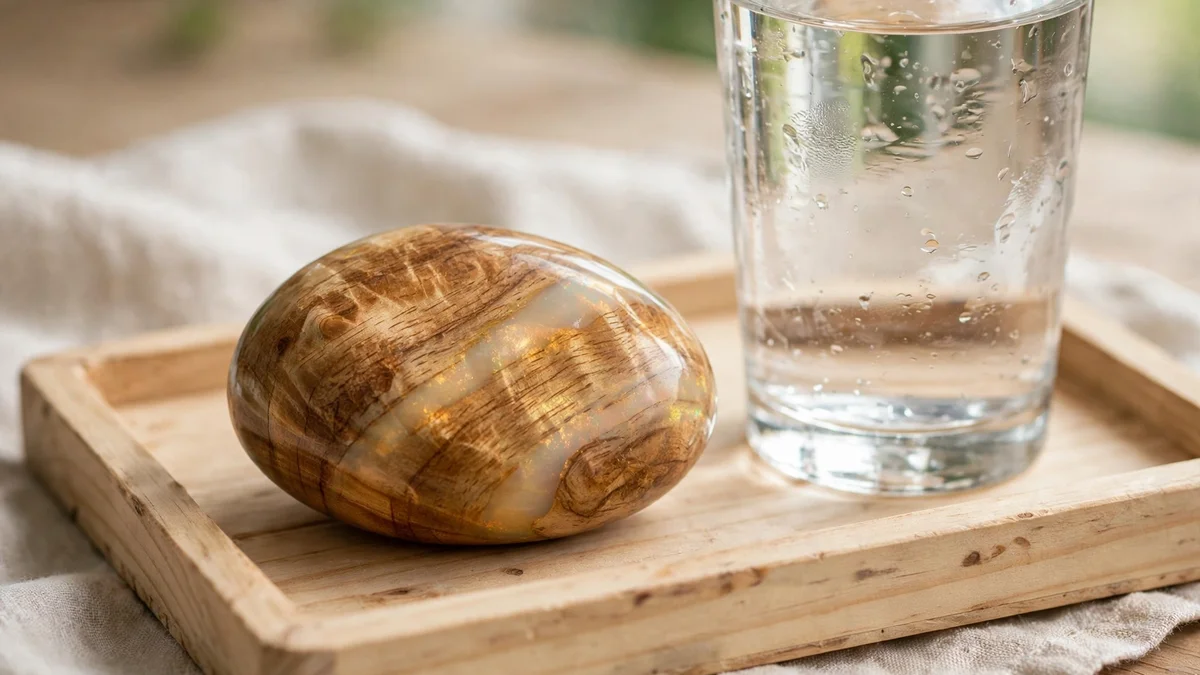
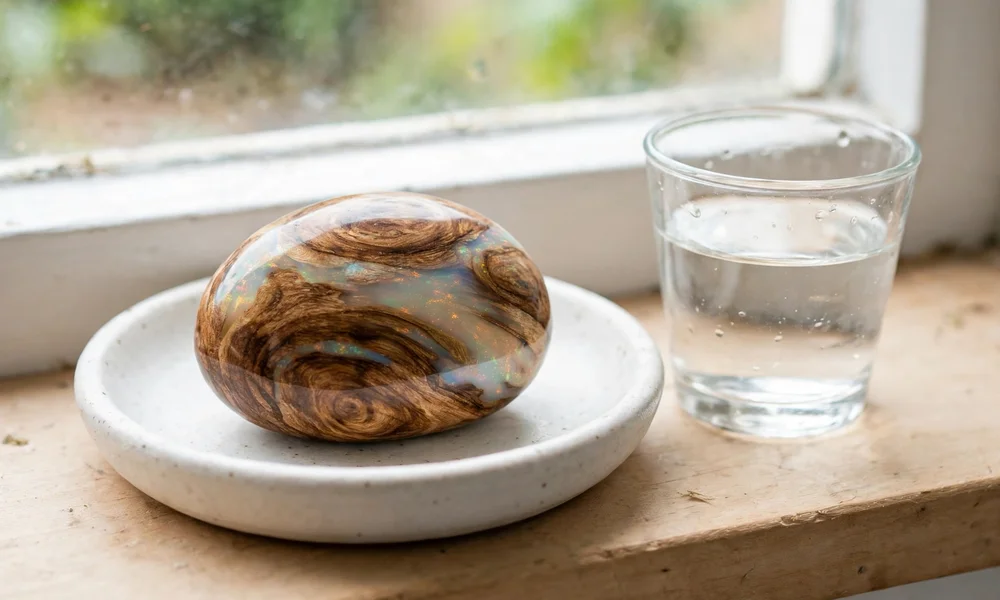
Wood opal suits that kind of day. It is opal that grew where wood once stood, keeping the grain of the old tree inside warm brown stone. Hold it up and you can trace the rings and lines of timber through honey and bark-brown bands.
What follows looks at this earthy stone: how it came to carry the shape of wood, what sets it apart from the flashy opals here, and how to give it a tray place next to a glass of water. Keep it as a lovely object; it mends nothing and treats nothing.
Key Takeaways
- Wood opal is opal that replaced ancient wood, keeping its grain in warm brown stone.
- Its earthy browns suit quiet days, slow hours, and unhurried rooms.
- Wood opal shows wood grain, not the bright rainbow flash of precious opal.
- Wood opal is for looking and holding: dry on a tray, beside water, never in it.
- One small piece of warm brown opal is enough for a whole quiet day.
What Wood Opal Is
Wood opal begins with a tree that fell long ago and lay buried under mud and ash. Over ages beyond counting, water carrying silica seeped through the buried timber, and bit by bit the woody matter gave way to opal. The shape stayed, so the finished stone still carries the rings, knots, and grain lines of the tree it once was.
No two pieces ever match. One may show fine straight grain like pine boards, another may carry a knot where a branch once grew, and the colours run from pale honey through amber to deep bark brown.
Most pieces are cut as smooth pebbles or flat slices, because the grain shows best on a polished face.
Why Warm Earth Suits Quiet Days
Brown is the colour of ground that has settled after rain, of a wooden table worn smooth by years of use, of earth that asks nothing of you. On a quiet day, when the house is still and the light comes in low and gold, a warm brown stone on a tray feels like part of the room.
The stone does not sparkle or demand attention; it sits there, steady and plain.
Choosing a Wood Opal Piece
Look for grain you can follow from one edge of the stone to the other, clear lines that run unbroken rather than faint smudges. The browns should shift gently from honey to bark without muddy grey patches, and the polished face should feel smooth, with no rough pits or crumbly edges. Turn the piece in the light; a good wood opal glows faintly, never blazes.
Ask the seller to call it wood opal by name, and walk away from any piece sold merely as brown opal at a grand price. A smaller piece with honest grain beats a large dull one.
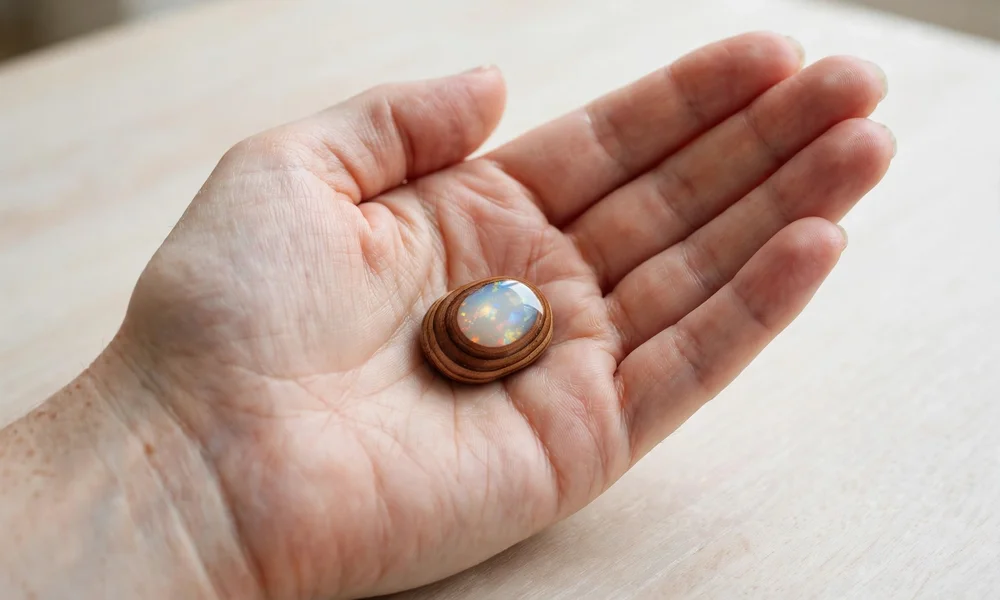
A Quiet Day with Wood Opal
Set the wood opal on a wooden tray near the window, with a tall glass of cool water standing apart from it. Drink the water slowly, let the light move across the grain, and take one long breath.
The stone itself does nothing; the quiet day is your own making.
Wood Opal Beside Water
A glass of water and a wood opal look settled together on one tray, and sharing that tray is as near as they ever get. Put the glass at one end and the stone at the other, with plain wood between them, so the cool drink stays pure and the opal stays dry. A splash should be dabbed off straight away.
Rinse your hands well once the stone is down, and never let it fall into a cup, a jug, or a tub.
Wood Opal at a Glance
| Warm brown grain | Quiet days | Display only |
|---|---|---|
| Rings, honey, bark | Tray, shelf, sill | Wash hands after |
| Polished pebble | Soft light, slow | Keep it dry |
| Earth tones | Water, rest | Dry cloth wipe |
Wood Opal and Boulder Opal
Boulder opal is the nearest earthy cousin, and the two can look like kin until you know what to look for. Boulder opal for grounded days covers opal that grew inside dark ironstone rock in Queensland, warm brown rock threaded with bright blue, green, and gold veins.
Wood opal carries no such veins. Its pattern is the grain of a tree, long lines and rings in honey and bark brown. One remembers a forest, the other a riverbed of rock.
Wood Opal and Petrified Wood
Petrified wood is the closest relation of all, and telling the two apart takes a careful eye. Petrified wood for slow living covers wood that turned to stone over millions of years, keeping every ring and grain line where it grew.
The difference sits in what replaced the tree. Petrified wood became stone through minerals such as quartz, hard and glassy in feel. Wood opal became opal, silica laid down in softer milky patches with a gentle sheen. Both keep the tree, yet wood opal holds a milky glow that petrified wood does not.
Wood Opal, Crystal Opal, Jelly Opal and Australian Opal
Three more opals join the family in this same batch, each showing a different face of the stone. Crystal opal, the sibling numbered 750, is clear and glassy, with bright flashes moving through it like light through clean water. Jelly opal, the sibling numbered 752, is soft and translucent, like pale jelly held up to a lamp. Australian opal, the sibling numbered 756, is the classic precious opal of Australia.
Wood opal is the earthy one among them: no flash, no glow-through, no rainbow play, only the warm brown grain of an old tree.
Wood Opal and the Other Opals
Beyond the nearest kin, the opal family keeps many more colours. White opal is milky white with a gentle rainbow flash, while common opal is plain milky white with no flash at all. Black opal is dark-bodied with vivid blue, green, and violet flashes, and Ethiopian opal is pale and fiery, throwing sudden sparks as it turns.
Hyalite opal is clear and colourless, glowing green only under ultraviolet light, and opalite is milky glass made by people, not a natural stone. Peruvian opal is soft blue, pink opal is milky pink like the inside of a shell, blue opal is pale sky blue, and fire opal burns warm orange with red and gold. Dendritic opal is milky white marked with grey fern-like branches, matrix opal is dark rock threaded with bright white veins, and yowah opal is warm brown, rust, and cream boulder opal. White opal for bright days gathers one of these pale cousins, yet none of them keeps the grain of a tree the way wood opal does.
Caring for Wood Opal
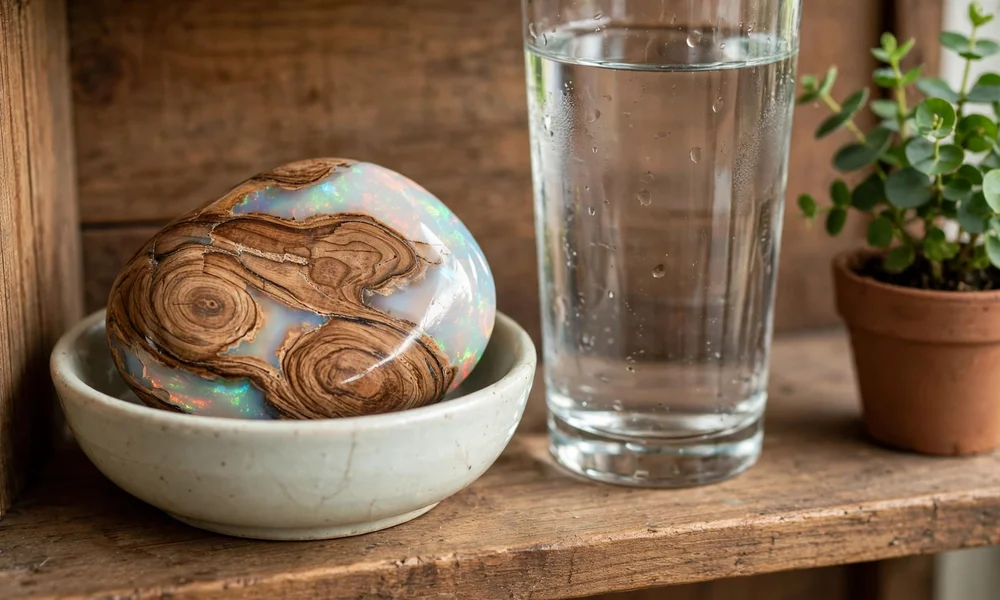
Wood opal is tougher than the softest opals, yet it still likes a gentle hand and a dry home. Rest it in a padded case with a lid, or on a high ledge clear of falling jars, far from fierce bright sun and damp corners.
Brush dust away with a dry soft cloth, moving lightly over the polished face. Leave soap, sprays, and creams in the cupboard, and never set the stone down in a sink.
Stones That Must Never Touch Water
Some minerals have no place near anything you might drink, so keep this short list in mind. Malachite leads the warning: never rest it in a cup, a jug, or a glass, and never stir it through water meant for drinking. Hematite belongs on the same keep-away list, always held far from drinking water.
Apatite and lepidolite want the same wide distance, and lepidolite carries lithium inside its grey flakes. Pyrite, angelite, and amber join the same dry list, nowhere near a glass or a soaking bowl. Wood opal rests dry beside the glass too.
Your Quiet Days Checklist
- Lay the wood opal on a dry tray, with a filled glass close beside it.
- Sip the water slowly while light moves over the brown grain.
- Wash hands with soap after the stone is back on the tray.
- Choose a seller who calls the stone wood opal.
- Store it dry and high, far from little hands.
- If a health worry keeps nagging, speak to a doctor; a stone holds no answers.

Frequently Asked Questions
What is wood opal?
Wood opal is opal that took the place of buried wood over a very long time. Water carrying silica seeped through the fallen timber, and the woody matter slowly gave way to opal, while the rings and grain lines stayed where they grew.
How is wood opal different from petrified wood?
Both began as trees, yet different minerals replaced the wood. Petrified wood turned to stone through minerals such as quartz, hard and glassy. Wood opal turned to opal instead, showing softer milky patches and a gentle sheen.
Does wood opal flash like other opals?
No, and that is part of its charm. Wood opal may show a soft milky sheen, yet it never throws the bright rainbow flashes of black opal or Ethiopian opal. Its beauty sits in the grain, not in any sudden sparkle.
Is wood opal safe to hold?
A hold is harmless, provided you clean your hands with soap once the stone is back on its tray, and keep it away from little hands and meals. Lift it with care and lay it down softly.
Why must wood opal never go in water?
Keep opal on the tray and water in the cup. Do not sink the stone in a mug, do not leave it soaking in a tub, and do not swirl it through a drink; if a drop lands, pat it dry at once.
Where should I keep wood opal at home?
Choose a quiet, dry spot — a wooden tray, a calm shelf, a windowsill — with the glass close by but apart, out of reach of small children.
The Bottom Line
Wood opal gives quiet days a warm brown grain: one small earthy stone in soft light, on a wooden tray next to a glass of water, admired, never swallowed.
A Note for Quiet Days
Keep the lamp dim and the opal dry. One small warm brown stone, one glass of cool water, and a few slow unhurried quiet evening hours are plenty.