Some evenings ask for more than a quiet stone on a shelf. The lights are low, the room is dressed up, and the night deserves one small thing that catches the eye. A bold evening needs one dark, shining thing that holds the light for a moment and then lets it go.
Black opal is a stone for evenings like these: a dark-bodied opal, deep grey and near-black, with bright flashes of blue, green and violet that move across its surface as it turns. In daylight it can look almost plain. In evening light, the flash wakes up, and the stone looks like a small piece of night sky.
This guide explains what black opal is, how to choose a piece, how to keep it safely beside water, and how to wear or display it for bold evenings. The stone is a companion, never a treatment. It will not heal anything.
Key Takeaways
- Black opal is a dark-bodied opal with bright blue, green and violet flash.
- Its dark body makes the flash stand out in low evening light.
- Black opal is for display and wearing only; it will not heal anything.
- The stone stays beside drinking water, never in it, and should be kept dry.
- A bold evening needs very little: one dark stone, warm light, and a simple setting.
What Black Opal Is
Black opal is a variety of precious opal, named for the colour of its body, not for a black flash. The body is dark grey, charcoal or near-black, made of tiny spheres of silica packed closely together. Light passes between those spheres and breaks into colour, so bright flashes of blue, green and violet appear and disappear as the stone turns. That moving colour is called play of colour, and it looks stronger against the dark body, like stars against a night sky.
Most black opal comes from Lightning Ridge in New South Wales, Australia, where it forms in thin seams inside pale claystone. A good stone is judged by the brightness of its flash, the range of its colours, and the pattern across it, not by size alone.
Hold a polished piece and it feels cool, smooth and solid. The surface is glassy and bright, and the flash moves as you tilt it, blue first, then green, then a hint of violet.
Why Dark Flash Suits Bold Evenings
A bold evening is built on contrast: a dim room, dark clothes, and light from lamps and candles rather than the sun. In that light, pale stones can fade, while a dark stone with a bright flash stands out. Black opal works because its dark body matches the night, and its flash answers the warm light.
Choosing a Black Opal
Choosing a black opal starts with the body colour: a good piece has a dark, even body, deep grey or near-black, with no pale patches that wash out the flash. The flash should be bright and clear, not faint or cloudy. Blue and green are the most common colours; violet and red are rarer and cost more.
Look at the pattern too: some show broad, rolling flashes, others small pinpoints of colour, like stars. Hold the stone under a warm lamp and turn it slowly — if the flash stays bright as it moves, the stone is a good one.
Size matters less than brightness: a small cabochon with a vivid flash will outshine a large dull stone. Check the polish too — smooth and glassy, with no pits or dull patches, and edges free of chips. If a piece feels pleasant in your hand and its flash makes you pause, it is the right one.

How Black Opal Differs from Other Opals
Black opal is easy to tell apart from its cousins. Where blue opal soft shimmer daytime offers a pale milky blue stone with a soft glow for daytime looks, black opal offers a dark body with a bright, moving flash for evenings.
Pink opal is softer still: a milky pink stone with no fiery flash, made for gentle mornings and sensitive skin. Where pink opal gentle glow sensitive skin keeps a calm pink companion for quiet routines, this guide keeps a dark flashing stone for bold evenings. Dendritic opal is a quiet pattern stone, while Andamooka and Peruvian opals are pale and even, made for calm days and quiet afternoons.
Matrix opal comes closest in darkness, but it is a different stone: dark brown host rock threaded with bright veins, a bold pattern rather than a flash. Where matrix opal patterned light bright days shows patterned veins for bright daylight, black opal shows moving colour on a dark body for evening light. Yowah and boulder opals carry warm earth colours in ironstone, while black opal carries cool blue and green fire on black. In this same batch, 370 Ethiopian Opal is light-bodied with a bright, lively flash for light days, and 374 White Opal is pale and milky with a soft glow, while black opal is the dark-bodied evening stone of the three.
A Bold Evening Look
A bold evening look starts with simplicity: one dark stone, with room to shine. A single pendant on a fine chain, worn against dark silk or velvet, will flash with every small movement, and a small cabochon ring does the same for the hands.
Keep the rest of the look quiet — dark clothes, plain lines, very little else — so the stone is the one bright thing in the room. Avoid pairing it with other flashing stones, because two bright things compete. At home, a dark tray, a dark cloth and one warm lamp do the same work: set the stone down, pour a glass of water beside it, and let the evening gather around it.
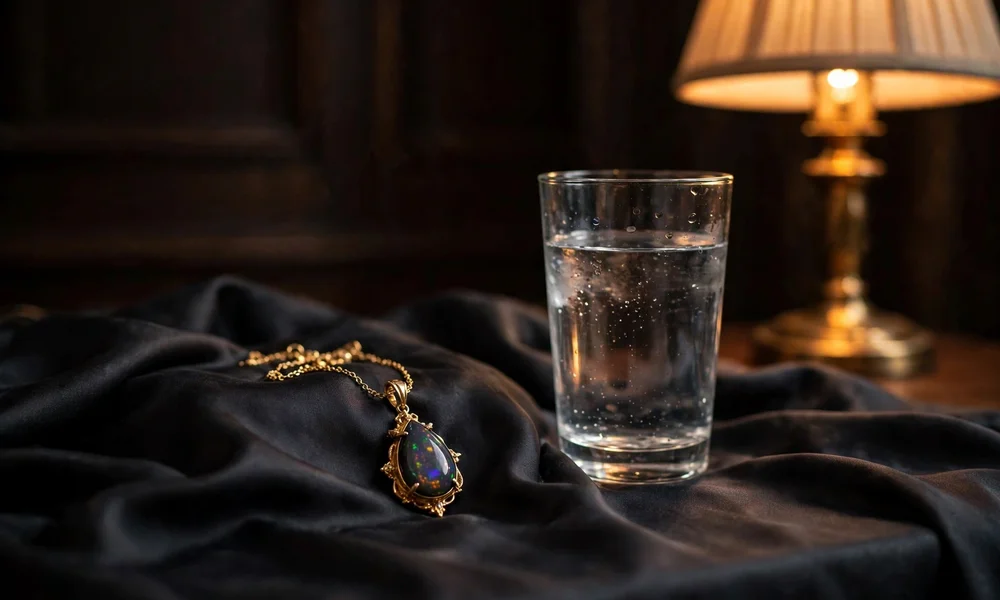
Black Opal Beside Water
Water belongs beside the stone, never around it. Set a clear glass of fresh drinking water next to the stone on its tray. They share a tray, not a glass, and that is the only safe way to pair them. Never place the stone inside drinking water, and never soak it, because a stone in water can chip, dull or carry dust into the glass.
Black opal is softer than many stones, so this rule matters even more: a knock, a long soak, or a scrub with soap can dull the polish and dim the flash. If the glass spills, lift the stone away, dry it with a soft cloth, and set it back once the tray is dry.
Keeping the Stone Dry and Clean
Black opal is a soft, delicate stone, so it deserves gentle, dry care: dust it with a soft, dry cloth, and nothing else. Do not use soap, polish, cleaners or ultrasonic cleaners, and never scrub it. A dry cloth and a light touch will keep the polish bright.
Keep the stone away from damp windowsills, steamy bathrooms and kitchen sinks. Store it in a soft pouch or a lined box, in a dry room, out of direct sun. Do not wear it while washing hands, swimming or working with your hands, because a knock can chip the edge. If it ever gets wet, dry it at once and leave it in open air. Handle it with clean, dry hands, and put it on last when you dress.
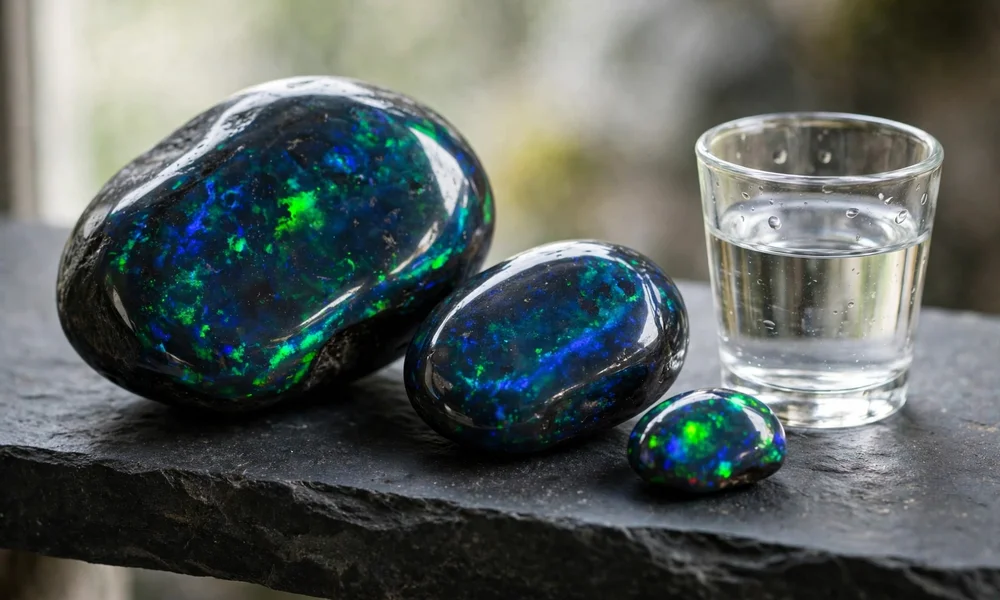
Black Opal at a Glance
| Dark body | Bright flash | Evening light |
|---|---|---|
| Near-black stone | Blue and green | Warm lamp light |
| Cool, smooth polish | Violet at edges | One stone only |
| Soft, handle gently | Moves as turned | Beside water only |
Stones That Must Never Touch Water
Not every stone is safe beside water, and some must never touch water at all. Malachite must never go in water or in elixirs, because it can release harmful substances. Hematite must never go in drinking water. Apatite, lepidolite — which contains lithium — pyrite, angelite and amber must never go in drinking water or in soaks either. These stones belong on a dry shelf, far from any glass.
Black opal is different: it is a soft stone that is safe to hold and display. Even so, it still stays beside water, never in it, and it must never be soaked. If you are ever unsure about a stone, treat it as a display piece only and keep it dry.
When a Stone Is Not the Answer
A stone is not the answer to a health problem, and black opal is no exception. It will not heal anything, and it will not replace rest, food, water or a doctor. The stone is a beautiful object, and that is enough.
If you feel unwell or worried about your health, please see a doctor. Enjoy the stone for what it is — a piece of dark earth with a flash of colour.
Your Bold Evenings Checklist
- Choose a dark-bodied stone with a bright blue and green flash.
- Wear one black opal piece only, against dark cloth, for a bold evening.
- Keep the stone beside a glass of water, never inside drinking water.
- Dust the stone with a soft, dry cloth, never soap or cleaners.
- Store it in a soft pouch in a dry room, away from knocks.
- Remember the stone will not heal anything; see a doctor for health problems.

Frequently Asked Questions
What is black opal?
Black opal is a dark-bodied precious opal, deep grey or near-black, with bright flashes of blue, green and violet that move as it turns.
Why does black opal suit bold evenings?
Its dark body matches dim evening light, and its bright flash stands out under warm lamps, while pale stones fade.
Is black opal safe beside water?
Yes, black opal is safe beside a glass of drinking water, on the same tray. It must never be placed inside drinking water or soaked.
Will black opal heal anything?
No. Black opal will not heal anything. It is a beautiful object for display and wearing.
How do I clean black opal?
Dust it with a soft, dry cloth only. Do not use soap, polish, cleaners or ultrasonic cleaners, and never scrub it.
How is black opal different from Ethiopian opal and white opal?
Ethiopian opal is light-bodied with a bright, lively flash for light days, and white opal is pale and milky with a soft glow. Black opal is the dark-bodied stone of the three, its flash set against near-black for bold evenings.
The Bottom Line
Black opal brings dark flash to bold evenings: a near-black stone whose bright blue, green and violet colour wakes up in warm evening light. Keep it beside water, never in it, dust it dry, and wear one piece only.
A Note for Bold Evenings
Keep it dark, keep it dry, keep it simple. One flash of colour is enough to carry an evening.