
A salad spinner looks like a luxury until the first bowl of leaves comes out dry and crisp instead of wet and limp. The tool is simple: a basket with holes inside a bowl, with a lid that makes the basket whirl, and the water flies off the leaves and gathers below.
Most cupboards hold one that is unused, because nobody showed its owner the order of things: wash first, load loosely, spin in short bursts, and tip the water away between spins.
This guide follows the spinner from sink to table: choosing one, washing the leaves, loading the basket, and keeping it clean. It is gentle general information, and it promises nothing for health.
Key Takeaways
- A salad spinner dries washed leaves by spinning the water off them.
- Wash the leaves under cold running water before they go in the basket.
- Load the basket loosely, never packed tight.
- Spin in short bursts, tipping the water out between spins.
- Dry leaves keep a salad crisp, and a clean spinner lasts longer.
What a Salad Spinner Does
A salad spinner does one job, and it does it with air and speed. Wet leaves go into a basket of small holes, the lid goes on, and a handle or pump sets it turning. The spin throws the water outward through the holes, and the water collects in the outer bowl below.
The difference shows in the bowl: dressing clings to dry leaves instead of sliding off in a puddle. A spinner is not a washer or a chopper: it dries what has already been washed.

Picking the Right Spinner
A good spinner starts with size: a small one suits a single lunch, a large one a family bowl, and the basket should hold a day's leaves without being stuffed.
The lid matters more than the colour: a pump handle is quick and steady, a pull cord spins fast but needs a firm grip, and a crank is slow. Any of the three works when the lid sits flat and the basket turns without wobbling. Clear plastic shows the water gathering below, and a basket that lifts out cleans far more easily than one fixed in place.

Washing the Leaves First
Leaves carry soil and dust, so they are washed before they are spun. Fill a large bowl or the sink with cold water, lower the leaves in, and swish them gently so the dirt sinks. Lift the leaves out, rather than pouring the water away through them.
Change the water and repeat when the first bowl looks cloudy; two washes suit shop leaves, while garden leaves often need a third. Use cold water: warm water wilts the leaves, and the spinner cannot bring back a leaf that has gone soft. Wash only what you will eat today.
Loading the Basket Well
Load the basket loosely, in handfuls, and stop when it is two thirds full, so the leaves have room to move. Leaves pressed tight trap water in the middle, where the spin cannot reach them.
Tear large leaves into bite-sized pieces first, and shake off the worst of the water over the sink. Heavy stems go at the bottom, where the spin is strongest. Do not add dressing, salt or lemon to the basket: those belong in the serving bowl after the leaves are dry, because the spin would throw them off with the water.
Spinning Without a Mess
Set the spinner on a flat counter, press the lid down until it sits level, and hold the bowl steady with one hand. Pump or turn the handle in short, even bursts rather than one long frantic whirl. Three or four short bursts dry most leaves.
Listen to the spin: a smooth hum means the basket is balanced, while a rattling wobble means the leaves have bunched to one side. Stop, spread the leaves out again, and start over. Tip the water out of the outer bowl after the first spin, before spinning again, because water left below climbs back onto the leaves as the basket turns.
Dry enough is easy to test: lift a leaf and press it lightly between your fingers; it should feel cool and damp, not wet, and no drops should fall. Two spins are usually enough, and three settle the most stubborn leaves, so stop while the leaves look lively.
A Lunch-Table Spin, Step by Step
Lunch is the best hour for the spinner, when the kitchen is calm. Fill a wide bowl with cold water at the sink, lower in a handful of lettuce, and swish it gently. Lift the leaves out, shake them once over the sink, and lay them loosely in the spinner basket.
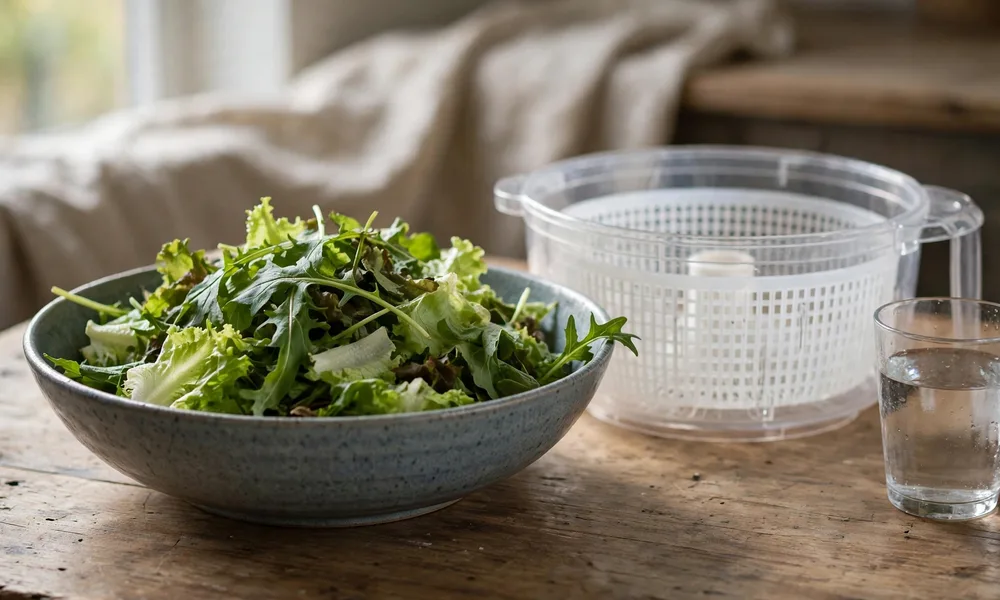
Set the spinner on the counter by the window, press the lid down flat, and pump it in short, steady bursts. Tip the water out, spin once more, and lift the dry leaves into a wide serving bowl. Pour a glass of cool water for the table, set it beside the bowl, and toss the leaves with a little oil and a pinch of salt.
Salad Spinner at a Glance
| Loose dry leaves | Cold wash first | Two short spins |
|---|---|---|
| Basket two thirds | Tip water out | Dressing after spin |
| Flat firm counter | Short even bursts | Eat while crisp |
| Wash leaves first | Dry spinner stored | Clean after lunch |
Water and a Salad Bowl
Water and a salad bowl: a simple fresh ritual builds a wide bowl of washed, cut vegetables and torn green leaves, tossed with a little oil or lemon and eaten at one sitting, at lunch. The leaves there are washed under cold running water and shaken dry by hand over the sink.
This guide dries the leaves differently, with a tool built for the job. A salad bowl is the meal itself, the leaves already chosen and tossed, while a salad spinner is the step before the bowl, taking wet leaves and handing back dry ones. The bowl guide shakes leaves dry by hand; the spinner guide whirls them dry in a basket.
Water and a Lemon Slice
Water and a lemon slice: how to keep it fresh follows a thin slice of lemon in a tall glass of cold water, choosing a firm lemon, cutting one clean slice, and swapping it before it turns bitter.
The spinner guide shares the cold water and the kitchen counter, but nothing else. A lemon slice goes into the water and stays there, flavouring it slowly, while spinner leaves are washed in water and spun until the water is gone. One keeps water in the glass; the other gets water off the leaves.
Water and a Citrus Morning
A citrus morning with a simple fresh ritual begins before breakfast, with sliced citrus laid out on a plate and a tall glass of plain water next to it, the fruit for eating and looking at, the water untouched.
A salad spinner belongs to a different hour and a different job: the citrus morning is fruit beside water at breakfast, while the spinner is green leaves and cold wash water at lunch. One is a quiet ten minutes of looking and tasting; the other is a practical tool that dries leaves so a salad can be eaten.
Nine Neighbours in This Batch of Guides
The spinner is one of ten guides in this batch, and the other nine each hold a different corner of kitchen, garden and stone. A cold frame shelters seedlings from wind, and a seedling is the young plant the cold frame guards. A teacup holds a calm morning drink, and a colander drains pasta and vegetables, the spinner's closest cousin, since both let water run away through holes.
The five stone guides stand dry beside the water ones: cowrie, a smooth shell for quiet days; tagua, a pale nut for the same calm hours; basalt, a deep black stone; anatase, a sharp blue crystal for bright days; and amblygonite, a soft yellow stone to know before buying. The spinner dries leaves with water; the stones stay dry beside the glass.
Stones That Must Never Touch Water
A kitchen sink is a wet place, and some stones should never come near it, so they live on dry shelves far from the tap. Apatite turns cloudy after a soak, and the shine that made it worth keeping does not return when it dries. Lepidolite carries lithium in its flakes, which is reason enough to keep it away from every cup, jug and basin in the house.
Damp air darkens pyrite and steals its shine; angelite soaks water in and swells out of shape; amber, old tree resin and no true stone, clouds in a soak and never clears.
Your Crisp-Leaves Checklist
- Wash the leaves in cold water and lift them out.
- Load the basket loosely, about two thirds full, with room for the leaves to move.
- Spin in short bursts and tip the water out before spinning again.
- Test one leaf between your fingers; it should feel cool, not wet.
- Dress the leaves only after they are dry, in the serving bowl.
- If your stomach or skin troubles you after eating, ask a doctor — a spinner answers kitchen questions, not health ones.
Frequently Asked Questions
How many leaves can a salad spinner hold at once?
A basket holds about two thirds of its volume in loose leaves, enough for one family salad. Overfilling traps water in the middle, so spin a second small load rather than one packed one.
Should I wash the leaves before or after spinning?
Wash them first, always: the spinner only dries, it does not clean. Leaves washed in cold water, lifted out and shaken once, go into the basket damp and come out dry.
How many spins does a salad need?
Two short spins dry most leaves, and a third settles thick romaine ribs and herbs. More than that bruises the tender tops, so stop while the leaves still look lively.
Can I spin herbs in the same basket as lettuce?
Yes, herbs dry well in the same spin as long as they are scattered loosely among the leaves. Packed down, they clump together and hold water where the spin cannot reach.
How do I clean the spinner itself?
Rinse the basket, bowl and lid under warm water with a little soap, then shake them dry and leave them upside down on a cloth. A spinner put away wet grows a stale smell, so let every part dry first.
Does a spinner work for spinach and soft leaves?
It does, but soft leaves need gentler handling: spin them in short, slow bursts and check after each one, because thin leaves bruise faster than sturdy lettuce.

The Bottom Line
Water and a salad spinner work together when the leaves are washed cold, loaded loosely, spun in short bursts, and dressed only once dry.
A Note for Crisp Lunches
Wash cold, spin short, tip the water away, and eat while the leaves are crisp — that is the whole of it.


