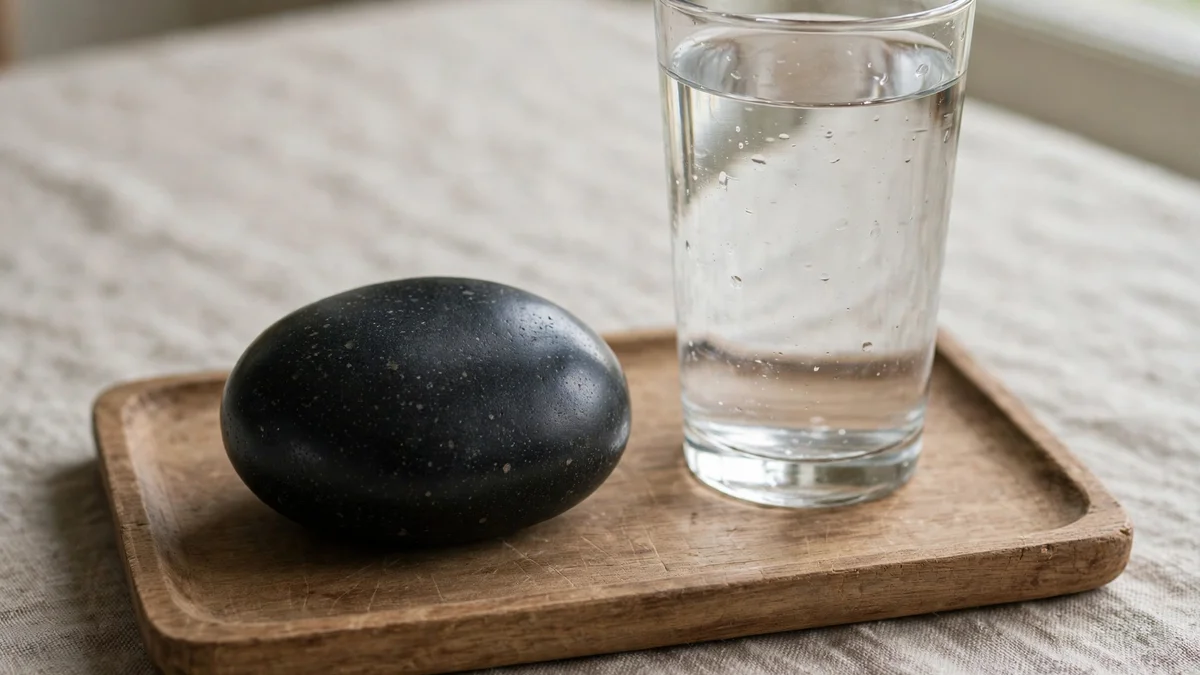
Basalt is the dark stone under much of the world. It paves old streets, builds sea cliffs, and rises in tall columns where lava once cooled and cracked, yet most people walk over it daily without knowing its name.
A polished basalt pebble looks simple at first glance, but the simplicity is honest: no sparkle, no banding, no bright colour, only a deep grey-black surface that feels cool and steady in the hand. That steadiness is why people keep a piece on a desk or a shelf.
This guide explains the stone from the ground up: what it is made of, how it forms, how to tell a real piece from a look-alike, and how to look after it at home. It is general information, promising nothing for health; a health question belongs with a doctor.
Key Takeaways
- Basalt is a fine-grained volcanic rock, dark grey to black.
- It forms when lava cools at the surface and tiny crystals grow.
- Basalt is a stone with crystals; obsidian is a glass without them.
- A real piece feels heavy, cool, and matte, never glassy.
- Keep it on a dry tray beside water, never in a drink.
What Basalt Is
Basalt is a volcanic rock: molten rock that reached the surface and cooled there. Its colour runs from dark grey to deep black, and its surface is fine-grained, the crystals inside too small for the eye to pick out, so the stone looks even and smooth.
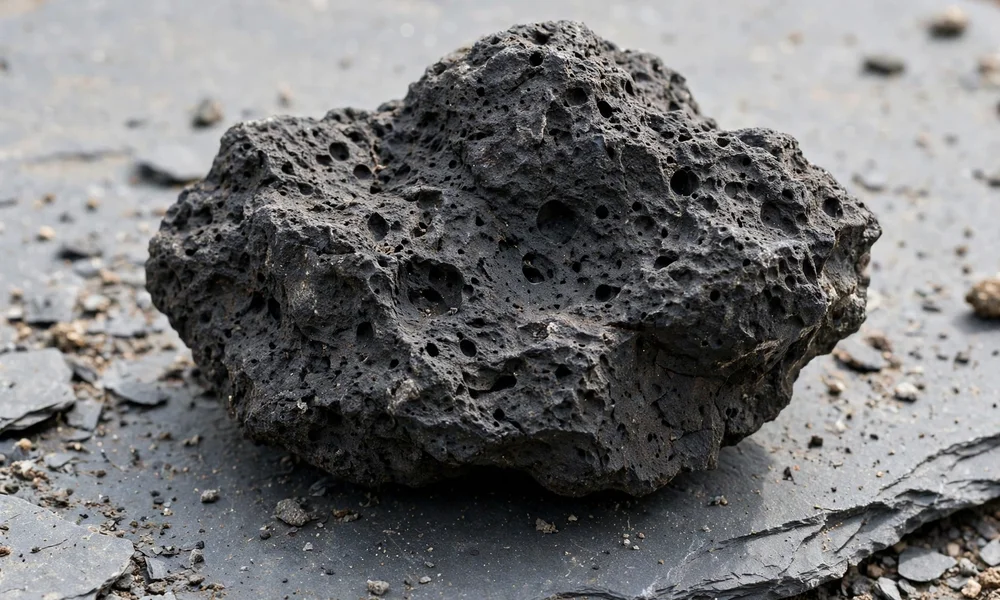
Touch tells the rest. A basalt piece feels dense and cool, heavier than it looks, matte rather than shiny, with a faint grain under the fingertips. Some pieces carry tiny holes where gas bubbles were trapped as the lava cooled, and some carry pale speckles. Neither mark is a flaw.
How Basalt Forms
Basalt begins deep underground, where rock melts into magma rich in iron and magnesium and poor in silica. When that magma finds a crack and rises, it spills out as lava in dark flows that can cover whole valleys. At the surface the lava cools quickly, but not so quickly that nothing can grow: tiny crystals form as it sets, giving basalt its fine grain.
Where a thick flow cools slowly, it shrinks and cracks into tall columns, often six-sided, standing together like the pipes of an organ. The Giant's Causeway and the basalt cliffs of Iceland are the famous examples, but the same columns appear wherever old lava cooled undisturbed.
Spotting Real Basalt
A real basalt piece gives itself away in three ways, none needing a tool. First, the weight: pick it up, and it should feel heavier than a pebble of the same size made of sandstone or glass. Second, the surface: matte and faintly grainy, not smooth and shiny like glass.
Third, the colour: an even dark grey or black all the way through, with no bright bands and no glitter. Hold it in plain daylight and turn it slowly; a dyed stone often shows a paler patch where the colour did not reach, and a glass imitation catches the light with a sharp shine basalt never has.
Basalt and Obsidian: Glass Against Stone
Basalt and obsidian are cousins, and the likeness confuses buyers more than any other pair of dark stones. Both come from lava, both are dark, and both turn up in the same shops, yet they are made in opposite ways. Obsidian forms when lava cools so fast that no crystals have time to grow, and the result is a natural glass: smooth, shiny, and sharp at a broken edge, black all the way through like a dark mirror.
Basalt cools more slowly, and its tiny crystals have time to grow, so the result is a rock, not a glass: matte, grainy, and dull at a broken edge. Hold the two side by side and the difference is plain. The test is simple: shine means glass, and grain means basalt.
Basalt and Black Obsidian
Black obsidian for protection in busy weeks describes it as a black glass born of volcanoes, made when molten rock chills in a rush, too fast for crystals to form, dark throughout, sleek in the hand. Its guide is about a glass that behaves like a stone.
This guide describes the other side of that cooling. Basalt is what the same lava becomes when given a little more time: crystals grow, the shine fades, and the glass turns to rock. Black obsidian is kept for busy weeks and handled gently because glass can chip; basalt is kept for quiet days because rock is tougher. The two share a birthplace in lava, and nothing else.
Basalt and Snowflake Obsidian
Snowflake obsidian for balance and routines follows a black volcanic glass scattered with pale white spots, crystals of cristobalite that formed as the lava cooled, each stone carrying its own pattern. Its charm is the contrast: white marks on a black glassy ground.
Basalt can carry pale speckles too, but the ground beneath them is different, a matte rock rather than a shining glass, and the speckles are other minerals caught in the flow rather than crystals grown inside glass. Snowflake obsidian must never go into drinking water because it can chip; basalt stays beside the glass because a rock belongs on a tray, not in a drink.
Basalt and Mahogany Obsidian
Mahogany obsidian for warm brown steady days is obsidian in its warm brown form, a volcanic glass made when lava cools so quickly that no crystals have time to grow, with a smooth glassy body and a warm brown glow. Its colour is its appeal.
Basalt never glows warm brown. Its colour is the colour of a cold cliff: dark grey to black, even and unchanging, with no glow and no warmth in the tone. A mahogany obsidian piece catches the light and shows its brown; a basalt piece takes the light in and gives nothing back.
Basalt at a Glance
| Dark volcanic rock | Fine tiny crystals | Matte, never glassy |
|---|---|---|
| Heavy and cool | Lava cooled slowly | Columns crack tall |
| Speckles are normal | Beside water only | Shelf keeps it |
| No bands, no glow | Daylight shows true | Quiet days suit |
A Quiet Morning with Basalt, Step by Step
A quiet morning with basalt starts the night before, with the stone already on its tray. When morning comes, fill a tall glass with cool water and set it on the tray beside the stone, so glass and rock share the same small space without touching. The water is for drinking, the stone for looking at.
Pick the stone up first, before the water, and hold it in one hand while the kettle heats. Feel its weight and cool surface, turn it over once, and set it back on the tray. Then drink the water slowly, in small sips, while the room is still quiet and the light is still low.

Nine Neighbours in This Batch of Guides
Basalt shares this batch with nine other guides, four stones and five water guides. The stones come first here: amblygonite is a soft yellow stone to know before buying, anatase a deep blue stone weighed up for bright days, tagua a soft cream seed for quiet days, and cowrie a smooth white shell for calm shell days.
The water guides turn the other way, toward kitchens and gardens: the colander guide shows the best ways to drain well, the salad spinner guide dries leaves with a spin, the seedling guide gives seven ways to help a young plant grow, and the cold frame guide explains why glass and water protect plants from the cold. The teacup guide rounds the batch out with the warmest subject of all, a small cup for calm mornings.
Stones That Must Never Touch Water
Not every stone belongs near a glass: the drink stays a drink, and the stones stay dry beside it. Some stones lose their looks in water, and a few carry something that should never reach the mouth. Apatite is spoiled by a soak, because the water dulls the polish and the shine never quite comes back.
The flakes of lepidolite hold lithium, a reason on its own to keep that stone far from every cup. Dampness darkens pyrite and turns its bright face dull, angelite swells and goes cloudy when it stays wet, and amber, hardened tree resin rather than a true stone, turns milky in a soak. Basalt itself can be rinsed and dried without harm, yet even basalt is kept beside the glass, not inside it.
Cleaning and Keeping Basalt
Basalt is forgiving to clean. Wash it in lukewarm water with a drop of mild soap and a soft cloth, then rinse and pat it dry at once, so no water sits in its small holes. Never soak it for hours, and never use harsh chemicals or a stiff brush.
For keeping, a wooden tray or a lined box suits it best, somewhere the stone will not roll against harder pieces. Give it its own compartment or cloth, away from keys and coins, and keep it out of long dampness.
Your Basalt Checklist
- Hold the piece in daylight and look for an even dark grey or black.
- Feel for weight, coolness, and a matte grainy surface, not glassy shine.
- Check for tiny holes or pale speckles, which are natural, not flaws.
- Keep the stone on a dry tray beside a glass of water, never in it.
- Wash it with lukewarm water and mild soap, then pat it dry at once.
- Store it in its own cloth or compartment, away from harder stones.

Frequently Asked Questions
Is basalt a crystal or a rock?
Basalt is a rock, not a single crystal: many tiny crystals of different minerals grown together as lava cooled. A crystal is one mineral with one structure; basalt is a whole rock built from several.
How can I tell basalt from black obsidian?
Look at the shine: obsidian is a glass, smooth and shiny, while basalt is a rock, matte and faintly grainy. A broken edge tells the same story.
Does basalt have any holes in it?
Many pieces do: gas bubbles were trapped in the lava as it cooled, leaving small round holes called vesicles. The holes are natural.
Can I put basalt in drinking water?
No, keep basalt beside the glass, never inside it. A drinking glass holds water and nothing else.
Where does basalt come from?
Basalt comes from lava flows all over the world, wherever volcanoes have erupted, and it is one of the commonest rocks on Earth.
How should I clean a basalt pebble?
Wash it in lukewarm water with a drop of mild soap and a soft cloth, rinse it, and pat it dry straight away. Never soak it, and never use harsh chemicals or a stiff brush.
The Bottom Line
Basalt is a dark volcanic rock of tiny crystals, matte and heavy and plain, best kept on a dry tray beside a glass of water.
A Note for Quiet Days
A dark stone, a glass of water beside it, and ten minutes with nowhere to rush to.


