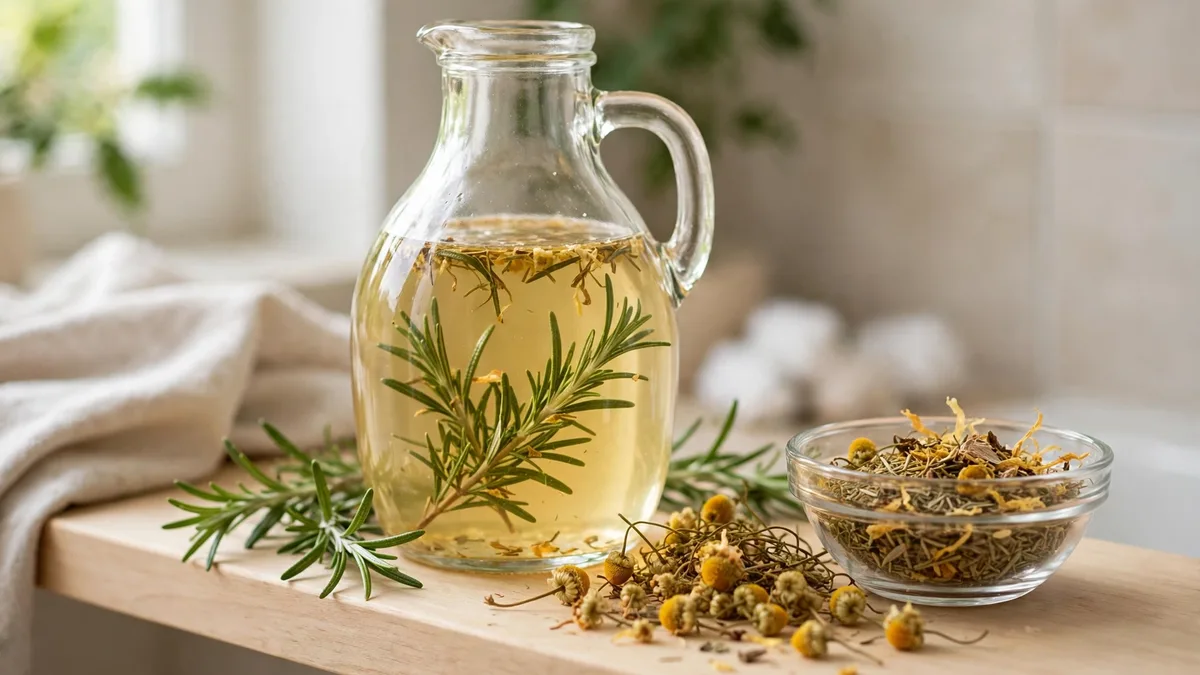
Some habits feel old in the best way. Long before shelves filled with bottles, people steeped herbs in hot water, let it cool, and poured the pale golden liquid over their hair. It smelled of the garden and asked for almost nothing.
A herbal rinse is that habit, kept simple: water, a few gentle herbs, a jug, and a few minutes. It is not a treatment and it will not fix your hair or skin. It is a fresh ritual, done slowly, that leaves hair feeling clean and skin feeling calm.
This guide explains what a herbal rinse is, which herbs to start with, how to make one, and how to build a short fresh ritual around it. The rinse is for hair and skin only — never a drink, and never a cure.
Key Takeaways
- A herbal rinse is herb-infused water poured over hair or skin, made fresh each time.
- Start with gentle kitchen herbs — rosemary, chamomile, mint — one or two at a time.
- A rinse is not a compress, a toner, a flower water, a tea to drink, or a hair mask.
- Rinse only, never drink; strain well, cool fully, and patch-test first.
- Make a small batch, use it the same day, and see a doctor for scalp or skin problems.
What a Herbal Rinse Is
A herbal rinse is water that has carried herbs for a little while. You pour hot water over dried or fresh herbs, cover the bowl, wait for the water to turn pale gold or green, strain the herbs out, and let it cool. What is left is a light, scented water for clean, wet hair or skin.
The herbs do not dissolve the way salt does. They lend the water colour and scent, and then they are strained away. The rinse is thin and clear, and it runs off the hair almost at once.
People have rinsed with herbs for centuries. At Crystal by Ayesha, we keep it exactly that way: a simple fresh ritual, gentle general information only, never medical advice, never a promise to cure anything.
Choosing Your Herbs
Choosing your herbs is the heart of this ritual: start small. Rosemary is the classic hair herb: fresh green sprigs with a clean, pine-like scent. Chamomile is the gentlest: small dried flowers that smell faintly of apples. Mint is the fresh one: cool green leaves for a bright, clean rinse.
Start with one herb, or two at most, and use a small amount: a spoonful of dried herb, or one fresh sprig, in a jug of hot water. Never mix five herbs at once: if your skin reacts, you will not know which one caused it. Buy food-grade dried herbs, never potpourri. Skip chamomile if you are allergic to ragweed or daisies.
How to Make a Herbal Rinse
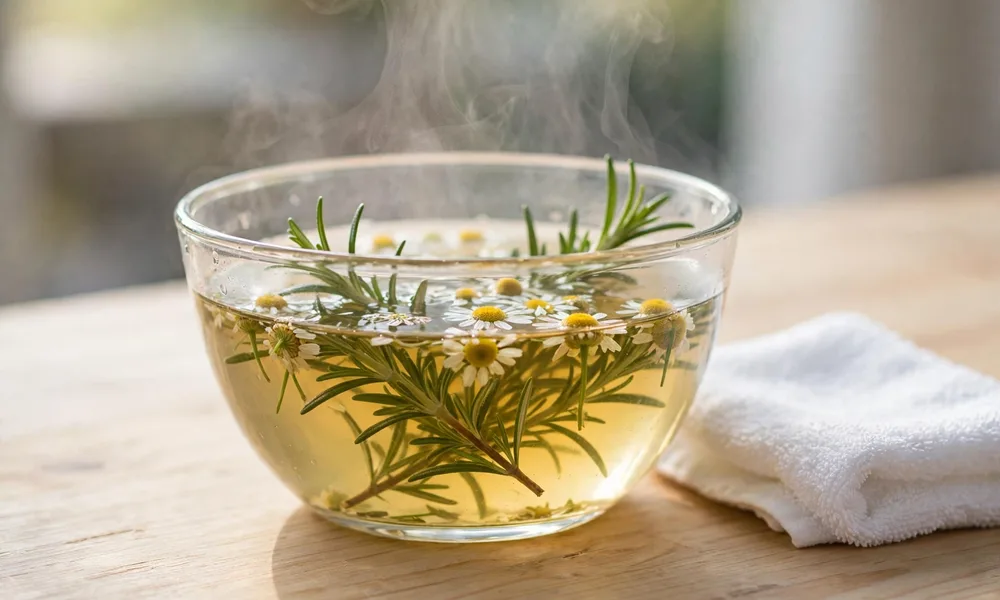
Making a herbal rinse takes twenty minutes, most of it waiting. Boil a kettle and pour two cups over your herbs in a clean glass bowl or jug. Cover it, so the scent stays in, and leave it to steep for fifteen minutes.
Then strain it well through a fine sieve or a clean cloth, so no leaves or flowers are left in the liquid. Bits of herb caught in hair are the most common complaint. Let it cool until lukewarm on your wrist, never hot. Use it the same day, and throw away what is left.
A Simple Fresh Ritual
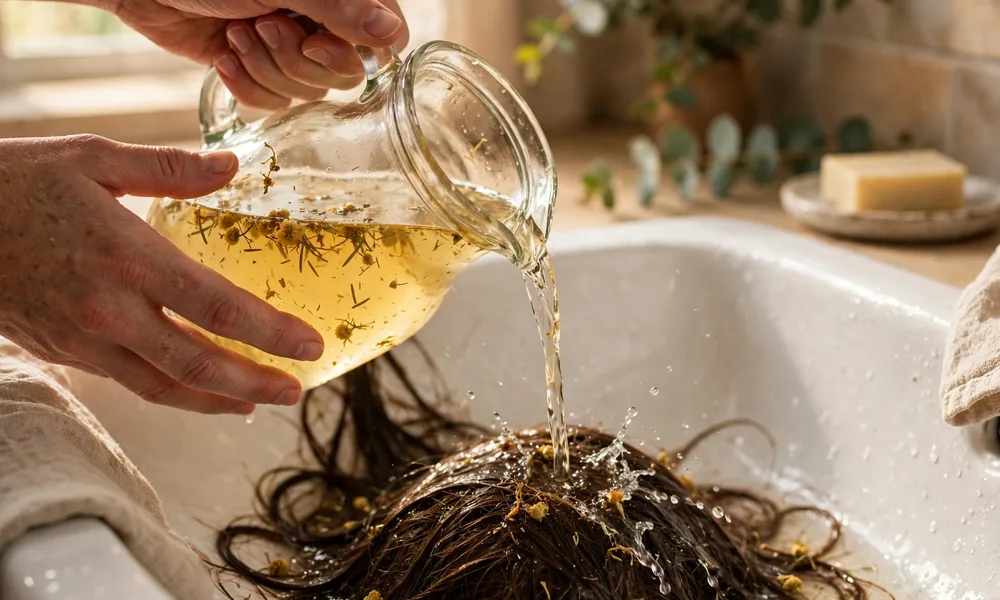
A simple fresh ritual takes only a few minutes once the rinse is ready. Wash your hair as usual, rinse with plain lukewarm water, and then pour the herbal rinse slowly over your hair, from roots to ends, catching it in a bowl to pour twice.
Let it sit for a minute, then leave it in or rinse it lightly with plain water. Pat your hair dry with a soft towel, never rub it, and air-dry when you can. For skin, pat a little cooled rinse over clean skin, let it dry, and follow with your usual moisturiser.
Herbal Rinses at a Glance
| Fresh rinse | Hair, skin | Rinse only |
|---|---|---|
| Rosemary, chamomile | Pour slowly | Never drink |
| Steep, strain, cool | Leave or rinse | Patch-test first |
| Use the same day | Towel dry softly | See a doctor |
Herbal Rinses and Chamomile
Herbal rinses and chamomile compresses share one herb, but they are different habits. A chamomile water compress is a cool, damp cloth laid gently over closed eyelids for five to ten minutes, for tired eyes, and it stays on the eyes and nowhere else.
A herbal rinse is poured over hair, or patted over skin, and it moves: through the lengths and down the neck, never over the eyes. The compress is still; the rinse flows. Chamomile water compresses for tired eyes: a cool cloth for closed eyelids only, not a poured rinse.
Herbal Rinses and Rose Water
Herbal rinses and rose water toner both leave the skin feeling fresh, but they are used in different ways. Rose water toner is a light, fragrant water patted over the face after washing, about a teaspoon, once or twice a day.
A herbal rinse is a larger, looser habit: two cups of herb water poured over hair or patted over skin, made fresh each time. Toner comes from a bottle and keeps; a rinse is brewed, strained and used the same day. Rose water toner, used well: a bottled water for the face, not a fresh jug for hair and skin.
Herbal Rinses and Flower Waters
Herbal rinses and flower water blends both smell of flowers, but they are made in different ways. Flower water, also called hydrosol, is the scented water left after steam distillation, carrying only a faint trace of essential oil. Blends mix two flower waters at a time, in equal parts.
A herbal rinse is simpler: herbs steeped in hot water, strained through a cloth, and poured over hair. No distillation, no bottle — just hot water, herbs and a sieve. Flower waters are precise and bottled; a herbal rinse is fresh and home-made. Flower water blends for softer skin: distilled hydrosols for the face, not steeped herbs for hair and skin.

Herbal Rinses and Tea Blends
Herbal rinses and tea blends share a kettle and a handful of herbs, and then they part ways completely. A tea blend mixes a couple of mild teas or herbs in one pot and is sipped slowly beside a glass of fresh water through the afternoon.
A herbal rinse is never drunk: poured over hair or patted over skin, the cup never near your lips. The two habits look alike at the brewing stage — hot water, herbs, a covered pot — and that is exactly why the rule matters: a rinse is for the outside only, a drink for the inside only. Keep them apart.
A live green tea rinse guide also exists here, a hair-only ritual of brewed green tea. A herbal rinse is broader: mixed kitchen herbs, for hair or skin, never a single tea.
Herbal Rinses and Hair Masks
Herbal rinses and hair masks both care for hair, but they work in opposite ways. A hair mask is a rich cream, worked through the lengths once a week, left to rest, and then rinsed away. It is heavy, slow and rich.
A herbal rinse is thin and quick: water that runs through the hair in a minute and is gone. It does not coat or rest, and it is not weekly — a rinse can follow every wash, or once a week. The mask feeds the lengths; the rinse freshens them. Used together: mask first, rinse it away, and finish with the herbal rinse.
Herbal Rinses and Grey Hair
Herbal rinses and the grey-hair shine routine both end with a rinse, but only one uses herbs. The grey-hair shine routine is built on plain water: lukewarm water, a gentle wash, a longer rinse, and a cooler finish, because grey hair shows dullness and yellowing easily.
A herbal rinse adds herbs to that finish — chamomile for fair or grey hair, rosemary for darker hair — poured slowly, towel-dried softly, with the patch-test and same-day rules.
Rinse Only, Never Drink
The most important rule is the simplest: a herbal rinse is for the outside only. Never drink a rinse, never use rinse water as tea, and never put rinsing herbs into a drinking cup. Rinse water is not drinking water.
Patch-test every new herb first: pat a little cooled rinse on your wrist, wait a day, and only then use it. If your skin turns red, itchy or sore, stop at once and wash with plain water. Keep rinses away from the eyes, and hot water off the scalp — lukewarm only. If your scalp or skin troubles you and it does not settle, see a doctor or a dermatologist.
Your Fresh Ritual Checklist
- Choose one gentle herb to start: rosemary, chamomile or mint.
- Steep a small batch in hot water, covered, for fifteen minutes.
- Strain the rinse well through a fine sieve or a clean cloth.
- Let it cool until lukewarm on your wrist before you use it.
- Pour it over clean, wet hair, or pat it over clean skin.
- Remember: rinse only, never drink, and see a doctor for problems.

Frequently Asked Questions
What is a herbal rinse?
A herbal rinse is water that has carried herbs: hot water poured over herbs, steeped, strained and cooled, then poured over hair or patted over skin.
Can I drink a herbal rinse?
No. A herbal rinse is for the outside only — hair and skin — and it must never be drunk. Rinse water is not drinking water.
Which herbs should I start with?
Start with one gentle kitchen herb: rosemary for hair, chamomile for sensitive skin, or mint for a fresh feeling. Use one or two at most, and patch-test first.
How often can I use a herbal rinse?
You can use a rinse after every wash, or once a week. Make a fresh batch each time and use it the same day.
Is a herbal rinse the same as a chamomile compress?
No. A chamomile compress is a cool, damp cloth laid over closed eyelids only, for tired eyes. A herbal rinse is poured over hair or skin, never over the eyes.
What if my scalp or skin reacts?
Stop at once, wash with plain water, and do not use that herb again. If it does not settle, see a doctor or a dermatologist.
The Bottom Line
Water and herbal rinses are a simple fresh ritual: herbs steeped in hot water, strained, cooled and poured over hair or skin. Rinse only, never drink, patch-test first.
A Note for Fresh Rituals
Keep it fresh, keep it simple, keep it outside only. A jug of pale golden water and a handful of herbs can make an ordinary wash a small ritual.


