
Some pink stones stay pink. Tugtupite does not quite behave. A piece can look pale and blushing in the morning, then deepen toward rose by the lamp in the evening, and the change is the first thing most people notice about it. It is a soft pink mineral from Greenland, rare enough that many crystal lovers have never seen one in person.
A tender day suits a stone like this. Nothing on the list is urgent, the house is calm, and there is time to sit with one small pink stone and watch how the light moves across it.
This guide stays with what can be seen and held: what tugtupite is, how it differs from the blue stones already in this journal, the marks of a good piece, and the dry corner where it rests best. It is a stone to look at and lift for a moment, and it will not heal anything.
Key Takeaways
- Tugtupite is a soft pink mineral from Greenland, in the sodalite group.
- Its pink deepens in some lights and softens in others, so keep it out of strong sun.
- It rests beside a glass of water, never inside it, and stays dry.
- A good piece shows even pink, clean edges, and no chalky patches.
- It is a stone to look at and hold briefly, and it cures nothing at all.
What Tugtupite Is
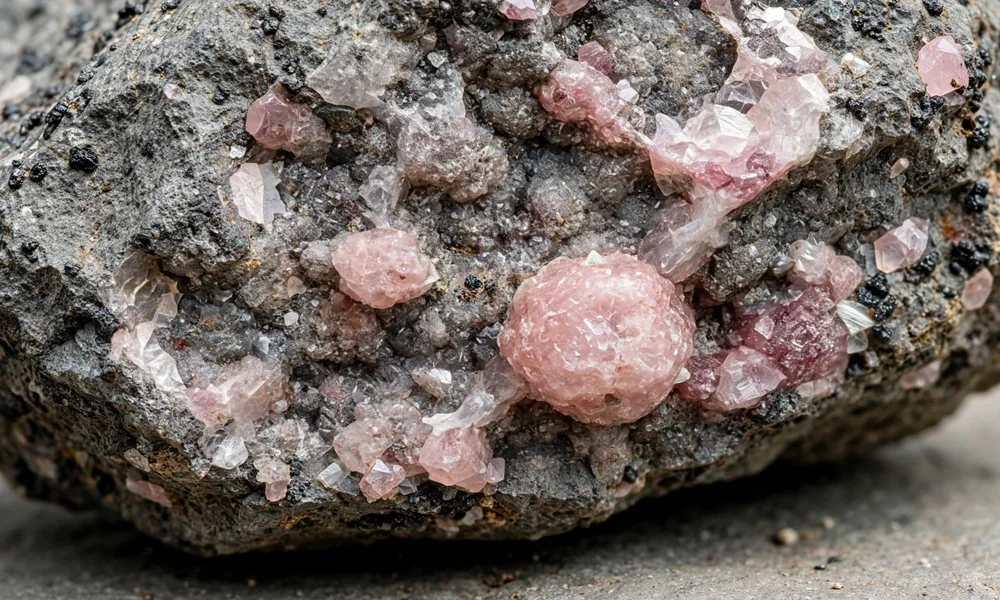
Tugtupite belongs to the feldspathoid family, minerals that crystallise where the ground holds too little silica for quartz to form. It grows in the Ilimaussaq complex of south-west Greenland, a cold, rocky place famous among collectors for minerals found almost nowhere else. The crystals are usually small and blocky, tucked into dark rock beside other rare minerals.
The colour runs from a pale blush through soft rose to a deeper raspberry pink, and it can shift with the light: some pieces look stronger in warm lamplight and paler in daylight. The mineral was named for Tugtup, the Greenlandic name of the place where it was first found.
Tugtupite and Sodalite
Sodalite deep blue for quiet study is about a royal blue stone with pale calcite lines running through it, kept on a desk through silent evenings of reading. Its blue is deep and steady, the colour of dusk just after the sun has gone.
The two minerals share a family, the sodalite group of feldspathoids, yet their looks sit far apart. Sodalite is royal blue with white lines running through it, while tugtupite is soft pink without a single vein, and where sodalite is polished into smooth desk pieces for study, tugtupite is kept as a small pink stone for slow, tender hours. The journal holds a second sodalite guide too, a focus-stones piece built around timed work blocks, and tugtupite suits a different pace: no timer, no task, only looking.
Tugtupite and Afghanite
The complete guide to afghanite is about a soft blue feldspathoid grown as pale blue prisms in dark rock, from a far valley in Afghanistan. Its blue is the blue of a morning sky, even and gentle.
Afghanite and tugtupite share the same mineral family and the same habit of growing in dark rock, yet their colours could not be further apart. Afghanite is pale sky blue with no veining, tugtupite is soft pink with no veining either, and where afghanite usually stays rough with its prisms still set in the rock, tugtupite is most often seen polished smooth.
Tugtupite and Nosean
The complete guide to nosean is about a blue-grey mineral so uncommon that most people never meet one, its crystals small and set into dark volcanic stone. Its colour stays muted and smoky, grey-blue rather than bright.
Both minerals are rare members of the sodalite group, and both repay slow looking, yet in the hand they could hardly differ more. Nosean keeps its blue-grey quiet and close, its crystals tiny, while tugtupite opens its pink wide, a colour visible from across the room.
Reading the Pink: Shades and Light
Not all tugtupite is the same pink. Some pieces are a pale blush, almost white in bright daylight, while others are a rich rose that holds its colour even in a dim room. For tender days, choose the pink you enjoy looking at, because there is no right shade beyond the one that pleases your eye.
Light changes the stone more than most minerals. A piece can look deeper pink under a warm lamp and paler beside a bright window, and that shifting is part of its charm rather than a flaw. Keep it out of strong sun all the same, since long bright light can fade the pink.
How to Choose a Tugtupite Piece
Hold the piece up near a bright window before deciding, and roll it gently in your fingers so the daylight moves across every face. A good piece shows pink of one even tone, its edges clean and its surface free of pale, worn-looking patches. Ask where it was collected before you pay. Leave the stone behind if the seller begins promising health benefits or cures, since no honest seller makes those claims.
A Tender Afternoon with Tugtupite
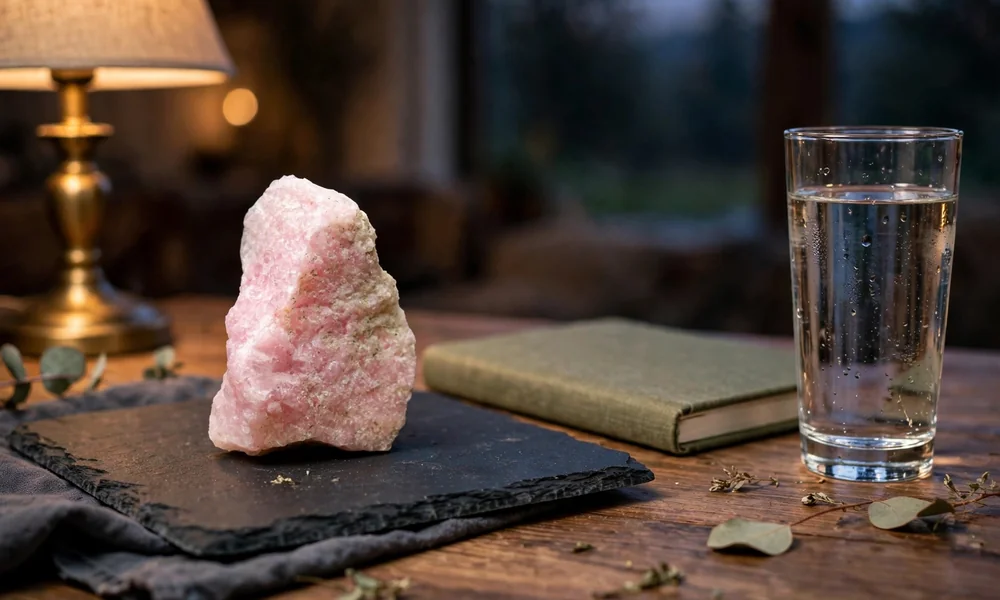
Start by opening the garden door and letting the afternoon air into the quiet room. Lay a folded grey cloth over the low table by the door, set the tugtupite where the soft light reaches it, and stand a tall glass of water at the far end of the cloth, with bare fabric between them.
Fill the glass, sip it slowly as the light moves, and lift the stone once to turn it in your hand and watch the pink deepen and pale.
Tugtupite Beside Water
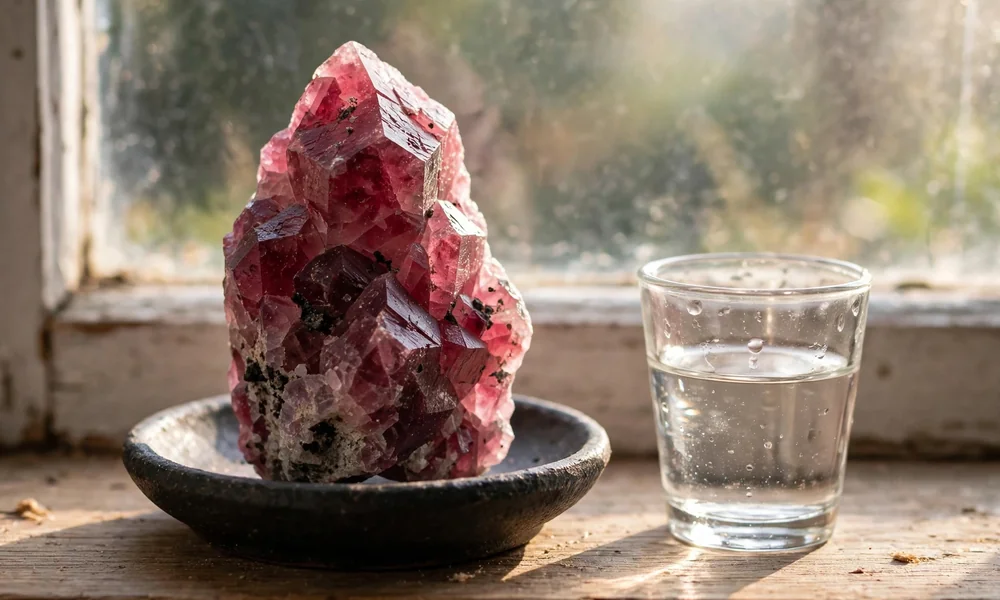
One cloth can hold both the water and the tugtupite, so long as the two never touch. Set the glass down at the cloth's far edge and the stone at the near one, leaving bare fabric in the middle to catch drips. Never run the stone under a tap, and never drop it into a glass: a wet stone is slippery, and a dropped piece chips.
A dry brush once a week is the whole cleaning routine, and tugtupite is never soaked.
Tugtupite at a Glance
| Soft pink stone | Dry tray, daylight | Hands washed after |
|---|---|---|
| Sodalite group | Tender days, slow hours | Glass kept apart |
| Greenland mineral | One small piece | Keep it dry |
| Colour shifts in light | Cloth, wood, shelf | Out of strong sun |
Tugtupite Among the Other Stones in This Batch
This batch holds nine more guides besides this one, and no two of them walk the same path. Rutile is warm gold and bright, a stone for bright days, while triphane is warm yellow in the same bright mood. Chloritoid is deep grey for quiet days, and lithium quartz is soft violet, also for quiet days.
The water guides in this batch are just as varied: a silver polish guide with five ways to shine, a car wash guide for beginners, and a linen spray guide for fresh rooms. The hand soak guide dips hands into a small bowl of plain water and leaves them there to soak gently, while the scalp rinse guide tips water over hair and scalp instead — pouring, not soaking.
Where Tugtupite Rests at Home
Give it a spot out of the daily traffic — a quiet shelf, a sideboard end, or a cupboard top. Keep it far from taps, kettles and steam, away from small hands and pets, and out of strong sun.
For a journey, nestle it in soft tissue inside a hard box of its own, so it cannot roll against anything harder.
Stones That Must Never Touch Water
Which stones does water spoil? The answer is longer than most people expect, and it is worth learning before any stone comes near a glass. Pyrite is one: leave it damp and it rusts, dulling to a brown crust that never polishes away. Apatite is another, since a soak wears its smooth face thin and leaves it rough.
Then there are the stones that carry something unwelcome inside them. Inside lepidolite's flakes sits lithium, which has no business near any cup or jug, and malachite must never go in water or elixirs at all. Hematite never belongs in drinking water either. Amber is hardened tree resin, and a soak turns it milky for good, while angelite drinks in water and comes out cloudy, its polish gone. Tugtupite takes the same dry treatment.
Your Tender Days Checklist
- Lay the tugtupite on a dry cloth, pink side to the light, glass a hand-span away.
- Sip the water slowly, a little at a time, as the afternoon moves on.
- Lift the piece once and watch the pink deepen in lamplight.
- Set the stone back on its cloth, then wash your hands with soap.
- Buy from a seller who names the find spot in plain words.
- For a health question, a doctor is the person to ask — a pink stone cannot answer it.

Frequently Asked Questions
What exactly is tugtupite?
Tugtupite is a soft pink feldspathoid mineral from Greenland, in the sodalite group, grown as small crystals in dark rock low in silica.
Why does tugtupite change colour in light?
Its pink looks deeper under warm lamplight and paler in bright daylight, because the colour responds to the light falling on it, and the shift is part of its charm.
How is tugtupite different from sodalite?
Sodalite is deep royal blue with pale veins running through it, sold polished for study, while tugtupite is soft pink without veins, kept for slow, tender hours.
Can tugtupite go in drinking water?
No, never. Tugtupite should never go into drinking water, a soak, or a bath, and it rests on its tray beside a glass, never inside one.
May I pick up tugtupite to look at it closely?
A grown person may lift a small dry piece briefly, study the pink for a moment, then place it back and rinse their hands with soap and water.
Where is the best place for tugtupite at home?
Give it a dry place in soft light, like a high shelf or a sideboard end, far from taps, steam, small hands and pets, and out of strong sun.
The Bottom Line
Soft pink, kept dry, and a glass standing clear of it: tugtupite asks for little else on a tender day.
A Note for Tender Days
Pink stone, clear water, and an afternoon free of errands — that is all tugtupite needs, and it is plenty.


