
Some days arrive quietly, without any fanfare at all. The light is pale, the house is still, and you move a little more slowly than usual, as though the day itself were asking you to be gentle with it. Those are tender days, and they call for soft colours rather than bright ones.
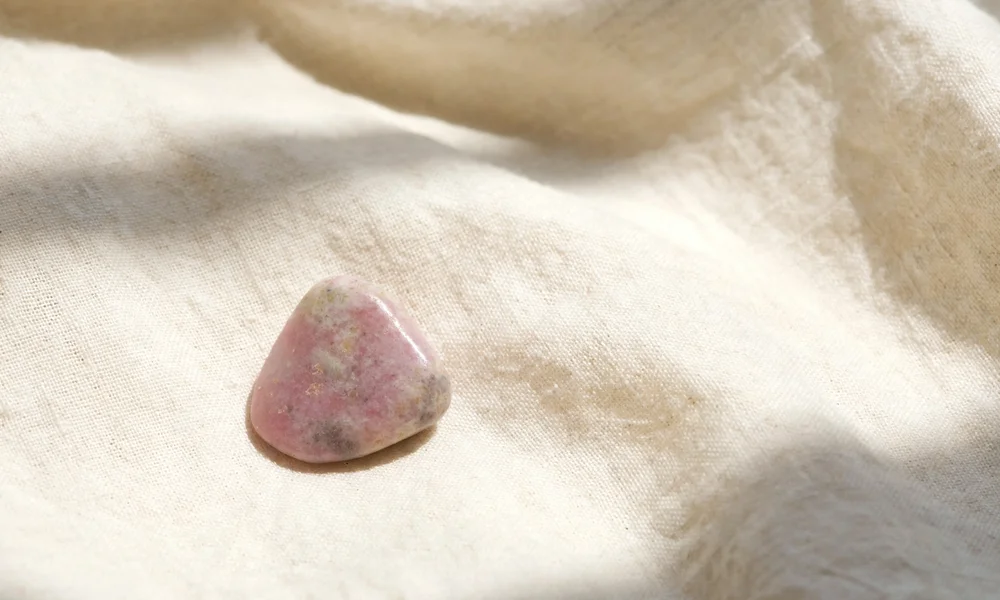
Thulite answers that call with a dusty rose pink, the colour of a petal pressed between pages, or of the sky just before the sun has fully risen. It is not a loud pink, and it does not try to catch the eye from across the room. Instead, it sits calmly on its tray, a small patch of warmth you notice when you are near it.
Keep one simple fact in mind as you read. Thulite is a stone to look at and to hold for a moment, never a remedy, and it belongs beside a glass of water, never inside one. It will not change how you feel on its own, but a quiet minute with a soft pink stone and a slow drink of water can be a kind way to begin a tender day.
Key Takeaways
- Thulite is a soft opaque pink zoisite, coloured by manganese.
- Its dusty rose pink suits quiet mornings and unhurried days.
- Thulite differs from tanzanite, ruby zoisite and morganite.
- Thulite is for looking at only: it will not heal anything.
- Rest it on a dry tray with a glass of water nearby, not inside the glass.
What Thulite Is
Thulite is a pink variety of the mineral zoisite, the same mineral family that gives us tanzanite. Its colour comes from manganese held inside the stone, and that small difference turns the usual grey-green zoisite into a warm rose pink, sometimes pale and milky, sometimes deeper, like the inside of a rose petal.
It was first noticed in Norway, and the name recalls Thule, an old name for the far north. The stone is usually cut into smooth palm stones, beads, or small cabochons, because its colour shows best on a soft, rounded surface.
Why Soft Pink Suits Tender Days
Soft pink is the colour of things that do not demand anything. A pale rose does not shout, a blush on a cheek does not insist, and thulite carries that same easy manner onto the tray. On a day when your energy is low, a gentle colour is easier to live with than a vivid one.
A thulite stone beside a glass of water looks as though it belongs there, part of the morning itself, and that quiet belonging is exactly what a tender day needs.
Choosing a Thulite Piece
Choose a thulite piece by looking at it in ordinary daylight, not under a shop lamp. A good piece shows an even rose pink, soft and a little cloudy, with no harsh white patches and no dark cracks running across the surface. The pink should look calm and steady, not painted on.
Keep the piece small. A palm-sized tumbled stone is enough for a tray, and it is easy to pick up, turn over, and set down again without any fuss. Choose a seller who names the stone plainly and says honestly where the stone was found, and leave at once if anyone claims it can improve your health.
A Tender Day with Thulite
Begin a tender day by setting the thulite on its tray in a patch of gentle light, with a glass of fresh water set a little apart, near enough to catch the same light yet never brushing the stone. Take the water in slow sips, and rest your eyes on the pink for a few breaths before the day begins.
Keep the tray somewhere you will notice it as the morning goes on, such as a desk or a bedside table. The stone does nothing by itself: the pause is yours, and the pink is only there to mark it.
Thulite Beside Water
Keep the glass and the stone as tray neighbours, with a clear gap between them. Water stays in its glass, the stone stays dry at its own end, and they never come together, because a drink must stay plain. Even a stone that looks spotless may hold specks of dust and grit that do not belong in a drink.
This rule holds for every stone, and it holds for thulite too. Never drop it into a glass, never leave it to soak, and never use it to stir a drink. If a splash reaches it, wipe it dry at once with a soft cloth, and keep the glass and the stone as neighbours, not as companions in the same water.
Thulite at a Glance
| Soft rose pink | Tender days | Beside water |
|---|---|---|
| Pink zoisite, manganese | Tray, desk, bedside | Never in water |
| Opaque, milky, calm | Morning, quiet afternoons | Dry cloth wipe |
| Palm stone, smooth | Slow sips, soft light | Wash hands after |

Thulite and Tanzanite
Tanzanite is thulite's closest relative, and the two stones share a family but wear very different colours. Tanzanite violet light for evening calm covers a violet-blue zoisite from Tanzania that changes colour as the light changes, turning bluer in daylight and more violet under a warm lamp.
Thulite keeps one colour all day. Its pink does not shift with the lamp, and it does not flash blue from any angle; it stays a steady rose, milky and calm, while tanzanite plays with the light. One is a stone of changing violet evenings, the other a stone of steady pink mornings, and both belong to the same zoisite family.
Thulite and Ruby Zoisite
Ruby zoisite is the bold cousin in the family, and it could hardly look more different from thulite. Ruby zoisite pink green for bold days covers a stone that holds vivid pink-red ruby set inside deep green zoisite, like bright flowers in a small garden, made for days when you want to speak up and be seen.
Thulite holds only one colour, and it is a much quieter one. There is no green in it, no vivid red, no bold contrast, just a single soft pink from edge to edge. Ruby zoisite suits a day of courage; thulite suits a day of rest, and the difference is plain the moment they sit side by side.
Thulite and Morganite
Morganite is another soft pink stone, and it is the one most often confused with thulite. Morganite soft pink beauty for gentle days covers a pale pink beryl, clear and glassy, with light passing through it like sunrise through a thin curtain.
Thulite is opaque where morganite is clear, and milky where morganite is bright. Morganite lets the light travel through it, while thulite holds the light on its surface, soft and even, with no sparkle inside.
Thulite and the Other Pink Stones
Beyond the three nearest neighbours, the pink shelf holds more company. Rose quartz is a pale, milky pink quartz, smooth and cool, and rhodonite is a deeper rose stone with dark veins running through it.
Thulite stands apart from all of them by its family and its finish. None of the others is a pink zoisite, and none of them has quite the same dusty, opaque rose, soft as a petal pressed in a book. That is why it earns its own guide: it is pink, but it is pink in its own quiet way.

Caring for Thulite
Thulite needs only simple care. Store it somewhere dry and cool, in a small box padded with soft cloth, and do not let it rattle loose in a pocket beside keys or coins, since a polished surface marks easily.
Dust it with a dry, soft cloth, never with soap or harsh cleaners, and never leave it sitting in water. A soft dry cloth and a calm hand are all it will ever ask for.
Stones That Must Never Touch Water
Some stones and water simply do not mix, so keep this short list in mind. Start with malachite: it can release substances no drink should hold, so it never goes near a glass or a jug. Hematite is just as strict — keep it away from any water you might drink. Apatite and lepidolite belong here too; lepidolite holds lithium inside it. Finish the list with pyrite, angelite and amber, none of which should sit in a glass, a jug or a soaking bowl. Thulite is softer in character than those, but it still rests next to the glass, never in it, and that boundary applies to each stone in this list.
Your Tender Days Checklist
- Lay the thulite on a dry saucer, a tall glass of water beside it.
- Take the water in slow sips while the quiet morning opens.
- Pick the stone up, look at its pink, then set it down again.
- Keep the stone dry, away from children, food and drinks.
- Buy from a seller who names the stone plainly and honestly.
- A stone heals nothing; lasting worries belong with a doctor.

Frequently Asked Questions
What is thulite?
Thulite is a pink variety of the mineral zoisite, coloured by manganese, and it is usually sold as a smooth polished palm stone. Its colour runs from pale milky rose to a deeper petal pink, and it is opaque rather than clear.
Is thulite the same as tanzanite?
No, although they are cousins. Both are zoisites, but tanzanite is violet-blue and changes colour with the light, while thulite is a steady soft pink that keeps one colour all day.
Can thulite go in drinking water?
No. Never lower it into a glass, leave it soaking, or stir a drink with it. Keep it next to the glass on a dry tray, and wipe it dry at once if a splash reaches it.
How is thulite different from rose quartz?
Rose quartz is a pale pink quartz, glassy and cool, while thulite is a pink zoisite with a dustier, milkier rose. Rose quartz often looks clearer and brighter; thulite looks softer and more opaque.
Will thulite heal anything?
No. It is a lovely mineral to keep on display and enjoy with your eyes, and any calm you feel after a quiet minute comes from the pause you took, not from the stone itself.
Where should I keep thulite at home?
Choose a calm, dry spot — a tray, a desk, or a bedside table — with a glass of water nearby but never touching the stone, and keep it beyond the reach of small children.
The Bottom Line
Thulite brings soft pink calm to tender days: a dusty rose zoisite resting on a dry tray beside a glass of water, admired in quiet minutes and never swallowed.
A Note for Tender Days
Keep the pink gentle, the stone dry, and the morning easy. One small stone, one glass of water, and a few still minutes are enough.


