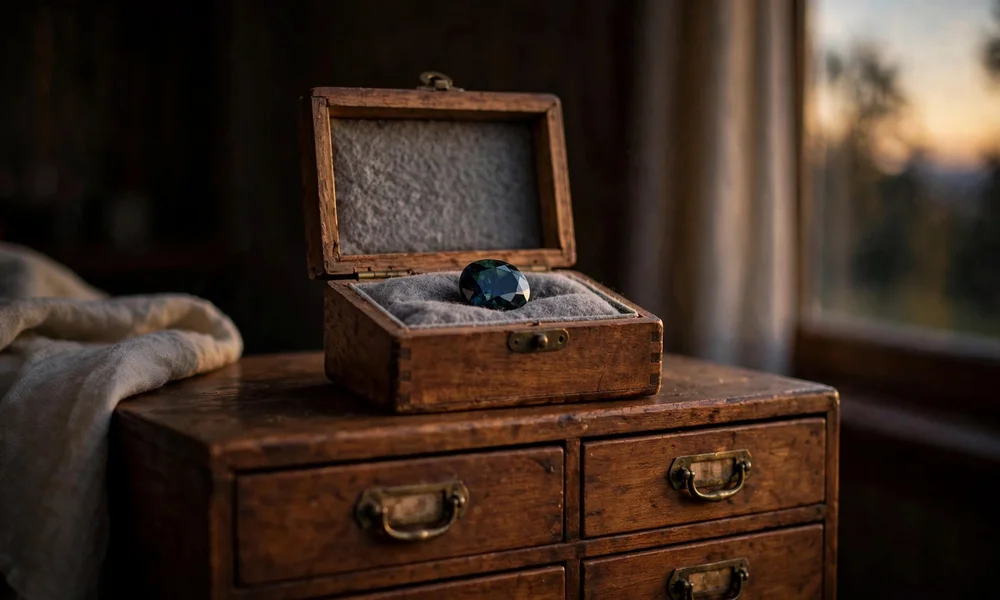
Some afternoons move at the pace of a kettle coming slowly to the boil. The post has been read, the washing is folded, the light across the floor has shifted a hand's width since lunch, and nothing on the day's list is asking to be hurried. Serendibite belongs to afternoons like these. It is a rare deep blue mineral, dark as ink in some lights and green-blue in others.
The stone takes its name from Serendib, an old name for Sri Lanka, the island where it was first recognised. That island link is part of its charm: a mineral found in only a handful of places, usually in small, dark crystals that catch the light quietly.
What follows is a plain look at this uncommon stone: its makeup, how to judge a good piece, the blue stones it keeps company with here, and the simple habit of keeping it dry beside a glass of water. Treat it as something pleasant to see and to hold briefly. It cures nothing.
Key Takeaways
- Serendibite is a rare deep blue borosilicate, dark as ink, sometimes shading toward green at the edges.
- Its deep blue fits calm days, slow afternoons, and hours spent at home without hurry.
- Serendibite is a collector's piece to admire and to hold for a moment; it treats nothing and promises nothing.
- Keep the stone on its own side of the tray, clear of the glass, and dry at all times.
- One small dark piece with a clear blue depth is enough for a whole calm day.
What Serendibite Is
Serendibite is a borosilicate mineral, built from calcium, magnesium and aluminium held together with boron and silicon, and it forms in limestone that has been baked and squeezed by heat deep underground. Good pieces are a deep, inky blue, sometimes shading toward green at the edges.
Most serendibite never reaches a jeweller's window. The crystals are usually small, dark, and cut for collectors rather than set in rings. In the hand it feels cool and weighty for its size, with a glassy surface that takes a polish without ever looking flashy.
Hardness sits around six and a half to seven, firm enough for a tray, soft enough to scratch against a harder gem. That is why a serendibite piece usually lives alone, in its own dish or box.
Why Deep Blue Suits Calm Days
A deep blue stone suits a slow afternoon because blue is the shade of stillness itself. Think of a pond after sunset, the sky once the sun has dropped, the shaded end of a garden in late light: each one is blue, each one is unhurried, and none of them asks anything of the person looking. A calm day runs the same way.
A bright stone would argue with that mood, and a very pale one would vanish against the wall. Deep blue does neither. It gives the eye one place to settle while the kettle boils, and the stone's darkness makes the daylight around it feel softer.
Choosing a Serendibite Piece
Buy serendibite in daylight, away from a shop's bright lamps. Hold the piece near a window and turn it slowly: the blue should hold its depth at every angle, with no grey wash and no chalky pale patches, and a faint green edge is a good sign rather than a flaw. Look for a smooth, unchipped surface, and a shape that sits flat without rocking.
Ask the seller plainly where the piece was found. Sri Lanka is the classic source. Walk away from any piece whose blue looks painted on, any price that treats a collector's mineral like a common pebble, and any seller who promises the stone can change your health.
A Calm Day with Serendibite
The afternoon starts with the tray. Lay a folded dark cloth over the side table, set the serendibite at one end with its best face toward the chair, and stand a tall glass of water at the opposite end, a clear gap of cloth left between them. Drink the water in unhurried mouthfuls while the stone gathers the window light.
Nothing else is required. The cloth, the glass and the stone are the whole plan, and the pause they make is the point.
Serendibite Beside Water
Water and serendibite make easy neighbours on one tray, each keeping to its own side. The tumbler stands on one side, the stone on the other, with an empty stretch of cloth in the middle, so the drink stays clear and the stone never gets wet. Wash your hands with soap after setting the stone down.
The stone never goes into a glass, a jug or a bath, and the tap is not a cleaning tool for it. A soft dry cloth lifts the dust, and nothing else is needed.

Serendibite at a Glance
| Deep blue stone | Calm days | Display only |
|---|---|---|
| Rare, dark blue | Slow hours, rest | Beside water only |
| Hard, cool feel | Desk, tray, shelf | Never soak it |
| Inky blue-green | Water, light, pause | Dust dry weekly |
Serendibite and Blue Sapphire
Blue sapphire for calm days is a classic deep blue corundum, faceted and bright, the stone most people picture when they hear the word sapphire.
Serendibite parts company with it at first touch. Sapphire is a corundum, hard and bright, cut to sparkle; serendibite is a borosilicate, dark and quiet, rarely faceted at all, and its blue runs deeper and greener than sapphire's clean cornflower tone. Sapphire is the stone most people picture when they hear the word blue; serendibite is one most people have never heard of.
Serendibite and Blue Topaz
Blue topaz for bright days is a clear, cool blue stone, the colour of a bright sky over clean water, smooth and glassy in the hand.
Serendibite is the opposite end of the blue scale. Topaz is pale and open, a sky-blue stone for bright days; serendibite is dark and close, an ink-blue stone for calm ones. Topaz flashes from every face, while serendibite holds its colour deep inside, and most shops never stock it.
Serendibite and Lapis Lazuli
Lapis lazuli for quiet evenings is a deep blue rock flecked with gold, the colour of the sky as the first stars appear, smooth and cool.
Serendibite shares the deep blue and the quiet mood, yet the two stones are built differently. Lapis is a rock, a mixture of lazurite with golden pyrite flecks and white calcite veins; serendibite is a single mineral, with no gold in it and no white veins at all. Lapis belongs to the evening; serendibite belongs to the calm afternoon.
Serendibite Among the Other Stones in This Batch
Four more minerals share this batch with serendibite, and each one wears a different colour. Marcasite is a warm gold mineral with a metallic glint, bright where serendibite is dark. Pyromorphite is a warm green stone, vivid and fresh, far from serendibite's deep blue. Sillimanite is a clear white mineral, pale and quiet, the opposite end of the scale. Taaffeite is a soft violet stone, gentle and rare, yet lighter and cooler than serendibite's inky blue.
Where Serendibite Sits at Home
Serendibite does best in a place that stays put and stays dry: the corner of a desk you rarely knock, a high shelf in the living room, or the top of a dresser left open to the light. Pick somewhere the morning sun can reach it, well away from taps, kettles and bathroom steam, and out of the way of small hands.
Once a week, run a soft, dry cloth over it to lift the dust. Between viewings, let it rest alone in a small lined box, clear of keys, coins and harder stones that might mark it.

Stones That Must Stay Away from Water
Not every mineral is as easygoing as serendibite, and a few are frankly unfriendly to water. Start with the green one: malachite's bands carry copper, and copper belongs nowhere near a mouth, so keep that stone far from jugs, tumblers and cooking pots. Hematite is another to watch — let it sit damp and rust creeps in, staining fingers and fabric, so it never goes near a drink either.
Then there are the crumblers and clouders. Apatite softens and breaks apart after a soak, pyrite sheds and dulls in damp air, and lepidolite carries lithium in its pale layers, which rules it out of any drink. Angelite loses its shine once it has been wet, and amber, hardened tree sap, turns milky when it is left to soak. None of them should come near food or drink, and serendibite follows the same rule: on the tray next to the glass, never inside it.
Your Calm Days Checklist
- Lay the serendibite on a dry cloth, with the tumbler a good hand's width away.
- Sip the water slowly, a mouthful at a time, while the stone catches the light.
- Pick the stone up, turn it once, and watch the blue shift toward green.
- Put the piece back on its tray and wash your hands with soap.
- Buy only from a seller who can say where the stone came from.
- For any health worry, see a doctor — a dark blue stone has no answers.
Cloth, glass, dry tray, one dark blue stone: the whole habit takes under a minute each morning.

Frequently Asked Questions
What exactly is serendibite?
Serendibite is a rare borosilicate mineral of calcium, magnesium and aluminium, found in only a handful of places, and its best pieces are deep, inky blue, sometimes shading toward green.
How can I tell a genuine serendibite from an imitation?
Look for a deep blue that holds at every angle in daylight, a faint green edge, a cool heavy feel, and a smooth unchipped surface.
How does serendibite differ from blue sapphire?
Blue sapphire is a bright faceted corundum, hard and sparkling, while serendibite is a darker, quieter borosilicate, rarely faceted, with a deeper and greener blue.
Can serendibite go into drinking water?
No. Keep serendibite away from drinking water, away from soaks, and away from baths. It rests on the tray next to the glass, never inside it, and a soft dry cloth is the only cleaning it needs.
Is serendibite safe to hold for a while?
Most adults can hold a small polished piece for a short while without trouble; just wash your hands after you set it down.
Where is the best place to keep serendibite at home?
Any dry corner with gentle light will do — a dresser top, a bookshelf edge, or the far end of a work table — as long as taps, kettles and little hands stay well away.
The Bottom Line
A calm day needs little more than this: one rare deep blue stone on its tray, a glass of water standing close, and the stone kept dry.
A Note for Calm Days
Dark blue stone, full glass, dry tray — that is all a calm day asks for.