A collector can spend years hunting pink stones and never once meet poudretteite in person. It surfaced only in the late twentieth century, in a single Canadian quarry, and it has stayed scarce ever since: a pale pink crystal that most shops have never stocked.
Slow days are where it belongs. When the house is calm and the list for the day is short, a pale pink stone earns its place on the tray, beside a glass of water, in soft light. It asks for no ceremony and no fuss, only a dry spot and a little care.
What follows is a plain, full account of the stone: its mineral family and its Canadian home, the pink cousins it gets mistaken for, the marks of a sound specimen, and the dry corner where it lives at home.
Key Takeaways
- Poudretteite is a scarce pink borosilicate mineral, recognised in Canada in 1987.
- Its pale pink suits slow, tender days and quiet hours at home.
- It is a pretty object to look at and hold, not a remedy for anything.
- Keep it on the dry side of the tray; the glass stays separate.
- A single small specimen is plenty for a tender day.
What Poudretteite Is
Mineralogists place poudretteite among the borosilicates, a family built from boron and silicon joined with oxygen, potassium and sodium, with a trace of manganese giving it the pink. Its crystals take the hexagonal form: small prisms, often no longer than a fingernail, in shades from almost colourless blush to a soft rose. Held to a lamp, a cut piece can shine like rose water in a glass, which explains why sellers have confused it with pink beryl for years.
The quarry that gave the stone its name sits at Mont Saint-Hilaire, in Quebec, where the Poudrette family worked the rock. The first description dates to 1987, and most good specimens still come from that one hillside, with a smaller supply later found in Myanmar.
At about 5 on the Mohs scale, poudretteite is a soft gem. It scratches with little effort, so a shelf suits it far better than a ring worn daily. Like every stone in this journal, it is a lovely thing to own and look at — it will not cure, calm, or fix anything, whatever a seller may claim.
Why Soft Pink Suits Tender Days
Some colours push you to move faster, and some let you rest. Pale pink belongs to the second group: it is warm without being loud, and it sits easily beside linen, pale wood, and clear glass. On a low-energy day, a loud colour feels like noise, while a quiet pink feels like company.
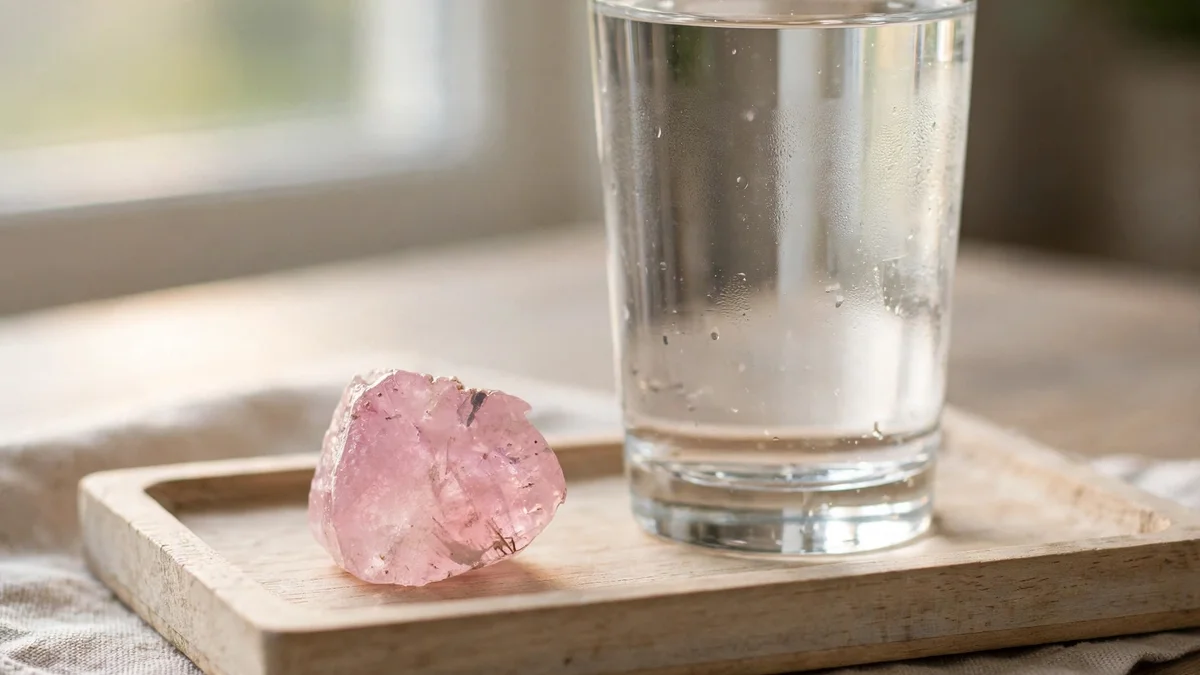
A glass of water beside the stone completes the picture. The two make a small still life on the tray — pink crystal, clear water, morning light. That is the whole point of a tender day: less to do, more room to breathe, and one small beautiful thing to look at.
Poudretteite and Morganite: A Borosilicate Beside a Beryl
The morganite guide in this journal describes a petal-pale beryl, tinted by manganese, that many people wear as a first pink stone. The two share a colour and a gentle reputation, yet their chemistry could hardly be further apart: one is a beryl, a cousin of emerald and aquamarine, and the other is a borosilicate.
Hardness tells the story in one number. Morganite measures 7.5 to 8, hard enough for a pendant worn every day, and it turns up in shops in Brazil, Madagascar, and California. Poudretteite measures about 5, scratches easily, and comes mostly from a single Canadian hillside.
As for water, the rule is the same for both: neither goes into a glass. Morganite carries beryllium, which has no place near a drink, and poudretteite is too soft and too scarce to risk near any liquid. Beside the glass, both are fine.
Choosing a Poudretteite Piece
Daylight is your best tool when you shop for this stone. Take the piece to a window, or step outside with it, and judge the pink there, away from shop lamps that flatter everything. A sound piece carries one even blush across its faces, without grey patches, cloudy streaks, or a crack through the middle.
Size matters less than condition. A thumbnail-sized piece is normal — large ones are rare and dear — so do not pay extra for size alone. Ask where the piece was dug and whether it has been tested, and leave the shop if the seller starts promising better sleep or calmer nerves. A straight answer about the quarry is worth more than a story.
A Tender Morning with Poudretteite
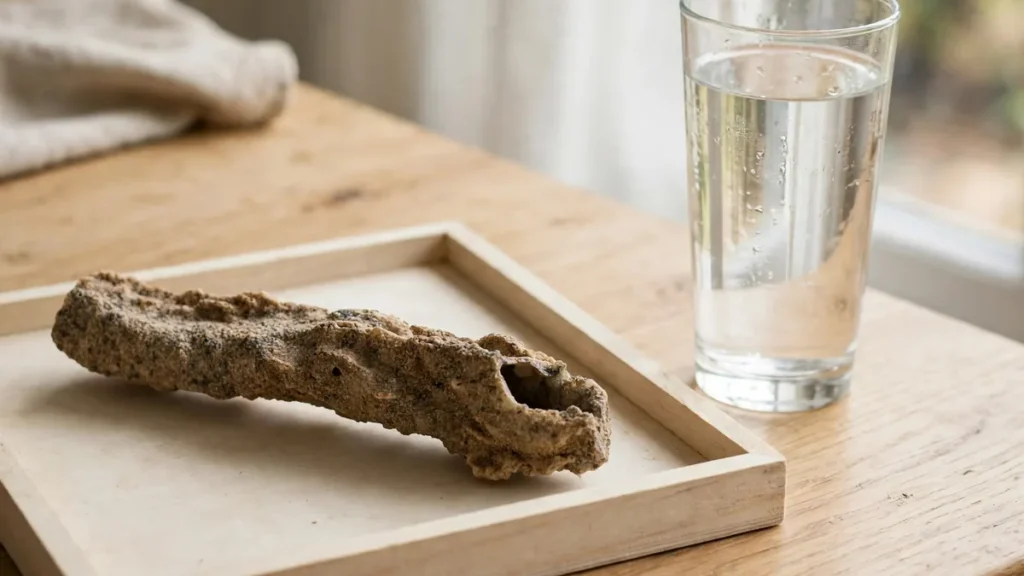
Clear a corner of the dressing table before the day begins. Lay down a small wooden tray, set the poudretteite near one edge, and pour a tall glass of water to stand on the other side. A folded cloth under the stone keeps it from sliding.
Spend a few minutes with the arrangement: drink the water slowly, turn the stone once in the light, and let the morning arrive without rushing it.
Poudretteite Beside Water
A shared tray works only when the two halves stay separate. Give the glass its own half and the stone its own half, with a hand's width of bare wood between them.
Keep it out of every vessel that holds water — glasses, jugs, baths, and taps alike. A soak would dull the pink and put an irreplaceable specimen at risk. A soft dry cloth once a week is enough.

Poudretteite at a Glance
| Soft pink borosilicate | Tray, shelf, desk | Dry hands only |
|---|---|---|
| Small hexagonal prisms | Tender days, slow hours | Glass kept apart |
| Rare, Canada origin | One small accent | Keep it dry |
| Thumbnail-sized piece | Wood, cloth, lamplight | Wipe dry weekly |
Poudretteite and Pezzottaite: Two Rare Pinks, Two Different Families
The pezzottaite guide in this journal covers a raspberry pink beryl from Madagascar, coloured by caesium as well as manganese and described only in 2003. Side by side, the difference is plain: pezzottaite is deep and jewel-like, while poudretteite is a paler rose, sometimes fading almost to clear.
Their families differ too. Pezzottaite belongs to the beryls and measures 7.5 to 8, hard enough to wear, while poudretteite belongs to the borosilicates and measures about 5. One comes mainly from Madagascar, the other mainly from Canada, and both are scarce enough that many collectors have seen neither.
Poudretteite and Thulite: Pale Pink Crystal, Dusty Rose Zoisite
The thulite guide in this journal describes a dusty rose zoisite, opaque and milky, often cut into smooth palm stones and beads. Thulite is the everyday pink of the pair: common, affordable, and easy to find in any crystal shop.
Poudretteite could hardly be more different in feel. It is clearer and brighter, and it usually appears as a small faceted gem or a rough crystal that a shop may never have stocked. If thulite is the pink you reach for daily, poudretteite is the pink you keep for looking at.
Poudretteite Among the Other Stones in This Batch
Four other minerals share this batch, and none of them is pink. Crocoite brings a warm orange brightness, ammonite brings an ancient warm brown, chalcopyrite brings warm gold, and lazurite brings a deep, calm blue. Against that spread, poudretteite is the only soft pink note.
On the water side, this batch offers a window box for plants, a clay bowl for beginners, a ceramic mug for morning drinks, and a hair clip for a fresh look.
Where Poudretteite Rests at Home
A high shelf in the bedroom does the job well, or the far end of a dressing table where elbows never reach. The spot should be dry, shaded from strong sun, and away from the bathroom, where steam drifts all day.
Once a week, lift the stone and wipe it with a dry soft cloth. When you travel, wrap it alone in a soft pouch, apart from keys, coins, and harder stones, since a mineral this soft picks up scratches from almost anything.

Stones That Must Never Touch Water
Other minerals carry a sterner warning than poudretteite, and a collector does well to learn their names. Inside malachite's green bands sits copper, a metal that must stay far from anything you drink. Hematite, left damp, can rust and stain skin and cloth.
Apatite is another one to keep dry: soak it and it softens until it crumbles in your hand. Angelite clouds over when it is damp and never quite regains its shine. Lepidolite hides lithium in its pale lilac flakes, and lithium belongs nowhere near a drink. Amber, old tree sap grown hard, turns milky in a soak. Poudretteite deserves the same treatment — a dry tray, a glass at a safe distance, and nothing the stone touches ever reaching your cup.
Your Tender Days Checklist
- Wipe the tray dry before the stone goes on it.
- Pour a glass of water and drink it slowly.
- Lift the stone into the light and turn it once.
- Put it back on the tray, then wash and dry your hands.
- Buy only from a seller who names the quarry.
- See a doctor about health worries; a stone cannot help there.
A dry tray, a full glass, and one small pink stone — that is the whole list.

Frequently Asked Questions
What exactly is poudretteite?
It is a scarce pink borosilicate, first described in 1987 from the Poudrette quarry at Mont Saint-Hilaire in Quebec, Canada.
How is poudretteite different from morganite?
Morganite is a beryl, hard enough at 7.5 to 8 to wear every day. Poudretteite is a borosilicate, soft at about 5, far rarer, and best kept as a single treasured piece on a shelf.
Can I put poudretteite in water?
No. Soaking takes the life out of its soft pink and endangers a specimen that cannot be replaced, so the stone stays beside the glass and the water stays in the glass.
How do I spot a good poudretteite piece?
Judge it in daylight, away from shop lamps. A good piece shows one even blush and no cracks, and its seller can say plainly where it was dug.
Can I hold poudretteite in my hand?
Most adults can lift a small dry piece for a moment, then wash their hands after setting it back. Handle it gently — at hardness 5, it scratches easily.
Where should poudretteite live at home?
A dry, shaded spot suits it, such as a high bedroom shelf or a dressing table end, where steam cannot reach it.

The Bottom Line
One rare pink stone, dry on its tray, and water that never leaves its glass: that is the whole of this guide.
A Note for Tender Days
A pink stone, a glass of water, and a slow morning — keep those three apart in the right way, and the day looks after itself.