
Some stones arrive with a long history and a shelf full of cousins. Musgravite arrives with almost none. It is one of the rarest gemstones on earth, a soft violet mineral that most collectors only ever read about, and a piece small enough to sit on a fingertip can still hold a whole quiet afternoon of looking. Its colour is a muted lilac-grey violet, the shade of dusk settling over dry hills.
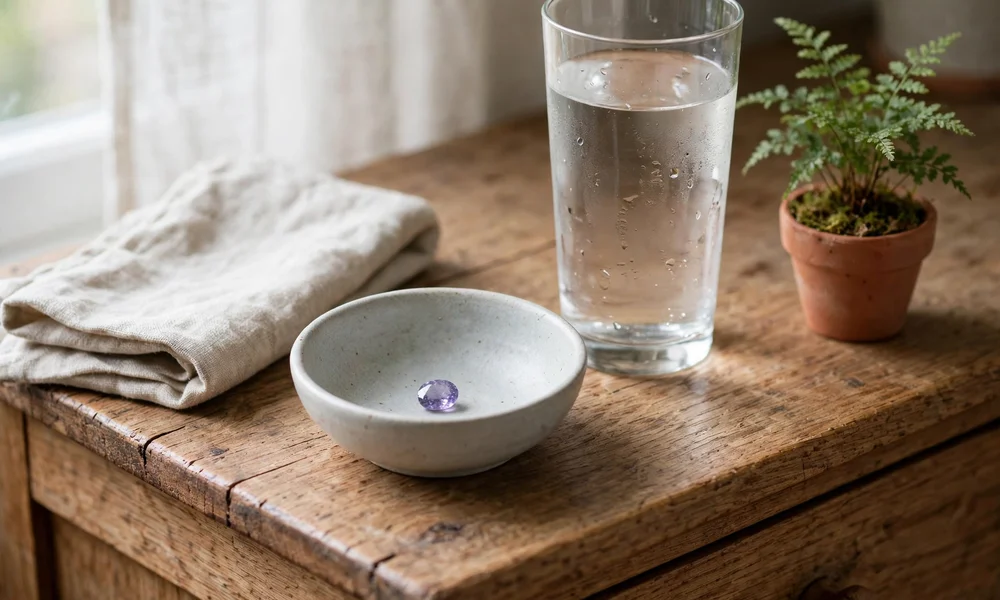
A day with nothing planned suits a stone like this. There is no rush to it, no bright flash to catch the eye from across the room, only a small violet stone on a pale tray and a glass of water beside it. Pour the water, set the tray where the morning light can reach it, and let the stone be the one small thing you notice slowly.
Musgravite will not change your day, and this guide will not pretend otherwise. It is a beautiful rarity to look at and hold for a short while, never a remedy, never a treatment, and it will never go into a drink.
Key Takeaways
- Musgravite is a very rare soft violet stone, a beryllium aluminium oxide from the Musgrave Ranges.
- Its muted lilac-grey violet suits quiet days, slow mornings, and rooms kept calm and tidy.
- The stone is for looking at and holding briefly; it heals nothing and promises nothing.
- Leave the stone dry on its tray, out of the glass, and clean your hands after you set it down.
- Small polished pieces are the usual way to enjoy musgravite, and a plain tray is all it needs.
What Musgravite Is
Musgravite is a beryllium aluminium oxide, a close cousin of taaffeite, and it is counted among the rarest gemstones known. It was first found in the Musgrave Ranges of South Australia in 1967, which is where its name comes from, and only a handful of gem-quality pieces have ever been cut. Later finds in Madagascar, Greenland, and Antarctica added a few more stones, but the total remains tiny, and most pieces sold today are small faceted gems rather than rough crystals.
The colour runs from greyish green to greyish violet, and the soft violet pieces are the ones this guide follows. Hold one in daylight and the violet sits quietly inside a grey lilac body, never bright, never flat, with a gentle glow when the light strikes a facet. It is a hard stone, around eight to eight and a half on the Mohs scale, so a polished piece keeps its shine with ordinary care.
Picking a Musgravite Piece
Choosing a musgravite piece starts with honesty about rarity, because a genuine stone is scarce and costly, and many violet stones are sold under grand names. Look at the piece in plain daylight, not under shop lamps, and watch whether the violet stays muted and greyish as you turn it. A colour that looks painted on, or a violet that glows bright pink at the edges, belongs to another stone. Ask the seller where the piece was found and whether a certificate comes with it.

A Quiet Day with Musgravite
A quiet day with musgravite begins with the tray. Spread a folded linen cloth across the dressing table, place the stone toward the front where daylight reaches it, and stand the glass of water at the far end, clear of any elbow. Drink the water in slow sips while the room warms up, and turn the stone once or twice so a new facet catches the light. Shift it to the windowsill for an hour in the afternoon, where sunlight can draw out the violet, and bring it back to its tray before evening.
Musgravite Beside Water
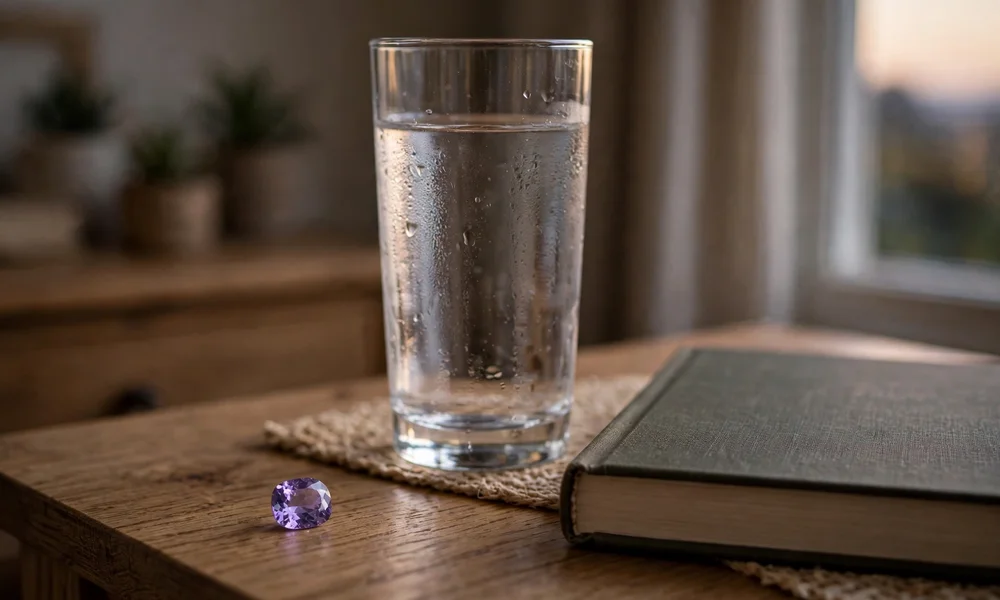
Water and musgravite make a pleasant pair on the tray, yet the two never touch. Put the tumbler at one end and the stone at the other, leaving a bare stretch of wood in the middle. Once you have set the stone down, clean your hands before you lift your drink. The stone goes into no glass, no jug, and no bath, and water is never poured over it for cleaning. A soft dry cloth does the whole job.
Musgravite at a Glance
| Soft violet gem | Pale tray, light | Dry hands only |
|---|---|---|
| Rare, hard stone | Quiet days, calm | Glass kept apart |
| Musgrave Ranges find | One accent, plain | Never in drinks |
| Grey lilac violet | Slow morning light | Never soak stone |
| Small pieces usual | Tidy shelf, tray | Dust dry weekly |

Musgravite and Violet Fluorite
Violet fluorite for quiet days is a pale violet fluorite, a calcium fluoride mineral with soft bands that show as the piece is turned in the light. It is a common stone, sold mostly as smooth tumbled pieces, and it suits unhurried hours in a quiet room.
Musgravite shares the pale violet mood and little else. Violet fluorite is soft, banded, and easy to find, while musgravite is hard, unbanded, and among the rarest stones on earth.
Musgravite and Amethyst
Amethyst for calm nights is a deep purple quartz, rich grape purple and darker at the base, sold as polished pieces or small clusters for the bedside table. It is the best-known violet stone of all, and its colour comes from iron inside the quartz.
Musgravite is no quartz at all. Its violet is muted and greyish where amethyst is deep and grape-like, and its story is scarcity where amethyst is abundance. Amethyst fills whole shelves; musgravite fills a single small dish, and that difference is the point of it.
Musgravite and Tanzanite
Tanzanite violet light for evenings is a violet-blue zoisite from the hills near Mount Kilimanjaro in Tanzania, a stone that shows blue from one angle and violet from another as you turn it in lamplight. It comes from only one place on earth, and its changing colour is its famous quality.
Musgravite changes far less as it turns. It holds one muted grey-violet and keeps it, while tanzanite shifts between blue and violet with every move. Tanzanite is a jeweller's stone with a wide trade, and musgravite is a collector's rarity that few jewellers ever handle.
Musgravite and the Other Violet Stones
Violet wears many outfits on these shelves, and musgravite still stands apart from them all. Charoite is a violet stone with soft lilac swirls like clouds, iolite is violet-blue and changes colour as you turn it, and sugilite is a deep gentle purple manganese stone for quiet evenings. Purple zircon is a soft violet zircon, even and muted like dusk, violet spinel is clear and glassy with bright facets, and spirit quartz grows as a cluster of many tiny soft violet points. Purple jasper, purple chalcedony, purple jade, lavender jade, siberite, and lavender spinel each carry their own shade of violet, yet none of them is as scarce as musgravite.
Musgravite and the Other Stones in This Batch
Four more stones share this batch, and every one of them stands apart from musgravite. Condor agate is a soft banded agate for quiet days, patterned in gentle bands where musgravite is plain and unbanded. Painite is a deep red stone for bold days, red through and through where musgravite is soft violet. Optical calcite is a clear light stone for bright days, colourless and glassy where musgravite holds its muted violet. Purpurite is a deep violet stone for quiet days, darker and richer than the pale grey-violet of musgravite.
Keeping Musgravite at Home
Find musgravite a bright, tidy nook where it can be admired without being bumped: a desk end, a shelf beside the morning window, or a little dish on the drawers. Keep water well away from that nook, so choose a place far from the sink, the kettle, and steamy bathroom air, and high enough that small hands cannot get to it. Each week, wipe the dust away with a soft, dry cloth. When the stone is not on display, lay it by itself in a lined box, clear of keys and harder stones.
Stones That Must Stay Away from Water
Some stones carry something unkind inside them, so the safest habit covers them all: no stone ever touches a drink. Malachite is banded green and rich in copper, a metal that has no place in any glass, so it stays far from jugs and tumblers. Hematite is kept out of drinking water as well, and the same dry rule holds for apatite and pyrite. Lepidolite carries lithium within it, so it is kept dry and far from every drink. Angelite goes cloudy and flat once it has been wetted, while amber, tree sap hardened over ages, turns milky in a soak and belongs nowhere near a drinking glass.
Your Quiet Days Checklist
- Lay the stone on a clean cloth, the glass kept well apart.
- Drink your water slowly, never in any hurry.
- Turn the piece gently and watch its violet move in the daylight.
- Set the stone back on its tray, then rinse your hands.
- Pick a seller who names the mine and the country plainly.
- For any health question, talk to your doctor first — a stone holds no answers for you here.
Frequently Asked Questions
What is musgravite?
Musgravite is a very rare beryllium aluminium oxide, a close cousin of taaffeite, first found in the Musgrave Ranges of South Australia.
Where does musgravite come from?
The first pieces came from the Musgrave Ranges in South Australia, and later finds came from Madagascar, Greenland, and Antarctica.
Why is musgravite so rare?
Only a handful of gem-quality pieces have ever been cut, so most collectors know it by name alone and never see one in person.
How is musgravite different from amethyst?
Amethyst is a common deep purple quartz coloured by iron, while musgravite is a rare muted grey-violet stone and no quartz at all.
Is musgravite safe to hold?
A brief hold of a small polished piece suits nearly everyone, since a dry stone passes nothing to the skin.
Where should I keep musgravite at home?
Choose a dry place with daylight, like a desk end, a window shelf, or a little dish on the drawers, far from water and steam.
The Bottom Line
Musgravite fits quiet days: a rare soft violet stone, a glass of water nearby, and the stone kept dry on its tray.
A Note for Quiet Days
One rare violet stone, a full glass, a dry tray — a quiet day asks for nothing more.


