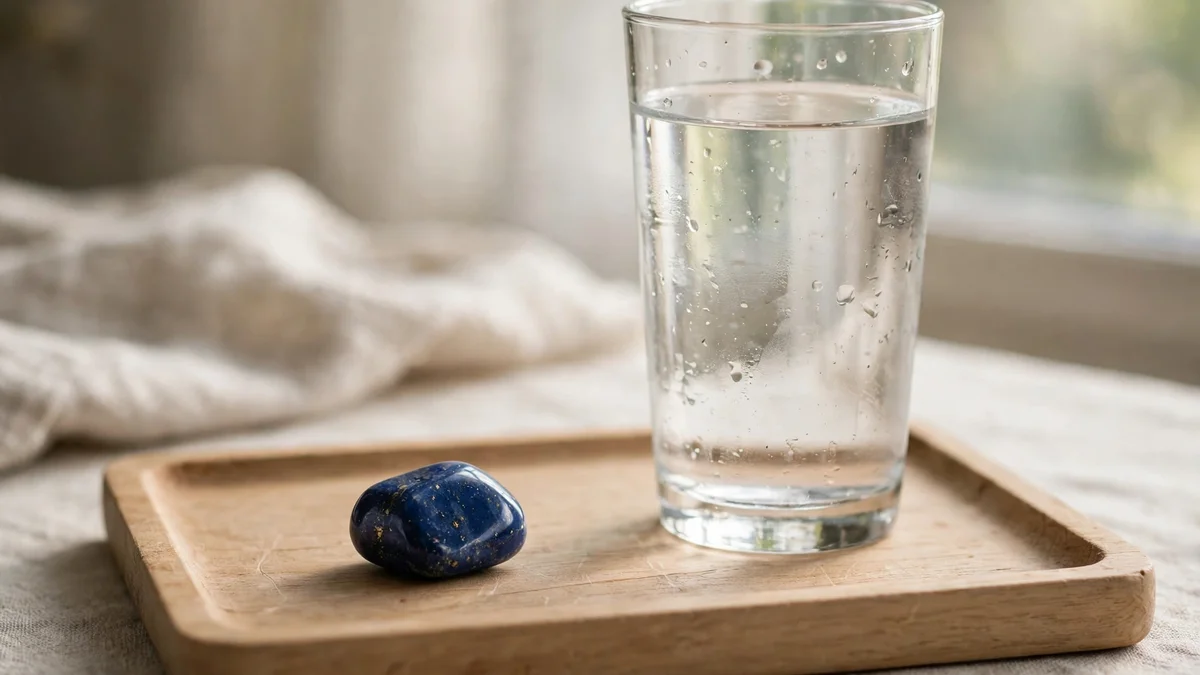
Some minerals are famous under another name, and lazurite is one of them. Most people meet it inside lapis lazuli, the celebrated blue rock of ancient jewellery, without hearing its name. On its own it is quieter: a single deep blue mineral, without the white veins and golden flecks that make lapis lazuli so busy to the eye.
A calm day suits that plainness. Nothing is scheduled to impress anyone, the hours move slowly, and the eye is glad of one steady colour to rest on. A small piece of lazurite gives the room exactly that: a patch of deep blue that stays put, asks for nothing, and looks richer as the light changes.
What follows takes the question at face value. You will find what the mineral is made of, the line between it and lapis lazuli, what to look for when buying a piece, and the spot on a shelf where it can sit next to a drink. Hold it, look at it, enjoy the colour — it promises nothing beyond that.
Key Takeaways
- Lazurite is a single deep blue mineral, the main blue part of lapis lazuli.
- Its plain deep blue suits slow hours, soft light and unhurried rooms.
- Lazurite is an ornament for the eye and the hand; it treats nothing.
- The stone rests beside the glass, never inside it, and stays dry always.
- One small polished piece on a plain tray is enough for a calm day.
What Lazurite Is
Lazurite is a blue feldspathoid mineral, built from sodium, calcium, aluminium, silicon, oxygen and sulphur, the sulphur giving it the rich blue colour. It forms in metamorphic limestone, where heat and pressure reshape the rock, and it usually grows as small grains or rounded masses rather than large crystals.
Good pieces show a strong, even blue, sometimes with a few specks of golden pyrite inside. It is softer than quartz, so cutters polish it gently. It has been dug for thousands of years, mostly in Afghanistan, and the finest material still comes from the mountains there.
Why Deep Blue Suits Calm Days
Blue is the colour of the sky after the sun has gone down and of still water at dusk, and both are moments when the world slows down. A calm day borrows that same slowness: the chores are few, the voices are low, and nobody is in a hurry.
A deep blue stone fits that mood because it never competes with it. It holds the eye for a second and then lets it go, and the room feels more settled for one steady colour in it. Pale stones can fade into daylight, and bright ones demand attention, but lazurite keeps its blue from morning to evening.
Lazurite and Lapis Lazuli: Mineral and Rock
Lapis lazuli deep blue for quiet evenings describes the famous rock: lazurite mixed with golden pyrite flecks and white calcite veins, polished into beads and ornaments for thousands of years. It is the rock most people picture when they hear of a blue stone.
Lazurite is the mineral inside that rock, the part that supplies nearly all of its blue. A piece of pure lazurite looks simpler: one even blue, with perhaps a speck or two of gold, and no white veining at all. If lapis lazuli is a patterned fabric, lazurite is the plain blue cloth it was cut from. Telling them apart is a matter of looking closely.
Choosing a Lazurite Piece
Judge a piece of lazurite in daylight, by a window or outdoors, where its blue shows without shop lamps warming it up. A good piece shows one rich blue from edge to edge, with no grey patches, no chalky white streaks, and no crack through the middle. It should feel smooth under the thumb, with a soft shine, not a dull, dusty face.
Pick a piece about the size of a walnut or a little smaller, one that sits flat without wobbling. Ask the seller where the stone was dug, and walk away from anyone who claims it can calm nerves or improve health. A plain answer about where it came from is worth more than any grand promise.
A Calm Morning with Lazurite
Start the morning by giving the stone a tidy corner. Lay a folded pale cloth on the side table, set the lazurite at one end with its bluest face to the window, and a tall glass of water at the far end.
Drink the water slowly, in small sips, while the room wakes up around you. When the glass is empty, the small ritual is finished, and the piece can stay on the tray for the rest of the day.
Lazurite Beside Water
Set the lazurite on a wide tray with a tall glass of water, but give each its own end of the board. Glass on the left, stone on the right, and a strip of bare wood or folded cloth in the middle keeps every drop off the blue faces and the water clear. Keep it out of every vessel: no tumbler, no jug, no bath, and never under a running tap. A weekly wipe with a soft dry cloth is the whole of its care.

Lazurite at a Glance
| Deep blue mineral | Tray, shelf, desk | Dry hands only |
|---|---|---|
| Feldspathoid, sulphur blue | Calm days, slow hours | Glass kept apart |
| Even blue, gold specks | One small accent | Keep it dry |
| Walnut-sized piece | Wood, cloth, lamplight | Wipe dry weekly |
Lazurite and Hauyne: Two Blue Cousins
Hauyne deep blue for calm days follows a feldspathoid cousin of lazurite, a mineral that forms in volcanic rocks low in silica, carrying a similar bright blue. Hauyne is usually found as small grains in lava, and fine blue crystals are scarce.
The two share a family and a colour, yet their homes could hardly differ: lazurite grows in changed limestone, hauyne in cooled volcanic rock. Hauyne tends toward a brighter, almost electric blue, while lazurite keeps a deeper, duskier tone. Side by side, the difference is plain, even though a first glance might mix them up.
Lazurite and Serendibite: Blue Without Gold
Serendibite deep blue for calm days follows another deep blue mineral that shares lazurite's quiet mood but not its makeup. Serendibite is a rare borate silicate from Sri Lanka, its blue dark and steady, with no gold in it at all.
Lazurite differs in the small details that matter to a collector. Its blue comes from sulphur in its structure, and golden pyrite specks often sit inside it, like stars in a night sky. Serendibite carries neither the sulphur nor the gold, and its crystals grow in a different shape. The two suit the same shelf, and a careful eye will not confuse them.
Lazurite Among the Other Stones in This Batch
This batch holds nine more topics beside lazurite, each wearing a colour far from deep blue. Crocoite is warm orange and bright, where lazurite keeps the colour of evening. Ammonite is warm brown and steady, a fossil's spiral against lazurite's smooth blue. Chalcopyrite is warm gold and shining, the opposite of this quiet mineral. Poudretteite is soft pink and tender, pale beside lazurite.
The nearest water articles are a window box, a clay bowl, a ceramic mug and a hair clip, all fresh rituals of water and household things. Lazurite holds the deep blue corner, the one evening note among oranges, browns, golds and pinks.
Where Lazurite Rests at Home
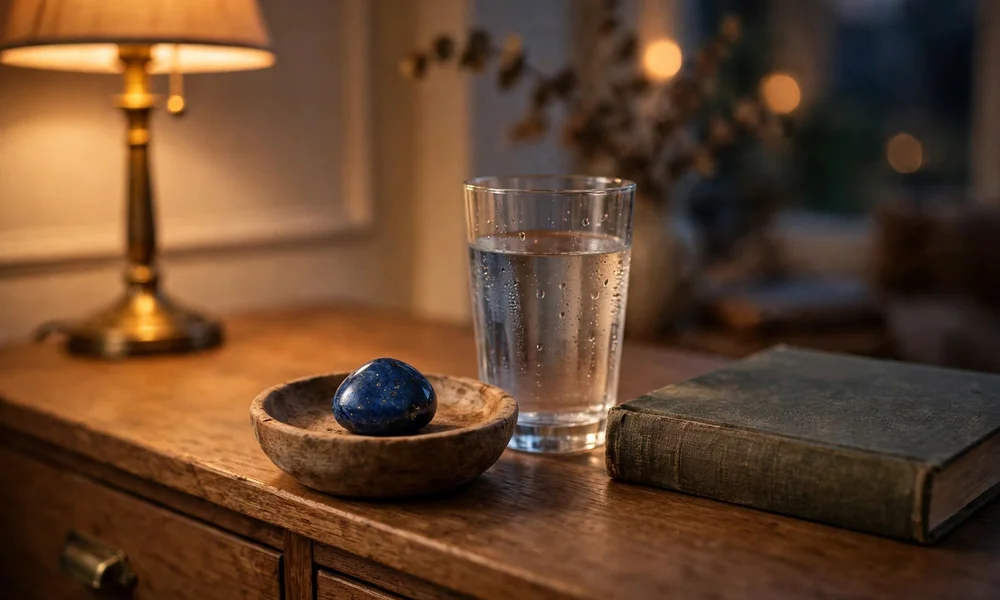
A good home for it is a surface the household walks past without touching: a shelf above eye level, the back of a sideboard, or a corner of the dresser. Steam from kettles and taps should stay well away, and small children should not be able to reach it.
Brush it over with a dry soft cloth each week, and look for any dull film creeping across the blue. When you travel, carry it in its own soft pouch, apart from keys and anything harder that could mark it.
Stones That Must Stay Away from Water
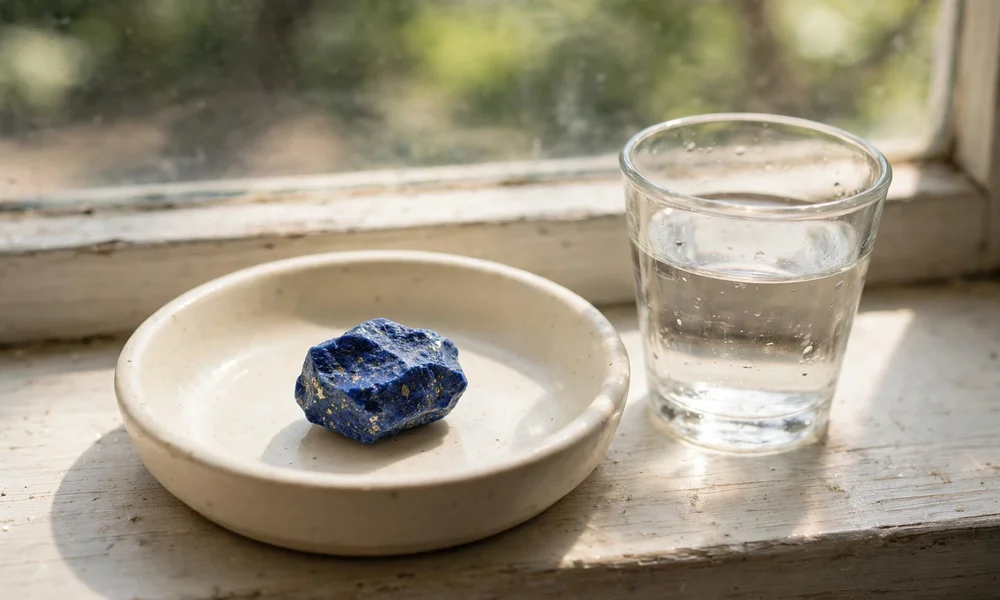
A few minerals deserve a wider berth than lazurite, and knowing their names keeps every shelf safer. Malachite's green bands hold copper, which has no place near a mouth, so that stone belongs on a high, dry shelf, far from every jug. Hematite can stain skin and cloth with rust when it sits wet, so it stays out of drinking water.
Apatite softens and flakes when soaked, and angelite turns cloudy once wet, so both belong where no drop can reach them. Lepidolite's pale flakes hold lithium, so keep every drink well away from that stone. Amber, old tree resin, goes milky when soaked. Lazurite gets the same careful handling: a dry tray, a glass standing close by, and nothing the stone touches ever reaching a cup.
Your Calm Days Checklist
- Lay the lazurite down on a dry cloth, with the glass a good distance away.
- Sip the water slowly, one small mouthful after another.
- Lift the stone and turn its bluest faces toward the daylight.
- Set the piece back on its tray, then wash your hands.
- Choose a seller who says plainly where the stone was dug.
- If a health worry lingers, speak to a doctor — no blue stone can settle it.
Tray, glass, cloth and one small blue stone — nothing else is needed.
Frequently Asked Questions
What is lazurite, in plain words?
Lazurite is a deep blue mineral, coloured by sulphur in its structure, and the main blue part of the rock known as lapis lazuli.
How is lazurite different from lapis lazuli?
Lapis lazuli is a rock made mostly of lazurite, golden pyrite and white calcite, while lazurite is the single blue mineral, plainer and without the white veining.
Can lazurite go into drinking water?
No. Lazurite belongs beside the glass, never inside it, because soaking can dull its blue and puts the stone where it does not belong.
How do I pick a good lazurite piece?
Look for one even deep blue in daylight, no grey patches and no crack, and a seller who says plainly where the piece was found.
Is it all right to hold lazurite for a short while?
Holding a small dry piece briefly is fine for most grown-ups; put it down again and wash your hands afterwards.
Where should lazurite live at home?
Give it a dry place in gentle light, such as a desk corner or a sunny shelf, far from water, steam and small hands.
The Bottom Line
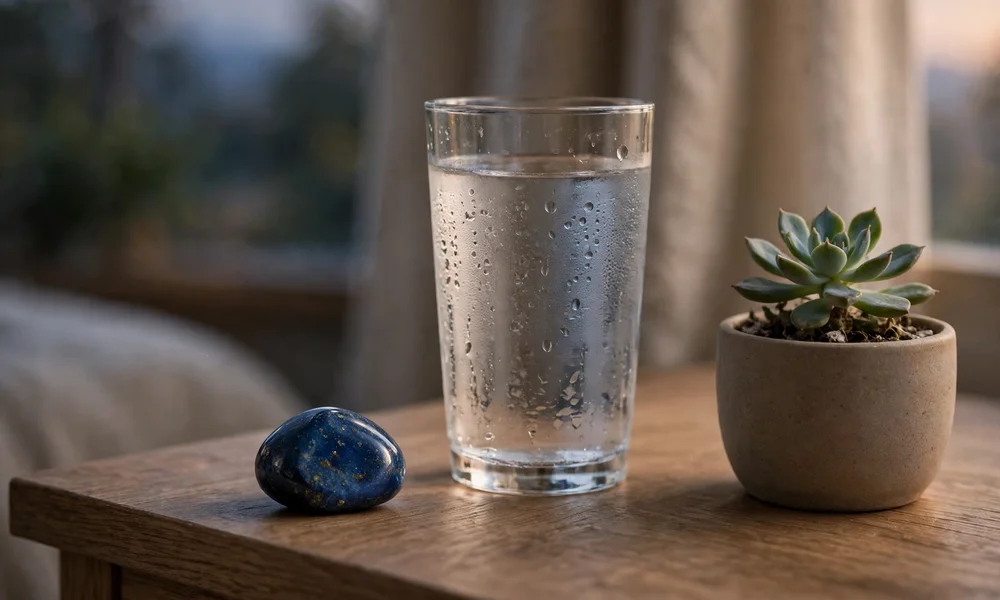
Lazurite asks for very little: a dry tray, a glass kept to itself, and a quiet afternoon to sit through. That covers everything a calm day wants from it.
A Note for Calm Days
That is the whole picture: blue kept dry, water kept in its glass, and an afternoon allowed to drift.


