Some days move at a slower pace from the very first hour, and nothing in the house seems to be in a hurry. The light through the window stays gentle, and the rooms feel quiet.
Jelly opal belongs to days like these. It is a jelly opal, pale and see-through like a spoonful of clear jelly, holding the light inside itself and giving it back as a soft, even glow.
In the pages below, jelly opal gets a close look: the jelly-like body that lets light pass through it, how it differs from each opal this site already writes about, what to check before you buy one, and how to let it sit quietly on a tray beside a glass of water. Enjoy it as a beautiful object; it cures nothing and treats nothing.
Key Takeaways
- Jelly opal is a translucent jelly-like opal, pale and glowing softly in calm light.
- Its soft glow suits calm days, quiet rooms, and slow unhurried hours.
- Jelly opal lets light through it, while common opal is milky and opaque.
- Jelly opal shows no play-of-colour flash, unlike Ethiopian opal and black opal.
- Jelly opal is for looking and holding: dry on a tray, next to water, never inside it.
What Jelly Opal Is
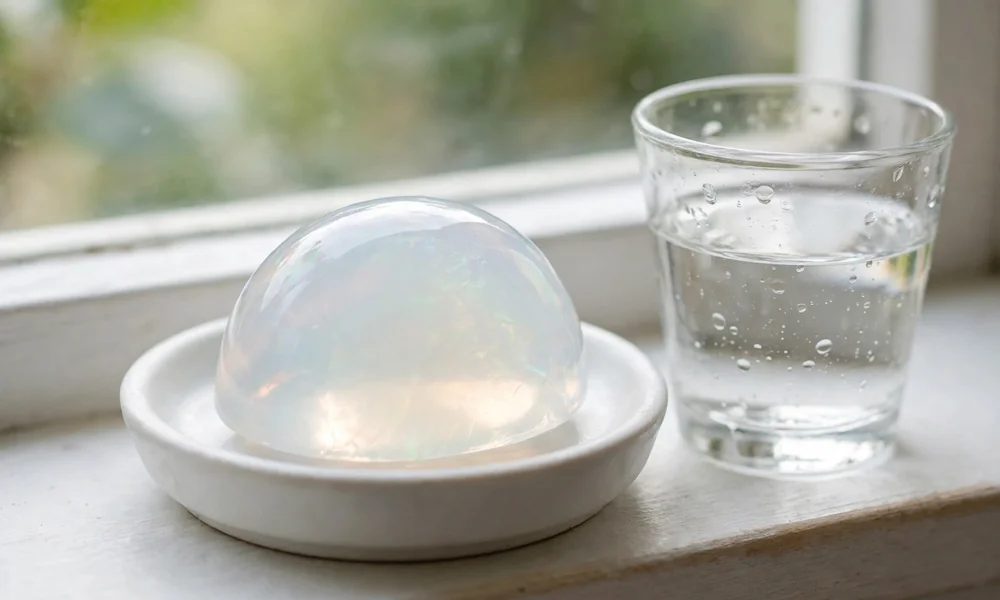
Jelly opal is opal in its jelly-like form, a natural mineral made mostly of silica and water held in tiny spheres too small to see. Those spheres are packed so evenly that light slips through the stone instead of bouncing back in coloured sparks, so it looks like set jelly rather than a milky pebble.
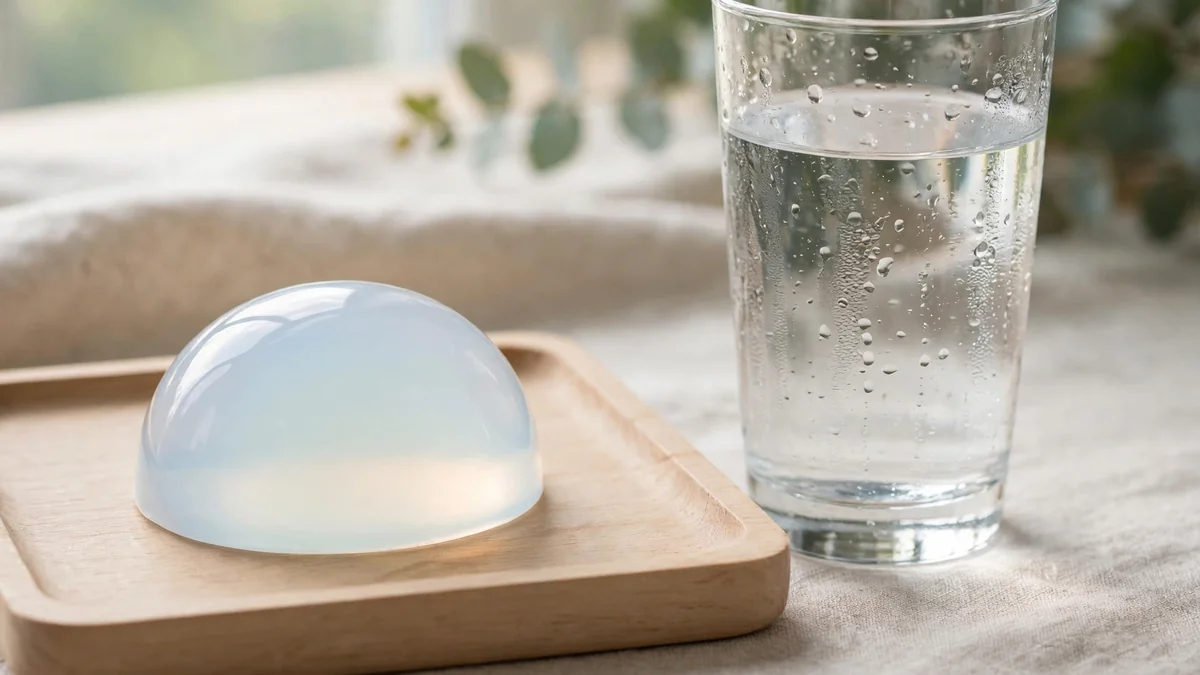
Hold a piece up to a window and you can sense the daylight passing through it, the way light passes through a pale jelly sweet. The edges look soft, the middle looks deep. Turn it slowly and the glow stays steady; no rainbow spark jumps out.
Most pieces are cut as smooth domed cabochons, because the jelly body shows best when the top is rounded.
Why a Soft Glow Suits Calm Days
A calm day has its own kind of light, softer than a bright morning and easier on the eyes. The curtains are half drawn, the room is neither dark nor dazzling, and everything in it looks gentle rather than sharp. A jelly opal on a tray fits that light exactly, because its glow is soft too, never flashing at you from across the room.
Choosing a Jelly Opal Piece
Look for a jelly body that stays clear from edge to edge, with no milky patches, no grey corners, and no dark specks floating inside. Hold the stone up to the light and check that the daylight passes through it evenly; a good jelly opal glows all the way through, while a poor one looks cloudy in the middle. The dome should be smooth, with no flat spots.
Ask the seller to say the words jelly opal out loud, and be wary of any piece offered merely as a pale gem at a steep price.

A Calm Day with Jelly Opal
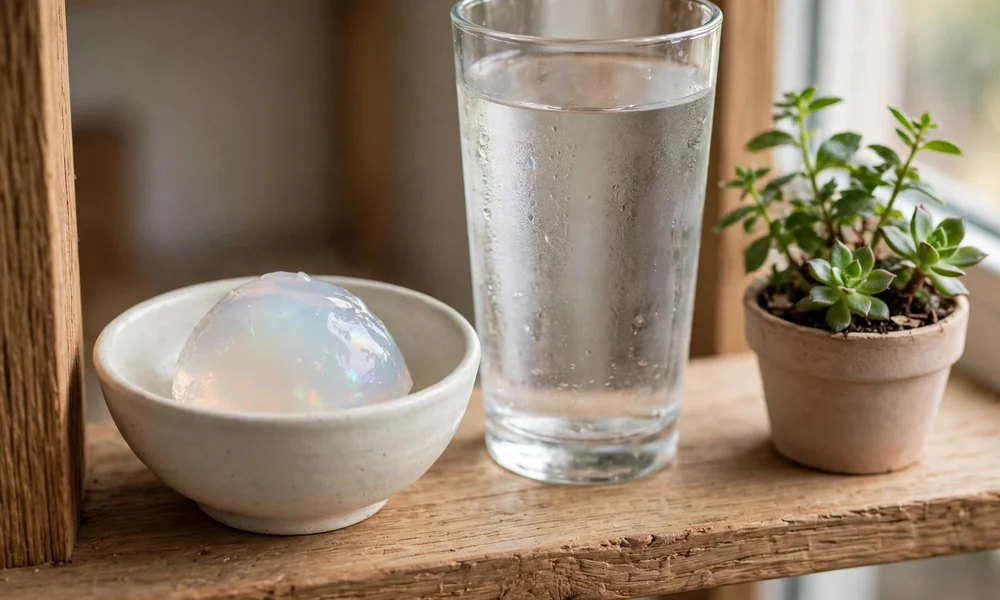
Begin by placing the jelly opal on a pale wooden tray near the window, with a tall tumbler of cool water standing softly apart from it. Drink the water in slow sips, watch the soft light move through the jelly dome, and take one long slow breath before the day's small tasks begin.
The stone itself does nothing; the calm day is your own doing, and the pale jelly only keeps you company through it.
Jelly Opal Beside Water
A jelly opal and a tumbler of water make a calm quiet pair on one pale tray, yet the pair never touches at all. Put the tumbler at one end, the stone at the other, and leave a wide strip of bare wood between them both.
After handling the stone, rinse your hands with soap, and take care it never tumbles into a tumbler, a jug, or a bath. They share one scene while staying separate: the water is for sipping, the stone is for gazing at.
Jelly Opal at a Glance
| Translucent jelly glow | Calm days | Display only |
|---|---|---|
| Soft light, no flash | Tray, shelf, windowsill | Wash hands after |
| Small cabochon, soft stone | Quiet light, slow hours | Never in water |
| Pale jelly, even glow | Rest, water, stillness | Dry cloth wipe |
Jelly Opal and White Opal
White opal is the closest pale cousin jelly opal has, and telling them apart is hard until you hold them next to each other. White opal for bright days covers a milky white stone that shows a small rainbow flash when the sun catches it.
White opal is milky white: you cannot see through it, and a gentle flash of colour appears in bright light. Jelly opal is translucent: daylight passes through it, and no flash appears at all, only a soft even glow.
Jelly Opal and Common Opal
Common opal is the plainest cousin in the family, and it makes the clearest contrast with jelly opal. Common opal for quiet days covers a milky white opaque stone that simply sits pale and still, with no flash as it turns.
Jelly opal shares the lack of flash with common opal, and that is where the likeness ends. Common opal is opaque: light stops at its surface. Jelly opal is translucent: light travels through the jelly body, so the stone looks deep and lit from within.
Jelly Opal, Crystal Opal, Wood Opal and Australian Opal
This same batch holds three further opals, and every one of them rests in a separate quiet corner from jelly opal. Crystal opal, the sibling stone numbered 750, is a clear bright opal whose body is like clean glass. Wood opal, the sibling numbered 754, is an opal that keeps the grain and pattern of the wood it once was. Australian opal, the sibling numbered 756, is an opal from Australia.
Jelly opal is none of those three: not glass-clear like crystal opal, not patterned like wood opal, and not defined by one place like Australian opal.
Jelly Opal and the Other Opals
Past the closest cousins, the opal family still holds more colour. Black opal is dark-bodied, with bright flashes of blue, green and violet. Ethiopian opal is pale at its base, with vivid flashes of rainbow colour. Fire opal is warm orange, sometimes with flashes of red and gold.
Blue opal is pale milky blue, pink opal is soft pink and milky, and Peruvian opal is a soft blue from the Andes with no fiery flashes. Hyalite opal is clear and glass-like, with no colour of its own, and it glows green under ultraviolet light. Hyalite opal for bright days covers that clear stone in full.
Boulder opal grew inside dark ironstone in Queensland, threaded with veins of bright blue, green and gold. Matrix opal is dark brown rock threaded with bright white and pale blue veins. Andamooka opal is a pale milky stone from South Australia, with gentle flashes of pale blue. Yowah opal comes from Queensland, warm browns and rust reds in thin seams across dark ironstone. Dendritic opal is milky white, marked with soft grey branches like tiny ferns.
Opalite is not a natural opal at all: it is man-made glass, milky white, glowing pale blue in the light. Opal shimmer is not a stone either, but a makeup idea borrowed from opal.
Caring for Jelly Opal
Jelly opal is a soft stone, so it needs a gentle hand and a safe place to rest. Store it someplace dry and away from fierce sun, inside a padded box with a lid, or on a shelf where nothing weighty can ever fall onto it.
Brush dust off with a dry soft cloth, sweeping lightly across the dome. Put soap, sprays and polishing creams in the cupboard.
Stones That Must Never Touch Water
Some minerals should stay well away from anything you might drink, so keep this short list in mind whenever you set a tray out. Malachite leads it: keep it out of every cup, jug and glass, and never swirl it through water you mean to drink. Hematite belongs on the same list, kept far from drinking water.
Apatite and lepidolite need the same wide gap, and lepidolite carries lithium inside its grey flakes. Pyrite, angelite and amber sit on the same dry list, nowhere near a glass or a soaking bowl. Jelly opal rests dry beside the glass too.
Your Calm Days Checklist
- Lay the jelly opal on a dry tray, with a full glass close beside it.
- Drink the water unhurriedly as soft light moves through the pale jelly dome.
- Rinse your hands with soap after you have put the stone away.
- Choose a seller who says the words jelly opal aloud.
- Store it dry, up high, away from food and from small hands.
- If health worries bother you, speak to a doctor; a stone holds no answers.

Frequently Asked Questions
What is jelly opal?
Jelly opal is opal in its jelly-like form, a natural mineral made mostly of silica and water held in tiny spheres. Those spheres are packed so evenly that light slips through the stone, so it looks like set jelly and glows softly.
How is jelly opal different from common opal?
Both show no play-of-colour flash, but common opal is milky and opaque: light stops at its surface. Jelly opal is translucent: daylight travels through its jelly body, so the stone looks deep and lit from within.
How is jelly opal different from white opal?
White opal is milky white and shows a small rainbow flash when bright light catches it. Jelly opal is translucent and jelly-like, and no flash appears at all, only a soft even glow.
Is jelly opal the same as opalite?
No, although both can look pale and glowing at first glance. Opalite is man-made glass, milky white, glowing pale blue in the light. Jelly opal is a natural opal, translucent and jelly-like, with a soft even glow.
Is jelly opal safe to hold?
A short hold is fine, provided you rinse your hands with soap once you put it back down, and store it away from small children and away from food. Lift it with care and lay it back softly, so the smooth dome stays unmarked.
Why must jelly opal never go in water?
Keep the stone next to the tumbler, and keep the water on its own. Never plunge it into a mug, never leave it soaking in a tub, and never swirl it through a drink.
The Bottom Line
Jelly opal lends calm days a soft see-through shine: one tiny jelly-like gem in mild light, placed on a pale wooden tray beside a tumbler of water, looked at, never swallowed.
A Note for Calm Days
Keep the daylight gentle and the gem dry. One tiny pale jelly stone, one tumbler of water, and a few soft slow unhurried hours are all you need.