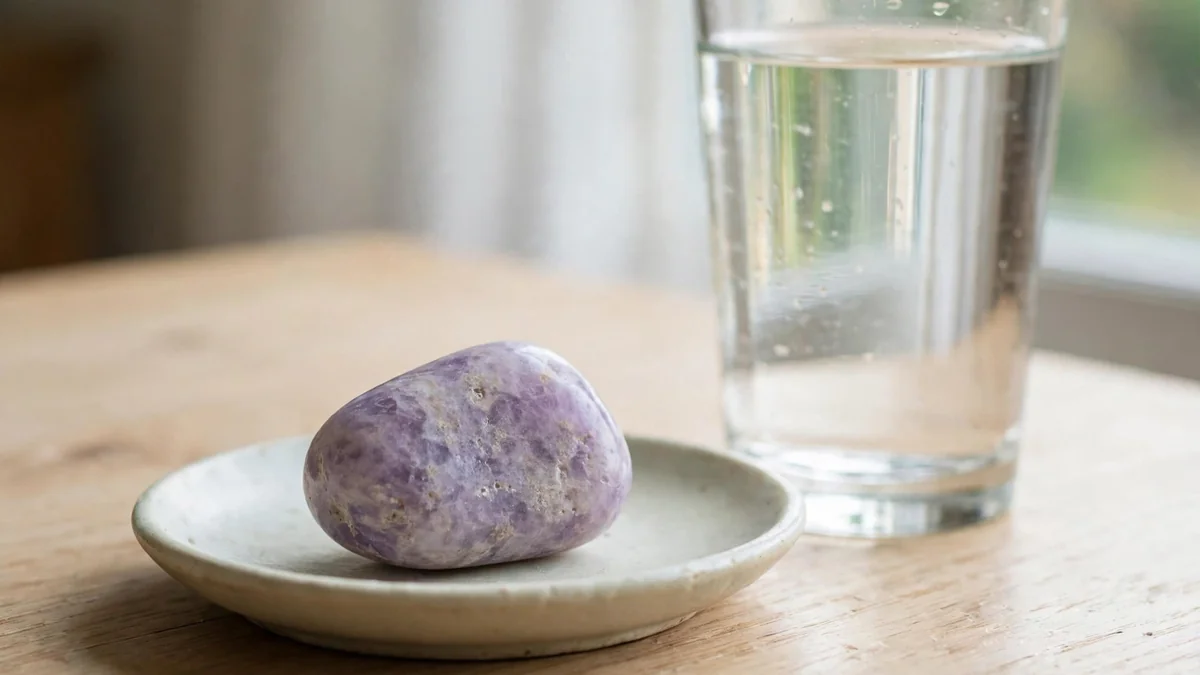
Some stones sit still and ask to be admired from a distance. Hackmanite does something stranger: it answers the light. Carry it from shade into sunshine and its soft violet deepens before your eyes; leave it in the dark and the colour slips away.
That shy trick, tenebrescence, makes hackmanite a stone for unhurried hours. A quiet day gives you time to watch the change happen, to turn the piece and see the violet gather and thin.
This guide stays with what can be seen and held: what hackmanite is, how it differs from its cousins here, what to look for, and how to keep it dry beside a glass of water. It is a beautiful object to look at, and it will not mend anything, cure anything, or stand in for a doctor.
Key Takeaways
- Hackmanite is a sulphur-bearing variety of sodalite, known for tenebrescence.
- Its soft violet deepens in sunlight or under a UV lamp, then fades in the dark.
- It suits quiet days and slow looking.
- It rests beside a glass of water, never inside it, and stays dry.
- It is an object to look at and hold briefly, and it heals nothing at all.
What Hackmanite Is
Hackmanite is sodalite with a secret: the same deep blue feldspathoid mineral, with sulphur tucked into its crystal framework in place of some of the chlorine. That small swap gives the stone its trick.
Greenland and Quebec material is often violet when freshly dug and fades toward grey-white in bright light, while Afghan and Myanmar material starts creamy white and deepens to violet or pink in sunlight. The change is slow enough to watch, and it can repeat many times.
The stone was named for Victor Axel Hackman, a Finnish geologist who studied the alkaline rocks of the Kola Peninsula, and it was first described from Greenland in 1901. Good pieces come from Greenland, Quebec, Afghanistan and Myanmar. At 5.5 to 6 on the Mohs scale, it chips if knocked against something hard.
Hackmanite and Sodalite
Sodalite Deep Blue for Quiet Study keeps a deep blue stone on a study desk for silent evening reading, its royal blue crossed by fine white calcite veins.
Hackmanite could hardly look less like its parent. Where sodalite is a steady royal blue, hackmanite is a soft violet that comes and goes with the light. Sodalite is sold polished and smooth, while hackmanite is usually kept rough or lightly tumbled. Sodalite suits a desk and a timetable; hackmanite suits a shaded table and an empty afternoon.
Hackmanite and Its Blue Cousins
Nosean is the quietest blue in the family. The Complete Guide to Nosean follows a soft blue-grey mineral that grows as tiny twelve-sided crystals in volcanic rock, a stone so uncommon that most people never meet one. Hackmanite shares that family, yet nosean's blue-grey never moves, while hackmanite's violet deepens and fades, and nosean's crystals are specks you must lean in to see.
Afghanite is the nearer cousin in looks, and the easier one to confuse. The journal's afghanite guide describes pale blue six-sided prisms in dark rock from a far valley in Afghanistan. Two marks give it away: afghanite's blue stays put, while hackmanite's violet answers the light, and afghanite's prisms are neat columns, while hackmanite shows as cloudy patches.
Hackmanite and Tugtupite
What Is Tugtupite? A Soft Pink Stone Guide follows a soft pink mineral from Greenland that deepens under a warm lamp and pales in daylight. The two are the sodalite group's colour-shifters, and both ask to be kept out of strong sun.
Yet the shift itself is different. Tugtupite's pink answers the warmth of the lamp, while hackmanite's violet answers ultraviolet light, deepening in sunshine and fading in the dark. One changes with the lamp, the other with the sun.
The Colour That Changes in Light
Tenebrescence is the proper name for the trick, and it is a real, studied property, not a story sellers tell. Inside the crystal, sulphur sits in cages alongside sodium and chlorine. Ultraviolet light moves an electron, the cage traps it, and the crystal starts absorbing green light, so the eye sees violet and pink instead. Visible light and warmth undo it over hours or days.
A UV torch shows the shift in seconds, which is also the quickest honest test when you are choosing a piece. Warm the stone gently and the colour fades back, which is normal, but fierce heat, past about 500 degrees, ends it for good, so hackmanite is never left near a stove, a radiator, or a hot lamp.
How to Choose a Hackmanite Piece
Carry the piece into a shaded doorway and look at it there first, because shop lighting flatters every violet. A good piece shows soft violet of one even tone, its surface free of chalky patches where the stone has begun to wear. Ask the seller to show the change: seconds under a UV torch should deepen the violet, and a minute in shade should ease it back. If nothing changes, it may be ordinary sodalite, dyed quartz, or glass.
Pick a walnut-sized piece that sits flat, check the edges for chips, and ask where it was collected. Leave if the seller promises cures.
A Quiet Day with Hackmanite
Wait until the breakfast things are cleared and the kitchen has gone quiet again. Take the shaded end of the table and lay a round cork mat on it. Set the hackmanite in the middle of the mat, pour water into a plain tumbler, and put the tumbler at the far end of the table with a stretch of bare wood between them. Open a magazine and let the morning drift.
Drink in small mouthfuls as you read, lift the stone once to watch the violet gather and thin, then set it back when the tumbler is empty.
Hackmanite Beside Water
The rule is simple: the glass and the stone share a table, never a drink. Put the tumbler down at the table's far end and the stone at the near end, leaving bare wood in between, so a knocked glass cannot splash the stone. Never run hackmanite under a tap and never drop it into a glass: a wet stone slips from the fingers and chips on a hard floor. A soft dry brush once a week lifts the dust.
Hackmanite at a Glance
| Soft violet stone | Shaded table, shelf | Hands washed after |
|---|---|---|
| Sodalite group | Quiet days, slow hours | Glass kept apart |
| Colour shifts in light | One small piece | Keep it dry |
| Greenland, Quebec, Afghanistan | Cork, wood, daylight | Out of strong sun |
Hackmanite Among the Other Stones in This Batch
Two companions close out this batch of three, and neither could be mistaken for hackmanite. The brass polish guide, Water and a Brass Polish: Why It Shines, is not about a stone at all: it is about water bringing a shine back to brass, while hackmanite's guide is about keeping water away from a stone. One polishes, the other protects.
Pentagonite, the last guide of the batch, is a deep blue stone, and that is where the likeness ends. What Is Pentagonite? A Deep Blue Guide follows a blue mineral for calm days, while hackmanite's violet answers the light. Pentagonite's blue stays steady; hackmanite's violet comes and goes.
Where Hackmanite Rests at Home
Give hackmanite a shaded corner nobody brushes past: a sideboard end, a shelf above the sink, or a bookcase top. Strong sun steals its colour, so shade is part of its home.
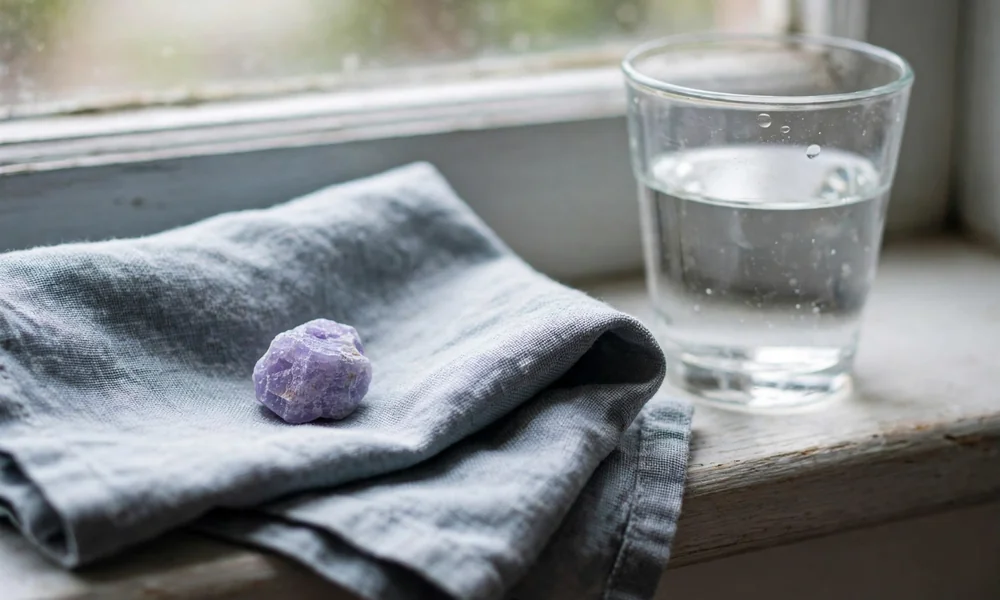
To travel, slip it into a small cotton drawstring bag inside a tin lined with a folded tea towel, so it cannot roll against anything harder.

Stones That Must Never Touch Water
Five stones, five separate warnings: A cup of water turns angelite dull and opaque. Pyrite answers dampness with rust. Apatite is too soft for soaking: its surface thins and roughens. Lepidolite carries lithium locked in its layered flakes, so it stays far from any cup. And amber, ancient tree sap rather than rock, goes cloudy in a soak and stays that way.
Malachite belongs on the same dry shelf. Hackmanite gets the same dry care: keep it away from damp cloths and water, and wash your hands once you have held it.
Your Quiet Days Checklist
- Set the hackmanite on its cork mat, tumbler a forearm away.
- Drink the water in small mouthfuls while you read.
- Lift the piece once and watch the violet gather and thin.
- Set it back on its mat, then wash your hands with soap.
- Buy from a seller who names where the stone was found.
- If a health worry is on your mind, a doctor is the one to ask — this stone holds no answers for it.
That is the whole routine.

Frequently Asked Questions
Why is hackmanite called a variety of sodalite?
Hackmanite is sodalite with sulphur in its crystal framework, so it belongs to the sodalite group of feldspathoid minerals. The sulphur is what gives it tenebrescence, the colour change ordinary sodalite never shows.
How does the violet change, and can I watch it happen?
Yes. Sunlight or a UV torch deepens the violet in seconds or minutes, and shade lets it fade back over hours or days. Afghan material often starts creamy white and turns violet in the sun, while Greenland material often starts violet and pales in the sun.
May hackmanite ever touch the water in my glass?
No, never. Hackmanite stays out of drinking water, out of soaks, and out of baths. Rest it on its mat beside a tumbler, so the water stays plain and safe to drink.
If I already own sodalite, why look at hackmanite?
Sodalite is a steady royal blue with white veins, sold polished for study, while hackmanite is a soft violet that deepens and fades with the light. They share a family, but they give a quiet day two very different kinds of looking.
Does holding hackmanite need any special care?
A grown person may lift a small dry piece briefly, turn it in the light, then set it back and wash their hands. Never hold it with wet hands, since a wet stone slips easily.
Which corner of the house suits hackmanite best?
A dry, shaded spot suits it, like the far end of a sideboard or a bookcase top, far from full sun, sinks, steam, small children and pets.

The Bottom Line
A violet stone that answers the light, a dry mat, and a glass that never touches it — that is hackmanite on a quiet day.
A Note for Quiet Days
Keep the stone shaded, the glass apart, and the day unhurried, and hackmanite will do the rest — it only ever wanted to be looked at.