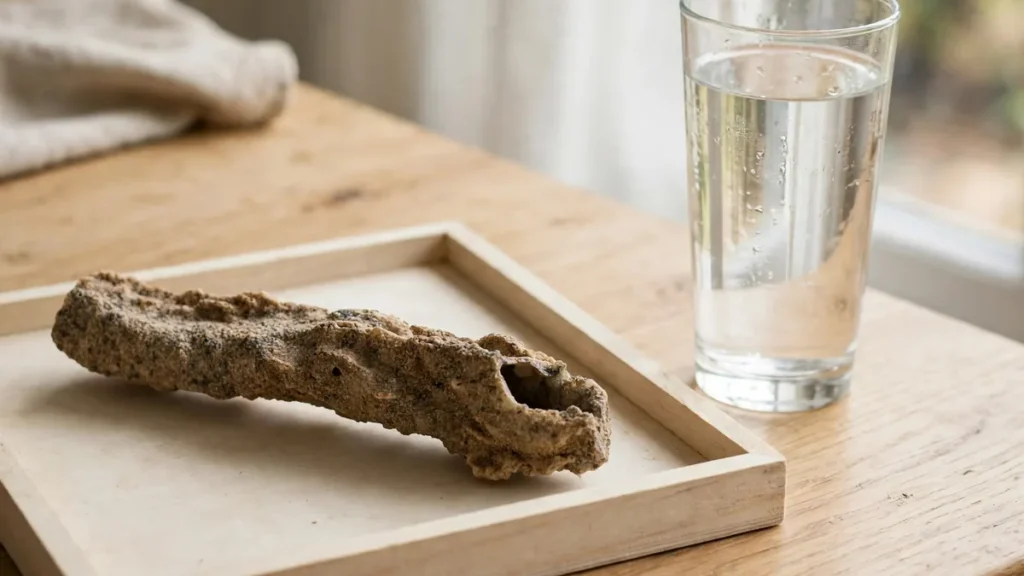
A deep blue stone does not need to be large to hold a room. Pentagonite arrives as a small spray of vivid blue blades on dark grey rock, its blue so clean against the dark stone that the eye keeps returning to it, the way it returns to sky through a window.
Calm days leave room for looking closely, and this stone rewards it. It asks for nothing more than a dish on a sill, a glass of water at the far end of it, and a few unhurried minutes to turn the piece in the light.
This guide takes the stone on its own terms: its make-up, its differences from cavansite and the other blue stones in this journal, how to pick a sound piece, and how to keep it dry at home. It is a beautiful object to admire and hold for a moment, and it heals nothing.
Key Takeaways
- Pentagonite is a vivid blue mineral in thin blades on dark matrix rock.
- It is cavansite's dimorph: the same chemistry, a different crystal shape.
- Its deep blue suits calm days, soft light and unhurried looking.
- It is a beautiful object to admire briefly, and it cures nothing.
- Keep the stone dry beside the glass, never in it, and wash your hands after.
What Pentagonite Is
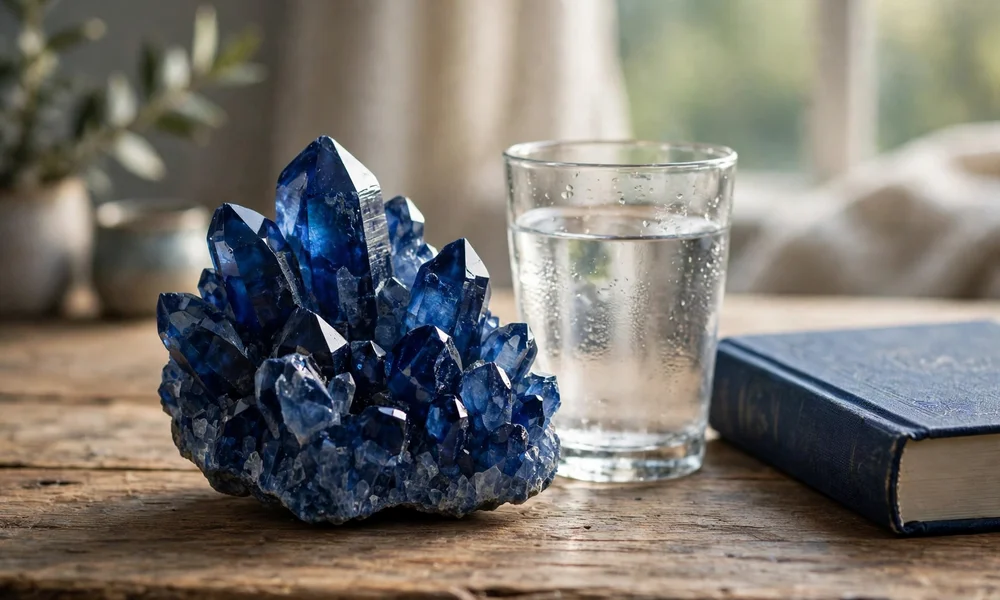
Pentagonite is a rare blue mineral, a calcium vanadium silicate, in thin, flat blue blades on dark grey or brown matrix rock. The best pieces show vivid blue sprays, like tiny blue fans, against the dark stone.
Shops usually sell it as small clusters on matrix, sometimes as single sprays, and a plum-sized piece fits neatly on a dish beside a glass. Collectors prize it because good pieces are scarce, so take your time. The blue should read clean and deep, never dull or grey, and the blades should sit firm on the matrix.
Pentagonite and Cavansite
Cavansite blue bursts for fresh mornings follows a stone in round, bright blue rosettes on dark rock, like small blue flowers after rain, suiting fresh mornings with cool water. The two stones share their chemistry exactly: both calcium vanadium silicates, grown on the same dark matrix in the same rocks of India.
Pentagonite is cavansite's dimorph: the same ingredients settled into a different shape. Where cavansite bursts into round rosettes, pentagonite stretches into thin, flat blades that often twin into five-sided sprays, and its name comes from that outline. A cavansite piece shows flowers; a pentagonite piece shows fans. Both are vivid blue, both stay dry, and a collector who owns one will want the other.
Pentagonite and Hauyne
Hauyne deep blue for calm days follows a stone so rare that a clean thumbnail-sized piece is already a find: a feldspathoid from volcanic rock, its rich blue coming from tiny amounts of sulfur held inside the crystal. Hauyne's blue is a solid, even blue inside a single small crystal.
Pentagonite's blue works differently. It is not one solid crystal but a spray of thin blades spread across dark rock, so the blue breaks into lines and points of light rather than filling one shape. Hauyne is a single gem-like piece to carry briefly; pentagonite is a small blue landscape to set on a dish. Both suit calm days, and neither belongs anywhere near water.
Pentagonite and Jeremejevite
Jeremejevite soft blue for bright days follows a pale blue borate in slender pointed prisms, named for Pavel Jeremejev, the Russian mineralogist who first wrote about it in 1883, when small blue crystals were found in the Siberian mountains. Its blue is soft, like a morning sky, and its pieces are among the rarest a collector can hold.
Pentagonite could hardly look more different: its blue is deep and vivid rather than pale, its crystals flat blades rather than pointed prisms, growing in sprays on dark matrix rather than standing alone. Jeremejevite suits bright days; pentagonite suits calm days. One is a pale prism, the other a deep blue fan.
Why Deep Blue Suits Calm Days
Deep blue belongs to calm days: the colour of still water and an evening sky, both asking the eye to slow down. A dark stone scattered with vivid blue feels like evening settling in, and that quiet feeling is what a calm day needs. The sprays are small, so nothing about the stone shouts; it rests on its dish, bright and quiet.
Blue fits a slow day for another reason too: it never shouts for attention. The stone sits quietly on its dish while you get on with the afternoon, and the colour is there whenever your eye wanders back to it. A glass of water, a book, and a blue stone mark the hours as calm, and a day that begins that simply tends to stay that way.
The Safety Rule First: Beside Water Only
Keep the stone beside the water and out of it: never in a drink, never soaked, never in any elixir. If a piece ever drops into a glass by mistake, pour the water away, wash the glass, and wash your hands too. The glass stays on one end of the sill and the stone on the other; the gap between them is the whole of the rule.
Pentagonite is a delicate cluster stone: water can work its blades loose from the matrix, so a piece that looks sturdy still stays dry. No stone belongs in a drink, ever, and a wet cluster slides out of a hand and breaks on a hard floor.
How to Choose a Pentagonite Piece
Hold the piece up to the window and turn it slowly before buying. Look for deep, clean blue blades, fixed firmly to dark matrix, with no loose or crumbling edges. The blue should shift as you turn it, deeper one way and paler the other.
Be wary of pieces that look painted, with one flat, even blue covering the whole stone. Real pentagonite shows dark matrix between the sprays, each spray its own shape. Buy from a seller who names the stone and the find spot in plain words, and walk away from anyone who promises it will change your health. When buying online, ask to see a photograph of the actual piece, not a stock picture.

A Calm Day with Pentagonite
In the middle of a calm day, when afternoon light slants across the reading chair, set the dish on the small table beside it, glass of water at the far edge. Sit down with a book, drink the water in slow sips, and glance at the blue sprays. When the glass is empty, leave the piece where it lies.
Pentagonite at a Glance
| Deep blue sprays | Calm days, soft light | Hands washed after |
|---|---|---|
| Dark grey matrix | Dish beside glass | Glass kept apart |
| Thin bladed crystals | One small cluster | Keep it dry |
| Palm-sized piece | Linen, wood, daylight | Shade from harsh sun |
Pentagonite Among the Other Stones in This Batch
Two companions share this last batch, each one taking a different road. The brass polish works with a cloth, shining metal with water, while the stones stay dry and simply glow. Hackmanite keeps its soft violet for quiet days, a stone to look at on a sill, gentle where pentagonite's blue is vivid.
Pentagonite closes the batch with the deepest blue, a spray of blades on dark rock for calm days. One shines metal, one glows violet, one burns blue — and the batch ends as it began, with small beautiful things kept dry beside water.
Where Pentagonite Sits at Home
Set the cluster somewhere quiet that nobody brushes past: the far end of a dresser, a high shelf in a room with no sink, or a bookcase top. Keep it clear of taps, kettles and steam, out of reach of little fingers and paws; hard midday sun stays off it too, and a knock can loosen the thin blades.
For travel, wrap it in tissue inside a small rigid box of its own, so the blades cannot knock against anything hard. A soft pouch alone is not enough for thin crystals; the box keeps the piece safe.

Stones That Must Never Touch Water
Some minerals take water well and others are ruined by it, and a few are unsafe near any drink, so they live on dry shelves, far from every cup. A bath takes the shine off apatite, and it does not return. Lepidolite holds lithium in its flakes, which is why it never goes near water at all. Pyrite darkens where dampness reaches it, and never looks the same again.
Angelite swells with water and turns dull, and stays dull. Amber is tree resin, not stone at all, and a soak turns it milky for good. The pentagonite cluster needs only dry care: no damp cloths, no water, clean hands after holding it.
Your Calm Days Checklist
- Set the cluster on its dish with the blue facing the room, glass well away from it.
- Sip the water slowly while you look at the blue, and let the afternoon slow.
- Pick it up once, turn it in the light, and set it back on its dish.
- Brush the dust off with a dry, soft brush, never water.
- Keep it in its own box when it travels, away from keys and hard stones.
- When something about your health troubles you, a doctor is the one to ask — a blue stone has no answers.

Frequently Asked Questions
What is pentagonite, in plain words?
Pentagonite is a rare vivid blue mineral in thin, flat blades on dark grey matrix rock, cavansite's dimorph: the same chemistry in a different crystal shape.
How can I tell pentagonite from cavansite?
Cavansite grows in round blue rosettes like small flowers, while pentagonite grows in thin flat blades that twin into five-sided sprays. The two shapes are easy to tell apart side by side.
Why must pentagonite stay out of water?
Water can loosen its thin blades from the matrix, and a wet cluster slides out of a hand and breaks, so keep the stone beside the glass and never under a tap.
Is pentagonite the same stone as hauyne?
No, hauyne is a deep blue feldspathoid from volcanic rock, coloured by sulfur, while pentagonite is a calcium vanadium silicate in blue sprays.
Can I hold pentagonite in my hand?
Yes, briefly: lift it with dry hands, look at it in the light, put it back on its dish, and wash your hands after.
Where is the best place to keep pentagonite?
Give it a high shelf in a dry room, away from taps and steam, where small hands and paws cannot reach it and midday sun does not fall.
The Bottom Line
Pentagonite is a deep blue spray on dark stone, water in its own glass, and a calm day that asks for nothing more.
A Note for Calm Days
A deep blue stone, a dry dish, and a glass kept apart — that is the whole of pentagonite, and it is enough.