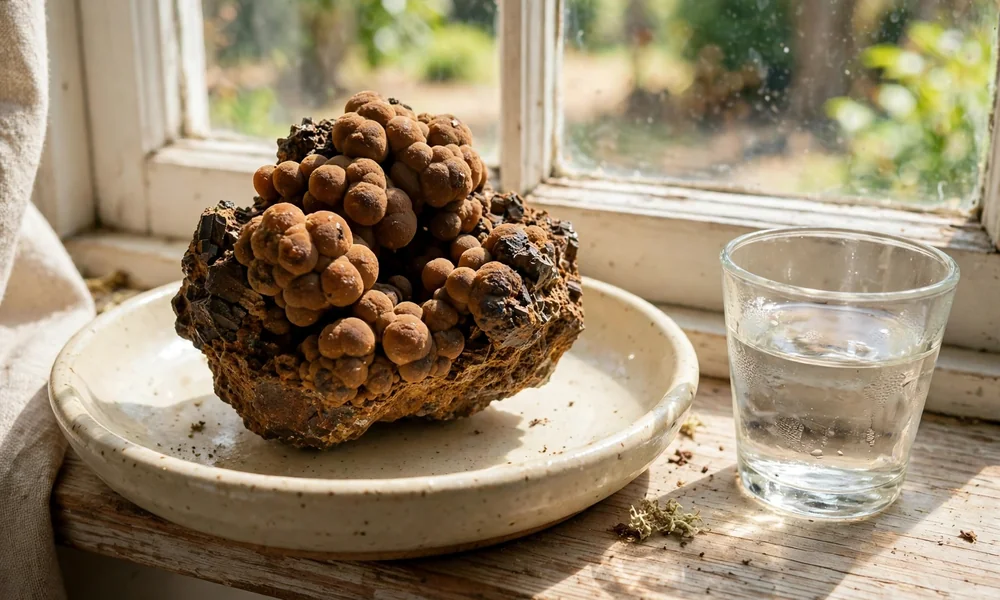
Goethite never tries to catch the eye from across the room. It sits low and quiet on its tray, a mass of rounded brown lumps the colour of damp garden soil, with here and there a fan of fine dark needles. Nothing about it flashes or sparkles, and that is exactly its charm on an ordinary day.
An ordinary day is where this stone belongs. The hours are unhurried, the jobs are familiar, and nothing on the list needs doing in a rush. A small brown mineral fits that pace because it asks for almost nothing: a dry place, a little daylight, and a firm distance from every glass in the house.
This guide takes goethite on its own terms: what the mineral is and where it comes from, how it stands apart from the other brown stones already in this journal, what to look for when choosing a piece, and where it rests best at home beside a glass of water. It is a thing to look at and to hold for a minute, and nothing more.
Key Takeaways
- Goethite is a warm brown iron mineral, grown as earthy lumps and fine needles.
- Its quiet brown suits steady days, plain routines and unhurried hours.
- Goethite can stain and crumble when wet, so it stays dry at all times.
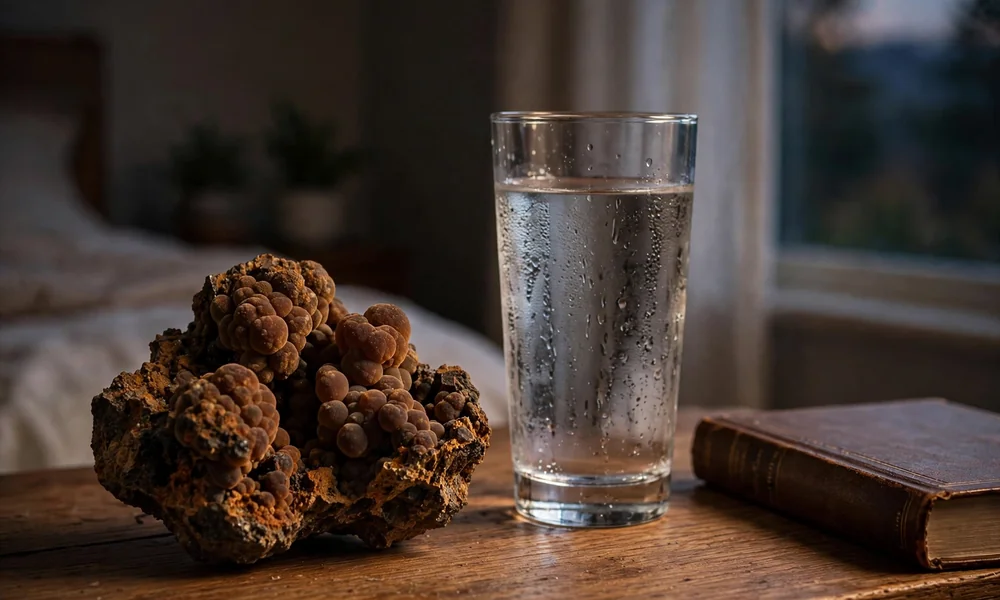
- The stone sits dry beside its glass, never inside it, on a plain tray.
- Wash your hands after handling it, and keep it away from children and pets.
What Goethite Is
Goethite is an iron oxyhydroxide, a mineral built from iron, oxygen and hydrogen, and it forms where iron-rich rock has weathered slowly in air and rain. It grows in rounded, grape-like lumps called botryoidal masses, in velvety crusts, and sometimes in thin sprays of needle-like crystals.
The colour runs from a yellow-brown like old straw through a rich chestnut to a near-black brown, and a fresh surface has a dull, earthy shine rather than a glassy gleam. Good pieces feel heavy for their size, because iron is dense.
Goethite is common in iron country all over the world, and it is one of the minerals that gives rusty soil its colour. Painters once ground it for ochre pigment.
Why Warm Brown Suits Steady Days
Brown is the colour of things that do not change in a hurry: turned soil, a wooden spoon, a leather-bound book, the bark of the tree outside the window. A brown stone on the tray matches that feeling, because it looks settled, as if it had always been there and would still be there next week.
Goethite wears its brown without fuss. There is no bright band to study and no sudden flash to catch the light, only a steady earthy tone that lets the eyes rest. On a day when nothing is urgent, that plainness is a pleasure in itself.
Goethite and Ammonite: Lumps Beside a Spiral
Ammonite warm brown for steady days follows a coiled fossil shell, the stone remains of a shelled sea creature that drifted through ancient seas. Its spiral is the first thing the eye finds, a smooth curve winding inward, and its warm brown comes from the stone that replaced the shell over millions of years.
Goethite could hardly be shaped more differently. Where ammonite winds into a neat spiral, goethite heaps itself into lumps with no pattern at all, and where ammonite is a fossil, goethite is a mineral grown from weathered iron rock. Both wear warm brown and suit a slow day.
Choosing a Goethite Piece
Look at goethite in plain daylight, away from shop lamps, and turn it slowly in your hands. A good piece shows lumps of one even brown, with a dry, earthy surface and no pale powdery patches where the mineral has begun to crumble. The needles, where they appear, should stand firm and not shed at a light touch.
Pick a piece about the size of a fist, heavy enough to feel solid, and check that it sits flat without rocking. Ask where the piece was dug up, and walk away if the seller starts promising health benefits.
A Steady Morning with Goethite
Start the day by setting out the stone's corner first. Lay a folded beige cloth on the side table, put the goethite where the roundest lumps catch the window light, and place a tall glass of water at the opposite end of the cloth.
Drink the water slowly while the light moves across the tray, then fold the cloth away and leave the stone where it sits.
Goethite Beside Water
Water and goethite can sit on one tray if they are kept apart. Stand the glass at one edge, rest the stone at the other, and leave a stretch of bare wood or cloth in the middle, so that splashes never touch the lumps. Never run the stone under a tap, since wet goethite softens and marks. Dust it once a week with a gentle puff of air, and nothing more.

Goethite at a Glance
| Warm brown lumps | Tray, shelf, desk | Dry hands only |
|---|---|---|
| Iron oxyhydroxide, earthy | Steady days, plain routine | Glass kept apart |
| Heavy, dull shine | One small piece | Wash hands after |
| Fist-sized piece | Wood, cloth, daylight | Keep it dry |
Goethite and Sinhalite: Earthy Lumps, Rare Brown Gems
Sinhalite warm brown for steady days follows a rare warm brown gem first found in Sri Lanka, named for the island's Sinhala people, and seldom seen outside a collector's cabinet. It is a borate mineral, cut and polished like a gemstone, and its brown is clear and warm, like honey held up to the light.
Goethite stands at the other end of the scale. It is common, rough and earthy, never cut like a gem, and its brown is the brown of soil rather than honey. Sinhalite is a prize for a cabinet, while goethite is a companion for a tray.
Goethite and Staurolite: Lumps Beside Crosses
Staurolite warm brown for steady days follows a deep warm brown mineral whose crystals often meet in a cross, one growing through the other at an angle. That crossed shape catches the eye before anything else, and the colour is the brown of turned garden soil and chestnuts split open in autumn.
Goethite grows no crosses and no straight lines at all. Its lumps pile up without order, and its needles spray out in every direction. Staurolite is a metamorphic mineral, born under heat and pressure deep underground, while goethite is born at the surface, where rain and air have slowly rusted iron rock.
Goethite Among the Other Stones in This Batch
Four other stones share this batch with goethite, each wearing a colour far from warm brown. Orthoceras is deep black, a straight-shelled fossil from an ancient sea. Bornite shifts its colours as the light moves, purple and blue over copper. Galena is soft grey, heavy and bright, a lead mineral for display only. Sphalerite is warm gold, bright where goethite is dark.
The water guides in this batch take a different kind of rest: one hangs a hammock between two trees, one gathers round a fire pit, one opens an umbrella against the rain, one pulls on wellies for wet grass, and one wraps up in a wool scarf.
Where Goethite Rests at Home
Give it a spot people pass each day without bumping: the quiet end of a worktop, a ledge above the sink's splash, or the top of a cupboard. Keep it clear of taps, kettles, steam, small hands and pets.
Once a week, lift it by its base and look for any loose crumbs underneath. To carry it anywhere, wrap it in tissue inside its own padded box.
Stones That Must Never Touch Water
Some stones are spoiled by water in ways you cannot undo, so each one earns its own warning. Pyrite dulls and stains if it stays damp for long, and amber, which is old tree resin turned hard, goes cloudy after a soak and never clears again. Angelite clouds too, while apatite falls apart when it is left in water, so both of those belong on a shelf where no glass ever stands.
Malachite is a different kind of danger: its green bands hold copper, and copper has no business near anything you might drink, so the stone is kept far from jugs, tumblers and baths alike. Hematite rusts if it stays wet, and lepidolite carries lithium in its flakes, which is another reason to keep every cup well away from it. Goethite needs the same treatment: no water, no damp cloth, and a wash of the hands after it is touched.
Your Steady Days Checklist
- Set the goethite down on a dry wooden tray, keeping the glass a hand-span away.
- Drink the water slowly, one small mouthful after another, while the light moves.
- Turn the piece over once and look at the lumps from the other side.
- Put the piece back on its tray, then wash your hands with soap.
- Choose a seller who answers plainly when you ask where the stone was dug.
- If a health worry stays with you, ask a doctor — no brown stone can answer it.
That is the whole arrangement: a tray, a glass, and a brown stone resting dry.

Frequently Asked Questions
What is goethite, in plain words?
Goethite is a warm brown iron mineral, formed where iron-rich rock has weathered slowly in air and rain, and grown as rounded earthy lumps with fine needle-like crystals.
Why does goethite stay out of water?
Wet goethite softens, crumbles and leaves rusty marks, so keep it out of every drink, soak and bath. If it ever drops into a glass, tip the water away and wash the glass with soap.
How can I tell goethite from hematite?
Hematite is steel-grey to black with a bright metallic shine and a red streak, while goethite is earthy brown with a dull surface and a yellow-brown streak.
How do I pick a good goethite piece?
Look for lumps of one even brown in daylight, with a dry earthy surface, firm needles and no pale powdery patches, on a piece about the size of a fist.
Is it all right to hold goethite for a short while?
A grown person can pick up a small dry piece for a moment to look at it closely, then put it back on the tray and wash their hands with soap and water.
Where should goethite live at home?
Give it a dry place in soft daylight, such as a high shelf or a cupboard top, far from water, steam, small hands and pets.
The Bottom Line
Keep the stone dry, keep the glass apart, and a steady day has everything it needs from goethite.
A Note for Steady Days
Dry stone, clear water, and an unhurried afternoon: goethite asks for little, and a steady day gives it gladly.