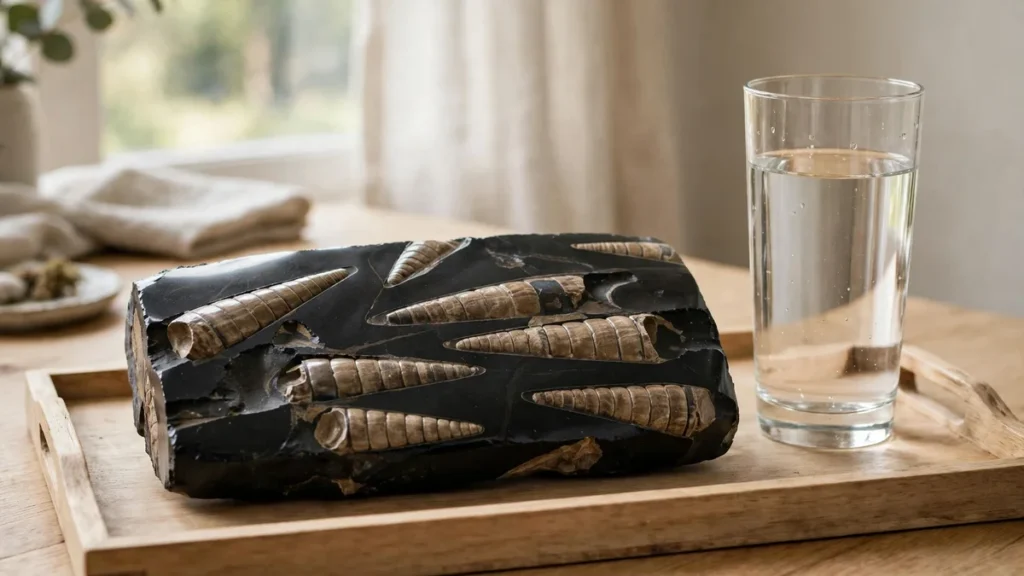
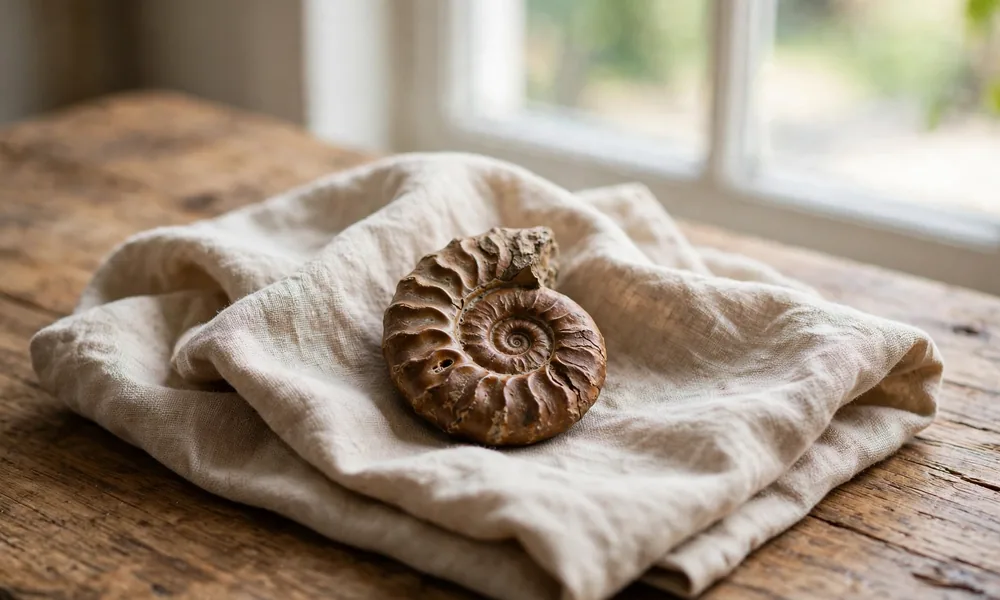
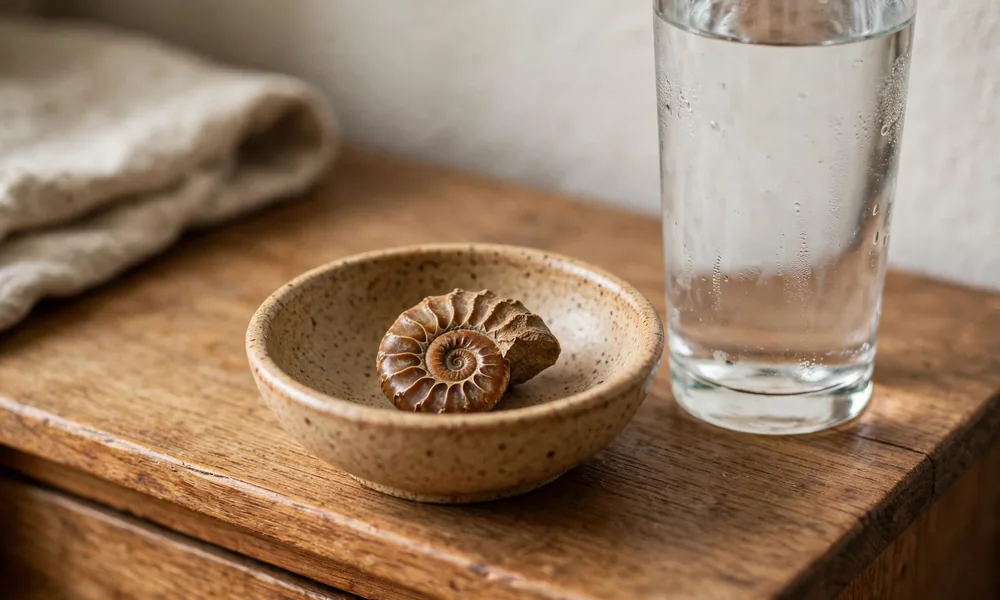
A coiled shell that once drifted through an ancient sea can still sit quietly on a modern tray. Ammonite is not a crystal at all: it is the fossil of a shelled sea creature, turned to stone over millions of years, and its spiral is the first thing your eye finds.
That shape is why it suits a slow day. A spiral has no sharp corners and no sudden turns, only a steady curve that keeps going round. On a morning when the house is calm and the list of jobs is short, a warm brown ammonite matches the pace of the hours, asking for nothing more than a dry spot and a little light.
What follows is a plain account of the fossil: how it came to be, what sets it apart from the brown stones this journal already holds, what to look for when buying one, and the best corner of the house for it, next to a glass of water. Admire it, hold it for a minute, and expect nothing more from it.
Key Takeaways
- Ammonite is a fossilised coiled shell, not a crystal, and it is millions of years old.
- Its warm brown spiral suits slow, unhurried days at home.
- Ammonite is for looking at and holding briefly; it treats nothing at all.
- The fossil sits beside the glass, never in it, and it must stay dry.
- One small piece on a plain tray is plenty for a whole steady day.
What Ammonite Is
An ammonite began life as a sea animal with a coiled shell, a distant cousin of today's squid and nautilus, swimming in oceans that vanished long before people existed. When the animal died, its shell sank into mud on the sea floor, and minerals slowly replaced the shell's substance grain by grain until the whole spiral turned to stone.
Most pieces sold today come from Morocco and Madagascar, where collectors split open rock nodules to reveal the shell inside. The shell is often polished to show its chambers, the thin walls that divided the coil into rooms the animal once lived in. Colours run from pale honey to deep chocolate brown.
Why a Spiral Suits a Steady Day
A steady day is made of circles rather than straight lines: the kettle boils, the dishes are washed, and the round repeats without fuss. A spiral belongs in that rhythm because it is a circle that never quite closes.
Warm brown helps too: wooden floors, old books and the crust of fresh bread, all things that make a house feel settled. A bright stone would pull the eye from the day's small jobs, while ammonite's brown lets the eye rest.
Ammonite and Brown Onyx: A Fossil Beside a Banded Stone
Brown onyx warm brown for steady days follows a banded stone, a variety of chalcedony laid down in smooth stripes of brown, cream and honey. Brown onyx grows in layers inside rock, and a cut piece shows those bands running straight across its face like the grain in a plank of wood.
Ammonite could hardly be more different. It was once a living shell, and its pattern is a curve, not a stripe: a spiral winding inward, with chambers like the rooms of a tiny house. Brown onyx is a mineral through and through, while ammonite is an animal's home turned to stone.
Choosing an Ammonite Piece
Hold the fossil up to the window and look along its spiral in daylight, where the brown can be judged without a shop lamp warming it up. A good piece shows a complete coil with chambers you can count, clean ridges, and no cracks across the shell. The centre should be whole, not chipped, because a broken middle spoils the spiral's line.
Choose a piece about the size of a plum, small enough to rest on one palm. Ask the seller where it was found and whether the shell has been filled or dyed, and walk away from any seller who claims the fossil can heal or protect you. A plain answer about its origin is worth far more than any promise.
A Steady Morning with Ammonite
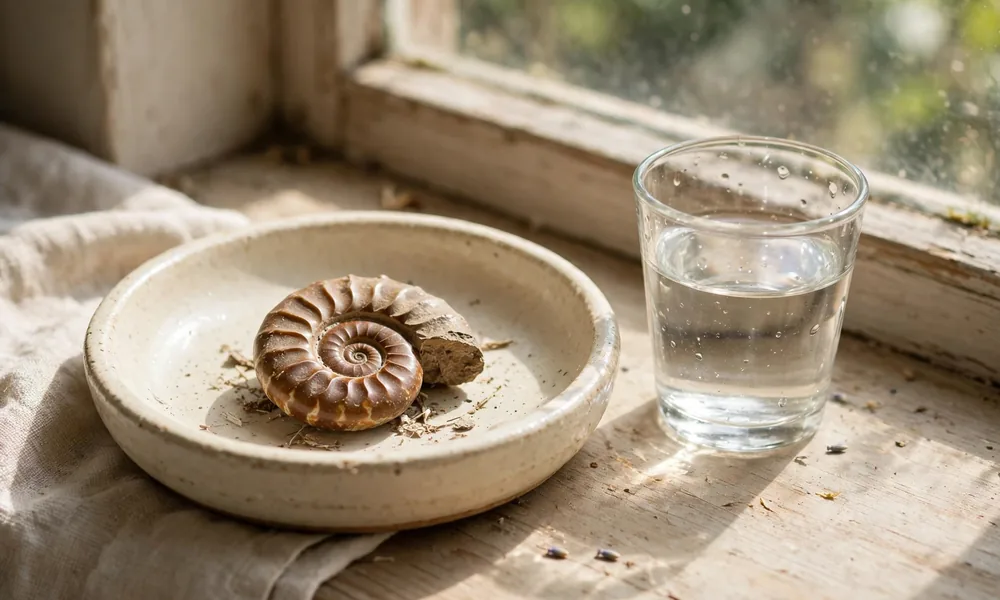
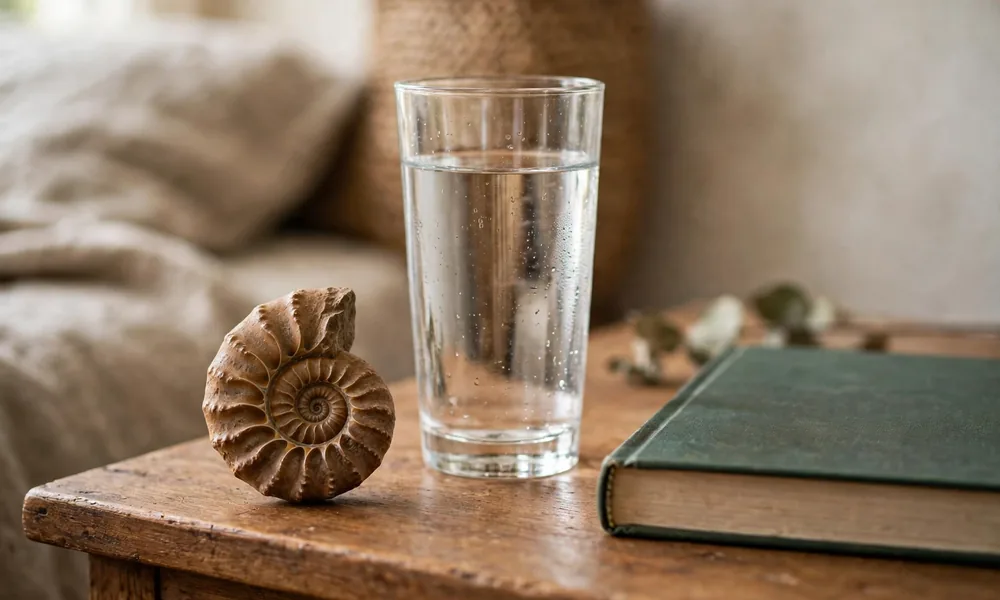
Give the fossil a small, tidy place in the first hour of the day. Lay a folded beige cloth on the side table, set the ammonite at one end with its spiral facing the room, and a tall glass of water at the far end, with bare cloth between them.
Spend a minute turning the shell over in your hands, tracing the spiral with one finger from the outer edge to the centre, then set it back on the cloth. When the glass is empty, the morning's small pause is done, and the fossil can stay where it is until evening.
Ammonite Beside Water
Water and a fossil can sit on the same tray without trouble, provided the two never meet. Place the tumbler on the left, the ammonite on the right, and leave a clear band of tray between them so nothing spills across. Keep the shell out of every vessel that holds a drink, and never rinse it under running water. A weekly pass with a soft dry brush clears the dust from between the ridges, and that is the whole of its care.
Ammonite at a Glance
| Fossil coiled shell | Tray, shelf, desk | Dry hands only |
|---|---|---|
| Spiral chambers, warm brown | Steady days, slow hours | Glass kept apart |
| Morocco, Madagascar origin | One small accent | Keep it dry |
| Plum-sized piece | Wood, cloth, lamplight | Brush dust weekly |
Ammonite and Axinite: Old Shell, Sharp Crystal
Axinite warm brown for steady days follows a brown crystal that grows in sharp, wedge-shaped blades, with edges that look cut by a knife. Axinite is a true mineral, formed by heat and pressure deep in the earth, and its colour comes from iron and manganese locked inside its crystals.
Ammonite was shaped by the sea, not by heat, and its lines are all curves. Where axinite points and angles, ammonite winds and rounds, and where axinite's brown is glassy and sharp-edged, the fossil's brown is soft and ridged like a shell on a beach.
Ammonite and Smoky Citrine: Fossil Brown, Quartz Brown
Smoky citrine warm brown for steady days is about a quartz whose brown comes from tiny traces of iron: gold darkened toward tea and old timber. You will find it in nearly every crystal shop, and its colour sits inside a clear, glassy crystal that light moves straight through.
Light stops at the surface of an ammonite. The fossil is solid and matte, its brown left behind by the minerals that took over a shell, with no iron-tinted quartz involved. A newcomer to brown stones would start with smoky citrine; the fossil belongs on a shelf that already has company, where its coil breaks up the straight lines.
Ammonite Among the Other Stones in This Batch
This batch holds four more minerals beside ammonite, each wearing a colour far from brown. Crocoite is bright orange, vivid and loud where ammonite keeps the colour of old wood. Chalcopyrite is warm gold with a metallic shine, glittering where the fossil stays matte. Lazurite is deep blue, cool and distant, almost the opposite of ammonite's warm glow. Poudretteite is soft pink, pale and tender, while ammonite is rich and earthy.
The nearest water article is water and a window box, a fresh ritual of plants and watering cans. Ammonite holds the warm brown corner of the batch, the one ancient note among oranges, golds, blues and pinks.
Where Ammonite Rests at Home
Pick a spot the household walks past every day but rarely knocks: a quiet stretch of worktop, a high shelf, or the top of a wardrobe. Choose somewhere away from kettles, taps and steam, and above the reach of small hands.
Run a dry soft brush over it once a week and check that its brown still looks bright. When you travel, wrap it in its own soft pouch, keeping it away from keys and coins that could nick the ridges.
Stones That Must Stay Away from Water
Beyond ammonite, a handful of other minerals call for even more care, and it helps to know them by name. Malachite is banded green and holds copper inside, so it must never come near anything you drink from. Hematite, left wet, can rust and mark skin and cloth, so it too stays away from drinking water.
Pyrite crumbles and smells of sulphur when soaked, and angelite clouds over when wet, so both belong on a dry shelf. Apatite softens and flakes in water, while lepidolite's pale flakes contain lithium, so keep every drink away from those two as well. Amber, hardened tree resin from long ago, turns milky when soaked. Treat ammonite the same way: a dry tray, a glass standing close, and nothing the fossil touches ever reaching your plate or cup.
Your Steady Days Checklist
- Set the ammonite on a dry cloth, glass at a good distance.
- Sip the water unhurriedly, one small mouthful at a time.
- Pick the fossil up and trace its spiral to the centre.
- Return the piece to its tray, then wash your hands.
- Choose a seller who says plainly where the fossil was dug up.
- If a health worry lingers, speak to a doctor — no old shell can settle it.
Tray, glass, cloth and one small brown fossil — nothing else is needed.
Frequently Asked Questions
What is an ammonite, in plain words?
An ammonite is the fossil of a shelled sea animal, a distant cousin of the squid, whose coiled shell turned to stone over millions of years.
Is ammonite a crystal?
No. Ammonite is a fossil, not a crystal: it was once the shell of a living creature, and minerals replaced the shell grain by grain.
Can ammonite go into drinking water?
No. Ammonite belongs beside the glass, never inside it, because soaking dulls its warm brown, so keep the drink in its own glass.
How do I pick a good ammonite piece?
Judge it by daylight: the coil should be whole, the chambers easy to count, the ridges clear, and the shell free of cracks. Buy only from someone who tells you where the fossil came from.
Is it all right to hold ammonite for a short while?
A grown person can lift a small dry piece for a minute or so, then wash their hands once it is back on the tray.
Where should ammonite live at home?
A dry corner with soft light suits it: a desk edge, a bookshelf, anywhere water, steam and small hands cannot reach.
The Bottom Line
An old brown spiral kept dry, and a glass of water that stays in its glass: a steady day asks nothing more of ammonite.
A Note for Steady Days
Dry fossil, clear glass, unhurried hours — nothing more to it than that.