Some mornings begin with sunshine already filling the room, turning the walls pale gold. Curtains brighten, floorboards warm underfoot, and a plain glass of water throws little sparks of light across the table. In that kind of brightness, a dark stone seems too solemn, and a very pale stone gets lost altogether.
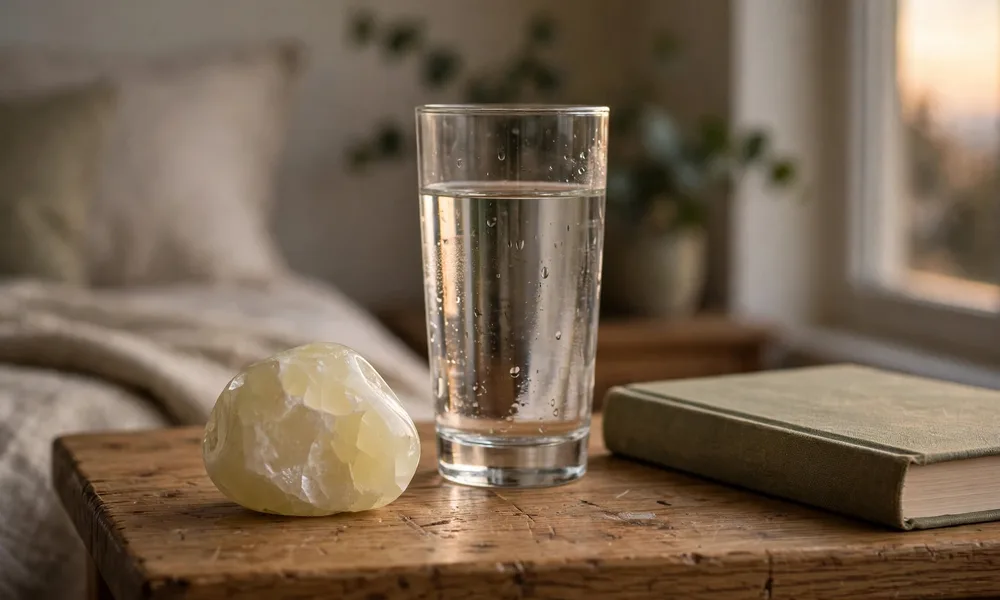
Datolite belongs on a tray in that kind of light. It is a soft yellow mineral, the colour of lemon peel left in the sun, often found as a smooth rounded nodule with a gentle waxy shine, and a polished piece feels cool in the hand.
Your glass stays separate from the stone, with a short space of dry cloth between them, and the stone itself stays dry.
Key Takeaways
- Datolite is a soft yellow mineral, often found as smooth rounded nodules.
- Its pale lemon colour suits bright days and rooms full of daylight.
- It is the only yellow stone in this journal that comes as a soft nodule.
- Hold it and look at it; that is all it is for.
- Your water stays in its own glass, apart from the stone, which stays dry.
What Datolite Is
Datolite is a calcium borosilicate, a mineral that grows in hollow pockets inside old volcanic rock, most famously around Lake Superior in Michigan. Its name comes from a Greek word meaning to divide, because the mineral breaks into small grains, and shop pieces are usually smooth pale nodules.
A polished piece is usually a small pebble or soft oval, cool to the touch, with a waxy shine. The yellow is gentle, a pale lemon, and held to a window it lets a little light through its edges. Datolite is a tender stone, softer than quartz, so it scratches easily and must be kept apart from harder pieces.
Picking a Datolite Piece
Choose a datolite piece in plain daylight, turning it slowly. Look for a colour that stays even as the stone moves, a pale lemon yellow with no chalky patches and no dark stains, and a surface smooth all over, with no rough pits and no sharp chips. A good piece glows softly in the light and sits comfortably in the palm.
Ask the seller where the stone came from and whether it is genuine datolite, since pale yellow nodules can look alike. A seller who can name where it was found, and who speaks plainly about how soft it is, is worth trusting.

A Bright Day with Datolite
A bright day needs almost nothing from you. Lay a pale cloth over the side table, put the stone near one corner, and set your glass near the opposite corner. Sip the water slowly as the stone gathers the daylight, and let the gentle yellow rest your eyes.
Datolite Beside Water
A glass and a stone make a pretty pair on a tray, yet they belong apart. Set the glass at one side and the stone at the other, leaving bare cloth between them, so your drink stays clean and the stone never gets wet.
Rinse your hands after handling the stone and ahead of picking up your glass. Do not drop the stone into any cup, jug, or bath, and do not pour water across it. Datolite is soft, and soaking can take the shine off it.
Datolite at a Glance
| Soft pale yellow | Bright tray, desk | Dry hands only |
|---|---|---|
| Translucent, smooth | Slow mornings, light | Glass kept apart |
| Nodules, Lake Superior | Open windows, calm | Never in drinks |
| Palm-sized pebble | One tray, one glass | Dust dry weekly |
| Pale lemon | Sunny tray | Keep dry |

Datolite and Yellow Sapphire
Yellow sapphire for bright days is a clear yellow corundum that sparkles brightly, like lemon rind held against the sun. Its cut faces throw light back in sharp glints, and its yellow runs deeper than datolite's pale lemon. It ranks among the hardest stones a shelf can hold.
Datolite is softer and quieter. Where the sapphire is faceted and sparkling, datolite is rounded and waxy, its glow spreading softly rather than flashing, and where the sapphire can sit beside any gem, datolite must be kept apart from harder stones. Both share a yellow colour and a love of bright days, but no one holding them together would mistake one for the other.
Datolite and Yellow Topaz and Yellow Zircon
Yellow topaz is warm yellow, clear and sparkling, the colour of lemon peel held up to the sun. Its facets send the light back in bright points, and its colour is deeper than the pale lemon of datolite.
Yellow zircon for bright days is warm golden-yellow, faceted and sparkling too, the colour of late morning sun through a clear window, cut to catch the light at every turn. Datolite stands apart because it is never faceted: a smooth nodule, soft and rounded, with a waxy shine instead of a sparkle, and a yellow paler and milkier than the clear gold of topaz or zircon.
Datolite and Yellow Agate and Yellow Moonstone
Yellow agate for bright days is a striped chalcedony, honey and cream bands crossing a sunny yellow ground, smooth in the hand and bright yet never loud. Yellow moonstone is a yellow feldspar, buttercup coloured, with a gentle light that drifts across it as it turns. Datolite has no bands and no drifting light: its yellow lies plain and even over a rounded nodule.
Datolite and Brazilianite, Cancrinite and the Other Yellow Stones
Brazilianite is a soft yellow stone with a faint, almost watery light, and cancrinite is a pale lemon-yellow mineral, its shine waxy and muted beside a cut gem. Both are close cousins to datolite in colour, yet each keeps its own shape: brazilianite grows in clear crystals, cancrinite in grainy masses, and datolite arrives as a smooth rounded nodule.
The rest of the yellow family is easy to tell apart too. Citrine is clear golden quartz; yellow jade is smooth and even; yellow calcite is soft and buttery; yellow jasper is opaque and earthy; yellow aventurine sparkles with tiny flakes; yellow spinel is small and bright; canary tourmaline is vivid yellow-green; lemon quartz is pale and glassy; mimetite is a waxy yellow crust; bumblebee jasper is banded in yellow and black; and yellow fluorite is a clear glassy cube. None of them is a soft pale nodule like datolite.
Datolite and the Other Stones in This Batch
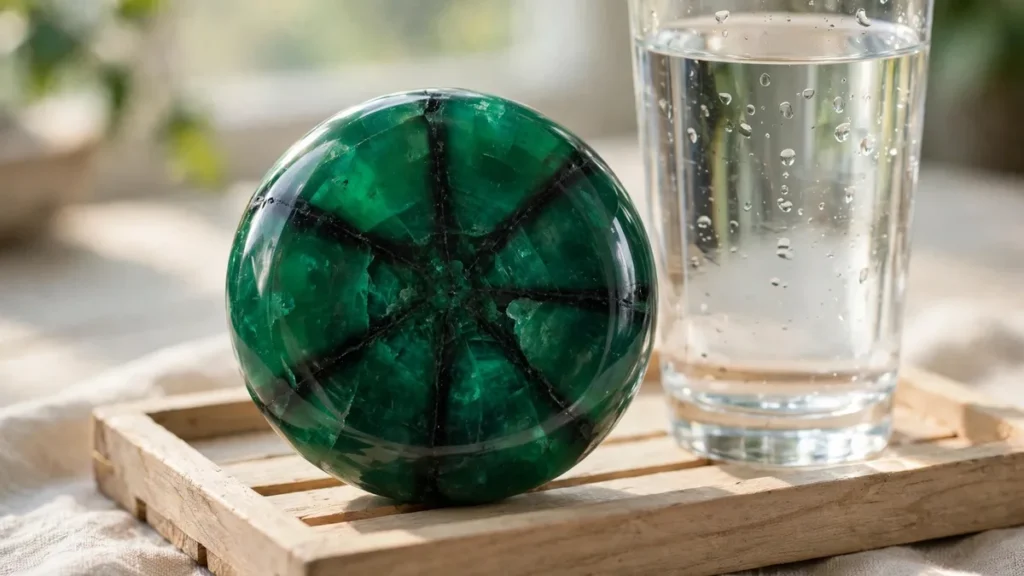
This batch holds four other stones beside datolite, each a different colour. Trapiche emerald is a fresh green stone with a star of spokes through its heart, zultanite shifts its colour as the light changes, euclase is a soft blue stone for calm days, and chrome chalcedony is a fresh green stone for calm days. Datolite is the only soft yellow stone among them.
The batch also holds a fountain, a public water feature in a park: datolite sits still on a tray beside a glass, while a fountain pours water outdoors for everyone to watch. One is a pebble for bright days at home, the other a place to visit.

Keeping Datolite at Home
Datolite does best somewhere bright yet sheltered, in a room that stays orderly. Try the sill by the morning window, a corner of the desk, or a small dish on the drawers, anywhere it can be seen easily and kept clear of bumps and splashes.
Keep the tray far from taps, kettles, and steamy washrooms, and out of reach of young children. Dust the stone weekly with a soft, dry cloth, and never use soap, polish, or sprays, since moisture and chemicals can dull the shine. When it is not on display, keep it by itself in a small cotton pouch, away from keys and harder gems.
Stones That Must Stay Away from Water
Certain stones carry substances that have no business in a drink, so it helps to know them by name. Malachite is green with copper running through it, and copper is not for swallowing, so malachite stays out of water and out of every drink made with stones.
Hematite can rust and stain, and it does not belong in a glass either. Apatite, lepidolite, which holds lithium, and pyrite all need to stay dry, angelite melts away in water, and amber, old tree sap turned hard, goes cloudy in a soak. Keep all of them away from food and drink, and keep datolite the same way: beside the glass, never inside it. A stone will not heal anything, and a glass of water is only water, so enjoy both for what they are and ask your own doctor about any health worry.
Your Bright Days Checklist
- Set the stone on dry cloth, with the glass a short way off.
- Sip the water slowly, taking your time.
- Pick the stone up, feel how cool it is, and put it back.
- Put the stone away on its tray before you wash your hands.
- Buy from a seller who tells you plainly where it came from.
- For any health worry, please ask your own doctor, never a stone.
Frequently Asked Questions
What is datolite?
Datolite is a calcium borosilicate, a mineral that grows in hollow pockets inside old volcanic rock, most famously in the basalt around Lake Superior. Its soft yellow pieces are usually smooth rounded nodules.
Where does datolite come from?
Datolite comes from the Lake Superior region in the north of America, and from other old volcanic places, including parts of New Jersey and Connecticut. It forms in cracks and pockets in basalt, where its rounded nodules grow slowly.
How is datolite different from yellow sapphire?
Yellow sapphire is a hard, faceted corundum that sparkles in sharp points of light, while datolite is a soft, rounded nodule with a quiet waxy glow. The two feel nothing alike in the hand.
How is datolite different from yellow agate?
Yellow agate is banded, striped with honey and cream, while datolite is plain and even, with no stripes at all. Datolite is also softer, and it arrives as a smooth nodule rather than a banded slice.
Is datolite safe to hold?
A short hold of a small polished piece troubles almost nobody. When you finish, set it back in its place, rinse your hands, and keep it somewhere small children cannot reach.
Where should I keep datolite at home?
A dry sunny sill, a desk corner, or a dish on the drawers all work well. Keep it away from the glass, out of strong sun, and apart from harder gems.
The Bottom Line
Datolite fits bright days: a soft yellow nodule in the light, your water in its own glass, the stone left dry.
A Note for Bright Days
Pale lemon light, a dry stone, a full glass — a bright day asks for nothing more.