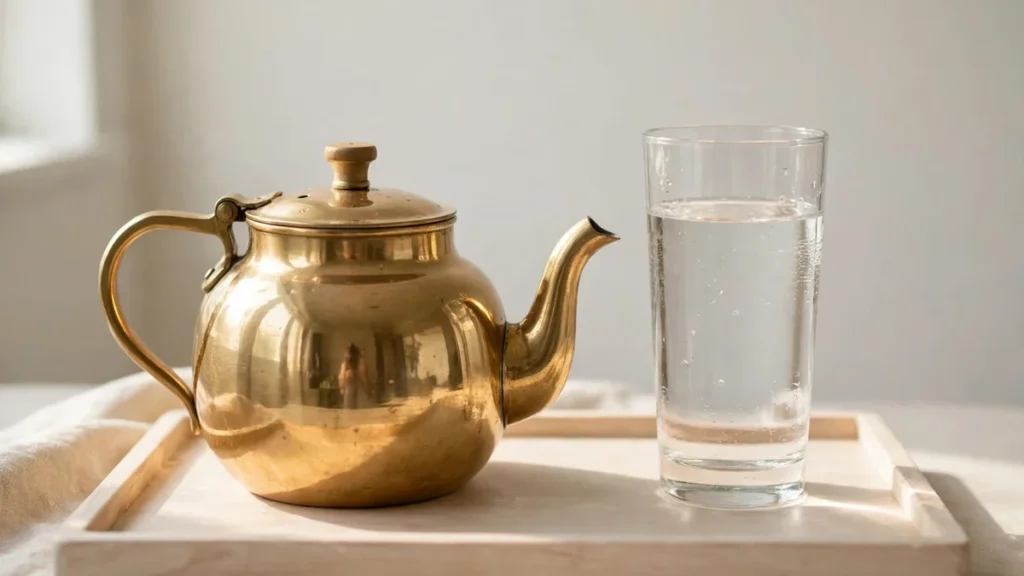
A straight black cone, lying still on a tray in a quiet room, is the first sight orthoceras gives you. It is not a crystal that grew in a cave. It is the shell of a sea animal that swam in oceans hundreds of millions of years ago. When the animal died, its shell sank into mud, and minerals took its place grain by grain until the cone had turned to stone.
Such an old thing belongs on a slow day. When the house is still and the hours stretch out, a small dark fossil on a tray gives the corner a quiet centre. All it needs is a dry spot, some room around it, and one strict rule about water.
Water is the rule that shapes this whole guide, so it comes first. Orthoceras is a fossil to look at and to hold for a moment, nothing more. Keep it on its tray, keep it away from every drink, and wash your hands once you have handled it. Once that is clear, the rest is pleasure: what the fossil is, how it differs from the coiled ammonite, and where it sits best at home.
Key Takeaways
- Orthoceras is the fossil of a straight-shelled sea animal, hundreds of millions of years old.
- Its deep black colour and straight lines suit quiet days, slow rooms and soft light.
- Orthoceras is a display piece only; it treats nothing and promises nothing.
- The fossil sits beside the glass, never in it, and it must stay dry always.
- One small slab on a plain tray is plenty for a whole quiet day.
What Orthoceras Is
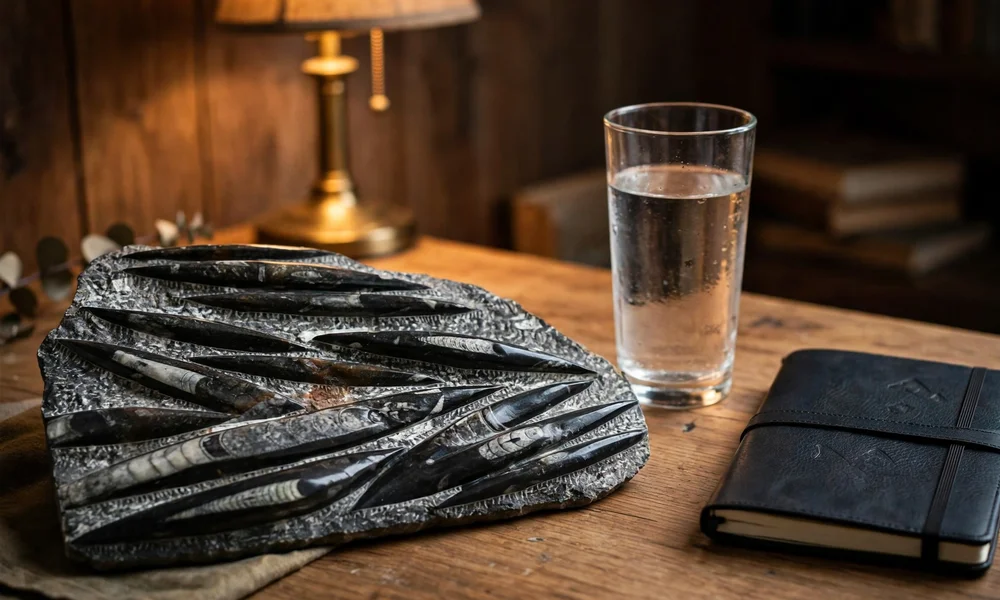
Orthoceras was a sea animal with a long, straight shell, shaped like a tapering cone, divided inside into a row of small chambers. The animal lived in the largest chamber at the open end, adding new chambers behind it as it grew. The shell is usually black or dark grey today, polished to a soft shine that shows the chamber walls as pale lines across the cone.
The best-known pieces come from Morocco, where collectors cut and polish dark limestone slabs holding several straight shells side by side. A single loose cone is common too, small enough to rest across one palm. The stone feels cool, heavy and smooth, and its straight lines give it a calm, orderly look.
Why Deep Black Suits Quiet Days
Black belongs to a room at rest. It never calls out the way a bright stone does, and it never melts into the wall the way a pale one can. A deep black fossil on a tray catches the eye for a moment, then releases it.
Orthoceras and Ammonite: Straight Shell, Coiled Shell
Ammonite warm brown for steady days follows a fossil whose shell winds into a spiral, warm brown and ridged, chamber by chamber. The animal that lived in it swam in seas that disappeared long before people, a far-off relative of the squid.
Orthoceras could hardly be shaped more differently. Its shell runs straight from tip to opening, a long cone rather than a coil, and its colour is deep black where ammonite's is warm brown. Both are fossils of shelled sea animals, both millions of years old, and both sit beside the glass and never in it. One winds round, the other points straight ahead.
Choosing an Orthoceras Piece
Judge an orthoceras piece by daylight, not by a shop lamp. A sound slab shows two or three straight cones in one even, deep black, with pale chamber lines crossing each shell cleanly and no washed-out patches where the polish has thinned. The dark stone around the shells should feel solid and unbroken.
Choose a piece near the size of a plum, or a small slab near the size of your hand, and inspect the surface with your eyes only — a nail can dull the polish in one stroke. Find out from the seller where the piece was dug up, and leave the shop if anyone tells you the fossil can heal you.
A Quiet Morning with Orthoceras
Begin the morning by giving the fossil its place. Spread a folded grey cloth over the side table, place the orthoceras where its longest cone faces the window, and stand a tall glass of water at the far end.
Spend a minute turning the slab over in your hands, following one straight cone from tip to open end, then set it back on the cloth. Once the glass is drained, the little quiet rite is finished, and the fossil may rest there till evening.
Orthoceras Beside Water
Water and fossil can sit on one tray as long as they never meet. Stand the glass at one end, the slab at the other, and keep a bare strip of wood or cloth between them so no splash crosses over. Keep the fossil away from every vessel that holds a drink, and never hold it under a running tap, since soaking can take the shine off the polish. A weekly wipe with a soft dry cloth is the only cleaning it needs.

Orthoceras at a Glance
| Straight black cone fossil | Tray, shelf, desk | Dry hands only |
|---|---|---|
| Ancient sea shell, Morocco | Quiet days, soft light | Glass kept apart |
| Cool, heavy, polished stone | One small slab | Wash hands after |
| Plum-sized piece | Wood, cloth, lamplight | Keep it dry |
Orthoceras and Fossil Coral: Shell and Honeycomb
Fossil coral warm patterns for ancient days follows a stone in warm honey, rust and cream, its face marked with tiny six-sided cells and rings like small flowers — the old homes of sea creatures that lived in warm shallow water. The marks crowd together like a honeycomb, and no two pieces are marked alike.
Orthoceras shares the ancient sea but little else. Its pattern is a few long straight cones, bold and plain, where fossil coral's pattern is hundreds of tiny cells, busy and fine. Fossil coral is warm honey and rust; orthoceras is deep black. Both are fossils turned to stone over millions of years, and both stay beside the glass, never in it.
Orthoceras and Petrified Wood: Sea and Forest
Petrified wood ancient calm for slow living keeps the remains of a tree that lay buried until its wood turned to stone, rings and grain still showing. Its lines follow the grain, warm and woody.
Orthoceras comes from the opposite world. It is a sea shell turned to stone, not a tree, and its lines run straight across the cone as chamber walls, not along a grain. Petrified wood is warm and brown; orthoceras is black and cool. What the two share is age, and the same dry-tray rule.
Orthoceras Among the Other Stones in This Batch
This batch holds four more minerals beside orthoceras, each wearing a colour far from deep black. Goethite is warm brown, earthy and steady. Bornite is soft and shifting, sliding from bronze to blue. Galena is soft grey, heavy and metallic, and sphalerite is warm gold, bright where orthoceras is dark.
The nearest water article is water and a fire pit, a beginner's guide to a safe outdoor fire with water close by. The other water rituals in this batch are water and a hammock, water and an umbrella, water and wellies, and water and a wool scarf. Orthoceras holds the deep black corner of the batch, the one straight-lined note among browns, bronzes, greys and golds.
Where Orthoceras Rests at Home
Give it a spot people pass every day but seldom bump — the quiet end of a worktop, or a ledge above head height — away from taps, kettles and steam, and out of reach of small hands and pets.
Once a week, lift it by its edges and look over the polish for dull spots. For a journey, cushion it in tissue inside a padded box of its own.
Stones That Must Stay Away from Water
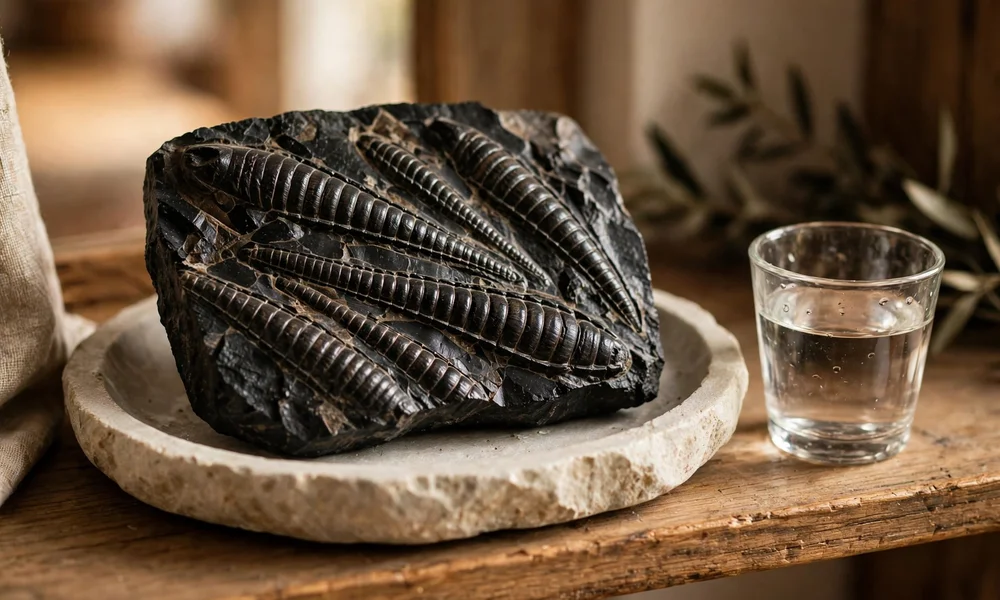
Before any stone goes beside a drink, learn the names that must never be wetted. Malachite is one: its green bands hide copper, and copper has no business near a mouth, so keep that stone far from jugs and tumblers. Hematite is another — leave it wet and it rusts, marking skin and cloth, so it never goes near drinking water either.
Then there are the stones water quietly ruins. Soaking makes apatite fall apart, and angelite loses its clear look after one wetting; both live on dry shelves. Lepidolite's pale flakes hold lithium, so drinks stay well clear of it. Amber, old tree resin turned hard, goes milky in a soak. Pyrite stains and tarnishes if it stays damp. Keep orthoceras under the same rule: tray dry, glass apart, hands washed once the fossil is back down.
Your Quiet Days Checklist
- Lay the orthoceras on a dry cloth, with the glass a good hand's width away.
- Drink the water unhurriedly, in small sips, while the light is soft.
- Look along the straight cones and count the pale chamber lines.
- Put the slab back on its tray, then wash your hands with soap.
- Buy from a seller who can say plainly which quarry the piece came from.
- If a health worry will not go away, take it to a doctor — no old fossil can settle it.
Cloth, glass, tray and one small dark fossil — nothing else is needed.
Frequently Asked Questions
What is orthoceras, in plain words?
Orthoceras is the fossil of a straight-shelled sea animal, a long tapering cone divided into chambers, turned to black stone over millions of years.
Why is orthoceras kept out of water?
Soaking can dull the polish of this fossil, so it never goes into drinking water, a soak or a bath. If it ever drops into a glass, pour the water away and wash the glass well.
How can I tell orthoceras from ammonite?
Ammonite is a coiled shell that winds round in a spiral, while orthoceras is a straight cone from tip to open end, so the shape alone tells them apart.
How do I pick a good orthoceras piece?
Look for straight cones of one even deep black in daylight, with clean pale chamber lines and no worn patches.
Is it all right to hold orthoceras for a short while?
Most adults can pick up a small dry slab by its edges for a brief look, then put it down and wash their hands.
Where should orthoceras live at home?
A dry shelf in soft light suits it — somewhere high, away from water, steam, small hands and pets.

The Bottom Line
One deep black fossil kept dry, and water that stays in its glass: that is all a quiet day asks of orthoceras.
A Note for Quiet Days
A dark fossil kept dry, a glass standing clear, and evening light drifting across the room — that is the whole of it.