There are mornings when the house runs on rails: breakfast plates stack in the sink in the same order, the post arrives while the kettle is still singing, and the hours pass without a single surprise. Marcasite belongs on mornings like those, a brassy gold mineral, bright as a new coin in a sunbeam.
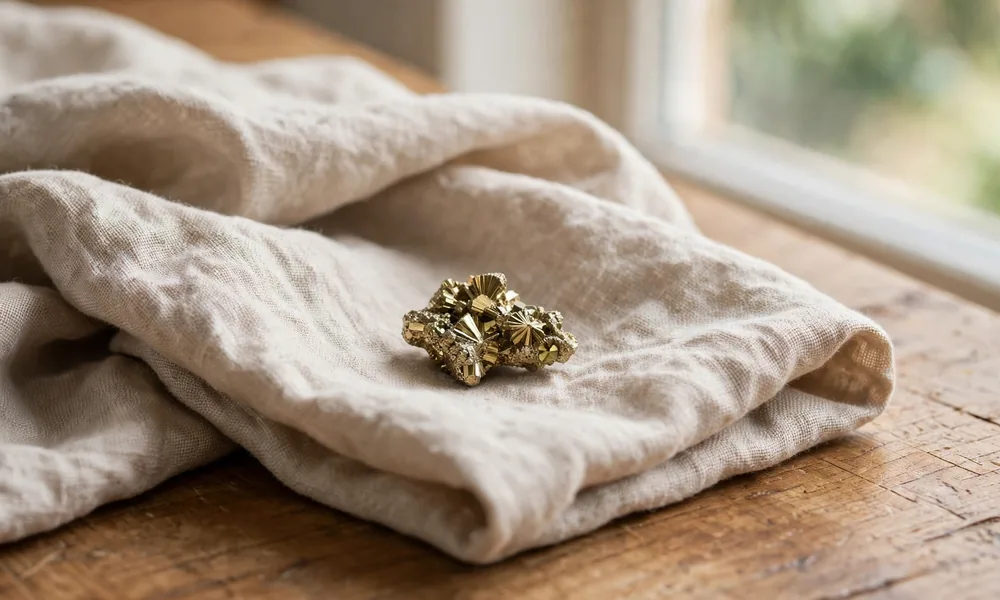
Turn a piece under a lamp and dozens of tiny flat faces answer back with small sharp sparkles. The colour sits between pale bronze and full gold.
This guide takes marcasite slowly and plainly: the mineral it is, the famous cousin it is so often mixed up with, how to pick a sound piece, and the dry shelf where it lives beside a glass of water. It is a handsome thing to look at and to hold for a minute, and nothing beyond that.
Key Takeaways
- Marcasite is iron sulfide, a brassy gold mineral whose crystals often grow in jagged crested clusters.
- It shares its chemistry with pyrite yet builds its crystals differently, and the two are not the same.
- Warm gold suits unhurried days and plain routines.
- Marcasite must stay dry: damp air can dull it and make it crumble.
- One small bright piece on a plain tray is plenty for a whole steady day.
What Marcasite Is
Marcasite is a mineral made of iron and sulfur, the same two ingredients that make pyrite. Its crystals grow in the orthorhombic pattern, forming spear-shaped points and crested clusters, all sharp edges and crowded points. A fresh piece gleams, pale gold at first glance and deeper bronze where the light falls away.
It turns up in chalk beds, clay seams, and coal country. Today it mostly lives in collections and on display shelves, where dry air keeps its gold bright.
Why Warm Gold Fits Steady Days
Gold has a reputation for flash, yet the gold of marcasite is a working gold, the colour of brass door handles and wheat in late summer. It does not shout. It sits quietly on the tray and catches the light whenever the sun moves across the room.
A steady day is built the same way, from small repeated jobs rather than grand gestures: the washing goes out, the bread is sliced, the letters are answered, and the hours pass without fuss. A bright stone fits that rhythm because it asks for nothing.
Marcasite and Pyrite: Same Recipe, Different Build
Pyrite shine with warm metal tones is the bold gold cousin of this stone, a brassy mineral that grows in neat cubes and clusters. Pyrite and marcasite share the exact same recipe, iron sulfide, FeS2, yet they build their crystals in different patterns: pyrite grows cubic, forming square faces and straight-edged cubes, while marcasite grows orthorhombic, forming spears and crested combs.
That difference shows the moment the two sit side by side. Pyrite looks orderly, its flat square faces lined up like tiles, and its gold runs deep and brassy. Marcasite looks wilder, its points crowded and uneven, its gold paler and sharper. Pyrite is the steadier of the pair in dry air, while marcasite is the more fragile one: damp air can tarnish it, and a neglected piece can powder and fall apart where pyrite would only dull.
Choosing a Marcasite Piece
Look for marcasite in daylight, by a window or out in the open air, where its gold can be judged honestly. A good piece shows a bright, even gold across its faces, with no grey crust and no powdery patches. The crystal points should feel firm, not loose, and the piece should sit flat without rocking.
Pick a size that fits the palm, about the size of a walnut or a little larger. Ask the seller where the piece was found and how it has been kept, and walk away from any seller who claims the stone can improve health, sleep, or luck. Leave behind any piece whose gold looks painted on.
A Steady Morning with Marcasite
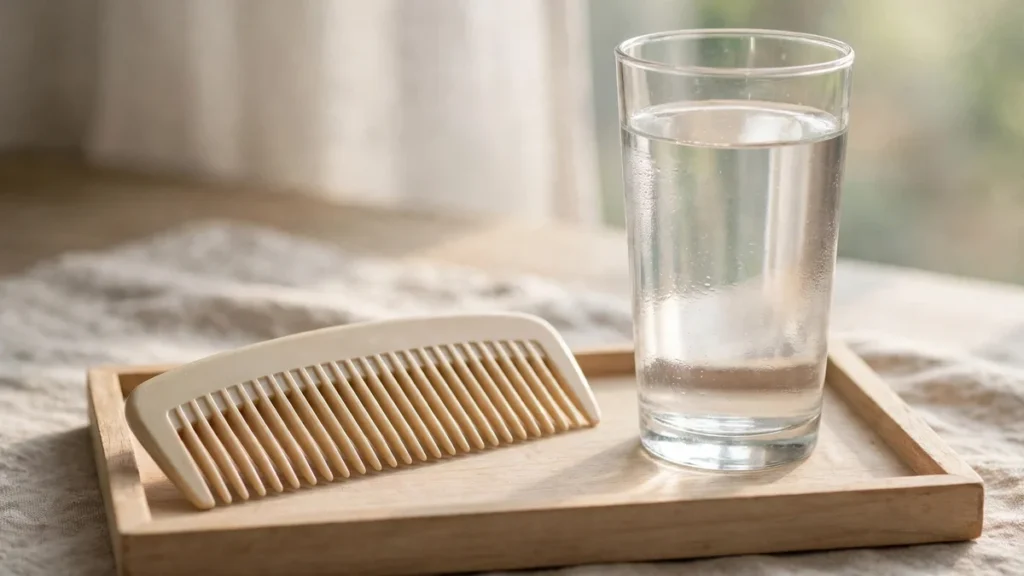
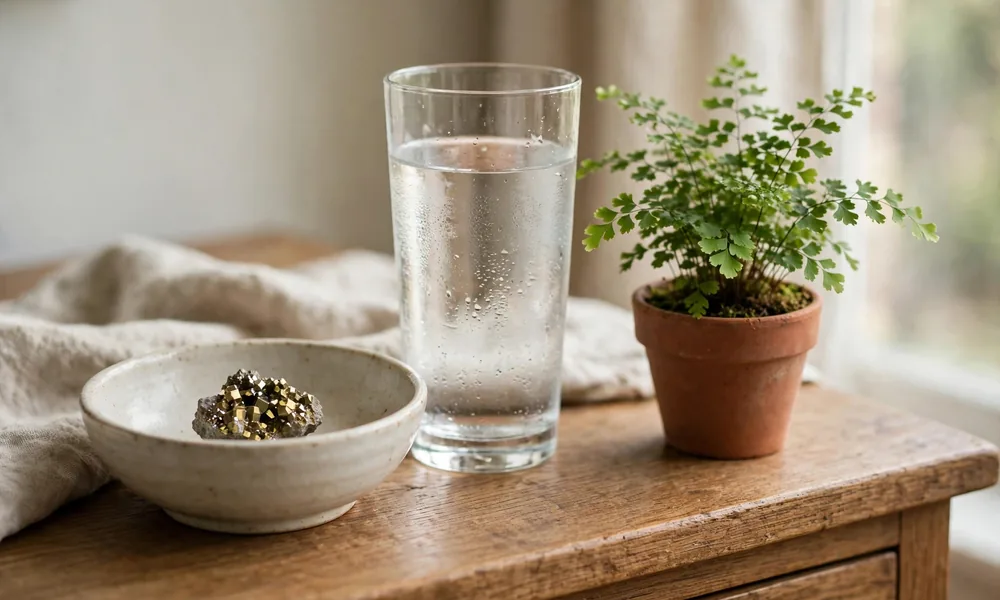
Mornings set the tone, so give the stone a small place in the first hour. Lay a folded beige cloth on the side table, set the marcasite at one end with its brightest face toward the window, and put a tall glass of water at the far end, with dry cloth between the two. Drink the water slowly while the stone gathers the morning light.
There is no task to complete and no order of steps to memorise. When the glass is empty, the morning's work is done.
Marcasite Beside Water
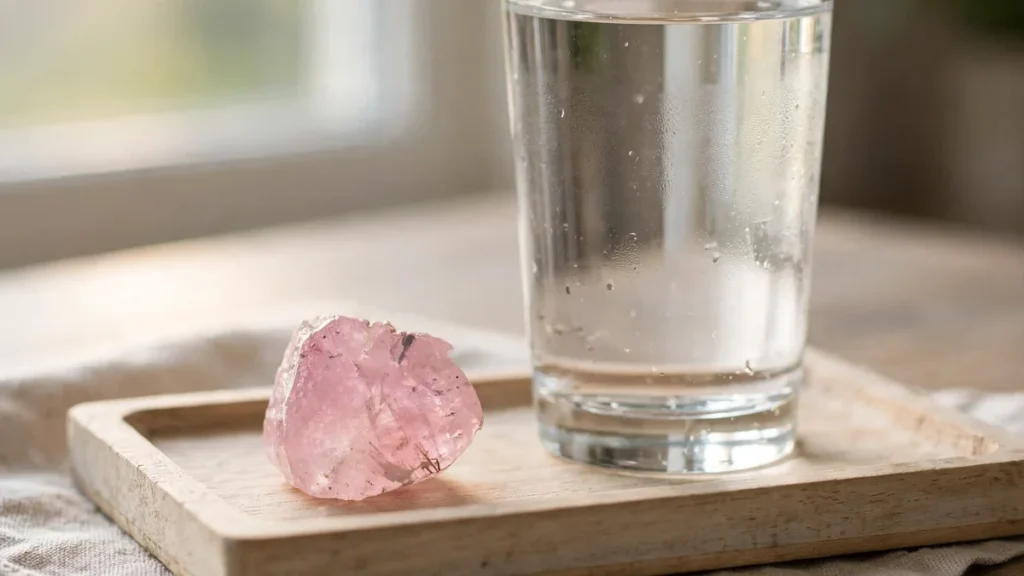
Water and marcasite make a pleasant pair on one tray, yet their places must never change hands. Keep the tumbler at one end and the stone at the other, with bare cloth or wood in between, so the drink stays clear and the stone stays untouched by any splash. Wash your hands with soap before you lift the glass.
Keep it out of every glass, jug, and bath, and never hold it under a running tap. Dampness is the one thing that spoils marcasite: it can dull the gold and in time make the crystal points crumble. A soft dry cloth, drawn gently across the faces once a week, is the only cleaning it ever needs.
Marcasite at a Glance
| Pale bronze gold | Tray, shelf, desk | Dry hands only |
|---|---|---|
| Crested, spear-like points | Steady days, slow hours | Glass kept apart |
| Iron sulfide, FeS2 | One bright accent | Keep it dry |
| Walnut-sized piece | Wood, cloth, lamplight | Wipe dry weekly |
Marcasite and Titanite
Titanite warm gold for bright days follows a honeyed gold mineral whose colour slides toward green as the piece is turned, a trick of the light called pleochroism. Titanite grows in flat wedge-shaped crystals, and a faceted piece throws quick flashes as the sun moves across the tray.
Marcasite shares the warm gold yet keeps a very different character. Titanite is clear and glassy, its gold glowing from inside the stone, while marcasite is opaque and metallic, its gold sitting on the surface like polished brass.
Marcasite and Scheelite
Scheelite warm gold for bright days follows a calcium tungstate mineral, usually warm gold, with a clear glassy sparkle in daylight. A cut scheelite feels cool at first touch and noticeably heavy for its size, because tungsten is dense, and its facets throw a lively sparkle across a sunny shelf.
Marcasite is the rougher, earthier member of the pair. Where scheelite is smooth, glassy, and cut into neat facets, marcasite is jagged and clustered, its gold broken into dozens of tiny flat faces. Scheelite keeps its colour in ordinary air, while marcasite is far more fragile in dampness.
Marcasite Among the Other Stones in This Batch
This batch holds four more minerals beside marcasite, and each one wears a colour far from gold. Pyromorphite is a warm green mineral, bright as new leaves after rain, where marcasite keeps the colour of brass. Sillimanite is a clear white stone, quiet and pale. Taaffeite is a soft violet gem, rare and gentle in tone, while marcasite is common and brash by comparison. Serendibite is a deep blue stone, dark as evening water. Marcasite holds the middle of the tray among them, the one bright metal note.
Where Marcasite Rests at Home
Pick a corner the household walks past but never knocks into: the end of a worktop, a high ledge, or the top drawer of a cabinet. Sun from the morning window suits it, and the perch needs to stay clear of taps, kettles, and steamy air, and out of the way of little fingers.
Once a week, brush the dust away with a dry soft cloth and look over the points for grey film or loose grains. When the piece leaves its tray, give it a small lined box of its own, away from keys, coins, and anything harder that could mark it.

Stones That Must Stay Away from Water
Some minerals carry a sharper warning than marcasite, and knowing their names keeps every shelf safer. Malachite holds copper in its green bands, and copper has no business near a mouth, so the stone stays far from every jug and tumbler. Hematite left in dampness can rust and stain skin and cloth, so it stays out of drinking water too.
Soaking ruins apatite, which softens and falls apart, and a wet angelite goes dull and cloudy, so give both a dry shelf. Lepidolite carries lithium in its pale flakes, so keep every drink far from it. Amber, old tree sap grown hard over long ages, goes milky in a soak. Treat marcasite the same way: admire it beside the glass, never inside it, and keep every one of these stones far from food and drink.
Your Steady Days Checklist
- Lay the marcasite on a dry cloth, with the tumbler well clear of it.
- Drink the water slowly, a mouthful at a time.
- Lift the stone and turn its brightest faces to the window.
- Put the piece back on its tray, then wash your hands.
- Buy from a shop that says plainly where the stone was dug up.
- If a health worry hangs on, ask a doctor — a gold stone cannot answer it.
A tray, a glass, a dry cloth, and one bright gold stone: that is the whole arrangement.
Frequently Asked Questions
What exactly is marcasite?
Marcasite is a mineral of iron and sulfur, FeS2, that grows in spear-shaped crystals and crested clusters, with a bright metallic gold from pale bronze to deep brass.
How is marcasite different from pyrite?
Both are iron sulfide with the same chemistry, yet pyrite builds its crystals in a cubic pattern with square faces, while marcasite builds them in an orthorhombic pattern with spears and crests, and marcasite tarnishes in damp air far more readily than pyrite does.
Can I put marcasite in water?
No. Marcasite must stay out of drinking water, out of soaks, and out of baths, because dampness dulls its gold and can make its points crumble, so the stone sits beside the glass and never in it.
How do I spot a good marcasite piece?
Look for bright even gold in daylight, firm points with no loose grains, no grey crust, and a seller who can say plainly where the piece was found.
Is marcasite safe to hold for a moment?
A brief hold of a small dry piece suits most adults, as long as you wash your hands once you have set it down.
Where should marcasite live at home?
Keep it on a dry spot in soft light, such as the end of a desk or a shelf by the morning window, well away from water, steam, and small hands.

The Bottom Line
For a steady day, marcasite is enough: one bright gold stone kept dry on its tray, and water that stays in its own glass.
A Note for Steady Days
Gold on the tray, water in the glass, and nothing wet near the stone — a steady day asks for little more than that.