Some stones are easy to find in any shop, and some are so scarce that most people never see one in person. Grandidierite belongs to the second group. It is a rare blue-green mineral, first found in Madagascar, and good pieces are still few and far between. The colour is quiet: a soft blue-green between a still lagoon and a shaded leaf, changing a little as the stone turns.
That shifting colour is the stone's best trick. Tilt a piece one way and the blue comes forward; tilt it another way and the green takes over; tilt it again and parts of it go almost clear. Gem cutters call this change pleochroism: the stone shows different colours from different angles.
Grandidierite is a beautiful object to look at and to hold for a little while, and nothing more. It will not change your mood, your sleep, or your health, and it should never go near drinking water. Keep the glass apart from the stone and enjoy the colour.
Key Takeaways
- Grandidierite is a rare soft blue-green stone from Madagascar that shifts colour as it turns.
- Its blue-green suits calm days, slow mornings, and rooms with gentle daylight.
- The stone is scarce and costly, so small polished pieces are the usual way to enjoy it.
- Grandidierite is an object to admire and hold for a moment; it cures nothing.
- Drink from your own glass, and leave the stone dry beside it.
What Grandidierite Is
Grandidierite is a rare mineral named after Alfred Grandidier, a French explorer who studied Madagascar. The first pieces were found in the south of that island in the early nineteen hundreds, and Madagascar remains the source of most good pieces. Small finds have turned up elsewhere, but it is still one of the rarest blue-green minerals a collector can meet.
The colour is what people notice first. A fine piece is a soft blue-green, neither fully blue nor fully green, and the balance shifts as the stone moves. Light travels through the crystal at different speeds in different directions, and each direction shows a different shade.
Most grandidierite is sold as a small polished piece, a tumbled stone, or a tiny faceted gem. Large pieces are almost unheard of, and a piece about the size of a grape is already generous.
Picking a Grandidierite Piece
Choose a grandidierite piece in plain daylight, away from shop lamps that flatter every blue. Hold it flat and look from several angles: the blue-green should stay soft and clear, and the colour should shift gently as you turn it. A piece dull grey from every angle is poor, and one bright only under a lamp may disappoint at home.
Ask the seller where the stone was found and whether the colour is natural. Check for chips along the edges, since this stone is not as hard as some. Buy the smallest piece that pleases you, and keep the receipt.

A Calm Day with Grandidierite
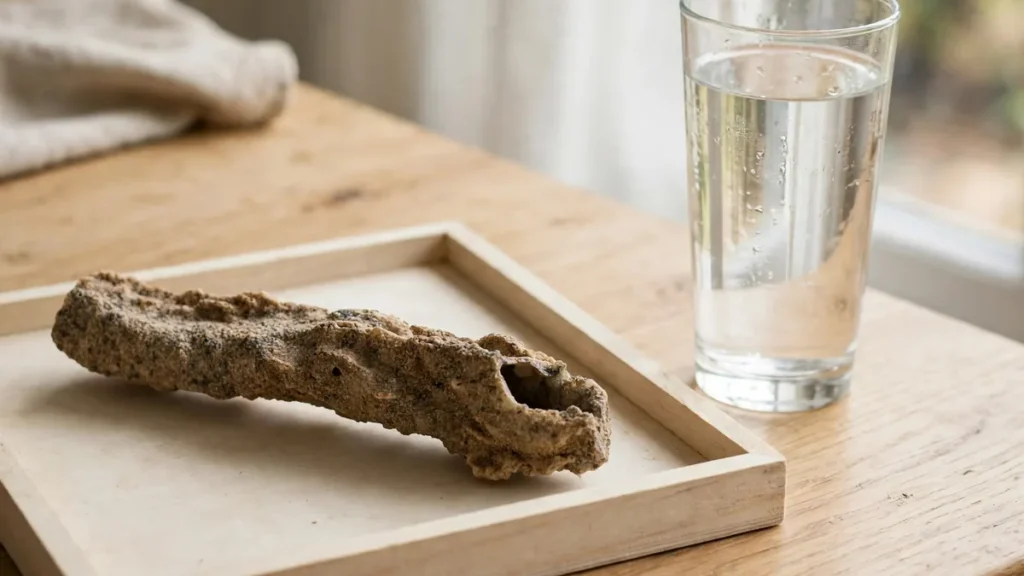
A calm day with grandidierite starts with the stone in plain sight. Lay a pale cloth on the dressing table, set the stone near the front edge where the morning light reaches it, and place a glass of water at the far end. Drink the water in slow sips while the daylight moves across the stone.
The stone suits a slow morning because it asks for nothing. Leave it where the light falls and glance at it when you pass. In the afternoon, move it to the windowsill for an hour, then back to its tray.
Grandidierite Beside Water
Water and grandidierite look lovely side by side, yet they must never meet. Set the tumbler on one side of the tray and the stone on the other, with bare wood showing between them. Wash your hands after handling the stone, and only then lift your drink.
The stone never goes into a glass, a jug, or a bath, and no water is poured across it. A dry cloth wipe is the only cleaning it needs: the stone stays on its tray, and the water stays in its cup.
Grandidierite at a Glance
| Soft blue-green | Pale tray, desk | Dry hands only |
|---|---|---|
| Shifts blue, green | Calm days, light | Glass kept apart |
| Rare, small pieces | One accent, plain | Never in drinks |
| Smooth, cool, solid | Clear window light | Never soak stone |
| Madagascar mineral | Tidy shelf, tray | Dust dry weekly |

Grandidierite and Euclase
Euclase for calm days is the palest blue stone in this journal. It grows as a long, slender prism with fine lines down its length, and its colour is a soft washed blue, like a sky that has cleared after rain. It splits easily, so it is handled gently.
Grandidierite is warmer and greener than euclase, and it changes colour as it turns, while euclase keeps one steady pale blue. Euclase is a straight prism; grandidierite is usually a smooth polished piece. One is quiet blue, the other shifting blue-green.
Grandidierite and Gem Silica
Gem silica for bright days is a blue-green chalcedony, clear and glassy like sunlit shallows, with a bright, vivid blue-green that glows in the light.
Grandidierite is softer and quieter than gem silica, and its colour change is subtler: a slow shift between blue and green rather than a bright glow. Gem silica is common in shops, while a small grandidierite piece is a real find.
Grandidierite and Paraiba Tourmaline
Paraiba tourmaline for fresh days is a vivid blue-green tourmaline, the colour of tropical sea water in bright sun, glowing from every face. Its colour is bold and electric, and it suits fresh days.
Grandidierite is the quiet cousin of paraiba tourmaline. Where paraiba glows bright and vivid, grandidierite stays soft and muted, and where paraiba shows one strong aqua, grandidierite shows blue, then green, then almost nothing.
Grandidierite and the Other Blue Stones
The rest of the blue family in this journal is large, and each member is easy to tell apart. Aquamarine is a pale blue beryl that keeps one steady blue, turquoise is bright blue with fine dark veins, blue topaz is clear and cool, lapis lazuli is deep blue flecked with gold, sodalite is deep blue, and azurite is deep blue too. Amazonite is soft blue-green with white streaks, chrysocolla is mottled blue-green with brown, abalone is a shining sea shell, blue pearl is a soft blue bead, blue jasper is matte blue, blue agate wears soft bands, blue onyx is cool blue, blue spinel is clear cool blue, blue zircon is bright clear blue, blue fluorite is cool blue with faint stripes, blue quartz is soft blue, blue calcite cool blue, blue chalcedony soft blue, blue opal shimmers softly, peruvian opal soft blue, and cavansite shows blue bursts on pale stone. Dumortierite is deep blue, shattuckite soft blue, hemimorphite light blue, blue kyanite clear blue, iolite violet-blue, indicolite deep blue, blue tigers eye deep blue with silky bands, blue goldstone starry blue glass, blue aventurine deep blue, blue coral soft blue, blue jade soft blue, covellite deep blue, benitoite deep blue, cobalt spinel deep blue, maxixe beryl soft blue, teal sapphire soft blue-green, star sapphire carries a star, blue sapphire classic deep blue, colour change sapphire shifts in different light, bi-colour sapphire shows two colours, black sapphire deep black, white sapphire clear white, green sapphire fresh green, yellow sapphire warm yellow, pink sapphire soft pink, purple sapphire soft violet, orange sapphire warm orange, padparadscha sapphire soft peach, blue amber soft blue resin, and blue obsidian is usually man-made glass, said so honestly. None of them shifts between blue, green and near-colourless the way grandidierite does.
Keeping Grandidierite at Home
Grandidierite is happiest in a bright, tidy spot: a shelf near the morning window, an open patch of desk, or a little dish on the drawers, where you can see it and nothing can nudge it off. Keep the tray away from sinks and steam, and keep it where small children cannot reach. Dust it weekly with a soft, dry cloth, and skip soap and sprays. Off display, rest it alone in a small soft pouch, apart from keys and harder stones.

Stones That Must Stay Away from Water
Some stones carry things inside them that should never reach a drink, and the safest habit is to keep every stone out of the glass. The green bands of malachite are rich in copper, a metal that must never be swallowed, so malachite is kept well away from water and from any drink made with stones. Hematite belongs out of drinking water as well, and so do apatite and pyrite. Lepidolite carries lithium, so it never goes near a drink either. Angelite fades and loses its polish when wet, and amber, old tree sap grown hard, turns cloudy after a soak and never belongs in drinking water. Grandidierite rests beside the glass.
Your Calm Days Checklist
- Lay the stone on a dry cloth, glass set apart.
- Drink your water slowly, with no rush.
- Turn the stone gently and watch the colours shift.
- Return the stone to its tray before washing your hands.
- Choose a seller who tells you plainly where the stone came from.
- For any health concern, talk to your doctor, not a stone.

Frequently Asked Questions
What is grandidierite?
Grandidierite is a rare blue-green mineral from Madagascar, named after explorer Alfred Grandidier. Its colour shifts between blue, green and near-colourless as it turns.
Where does grandidierite come from?
Most good grandidierite comes from southern Madagascar, where the first pieces were found in the early nineteen hundreds. Small finds have turned up elsewhere, but it stays rare.
Why does grandidierite change colour?
Light travels through the crystal at different speeds in different directions, and each direction shows a different shade. Turn the stone slowly and the faces take turns.
How is grandidierite different from aquamarine?
Aquamarine is a pale blue beryl that keeps one steady blue from every angle. Grandidierite is greener, rarer, and shifts between blue, green and near-colourless as it turns.
Is grandidierite safe to hold?
A brief hold of a small polished piece is fine for nearly everyone, since a dry stone gives off nothing. Put it back when you are done, then wash your hands.
Where should I keep grandidierite at home?
Any dry, bright spot works: a shelf, a desk corner, or a small dish on the drawers. Keep the stone away from the glass, safe from bumps, and out of steamy rooms.
The Bottom Line
Grandidierite fits calm days: a rare soft blue-green stone that shifts colour in the light, a glass of water nearby, and the stone kept dry.
A Note for Calm Days
One rare stone, two quiet colours, a dry tray, a full glass — a calm day asks for nothing more.