
Most blue stones arrive in the hand as smooth pebbles or round beads. Euclase arrives differently: it grows as a long, slender prism, straight-edged and cool, with fine lines running down its length, and the moment you pick it up you know it is not a pebble at all.
The colour is a soft, washed blue, the blue of a sky that has cleared after rain. It never shouts, and it never flashes. In gentle daylight the prism seems to hold the light inside itself for a second before letting it go, and that quiet glow suits slow days.
This guide looks at euclase in plain words: what the stone is, how to pick a good piece, how to enjoy it through a calm day, and how to keep it dry beside a glass of water. The stone is something to look at and to hold for a little while, and nothing more.
Key Takeaways
- Euclase is a pale blue mineral that grows in long slender prisms with fine lines down their length.
- Its soft blue suits calm days, slow mornings, and tidy rooms.
- Euclase splits easily along its length, so it is handled gently.
- The stone is for looking at and holding briefly only; it will not heal anything.
- Keep drinking water in a glass of its own, set apart, and keep the stone dry.
What Euclase Is
Euclase is a beryllium aluminium silicate, a mineral that forms in slender prismatic crystals with flat faces and sharp, clean edges. Its name comes from two Greek words meaning easy breaking, because the stone splits readily along one direction, and a sharp knock can cleave a crystal clean in two.
The best-known pieces come from Brazil and Colombia. The colour runs from colourless to a soft pale blue, and the blue pieces are the ones people seek. Hold one up to a window and the light passes through the prism, picking out the fine lines that run from one end to the other.
A euclase crystal feels cool and light in the hand, smoother than it looks, with faces that catch the light in thin, straight gleams rather than in sparks. It scores seven and a half on the Mohs scale, so it resists scratches well enough, but hardness is not toughness, and a fall onto a hard floor can split it.
Picking a Euclase Piece
Choose a euclase piece in plain daylight, turning it slowly between your fingers. Look for a blue that stays even as the crystal moves, pale and clear throughout, with lines that are fine and straight rather than cloudy or broken. A good piece shows clean flat faces, unchipped edges, and no cracks across the prism, since a crosswise crack is where it parts most easily.
A thumb-length crystal is plenty, and a smaller piece is easier to keep safe and easier to hold.
A Calm Day with Euclase
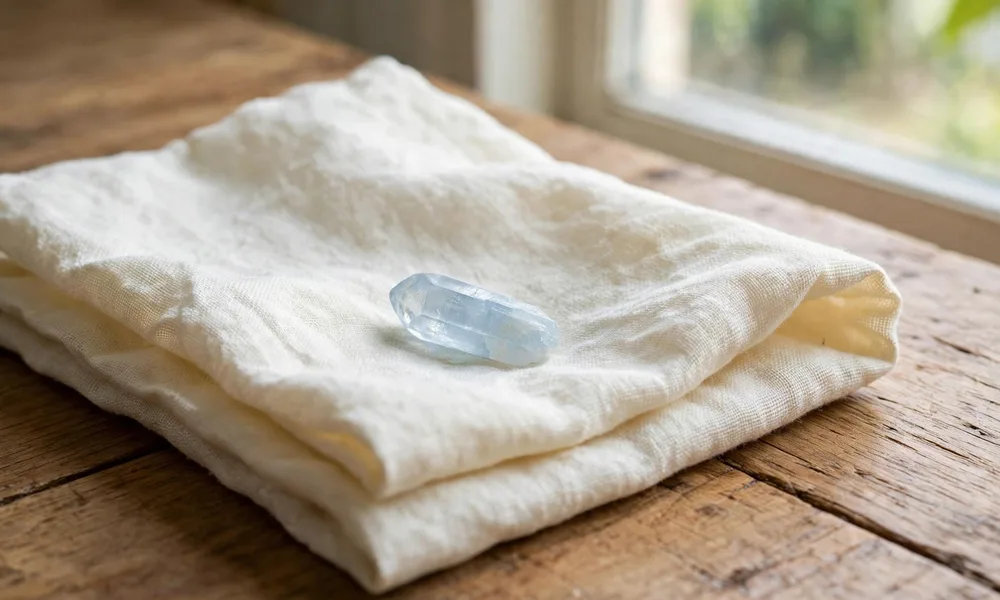
A slow day with euclase needs almost nothing. Lay a pale cloth on your desk, rest the crystal at one end where the daylight can reach it, and stand a glass of water at the far end, with bare cloth between the two. Sit down, drink the water in slow sips, and let your eyes follow the fine lines down the prism while the morning passes.
Datolite is the batch's soft yellow stone for bright days, while euclase stays a quiet blue for calm ones, and each stone keeps to its own colour in this journal. When the glass is empty, the crystal goes back to its tray until the next slow morning.
Euclase Beside Water
A tray can hold both a glass and a crystal, but only if the two never meet. Set the crystal at one end and the glass at the other, leaving bare cloth between them: the drink stays untouched, and the crystal stays out of the wet. A crystal that slips into a glass, a jug, or a bath has gone where it does not belong.
Once you have held the crystal, wash your hands before you pick up the glass, and give the crystal a wipe with a dry cloth when dust settles on it. Think of the two as neighbours on the tray, not as things that mix: the glass holds the water, and the crystal stays dry beside it.
Euclase at a Glance
| Pale blue prisms | Quiet tray, desk | Dry hands only |
|---|---|---|
| Soft, cool, light | Slow mornings, light | Glass kept apart |
| Fine lengthwise lines | Open windows, calm | Never in drinks |
| Fragile, handle gently | One tray, one glass | Dust dry weekly |

Euclase and Blue Zircon
Blue zircon for calm days is the brightest blue in this journal, vivid and sparkling, the colour of clear water under a bright sky.
Euclase is the opposite in temper. Its blue is pale and washed, never vivid, and its light is a soft gleam along straight faces rather than a sparkle. Where blue zircon is a dense, flashing gem, euclase is a light, slender prism with fine lines down its length.
Euclase and Blue Pearl
Blue pearl for calm days grows inside a shelled mollusc, thin coats settling one over another until a round bead takes shape, soft blue with a gentle shine that slides across the bead as it turns.
Euclase grows in rock, not in a shell, and it is a straight-edged prism rather than a round bead. Its blue sits in flat faces and fine lines, not in a glow that travels over a curve, and it is a piece for a tray or a desk, not for a necklace.
Euclase and Blue Sapphire
Blue sapphire for calm days is the classic deep blue corundum, faceted and bright, with small blue flashes from its cut faces.
Euclase is paler, softer, and far more delicate. Its blue is a washed sky blue beside the rich cornflower blue of sapphire, its shape is a natural prism rather than a cut gem, and its easy cleavage means it can split where a sapphire would only shrug off a knock.
Euclase and Blue Agate
Blue agate is a banded chalcedony, a pale sky blue crossed by fine white lines like ripples on a still pond. It forms in thin sheets laid down inside a hollow rock, so the finished stone shows soft bands of blue and milky white in easy curves.
Euclase wears lines, not bands. Its fine lines run straight down the length of a prism, while blue agate wears sweeping curves that wander across a rounded pebble.
Euclase and Blue Jasper
Blue jasper is opaque quartz in a quiet pale blue, its surface marked by soft grey veining that wanders the way weather moves across a sky. Nothing about it flashes or calls for attention; its appeal is in staying muted.
Euclase is clearer and crisper than blue jasper. Light passes through a euclase prism, while blue jasper holds its light on the surface, and where jasper shows soft marbling that drifts like cloud, euclase shows straight lines as fine as threads.
Euclase and Blue Obsidian, Blue Amber and Benitoite
Three more live blue stones complete the family, and each one is easy to tell apart from euclase. Blue obsidian is a smooth blue pebble of glass, and the pieces in most shops were coloured in a furnace rather than born from a volcano. Blue amber began as tree sap long ago, and looks honey gold until daylight draws a blue gleam out of it, a gleam that a warm lamp takes away.
Benitoite is a rare deep blue stone from California, grown in sharp triangular crystals. Euclase is none of these: a natural mineral prism, steady in its pale blue, with straight lines and a fragility that comes from easy cleavage.

Stones That Must Stay Away from Water
Before any stone goes near a glass, it helps to know which ones must never touch a drink. Malachite is first on that list: its green bands carry copper, and copper has no place in anything you swallow, so malachite stays far from water and from any drink made with stones. Hematite belongs on the same list for drinking water, and pyrite and apatite are safest kept dry as well, away from food and drink.
Lepidolite holds lithium inside it, so keep it out of water and out of any soak. Angelite is another to keep dry, because it grows soft and melts away a little each time it gets wet. Amber, old tree sap grown hard, turns cloudy and dull after a soak, so it never goes into drinking water either. Treat every one of them as you treat euclase: beside the glass, never in it.
Your Calm Days Checklist
- Set the stone on dry cloth, glass set apart.
- Sip the water slowly, without hurrying.
- Lift the stone, feel its cool lines, and set it down.
- Return the stone to its tray before washing your hands.
- Buy from a seller who says plainly where it came from.
- If a health worry lingers, ask your own doctor about it, never a stone.

Frequently Asked Questions
What is euclase?
Euclase is a pale blue beryllium aluminium silicate that grows in long slender prisms with fine lines down their length. Its name comes from Greek words meaning easy breaking, because the crystal splits readily along one direction.
Where does euclase come from?
Euclase comes mainly from Brazil and Colombia. The pale blue pieces are the ones most people seek, and a small thumb-length crystal is plenty.
How is euclase different from blue zircon?
Blue zircon is vivid and sparkling, a dense stone that throws back tiny flashes of light and feels a little heavy for its size.
How is euclase different from blue sapphire?
Blue sapphire is a deep blue corundum, faceted and bright, and at nine on the Mohs scale it is one of the hardest gemstones. Euclase is a pale blue natural prism, softer at seven and a half, and far more fragile, since a sharp knock can split it.
Is euclase safe to hold?
Most people can hold a small piece briefly with no bother at all. Put it back once you are done, rinse your hands, and store it where little children cannot reach it.
Where should I keep euclase at home?
A dry shelf, a desk corner, or a dish on the drawers all suit it, where it cannot roll off.
The Bottom Line
Euclase fits calm days: a pale blue prism in soft light, your water in its own glass close by, and the stone left dry and handled gently.
A Note for Calm Days
Pale blue lines, a dry stone, a full glass — a calm day asks for nothing more.


