Dark evenings arrive early in the colder months, and the house changes with them. Hallways grow dim, the garden path disappears, and a simple walk to the front door needs a little light. A torch answers that need in the plainest way: one beam, switched on with a thumb, pointing exactly where you look.
Water belongs in the evening habit around a torch, not inside it. A glass drunk slowly before you step out steadies the evening, and the torch stays dry beside the glass, never dipped and never splashed. The two sit together on the hallway table, each doing its own quiet job.
This guide gathers the best of the simple ideas: how to choose a torch, where to keep it, how to use it on a dark path, and how to build a small evening habit around it. It is gentle general information only, and a torch is a tool for seeing, not a cure — it will not heal anything.
Key Takeaways
- A torch is a hand-held light with one beam, switched on with a thumb.
- Keep the torch by the door, dry, with a glass of water beside it.
- Check the batteries once a week and carry spares in the drawer.
- A torch is not fairy lights: fairy lights stay fixed, a torch travels with you.
- A lit path is a comfort, not a cure; a torch will not heal anything.
What a Torch Is
A torch is a small hand-held light that throws one beam where you point it. It holds its batteries inside a short tube, and a button or a twist of the head switches it on. Most torches today use a single LED, which gives a steady white or warm light and sips power slowly.
A good torch fits the palm and weighs little, with a grip that does not slip when the hand is cold. The beam is the whole point: it goes where your eyes go, and nowhere else.
Why a Torch Suits Dark Evenings
Darkness makes a familiar house feel strange. A torch takes that strangeness away, because it puts light exactly on the next step, and the step after that.
A torch suits dark evenings because it asks for nothing in advance. No string to hang, no socket to find, no flame to guard: pick it up, press the button, and the path appears. When the walk ends, press it again, and the dark evening goes back to being quiet.
Choosing a Torch That Works
Choose a torch by holding it in your hand before you buy it, if you can. It should switch on with one thumb, without hunting for a tiny button in the dark. A warm or neutral beam is kinder on the eyes than a harsh blue-white one, and a beam that reaches the end of the garden is enough for most evenings.
Look at the batteries before the brightness: a torch that takes ordinary batteries is easy to feed, while a rechargeable one needs its cable kept in the same drawer.
Keeping a Torch by the Door
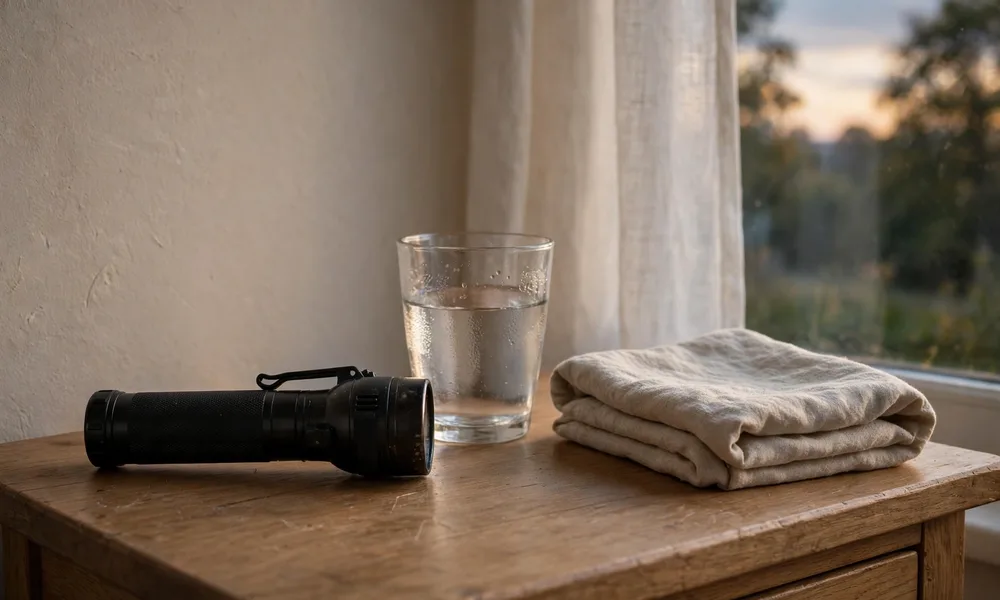
A torch earns its keep only when you can find it in the dark. Give it one home, and keep it there every night: a hook by the door, a small tray on the hallway table, or the top drawer of the dresser. The glass of water stands beside it, a hand-span away, so the evening drink and the light are reached for together.
Check the torch once a week, the way you would check a door lock. Switch it on, look at the beam on the wall, and switch it off again.
A Quiet Evening with Water and a Torch
Start with the glass, not the torch. Fill a tumbler, set it on the hallway table beside the torch, and drink half of it slowly while the house settles. The torch waits beside the glass, switched off, ready for the step outside.
When you go out, carry the torch in your stronger hand and point the beam low, at the ground a few steps ahead. Finish the glass, wipe the torch dry if the air was damp, and set it back on its hook.

Water and a Torch at a Glance
| One beam | By the door | Glass apart |
|---|---|---|
| Thumb switch first | Hook or tray | Sip before leaving |
| Warm beam kindest | Batteries checked weekly | Torch stays dry |
| Points where you look | Spares in drawer | Switch off after |
Water and Fairy Lights
For many small lights that stay fixed in one corner, see the fairy lights guide (live post id 6460).
That guide strings dozens of tiny warm lights along a wire, draped over a bed frame or a shelf, glowing in the same corner every night. The lights stay put, and the room comes to them.
This guide is about the opposite habit: one strong beam in the hand, carried from room to room and out to the path. Fairy lights decorate a corner that never moves; a torch lights the way you walk, and then it is switched off and hung back by the door.
Water and a Lantern
For one enclosed light you can set down anywhere, see the lantern guide.
That guide keeps a single steady light behind glass on the table, throwing a warm circle across the wood while a glass of water stands a hand-span away. A lantern is a light you set down and sit beside.
A torch does a different job: it travels in the hand and points its beam ahead, instead of sitting still and glowing in one place. The lantern warms a table; the torch walks the path.
Water and Stormy Evenings
For evenings when the weather turns rough, see the stormy evenings guide.
That guide keeps doors and windows shut, stays away from glass while lightning is close, and reaches for a torch rather than a candle if the power goes out. It is a guide for staying safe while the storm passes.
This guide picks up the calm side of that habit: on an ordinary dark evening, with no storm at all, the same torch walks you to the gate and back. The storm guide is for rough weather; this guide is for every dark evening.

A Torch and a Candle: Not the Same Thing
A candle gives a soft light that flickers, and it needs a steady hand and a watchful eye, because its flame is open.
A torch gives a steady beam that does not flicker, and it can be carried outside into wind and rain without going out. It suits a moving walk, a dark step, a keyhole in the cold. One glows where it sits; the other goes where you go.
Nine Neighbours in This Batch
Nine companions share this batch with the torch. A compass points the way home before the light fades, while a brochantite stone keeps a soft green calm on the shelf. The geode waits in clear light for the morning, a fireplace warms the room the torch leaves behind, and piemontite brings a tender pink to quiet days.
A doorstep marks where the torch is picked up, a meteorite rests grey and quiet from a far sky, a doormat shakes off the night's dust, and realgar burns warm red at the end of the shelf. Each one keeps its own corner, and the torch alone walks out into the dark.
Stones That Must Never Touch Water
A torch sometimes shares its hallway tray with a stone, so it helps to know which stones dislike water. Apatite goes soft in damp air, shedding flakes until it falls apart, and lepidolite carries lithium in its pale layers, a metal that must stay far from anything you drink.
Pyrite fares no better wet: its bright gold dulls, and rust-coloured stains can mark a pale tray for good. Angelite turns cloudy after one wetting and stays that way, while amber, hardened tree resin from long ago, goes milky when soaked. Stones rest beside the glass, never inside it, and none ever goes into a drink.
Your Torch Checklist
- Hang the torch on its hook by the door, in the same place every night.
- Pour a glass of water and drink half of it before stepping out.
- Switch the torch on and check the beam before you leave.
- Point the beam low, at the ground a few steps ahead.
- Wipe the torch dry when you come in, and set it back on its hook.
- If dark evenings leave you unsteady on your feet, or a worry about the dark lingers for weeks, ease off and ask a doctor; a torch lights a path, it is not a cure.

Frequently Asked Questions
How do I choose a torch for dark evenings?
Pick one that fits your palm, switches on with one thumb, and throws a warm beam to the end of the garden.
Where is the best place to keep a torch at home?
Hang it on a hook by the door, or keep it in a small tray on the hallway table, in the same place every night. Keep the glass of water beside it, a hand-span away, so both are reached for together.
Can I use a torch in the rain?
Yes, if the seller can tell you plainly that the torch is rain-proof. Wipe it dry when you come in, and never leave a wet torch in a closed drawer, because damp metal and batteries do not mix well.
How often should I check the batteries?
Check the beam once a week by switching the torch on and looking at the wall. Change the batteries as soon as the light fades, and keep a spare set in the kitchen drawer, ready to go.
Is a torch better than a candle in a power cut?
Yes, for walking about the house a torch is safer, because its beam is steady and it cannot set anything alight. A candle suits a still table only, and it must never be left burning alone in a room.
Can a torch help me feel calmer on dark evenings?
A torch can make a dark evening feel steadier, because the path ahead is lit and each step is clear. A lit path is not a cure, though: if low feelings stay with you for weeks, speak to a doctor.
The Bottom Line
A torch lights dark evenings when kept by the door: one beam, batteries checked, a glass of water drunk before the step outside.
A Note for Dark Evenings
A glass of water, a torch on its hook, and a slow walk to the gate — that is all a dark evening needs.