
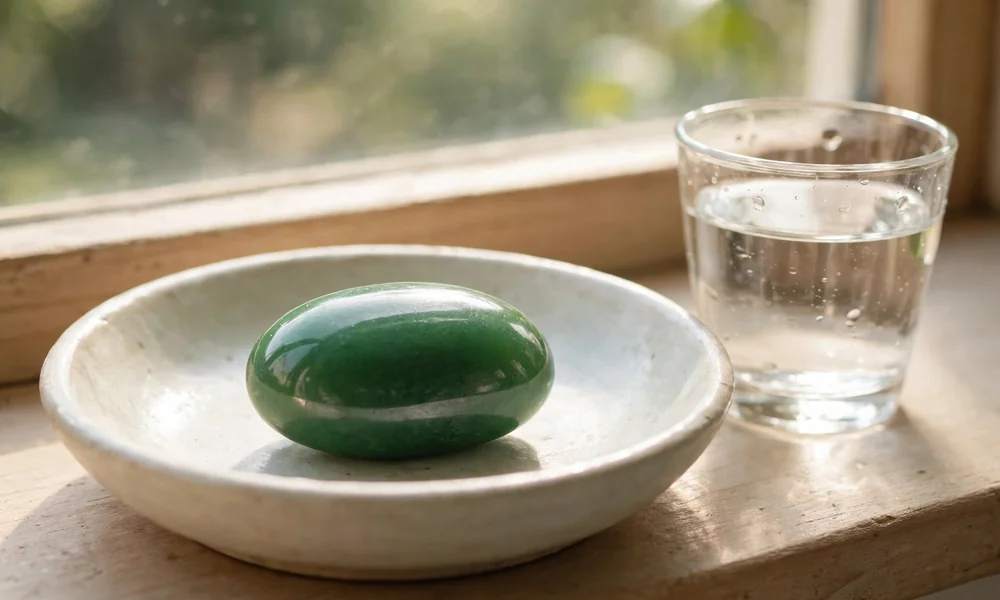
Calm days begin quietly, with nothing asking to be hurried. The light through the window is soft, the glass on the tray is full, and the hours ahead have room in them. A small fresh green stone fits that kind of day the way a leaf fits a garden: it adds colour without adding noise.
Vesuvianite is that green, held in a smooth polished piece you can rest on a tray and look at while the morning moves slowly. Its green is fresh rather than dark, the colour of new growth after rain, and it sits easily beside a glass of water without demanding attention.
This guide looks at vesuvianite on its own: what the stone is, how to pick a good piece, how to keep it beside water, and how it differs from the other green stones already in this journal. It is a thing to admire and hold briefly, and it will not heal anything.
Key Takeaways
- Vesuvianite is a fresh green stone, a calcium aluminium silicate first found near Mount Vesuvius.
- Its fresh green colour suits calm days, soft light, and unhurried hours at home.
- The stone is for display and handling only; it will not heal anything.
- Keep the stone dry beside the glass, never inside drinking water.
- One small polished piece on a plain tray is all a calm day needs.
What Vesuvianite Is
Vesuvianite is a mineral that grows in green, brown, and yellow tones, and the green pieces are the ones collectors look for first. It was named for Mount Vesuvius in Italy, where early pieces were found in the rocks around the volcano, and later finds came from Canada, Russia, Pakistan, and other places with old limestone country.
A polished piece feels cool against the palm when you first lift it, and it gathers warmth from your hand as you keep holding it. The green is fresh and leafy, sometimes with a faint yellow or brown thread running through it, and the surface takes a soft glassy shine rather than a hard glitter. Most pieces are small tumbled stones or little cabochons, easy to rest on a tray.
Picking a Vesuvianite Piece
A good vesuvianite piece is best judged outdoors in plain daylight, not under a shop lamp. Look for green that holds steady as you turn the stone, with no grey wash and no brown smudges at the corners. The face should be even and smooth throughout, free of nicks at the rim and rough hollows in the middle.
Ask the seller which country the stone came from and whether the green is untouched; green that pools in cracks is often dye, and a straight answer is worth more than a pretty stone. A palm-sized piece is enough, and one bright green stone is better than a handful of dull ones. Leave any seller who promises better health.

A Calm Day with Vesuvianite
Begin a calm day by clearing one small table. Put a pale cloth down, rest the stone near the window side, and set your glass on the opposite side so a stretch of bare cloth sits between them. Drink slowly while the light moves across the room, and let the green catch your eye now and then.
Nothing else is needed: a drink, a stone, and an hour that is not in a hurry. Later, carry the stone to a shelf where the afternoon sun can reach it, and bring it back to the tray before evening.
Vesuvianite Beside Water
Water and vesuvianite are neighbours, not partners. Set the tumbler down at the left end of the tray and the stone at the right end, with empty space between them, so the drink stays clean and the stone stays dry. A tray is for looking, not for rinsing.
After handling the stone, clean your hands before you drink, and never let the stone slip into a glass, a jug, or a bath. Water should never be tipped over it, and a dry cloth is the only cleaning it needs.
Vesuvianite at a Glance
| Fresh green stone | Calm tray, glass | Dry hands only |
|---|---|---|
| Leaf green tones | Soft daylight hours | Glass kept apart |
| Smooth, cool piece | One tray, one glass | Never in drinks |
| Named for Vesuvius | Slow, unhurried days | Never soak stone |
| Palm-sized piece | Tidy shelf, tray | Dust dry weekly |
Vesuvianite and Green Jade
Green jade for slow mornings is a soft calm green stone, smooth and cool, the colour of new leaves after rain, kept on a desk beside a glass of water for slow mornings. It is dense and tough, with a soft waxy shine and sometimes faint lighter veins.
Vesuvianite is greener and brighter than green jade, with a glassier shine where jade is waxy and soft. Jade drifts from pale sage to deep forest and carries cloudy patches, while vesuvianite keeps one fresh leaf green, and jade is the older, tougher stone of the two.
Vesuvianite and Green Onyx
Green onyx for calm days is a chalcedony in soft green, its face crossed by pale bands that drift through the stone in gentle layers. It rests on a tray by a glass, looking like a small still pool.
Vesuvianite wears no bands at all. Its green runs even and unbroken from edge to edge, where green onyx is striped with cream and pale green layers, and vesuvianite feels glassier in the hand while onyx feels waxy and dense.
Vesuvianite and Green Agate
Green agate for calm days is an agate whose green comes in stripes, pale lines crossing a deeper green heart, and it suits slow afternoons by an open window.
Vesuvianite shares the leaf green but not the stripes. Green agate is banded through and through, while vesuvianite is plain and even, and agate is a chalcedony where vesuvianite is a silicate mineral from volcanic country, so the two stones come from very different ground.
Vesuvianite and Green Fluorite
Green fluorite is a mineral whose green sits in bands and pale zones, and it is sold as smooth tumbled pieces or small glassy cubes, a soft stone that marks easily.
Vesuvianite is the harder, tougher stone of the pair, and it carries no cubes or zones. Fluorite shows its green in bands and layers, while vesuvianite holds one even fresh green, and fluorite needs gentle handling where vesuvianite can take ordinary care on a tray.
Vesuvianite and the Other Stones in This Batch
The batch around vesuvianite holds a small crowd of other stones, and each one takes a different road. Staurolite is a dark brown stone that grows in crossed shapes, like two sticks laid over each other, and it suits steady days rather than fresh green ones. Barite is a pale, heavy mineral, often colourless or soft blue, with a glassy weight that surprises the hand.
Titanite is a warm yellow-green stone with a bright, almost fiery sparkle, louder in the light than vesuvianite, and zincite is a rare orange-red mineral, warm as sunset, that stands at the far end of the batch from this quiet green. Vesuvianite is the fresh leaf green among them, calm where titanite flashes and warm where zincite burns.
Keeping Vesuvianite at Home
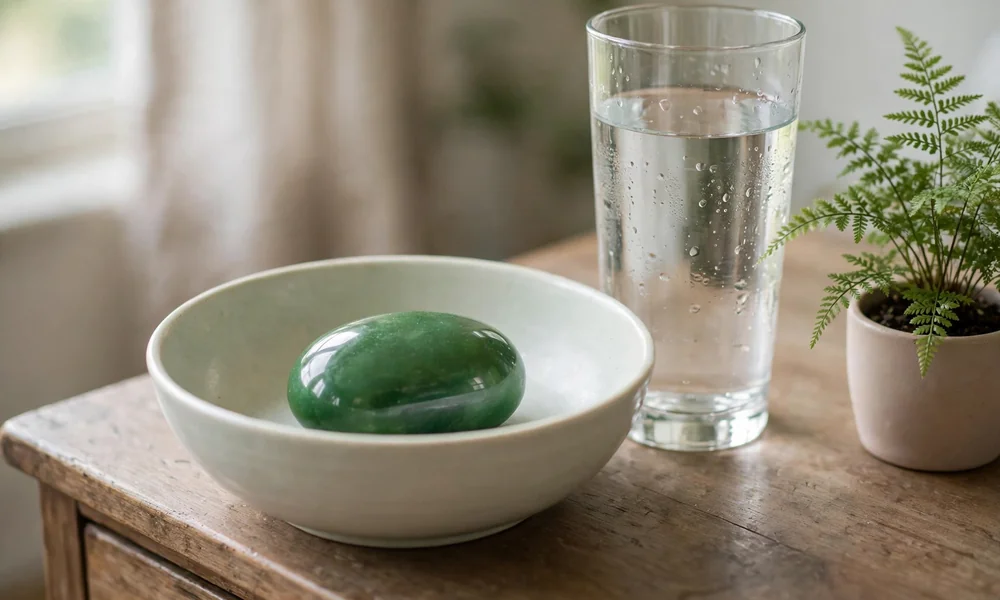
Find the stone a quiet home where it can be seen but not knocked over: the corner of a desk, a shelf that catches morning light, or a small dish on top of a chest of drawers. Choose a place far from sinks, kettles, and steamy bathrooms, and high enough that small children cannot reach it.
Once a week, wipe the stone with a dry soft cloth to lift the dust. When it is not being shown, keep it by itself in a cloth-lined box, away from keys and from harder stones that might mark its polished face.
Stones That Must Stay Away from Water
Some stones must never go near a drink, and the kindest rule is to keep all of them dry. Malachite is banded with copper, a metal that does not belong in anything you swallow, so it stays well away from jugs and tumblers. Hematite can stain and rust when it gets wet, so it never goes in drinking water, and apatite and pyrite follow the same rule.
Lepidolite contains lithium in its pale flakes, so it stays dry and far from every cup. Angelite loses its shine and goes cloudy after wetting, while amber, hardened tree sap from long ago, turns cloudy after a soak and belongs nowhere near a glass or a bath.
Your Calm Days Checklist
- Lay the stone on a clean pale cloth, keeping the glass well to one side.
- Drink your water at an easy pace, with no hurry at all.
- Lift the piece now and then and let daylight play across its green.
- Set the stone down again, then clean your hands before drinking.
- Choose a seller who can say where the stone was dug up.
- When a health worry lingers, talk to a doctor — no green stone can answer it.

Frequently Asked Questions
What exactly is vesuvianite?
Vesuvianite is a calcium aluminium silicate mineral, named for Mount Vesuvius, and the green pieces are the fresh leaf-green ones collectors keep for calm days.
How can I tell vesuvianite from green jade?
Green jade is waxy, dense, and drifts from pale sage to deep forest, while vesuvianite is glassier, brighter, and holds one even fresh green.
Does vesuvianite need special care?
No, ordinary dry care is enough: dust it weekly with a soft cloth, keep it away from water, and store it apart from harder stones.
May I drop vesuvianite into my drinking water?
No, never. The stone stays beside the glass, never in it, because a stone in a drink can chip, carry dust, and spoil the water.
Is holding vesuvianite safe for most adults?
Holding a small polished piece briefly is fine for most adults, because a dry stone leaves nothing behind on the skin.
Where is the best place to keep vesuvianite?
Any dry place in gentle light will do: a desk corner, a shelf near the morning window, or a dish on the drawers, far from water and steam.
The Bottom Line
For calm days, vesuvianite is enough: one fresh green stone, the glass full beside it, and the stone dry in its own place.
A Note for Calm Days
A fresh green stone, a full glass, a dry tray — that is all a calm day needs.


