
A quiet day rarely announces itself. The post comes late, the rain holds off, the phone stays silent, and the hours open up with nothing pressing inside them. Taaffeite belongs to days shaped like that. It is a soft violet stone so scarce that most people who love gems will never hold one, and its colour is a pale mauve that seems to shift a little whenever the light moves.
The stone takes its name from Count Richard Taaffe, who spotted the first piece in Dublin in 1945 among a parcel of cut spinels. For years afterwards only a handful of specimens were known, and even now a taaffeite large enough for a ring is a genuine rarity. The violet itself is gentle, neither loud nor washed out.
This guide looks at taaffeite in plain terms: what it is, how it differs from the spinels it is grouped with, how to choose a small piece, and how to keep it dry beside water. It is a beautiful object to look at and to hold for a short while, and nothing beyond that. It will not heal anything, and no honest seller will claim otherwise.
Key Takeaways
- Taaffeite is a rare soft violet mineral, a spinel-group stone first spotted in Dublin in 1945.
- Its pale mauve suits quiet days, slow mornings, and rooms kept calm and uncluttered.
- Purple spinel, violet spinel, and musgravite are its closest violet neighbours, and taaffeite stands apart from each of them.
- Taaffeite is for looking and brief handling only — it heals nothing and guarantees nothing.
- Leave the stone dry on its tray, away from the glass, and clean your hands after you put it down.
What Taaffeite Is
Taaffeite is a beryllium magnesium aluminium oxide that grows in the hexagonal system, which already sets it apart from spinel itself. Spinel crystallises in cubes, while taaffeite builds itself in six-sided forms. Its colour runs from pale mauve through soft violet to a faint pink, the violet pieces most sought after.
The stone is hard, between 8 and 8.5 on the Mohs scale, so a cut piece keeps its polish and resists the small knocks of daily handling. Most known taaffeite comes from Sri Lanka and Tanzania, with smaller finds in China, and nearly all of it arrives as tiny faceted stones. A pea-sized piece is already a notable find.
Why Soft Violet Suits Quiet Days
Soft violet never raises its voice. Loud colours pull the eye toward them, and the palest ones vanish against a white wall, yet a pale mauve stays visible without trying, the way late light lingers on a cloudy afternoon. When the diary is empty, that kind of calm fits: the stone waits on its tray while the day drifts past, noticed in passing rather than stared at.
Its shade shifts as the hours move, giving a slow day something small to follow. Morning light makes it a cool lilac, the afternoon warms it toward mauve, and lamplight deepens it just enough to catch the eye again.
Choosing a Taaffeite Piece
Shop in ordinary daylight, near a window rather than under a jeweller's lamp. Turn the piece slowly and look for a violet that holds steady at every angle, with no grey wash at the edges and no milky cloud inside it. The facets should meet cleanly and flash softly as the stone turns.
Pick a piece that rests flat without rocking and sits easily in a closed hand. Ask plainly where it was found and whether it comes with papers, since a stone this rare deserves a clear history. Walk away from any piece whose violet looks brushed on, and any seller claiming the stone can mend your health.
A Quiet Day with Taaffeite
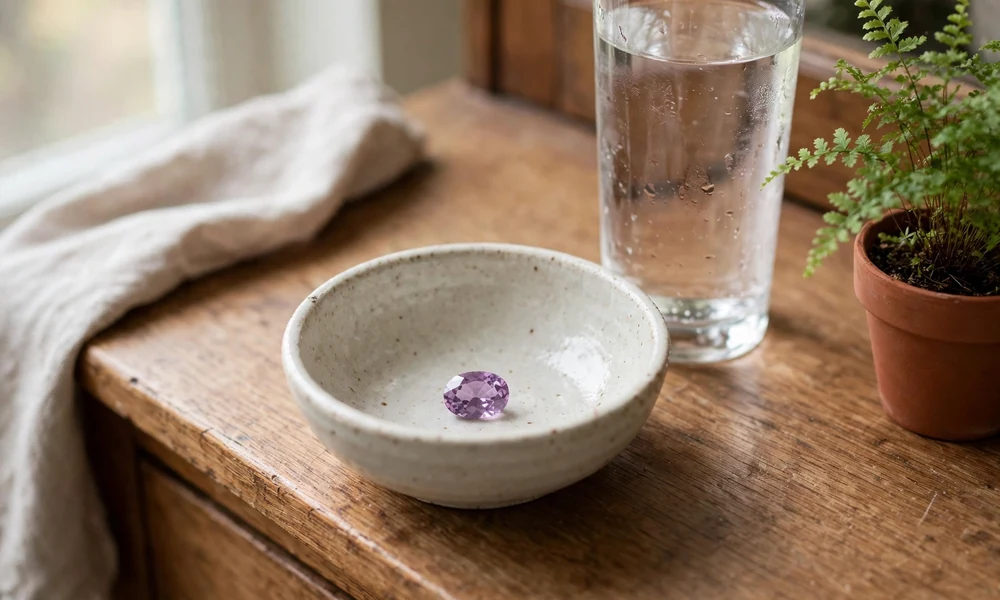
Late morning suits this stone best, when the light has settled and the house has gone quiet. Lay a folded lavender cloth across the side table, rest the taaffeite near one corner with its largest face toward the window, and stand a tall glass of water at the far end, leaving dry cloth between them. Drink the water in slow mouthfuls as the stone gathers the light.
There is no task to finish and no ceremony to follow. Read a few pages, fold the washing, open a window. As the afternoon fades, lift the stone once, watch its violet faces catch the last daylight, and set it gently back down.
Taaffeite Beside Water
A glass of water and a violet stone make a pleasant pair on one tray, but they must never trade places. Rest the tumbler at one end and the stone at the other, with bare wood or cloth in the middle, so the drink stays clear. Once the stone is down, wash your hands with soap before you pick the glass up.
Never drop it into a glass, jug, or bath, and never hold it under a running tap. A soft dry cloth is the only cleaning it ever needs.

Taaffeite at a Glance
| Soft violet gem | Tray, shelf, desk | Dry hands only |
|---|---|---|
| Pale mauve tone | Quiet days, slow hours | Glass kept apart |
| Hard, rare mineral | One accent, plain | Never in drinks |
| Fingertip-sized piece | Wood, linen, lamplight | Dust dry weekly |
Taaffeite and Purple Spinel
Purple spinel for quiet days is a mid-purple violet spinel, richer than lavender spinel's pale lilac-grey and softer than violet spinel's deeper violet, a clear bright stone that holds its middle purple without effort.
Taaffeite parts company with it in three ways. First, taaffeite is far scarcer: purple spinel is cut and sold in ordinary shops, while taaffeite is a rarity most dealers never see. Second, the violet is paler and greyer, a mauve rather than a true purple. Third, the two minerals grow differently, spinel in cubes and taaffeite in six-sided forms, so their facets meet differently.
Taaffeite and Violet Spinel
Violet spinel for calm days is a soft violet spinel, clear and glassy, with bright facets that catch the light in small violet flashes, the gentlest of the spinel family.
The two share a colour family and a quiet mood, yet they are not the same mineral. Violet spinel is a true spinel, a magnesium aluminium oxide that forms in cubes, and it is common enough to be cut in larger pieces. Taaffeite carries beryllium, grows in six-sided crystals, and is so rare that a pea-sized piece is already remarkable.
Taaffeite and Musgravite
Musgravite for quiet days is a scarce lilac-grey violet mineral from the Musgrave Ranges of South Australia, a stone so uncommon that most collectors know it only from books.
Musgravite is taaffeite's closest cousin, and its own guide names taaffeite as kin. They differ in shade and make-up: musgravite runs greyer, a lilac-grey that can look almost smoky in low light, while taaffeite keeps a clearer violet. Musgravite also lacks taaffeite's magnesium, and it is rarer still, with only a few faceted pieces known.
Taaffeite Among the Other Stones in This Batch
Four more minerals share this batch, and none of them looks anything like taaffeite. Marcasite is a pale brassy iron sulfide, a polymorph of pyrite, bright and metallic beside taaffeite's mauve glow. Pyromorphite is a lead mineral in green and orange crusts, for display only, never near water. Sillimanite is a pale fibrous aluminium silicate, a polymorph of andalusite and kyanite, thread-like beside faceted taaffeite. Serendibite is a rare blue-green boron mineral from Sri Lanka, dark beside taaffeite's soft violet.
Where Taaffeite Sits at Home
A spot you walk past daily without knocking into it suits taaffeite: a desk end, a shelf at waist height, or the top of a chest of drawers. It likes morning light, and it should live well away from taps, kettles, steamy air, and small hands.
Dust it weekly with a clean dry cloth, keeping water and polish far away. When it leaves the tray, keep it alone in its own padded case, clear of keys, coins, and harder gems.

Stones That Must Stay Away from Water
Some minerals need a firmer caution than taaffeite, so here are the ones to remember. Start with malachite: its green swirls carry copper, and copper has no business near anything you might drink, so the stone stays on a dry shelf and nowhere near a jug. Damp hematite rusts, and that rust can leave marks on skin and fabric, so keep it clear of drinking water too.
Soaking makes apatite fall to pieces, while damp air breaks pyrite down, so both live on dry shelves. Lepidolite keeps lithium locked in its pale flakes, so keep every drink far from it. Angelite turns dull and cloudy after one wetting, while amber, old tree sap hardened long ago, goes milky in a soak. Keep them far from food and drink, and treat taaffeite the same way.
Your Quiet Days Checklist
- Lay the taaffeite on a dry cloth with the tumbler a good distance away.
- Sip the water slowly, one small mouthful after another.
- Pick the stone up and turn it so its violet faces meet the light.
- Put the piece back on its tray, then wash your hands with soap.
- Buy only from a seller who can say plainly where the stone came from.
- For any health worry, see a doctor — no violet stone can help there.
Six small moves, none hurried, and the room is ready for the rest of the day.
Frequently Asked Questions
What exactly is taaffeite?
Taaffeite is a rare soft violet mineral, a beryllium magnesium aluminium oxide in six-sided crystals, first spotted in Dublin in 1945 among cut spinels.
How can I tell taaffeite apart from spinel?
Look for a paler mauve, a softer glow rather than a bright sparkle, and a seller who can show papers.
Why is taaffeite so hard to find?
Only a few deposits are known, mostly in Sri Lanka and Tanzania, and nearly all the material arrives as tiny faceted stones.
Can taaffeite go into water?
No. Taaffeite stays out of drinking water, soaks, and baths. Keep it beside the glass, never inside it, and clean it with a soft dry cloth only.
Is taaffeite safe to hold for a while?
A short hold of a small faceted piece suits most adults, if you wash your hands once you have put it down.
Where is the best place to keep taaffeite?
Choose somewhere dry in soft light — a desk end, a shelf near the morning window, or a dish on the drawers — clear of water, steam, and small hands.

The Bottom Line
Taaffeite suits a quiet day because both of them keep things small: one rare violet stone, one dry tray, and water that stays in its own glass.
A Note for Quiet Days
A small violet stone, a full glass, a dry tray — that is all a quiet day needs.


