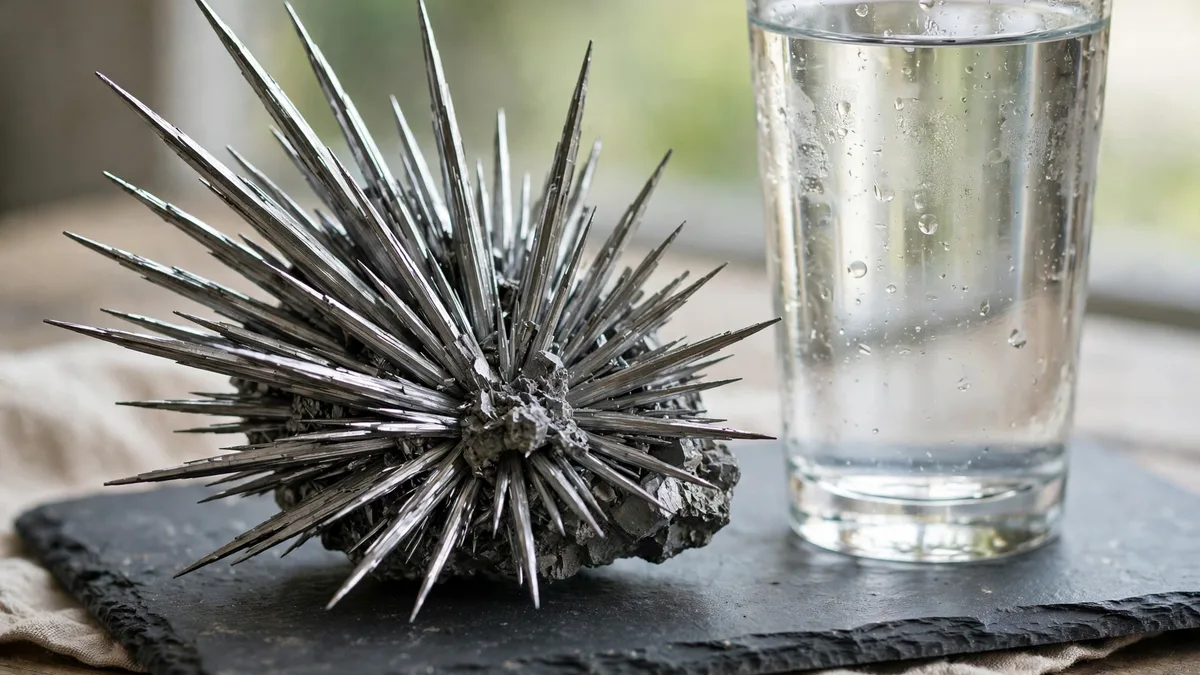
Some minerals invite a touch. Stibnite does the opposite: a burst of steel-grey needles that asks to be looked at from a small distance and left alone. The blades catch the light one at a time, like a fan of cold silver.
The short answer is yes, with rules. A solid specimen is safe at home in a closed case, handled briefly, hands washed after. The rules matter because stibnite holds antimony, which is toxic, so it is never worn, never put in water, and never left where children or pets can reach it.
What follows looks at the stone as it is: its make-up, how it stands apart from the other display stones here, choosing a sound piece, and keeping it safe on a quiet shelf. It is a beautiful object to look at; it heals nothing.
Key Takeaways
- Stibnite is an antimony sulfide in long steel-grey metallic blades.
- It is very soft, only 2 on the Mohs scale; a fingernail can mark it.
- It holds toxic antimony: display only, never in water, never worn.
- Wash your hands after handling it; keep it from children and pets.
- A closed case on a high, dry shelf is home.
What Stibnite Is
Stibnite is antimony sulfide, Sb2S3, the main ore of antimony. It grows in warm veins deep underground, where hot water rich in antimony and sulfur cooled slowly in cracks in the rock. The finest pieces come from old mines in Japan and China, where whole sprays grew undisturbed.
The crystals are the whole show: long, thin and sword-like, marked with fine lines down their length, often growing in radiating fans that catch the light. Fresh faces shine like new steel; older ones dull to blue-black. A good piece feels cool and surprisingly light: antimony is far less dense than the lead in galena.
Stibnite and Galena
Galena soft grey for quiet days and stibnite are the two grey metallic sulfides a collector meets first, and they share one rule: both are display-only, never in water, never near food or drink, hands washed after every touch. Galena carries lead, stibnite carries antimony, and both metals are toxic.
The stones themselves could hardly look more different. Galena grows in neat cubes with stepped faces, heavy and solid, shining like pewter. Stibnite grows in long blades that fan into sprays, light and spiky, shining like brushed steel. One is a block, the other a burst.
Stibnite and Vanadinite
Colour is the first difference, and it could not be wider. Vanadinite warm red for bold days is a deep warm red, glowing like embers in short hexagonal crystals, a stone for bold days. Stibnite is steel grey, cool and metallic, a stone for quiet days. One burns, the other gleams.
Under the colour, the two are closer than they look. Both are built around a toxic metal, lead in vanadinite and antimony in stibnite, so both live the same careful life: display only, never in water or elixirs, never near food, hands washed after handling, and out of reach of children and pets. The red one shouts, the grey one whispers, but the keeping rules are the same.
Stibnite and Malachite
Malachite deep green for bold shelves is the green stone every shelf seems to know: deep green bands swirling through a polished piece, soft enough to scratch, and always kept beside water rather than in it. It is a copper stone, warm in colour and smooth in the hand, and it suits a bold shelf.
Stibnite suits the opposite shelf. Where malachite is green and banded, stibnite is grey and bladed; where malachite is polished smooth, stibnite is all sharp points. Malachite is the louder stone, stibnite the quieter one, but both are for looking at, not soaking, and both stay dry beside the glass.
Why Steel Grey Suits Quiet Days
A quiet day has a colour, and it is the grey of a sky before rain, of still rooms and wet stone steps. Stibnite wears that colour, and it never shouts for attention. Where a bright stone fills a room, this one waits, and the eye comes back to it on its own.
What keeps it from looking flat is the shine. Each blade catches the light at its own angle, so the spray seems to shift as you walk past, brightening and dimming in turn. A glass of water on the same tray, kept well away from the stone, adds a second kind of light.
The Safety Rule First: Display Only
Before anything else, the safety rule. Stibnite contains antimony, which is toxic, so the stone lives on display and nowhere else: it never goes in water, never into an elixir or a soak, and never near food or drink, and never in the mouth. Wash your hands with soap after handling it, and keep it from children and pets.
Never make dust from it. Do not cut, crush, sand or scrape it, and never heat it: old books note that a splinter melts in a candle flame, but heating frees toxic fumes, so leave that test to the books. Dust the piece with a soft brush or a puff of air, and handle it by its base rather than its blades, which snap easily.
How to Choose a Stibnite Piece
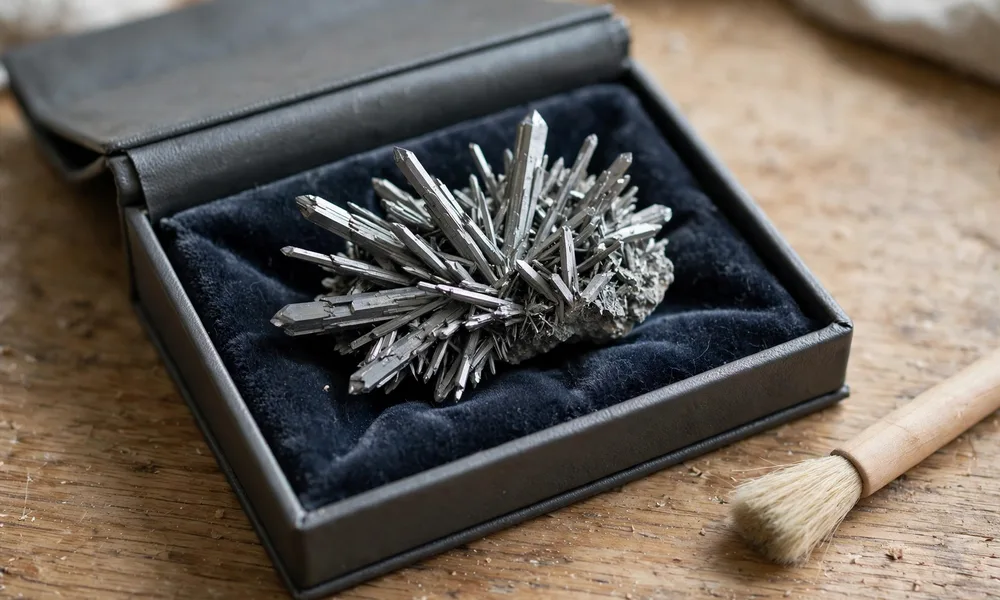
Pick the piece up by its base and turn it under a lamp. Look for long blades with bright, mirror-like faces, fixed firmly to their matrix, with no loose edges. The spray should look full rather than patchy, with most of its points unbroken.
Be wary of pieces that look glued back together, with blades leaning at odd angles or a cloudy seam where a break was mended. Repairs are common, because the crystals are so fragile, and a good seller will say so. Choose a seller who names the stone and the mine it came from in plain words, and step away from anyone who claims it will change your health. If you buy online, ask for a photograph of the piece itself, not a stock picture.

A Quiet Day with Stibnite
On a quiet day, when the house is still and the light is soft, the stibnite sits in its glass case on the shelf, the blades catching the light one at a time. A glass of water stands on a small table below, far from the case. Sit with a book, drink the water in slow sips, and glance up at the grey spray.
When the glass is empty, leave the case closed and the stone where it lies. The pleasure of stibnite is in the looking, not the holding.
Stibnite at a Glance
| Steel-grey blades | Quiet days, soft light | Hands washed after |
|---|---|---|
| Antimony sulfide | Closed glass case | Never in water |
| Mohs hardness 2 | High dry shelf | Never worn |
| Light, bladed spray | One small specimen | Dust with brush |
Stibnite Among the Other Stones in This Batch
This batch holds four more stones beside stibnite, each one taking a different road. Sard is a warm brown-red stone, steady and earthy, the kind that sits comfortably in the hand. Hydrozincite is a pale, soft white crust, chalky where stibnite is metallic. Trilobite is not a mineral at all but an ancient sea creature turned to stone. Cymophane is a golden cat's-eye stone, its bright band sliding as the light moves.
This batch also holds five water guides: a cake stand, a bread box, a wheelbarrow, a trowel and a lemon slice. Stibnite is the only one of the ten kept behind glass, and the one to admire from a distance.
Where Stibnite Sits at Home
Give stibnite a closed glass case on a high shelf in a dry room, away from taps and steam, out of reach of small hands and paws. A case keeps dust off and fingers away, and stops blades catching on sleeves or cloth. Hard midday sun stays off it too, since the shine dulls with time and light.
If the piece must travel, cushion it in tissue inside a small hard case, with nothing loose that the needles can strike. A soft pouch will not do for needle crystals; only a rigid case keeps the piece safe.

Stones That Must Never Touch Water
Water harms stones in different ways, and a few must never go near a drink. Angelite takes in water and turns dull, and it stays dull. Amber, tree resin and not stone at all, turns milky in a soak and never clears again. Apatite loses its polish in water, and the shine does not come back.
Pyrite darkens wherever dampness reaches it, and the dark marks stay. The flakes of lepidolite hold lithium, so that stone stays away from every cup and tap. Stibnite is kept dry for a different reason: water does it little harm, but anything that has touched the stone must never reach a drink.
Your Quiet Days Checklist
- Set the case on a high shelf in a dry room, away from taps.
- Look at the spray in soft light; leave the case closed.
- Lift the piece by its base only, and only when you must.
- Dust it with a soft brush or a puff of air, never water.
- Wash your hands with soap after every touch; keep it from children and pets.
- If something about your health worries you, ask a doctor — a grey stone has no answers.
Frequently Asked Questions
Is stibnite safe to keep at home?
Yes, in a closed case on a high, dry shelf, handled briefly, hands washed after. It is display-only: never in water, never worn, and away from children and pets.
Why must stibnite stay out of water?
Stibnite holds antimony, which is toxic, so it must never go in drinking water, elixirs or soaks. Keep the stone dry and the glass apart, and wash your hands after handling.
Can I hold stibnite in my hand?
Briefly: lift it by its base with dry hands, look at it, put it back, and wash your hands after. Never hold it long, and never let children handle it.
How can I tell stibnite from galena?
Galena grows in heavy grey cubes with stepped faces, while stibnite grows in light steel-grey blades that fan into sprays. Galena feels heavy; stibnite feels light.
What should I do if a blade breaks off?
Do not pick up a broken piece with bare fingers. Sweep it up with paper, bag it, wash your hands, and keep it away from children and pets.
Where is the best place to keep stibnite?
Give it a closed glass case on a high shelf in a dry room, away from taps and sun, out of reach of small hands and paws.

The Bottom Line
Stibnite is a steel-grey spray for a closed case, dry hands, and a quiet shelf — look, wash up, leave it be.
A Note for Quiet Days
A grey spray behind glass, a dry shelf, and a glass of water kept well apart — that is the whole of stibnite.


