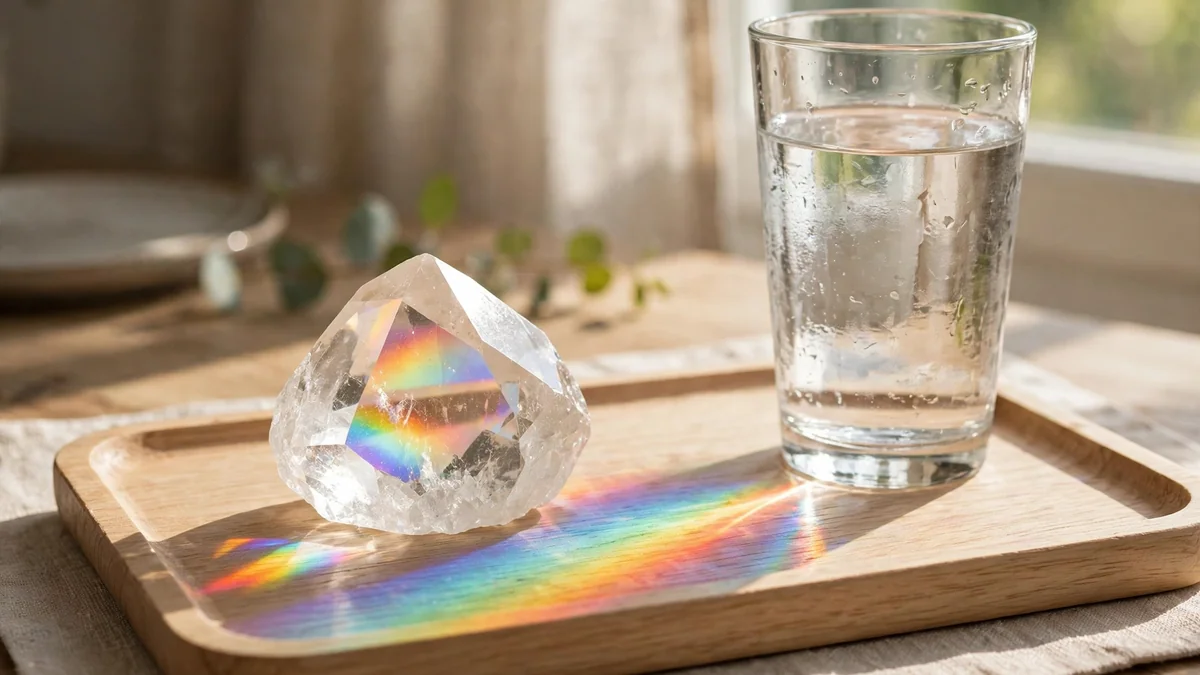
Hold a printed page under a clear piece of optical calcite and the words split in two. Slide the stone a little and the second image moves, like a shadow that refuses to sit still. No other stone on an ordinary shelf does this so plainly, and it needs only a sunny window and a clear piece.
Optical calcite is calcite at its clearest, the water-white kind once called Iceland spar, and it bends light along two paths at once instead of one. That double path splits the print, throws a small rainbow across a tray, and makes the stone feel brighter than the glass beside it. It is the same mineral as every coloured calcite, only colourless.
A bright day is the right setting for it. This guide looks at what optical calcite is, how to choose a piece that shows the double image well, and how to keep it dry beside water. It promises no healing and no change to your health; it is a clear stone to look through, hold briefly, and enjoy for the light it plays with.
Key Takeaways
- Optical calcite is clear, colourless calcite, also called Iceland spar, and it splits one image into two.
- The stone shows its double image best in plain daylight, over print or a straight edge.
- It is a stone for looking through and holding briefly; it heals nothing and changes nothing.
- Keep the crystal dry beside the glass, never inside it, and wash your hands after handling it.
- A small, clean, well-cut piece is the usual way to enjoy optical calcite, and a plain tray is all it needs.
What Optical Calcite Is
Optical calcite is calcium carbonate grown clear. Most calcite carries a tint — honey, blue, green, pink, orange — from small traces of other minerals that coloured it as it formed. Optical calcite formed without those traces, so it stays water-clear, in neat slanted blocks called rhombohedrons, with flat faces that meet at angles never quite square.
That shape is the whole secret. Light entering the stone splits into two rays that travel at slightly different speeds, and each ray leaves the stone in its own direction. Put the crystal over a printed word and you see the word twice, one image beside the other. Turn the stone slowly and one image stays put while the other drifts around it.
The finest clear pieces came from Iceland, which gave the stone its older name, Iceland spar. Iceland spar is not a different stone: it is optical calcite itself, the same clear mineral, and this guide treats the two names as one. No dye, no coating, and no workshop treatment makes the double image; the stone arrives clear from the ground.
Picking an Optical Calcite Piece
Choose a piece in plain daylight, with a printed page to test it on. Set the stone over a word and look for the split: a good piece doubles the print crisply, both images sharp, while a cloudy piece blurs the second image into a smear. Turn the stone a quarter turn and watch one image circle the other; that movement is the test that matters most.
Look through the stone, not just at it. Hold it up to the window and check for clean, even clarity, with no milky patches hiding inside. Feel the edges: optical calcite is soft for a crystal, so sharp corners chip easily, and a chipped corner is still fine to enjoy, only worth less. Ask the seller which country the piece came from and whether its colour was left untouched. Buy the smallest piece whose double image pleases you.

A Bright Day with Optical Calcite
A bright day with optical calcite starts at the window. Lay a folded linen cloth on the table, set the stone near the front edge where the light will reach it, and put a glass of water at the far end, clear of elbows. Drink the water in slow sips, and slide a page of print under the stone to watch the words double.
Optical Calcite Beside Water
Water and crystal share a tray, yet each keeps its place. Put the tumbler at one end and the stone at the other. Clean your hands once the crystal is back on its tray, and only take up the glass. No crystal goes into a glass, jug, or bath, and no rinse passes over it.
Calcite needs this care more than most stones. It is soft, and acids mark it, so even lemon water or vinegar left near it can cloud its faces. Leave the plain glass always at its own end of the tray, and keep sour things well away from the stone.
Optical Calcite at a Glance
| Double image | Bright tray | Dry hands |
|---|---|---|
| Slanted clear blocks | Sunny days | Glass kept apart |
| Iceland, Mexico finds | One accent, plain | Never in drinks |
| Cool, glassy, bright | Morning light | Never soak stone |
| Small pieces usual | Tidy shelf, tray | Dust dry weekly |
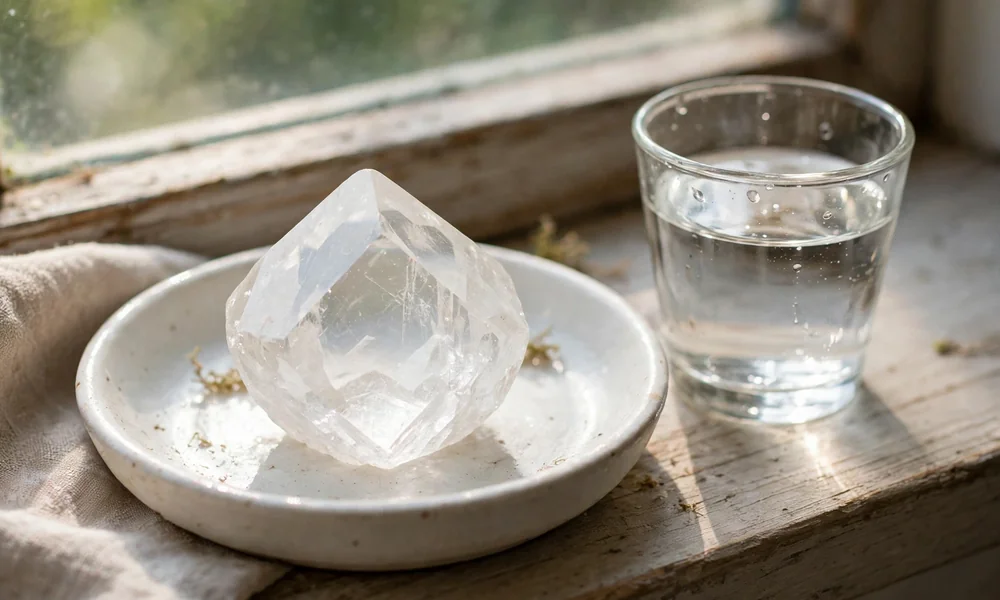
Optical Calcite and Honey Calcite
Honey calcite for autumn skin is a warm golden calcite, sold mostly as a smooth tumbled piece, and it spends its life on shelves in the low light of autumn afternoons.
Optical calcite carries no gold at all. It is clear and cool, while honey calcite is warm and honey-coloured, opaque enough to hide the print beneath it. One glows like late sun; the other splits the light and shows it twice.
Optical Calcite and Blue Calcite
Blue calcite for tired afternoons is a soft sky-blue calcite, pale and even in colour, sold mostly as a tumbled piece for a desk.
Optical calcite has no blue in it. It is colourless and glassy, its gift the double image, while blue calcite offers a calm blue colour and no doubling at all. One is a quiet blue; the other prints everything twice.
Optical Calcite and Green Calcite
Green calcite for tired afternoons is a cool mint-green calcite, soft in colour and smooth to hold, sitting on shelves as a gentle green accent.
Optical calcite is not green and not soft-looking. It is clear and sharp-edged, its flat faces catching the sun and splitting it, while green calcite is green, smooth, and still. One cools a room with colour; the other brightens it with doubled light.
Optical Calcite and the Other Calcites
Calcite comes in more colours than almost any other mineral family on these shelves, and optical calcite still stands apart from every one of them. Peach calcite is soft peach for tender days, cobalt calcite is soft pink for tender days, and chocolate calcite is warm brown for steady days. Red calcite is warm red for bold mornings, pink calcite is soft pink for gentle mornings, and pink mangano calcite is soft pink for skin. White calcite is clean white for fresh spaces, yellow calcite is sunny yellow for bright mornings, and blue calcite is cool and calm. Green calcite is cool green, honey calcite is warm gold for autumn, and orange calcite is warm and bright for fresh starts. None of them is colourless, and none doubles a printed word the way optical calcite does.
Optical Calcite and the Other Stones in This Batch
This batch brings four more stones, each keeping its own distance from optical calcite. Musgravite is soft violet for quiet days, violet through and through where optical calcite is clear. Condor agate is soft-banded for quiet days, layered in bands where optical calcite is one clear block. Painite is deep red for bold days, dark and rare where optical calcite is bright and plain. Purpurite is deep violet for quiet days, purple and opaque where optical calcite is clear and glassy.
Keeping Optical Calcite at Home
Set optical calcite where daylight finds it and elbows do not: a desk end, a shelf by the morning window, or a small dish on the drawers. Keep that corner dry, far from the sink, the kettle, and any steamy bathroom air. Once a week, wipe the dust away with a soft, dry cloth, and leave soap and sprays in the cupboard. When the crystal is off show, lay it alone in a cloth bag, away from keys and harder stones. A high shelf suits it best, out of reach of small hands and passers-by.

Stones That Must Stay Away from Water
A few stones hide something harmful inside, so one rule guards them all: keep every stone away from drinks. Malachite's green bands hold copper, a metal that must never reach a glass or a jug. Hematite stays out of drinking water as well, and apatite and pyrite stay dry for the same reason. Lepidolite holds lithium inside, so it never meets a glass. Angelite goes dull and soft after wetting, and amber, old tree sap set hard, clouds in a soak and has no place near a drink. Always wash your hands after handling them.
Your Bright Days Checklist
- Lay the crystal on a dry tray, the glass at the far end.
- Slip printed words beneath the stone and watch them double.
- Drink your water in slow, easy sips, with no rush at all.
- Set the crystal back on its tray, then clean your hands.
- Ask the seller which country the piece came from.
- If a health worry troubles you, ask your doctor — a stone cannot answer.

Frequently Asked Questions
What is optical calcite?
Optical calcite is clear, colourless calcite, the same stone once called Iceland spar, and it splits a single image into two.
Where does optical calcite come from?
The finest clear pieces came from Iceland, and good material also comes from Mexico and the United States.
Why does optical calcite double a printed word?
Light entering the stone splits into two rays that travel at slightly different speeds, so each ray leaves the stone in its own direction.
How is optical calcite different from clear quartz?
Clear quartz is a hard, glassy mineral with six-sided points; optical calcite is a softer, slanted block that doubles print.
Is optical calcite safe to hold?
A brief hold of a small, clean, plain piece suits nearly everyone, since a dry crystal passes nothing at all onto the skin.
Where should I keep optical calcite at home?
Choose a bright, dry nook far away from taps and steam: a desk end, a window shelf, or a drawer dish, with the glass kept well apart, and the stone safe from knocks.
The Bottom Line
Optical calcite fits bright days: a clear stone that doubles print and splits sunlight into rainbows, water close by, crystal kept dry at home.
A Note for Bright Days
One clear stone, a doubled word, a dry tray, a full glass — a bright day asks for nothing more.