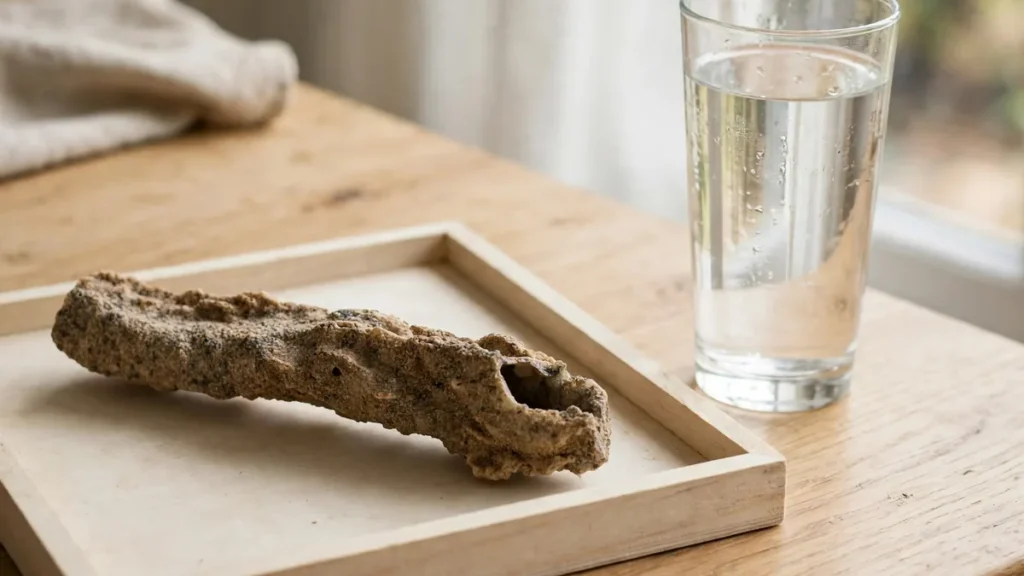
A white stone does not need colour to hold a room. Hydrozincite arrives as a pale crust dusted over dark rock, white as chalk and soft as powder, and the contrast is what catches the eye: bright white against dark stone.
Bright days suit it, because white shows best in clear light. On a bright morning the crust glows softly on its dish, the dark rock beneath it keeps the piece from washing out, and the whole thing asks for nothing more than a dry shelf and a glass kept well apart.
What follows is a plain look at the stone: what it is made of, how it stands apart from zincite, smithsonite and hemimorphite, what to look for when buying one, and the dry habit that keeps it safe. It is a pretty thing to look at, and it cures nothing.
Key Takeaways
- Hydrozincite is a soft white zinc carbonate hydroxide, also called zinc bloom.
- It forms as chalky white crusts where zinc ores have weathered.
- Its clear white suits bright days, soft light and unhurried looking.
- It is very soft and brittle, so it stays dry beside the glass, never in it.
- It is a beautiful object to admire briefly, and it cures nothing.
What Hydrozincite Is
Hydrozincite is a soft white zinc mineral, a carbonate hydroxide with the formula Zn5(CO3)2(OH)6, named in 1853 by Gustav Adolph Kenngott for the water and zinc in its make-up. Collectors also call it zinc bloom, a pale crust spreading across weathered zinc ore.
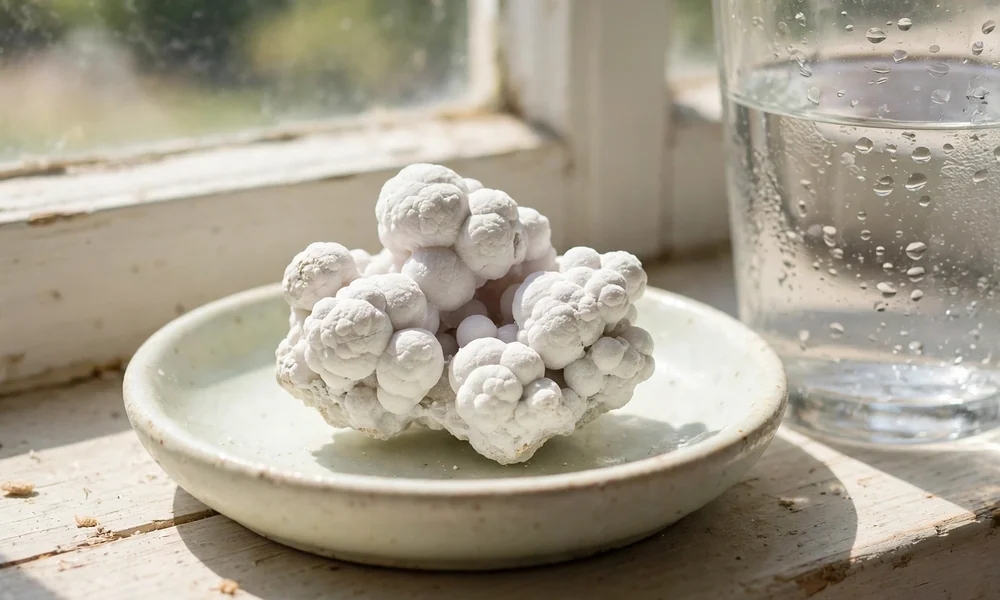
It almost never forms sharp crystals. Instead it appears as chalky, earthy or silky-fibrous crusts, lumps and coatings on dark rock, white to grey and sometimes stained pale pink, yellow or brown. Under a short-wave ultraviolet lamp it glows pale blue to lilac, one of the brightest such glows among common minerals.
It is a secondary mineral, born from weathering: rain and air work on sphalerite and smithsonite in the oxidised tops of zinc deposits, and hydrozincite is the pale crust left behind. It is very soft, only 2 to 2.5 on the Mohs scale, so soft a fingernail can mark it, and brittle enough to crumble if gripped hard.
Hydrozincite and Zincite
Zincite warm orange for bright days follows a warm orange zinc oxide crystal, mostly grown in a laboratory, the colour of a peeled clementine, smooth and glassy, glowing when light passes through it.
Hydrozincite could hardly be its opposite more plainly. Where zincite is a single clear orange crystal, grown in furnace heat, hydrozincite is a dull white crust grown by weather on dark rock. Zincite is cut and polished for the shelf; hydrozincite is a chalky coating that crumbles if handled roughly. Both carry zinc in their names and both suit bright days, but one glows orange and the other stays quietly white.
Hydrozincite and Smithsonite
Smithsonite soft pastel for gentle days follows a soft pastel zinc carbonate in pale blue-green, pink and lilac, smooth and cool in the hand, sold as polished tumbled pieces and palm stones.
The two stones are close kin, and they often grow side by side in the same weathered zinc ground. Smithsonite is the polished pastel, smooth and waxy, made to be held. Hydrozincite is the chalk-white crust that forms on top of it, earthy and powdery, made to be looked at on a dish. Smithsonite takes a gentle polish; hydrozincite would crumble under one.
Hydrozincite and Hemimorphite
Hemimorphite light blue for bright mornings follows a light blue zinc silicate whose best pieces grow in soft, bubbly clusters like tiny grapes, pale as a morning sky, the blue coming from tiny traces of copper.
Hydrozincite shares the zinc ground and little else. Hemimorphite is blue and bubbly, smooth to the touch, and sold polished as tumbled stones and beads. Hydrozincite is white and chalky, rough to the touch, and never polished at all. One looks like a bunch of small pale grapes; the other looks like frost dusted over dark rock.

Why Clear White Suits Bright Days
Clear white suits a bright day because it answers the sun without competing with it. A bright day is full of open windows and sharp daylight, and a white crust on dark rock holds its own in that light. The white catches the sun and throws it back softly, and the dark rock beneath it keeps the piece from washing out.
White suits a bright day because it asks for nothing. There is no colour to match and no shine to chase; the piece sits on its dish, quiet and pale, while the day gets on with itself. A glass of water, a book, and a white stone mark the hours as bright.
The Safety Rule First: Beside Water Only
Water and hydrozincite never meet in this house. The stone lives on its dry dish, the glass stands at the far end of the sill, and nothing wet crosses the space between them. A drink is for drinking only, and no stone goes into one. Should a crumb of the crust ever fall into a glass, tip the water away, rinse the glass well, and wash your hands before you pour again.
The reason is plain to see: hydrozincite is a chalky crust, and water turns chalk to paste. A wet piece crumbles in the hand and sheds white dust into the drink. Keep it dry, keep it whole, and the white stays white.
How to Choose a Hydrozincite Piece
Look at the piece in daylight before you buy it, and pick one whose white reads clean. The crust should sit firmly on its dark rock, with no loose flakes that fall away when you tip the piece. A palm-sized piece on matrix is plenty.
Be wary of pieces that look painted, with one flat, even white covering the whole stone, or of sellers who promise the stone will change your health. Real hydrozincite shows dark rock between the white patches, and each patch has its own shape. Ask the seller to name the stone and the find spot in plain words, and when buying online ask to see a photograph of the actual piece. Wash your hands after handling it, because the white dust gets everywhere.
A Bright Day with Hydrozincite
Begin the morning with the table already set. Put the dish on the small table by the chair the night before, glass at the far edge, and when the sun comes up, sit down with the water and let the white crust catch the first light. Drink the water in slow sips, turn the piece once in your fingers, and set it back before the glass is half empty.
The rest of the morning is yours, and the stone needs nothing more from it. Leave it where it lies while you get on with the day, and when evening comes, the white crust will still be there on its dish, dry and pale.
Hydrozincite at a Glance
| White chalky crust | Bright days, soft light | Hands washed after |
|---|---|---|
| Zinc carbonate hydroxide | Dish beside glass | Keep it dry |
| Soft, Mohs two | One small piece | Shade from damp |
| Fluoresces pale blue | Linen, wood, daylight | Never in water |
Hydrozincite Among the Other Stones in This Batch
Four more stones sit beside hydrozincite in this batch, and each one takes a different road. A trilobite is no stone at all in the usual sense but a fossil, an ancient sea creature turned to rock. Sard is a deep red-brown chalcedony, warm and banded, a stone for steady days rather than bright ones.
Five water guides share this batch too: a lemon slice, a trowel, a wheelbarrow, a bread box and a cake stand, each one taking water into a different corner of the whole house. Stibnite is dark needles, cymophane gold light, while hydrozincite stays quiet, white and dry.
Where Hydrozincite Sits at Home
Give the piece a still corner of the house, where no one walks past it and no steam ever reaches it. The far end of a dresser suits it, or a bookcase top away from the kitchen. Little hands and paws should not reach it, because a knocked piece sheds white dust and loses a corner.
When it travels, wrap it in tissue and pack it in a small hard box of its own, so the crust cannot knock against anything. A soft pouch on its own will not protect a chalky stone.
Stones That Must Never Touch Water
Water is unkind to several stones in this journal. A soak clouds amber for good, since amber is hardened tree resin and not a stone at all. Apatite comes out of water with its shine gone, and no amount of drying brings it back. Pyrite left damp grows rusty spots that do not wash off. Angelite drinks water in and turns dull and swollen. Lepidolite carries lithium inside its pale flakes, so it is kept far from every cup and jug. Hydrozincite itself is a soft chalky crust that crumbles when wet, so it lives on a dry dish beside the glass, never in it.
Your Bright Days Checklist
- Set the piece on its dish with the white crust facing the room.
- Sip the water slowly while the light fills the room.
- Pick it up once, look at the white in the light, and set it back.
- Dust it with a soft, dry brush, and never use water on it.
- Carry it in its own rigid box when it travels, away from keys and hard stones.
- If a health worry stays with you, see a doctor — a pale stone cannot answer it.

Frequently Asked Questions
What is hydrozincite, in plain words?
Hydrozincite is a soft white zinc mineral, a chalky crust on weathered zinc ore, also called zinc bloom.
How can I tell hydrozincite from smithsonite?
Smithsonite is a smooth pastel stone that takes a polish, while hydrozincite is a dull white crust that crumbles if handled roughly. The two often grow side by side, but they look nothing alike.
Why must hydrozincite stay out of water?
Water turns its chalky crust to paste, so a wet piece crumbles and sheds white dust. That is why the stone sits beside the glass.
Is hydrozincite the same stone as zincite?
No, zincite is a warm orange zinc oxide crystal, usually lab-grown, while hydrozincite is a white zinc carbonate hydroxide crust grown by weathering.
Can I hold hydrozincite in my hand?
Yes, briefly and gently: lift it with dry hands, look at the white crust, set it down again, and wash your hands after.
Where should hydrozincite live at home?
Keep it on a high shelf in a dry room, far from taps and steam, where children and pets cannot knock it down.

The Bottom Line
A white crust, a dry dish, a glass kept apart, and a bright morning — that is hydrozincite, and it is enough.
A Note for Bright Days
White stone, dry dish, full glass — a bright day needs nothing more than that.