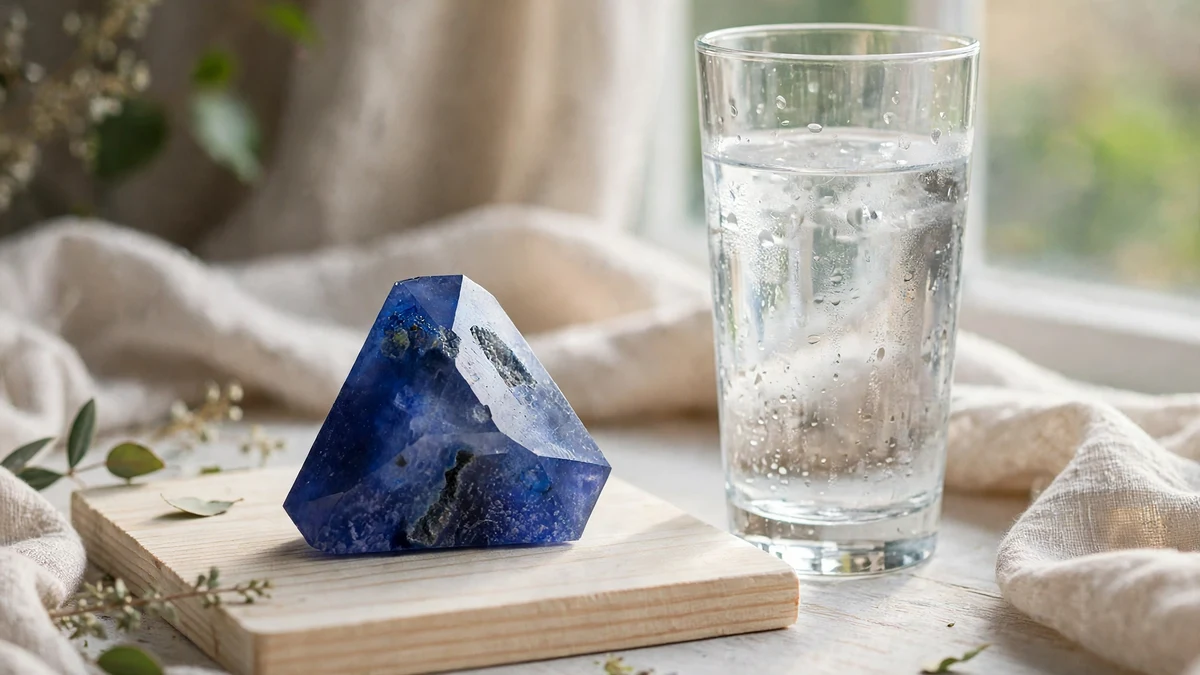
There are afternoons when the light turns the colour of weak tea and the house settles into a hush. The washing is folded, the post is still unopened, and the clock seems to tick more slowly than at breakfast.
Benitoite belongs to afternoons like that. It is a deep blue stone that grows in sharp triangular shapes, a rare Californian mineral the colour of evening water, and it holds its blue even when the room around it goes pale and quiet.
This guide looks at the stone: where it comes from, why its blue stands apart, how to pick a piece you enjoy, and how to keep it on a tray beside a glass of water with the two never touching. It is a beautiful object for the eye, not a remedy, and it will not cure or fix anything.
Key Takeaways
- Benitoite is a rare deep blue stone from California, grown in sharp triangular crystals.
- Its blue shifts as you turn it, pale from one side and deep from another.
- It suits calm days, slow afternoons, and rooms kept quiet and uncluttered.
- It is an object for looking and brief handling, not something that can heal or treat.
- Keep drinking water in its glass, far from the stone, and keep the stone dry.
What Benitoite Is
Benitoite is a barium titanium silicate found in only a handful of places, almost all of it from one stretch of ground in San Benito County, California. The county gave the stone its name, and California later chose it as the state gem.
The crystals grow as flat, sharp-edged triangles, glassy and deep blue. Turn the stone and the colour changes, rich blue from one angle and fading towards colourless from another, a trick called dichroism that few blue stones show so plainly. In daylight the blue is at its strongest.
A polished piece feels cool and smooth, and at 6 to 6.5 on the hardness scale it is softer than sapphire, so it asks for a gentle touch.
Why Deep Blue Suits Calm Days
Deep blue is the colour of things that hold still: a reservoir at dusk, the sea from a cliff path, the sky before night. A small deep blue stone borrows a little of that stillness and brings it indoors.
On a calm day the room needs no bright colour: reds hurry and yellows chatter. Benitoite keeps its blue through the afternoon, one dark point the eye can return to, as to a window when thinking.
Choosing a Benitoite Piece
Choosing a piece is mostly holding it up to daylight and watching the blue. A good stone shows a strong, even blue from its best angle, with no grey or milky patches, and a clear triangular shape with clean edges.
Turn it slowly: the colour should shift, the surface should feel smooth, and a plum-sized piece is easy to hold and move without dropping.
Ask the seller where the piece was found, and walk away from painted-looking stone or any promise that it will change your health.

A Calm Day with Benitoite
A calm day with benitoite needs no plan. Lay a navy cloth on the table, put the stone near one edge and a tall glass of water near the other, leaving dry cloth between them. Drink the water slowly while the deep blue catches the light.
Then lift the stone, turn it once so the blue shifts, and set it back down. It is there to be looked at between other small things: a page read, a letter answered, a few minutes at the window.
Benitoite Beside Water
Water and benitoite make a calm picture together, yet the two never meet. Put the glass near one edge of the cloth and the stone near the other, with dry fabric in the middle, so the drink stays clean and the stone stays dry. The cloth shows them together; nothing is ever dipped in it.
Rinse your hands with soap before you pick up the glass. The stone never enters a glass, a jug, or a bath: soaking can dull its polish and chip its sharp points, so keeping it dry is part of its care.
If the glass spills, lift the stone away and dry it at once, and keep the tray away from sinks and kettles.
Benitoite at a Glance
| Deep blue triangle | Calm tray, desk | Dry hands only |
|---|---|---|
| Blue shifts, glassy | Slow afternoons, hush | Glass kept apart |
| Cool, smooth stone | Low light, quiet | Never in drinks |
| Plum-sized piece | One tray, one glass | Dust dry weekly |

Benitoite and Blue Sapphire
Blue sapphire for calm days is the nearest famous stone to this one, and the difference is easy to see once they sit together. Blue sapphire is a deep blue corundum, faceted and bright, one of the hardest gemstones, with a blue that stays the same whichever way you turn it.
Benitoite is softer, rarer, and shaped by nature into triangles, its blue shifting as it moves. Where blue sapphire is the classic stone everyone pictures, benitoite is the quiet Californian cousin, found in one small county and seldom seen outside a collection.
Benitoite and Blue Spinel
Blue spinel for calm days is a cool deep blue stone with a bright glassy shine, clear and steady. It is hard and dense, and its blue does not change as you turn it in your hand.
Benitoite is a different kind of blue. Its crystals are flat triangles, its colour slides from deep blue to nearly colourless as the angle changes, and it comes from one Californian valley. A spinel is a jewel you might wear daily; a benitoite is a specimen kept on a tray and turned in the light.
Benitoite and Blue Topaz
Blue topaz for bright days is a clear, cool blue stone the colour of a bright sky over clean water, made for mornings when the sun is out. Its blue is pale and airy, and it suits fresh light and open windows.
Benitoite is deeper and darker, the colour of evening water rather than morning sky, for the slow hours when the light has gone low. Blue topaz is common in any jeweller's drawer; benitoite is scarce, tied to one county, and most people will never hold a piece.
Benitoite and the Other Blue Stones
The blue family is large, and benitoite stands apart from every member of it. Blue zircon is bright and sparkling; benitoite is darker, its blue changing as it turns. Blue obsidian is a soft pale glass pebble; benitoite is a sharp triangular crystal, far deeper in blue.
Blue agate is banded with thin white lines, blue jasper is pale with faint grey marbling, blue fluorite is cool and watery, and blue chalcedony is milky and gentle. Blue amber is fossil resin that glows blue only in daylight.
None grows in triangles, none shifts colour so plainly, and none comes from that one Californian valley.

Where Benitoite Rests at Home
Benitoite does well where the light is gentle and the room stays settled: a low shelf, a desk corner, or a tray on drawers, in view yet clear of passing elbows. Low afternoon light shows its shifting blue best, so a place near a window that never takes full sun is ideal.
Dust it once a week with a soft dry cloth; soap and scrubbing only wear the polish down.
Between displays, wrap it in a soft cloth bag of its own, away from keys and harder gems.
Stones That Must Stay Away from Water
Some stones should never meet water, because a few hold things that have no business in a drinking glass. The green stripes of malachite hide copper, and copper belongs nowhere near a drink. Hematite left wet goes rusty, and the rust marks everything it rests on.
Pyrite crumbles when soaked, angelite melts away in water, apatite chips if bathed, lepidolite carries lithium, and amber is old tree resin, dulled by a long soak.
Keep every one of them away from drinks, and treat benitoite the same way: beside the glass, never in it, with dry hands and a dry cloth.
Your Calm Days Checklist
- Lay the stone on dry cloth, with a full glass nearby.
- Drink the water slowly in the quiet room.
- Hold the stone for one slow breath, then set it down.
- Turn it once to watch the blue shift.
- Wash your hands with soap after setting it down.
- When health worries linger, ask a doctor; a stone is only something pretty to look at.

Frequently Asked Questions
What is benitoite?
Benitoite is a rare deep blue mineral from San Benito County in California that grows in flat triangular crystals. Its blue shifts as you turn it, deep from one angle and pale from another.
How is benitoite different from blue sapphire?
Blue sapphire is a hard, faceted corundum with a steady deep blue. Benitoite is softer, rarer, and triangular, its blue sliding from deep to nearly colourless with the angle of the light.
How is benitoite different from blue spinel?
Blue spinel is a hard, glassy stone with a cool, even blue. Benitoite is a triangular crystal from one Californian valley, its colour changing plainly as you move it.
How is benitoite different from blue topaz?
Blue topaz is a pale sky blue stone for bright mornings, common and easy to find. Benitoite is a deep evening blue for calm afternoons, scarce and tied to one county.
Is benitoite safe to hold?
Most people can hold a polished piece for a minute or two without trouble. Put it back afterwards, wash your hands with soap, and store it where children cannot reach it, away from food and drink.
Where should I keep benitoite at home?
Pick a calm, dry corner: a low shelf, a desk edge, or a tray on drawers, near a window that never takes full sun. Keep the glass apart and the stone away from damp, knocks, and strong direct sun.
The Bottom Line
Benitoite brings a rare deep blue to calm days: one triangular stone from California, its blue shifting as it turns, a glass of water beside it, never in it.
A Note for Calm Days
Keep the day slow and the stone dry: one deep blue triangle, one glass of water, a few unhurried hours.


