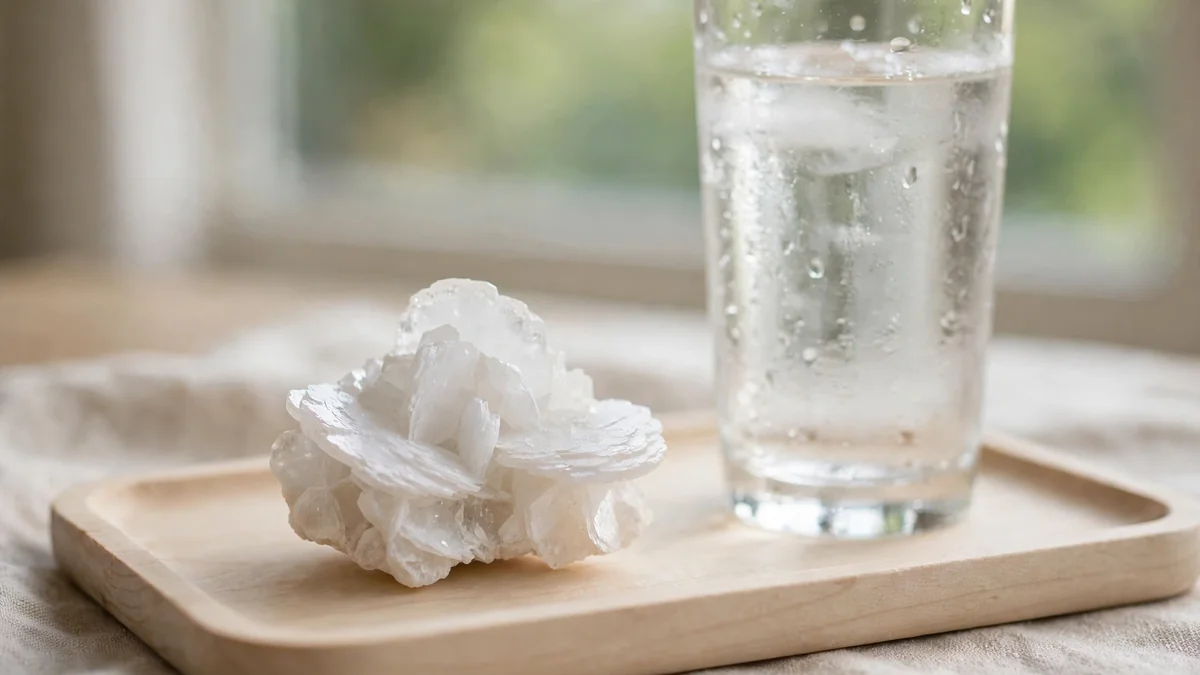
A quiet day moves at its own speed, and the room around it should do the same: pale light through the window and one plain object to rest the gaze on. Barite fits that mood without trying, a clear white mineral, cool and glassy, that sits on a tray like a piece of frozen daylight somebody left behind.
The first thing most people notice about barite is not its colour at all, but its weight. Pick up a piece the size of a plum and it surprises the hand, heavier than it looks, solid and cool, with flat glassy faces that catch the light in clean flashes. Set it down beside a glass of water and the pair looks settled.
Nothing here promises more than that. Barite is a mineral to look at, to hold for a minute, and to keep dry on its tray. It will not fix anything in your body, so enjoy it the way you would enjoy a pale shell on a windowsill: for its shape, its colour, and the quiet it brings to a corner of the room.
Key Takeaways
- Barite is a clear white mineral, barium sulfate, sold as glassy bladed crystals or smooth tumbled pieces.
- A piece feels far heavier than it looks, because barite is one of the densest common minerals.
- Its clear white colour suits quiet days, pale light, and rooms kept plain and uncluttered.
- Barite is for display and brief handling only; it will not heal anything or change your health.
- Keep the mineral dry beside drinking water, never in the glass, and wash your hands after holding it.
What Barite Is
Barite is a mineral made of barium sulfate, formed in veins and beds where warm mineral waters once moved through rock. The name comes from the Greek word for heavy, and the stone earns it: barite weighs about four and a half times as much as the same volume of water. Most shop pieces are clear white or pale cream.
Barite grows in flat, bladed crystals, stacked in fans and rosettes, with a glassy shine on the flat faces and a pearly glow along the edges. Tumbled pieces lose the blades and turn smooth and rounded, milky white like a pebble from a cold beach.
Picking a Barite Piece
Choosing barite starts in daylight, because a dim shop can hide a dull piece. Carry the stone toward the window and look for a clean, even white, clear enough that light passes through the thin edges, with no yellow stains or grey smudges. A good crystal shows flat faces that flash as you turn it, while a good tumbled piece feels smooth on every side.
Lift it before you buy it, because the weight is the honest test: a piece that feels light for its size may be another white mineral altogether. Ask the seller where the piece was found, and step away from anyone who promises it will improve your health.
A Quiet Day with Barite
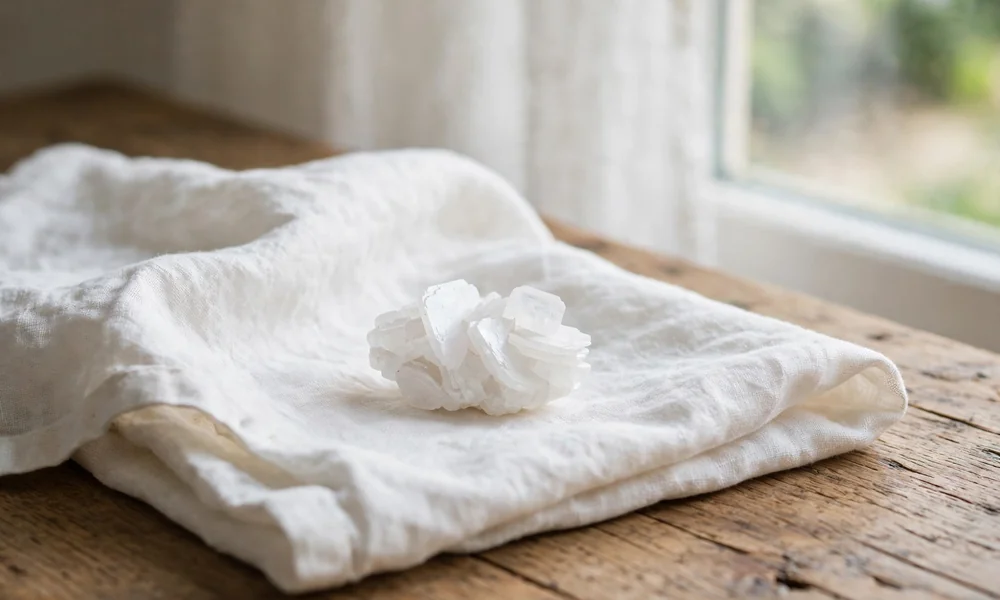
A quiet day with barite needs little more than a tray, a glass, and an unhurried hour. Spread a folded white cloth over the dressing table, place the crystal near the front so the morning sun finds it, and put the glass at the opposite end, leaving plain wood in between. Drink the water in slow sips, and turn the crystal once.
The stone asks nothing of the day. Let it stay where the sun touches it, notice it as you walk past, and shift it to the sill for a while in the afternoon. There is no schedule to keep, and the day stays quiet around it.
Barite Beside Water
Barite and water make a calm pair on a tray, as long as the two never touch. Put the tumbler at one end and the mineral at the other. Wash your hands after handling the stone and before you lift your drink.
The rule holds even though barite itself is a stable mineral. It goes in no glass, no jug, and no bath, and no one should rinse it under a tap to clean it, because a soak can dull its glassy faces. A soft dry cloth is all it needs.
Barite at a Glance
| Clear white mineral | Pale tray, window | Dry hands only |
|---|---|---|
| Heavy, cool, glassy | Quiet days, calm | Glass kept apart |
| Bladed crystal fans | One accent, plain | Never in drinks |
| Barium sulfate stone | Slow daylight hours | Never soak mineral |
| Small pieces usual | Tidy shelf, tray | Dust dry weekly |

Barite and White Jade
White jade for calm mornings is a milky, buttery white stone, polished to a soft glow, cool to the touch. It is hard nephrite jade, dense and tough, and it keeps its shine for years without fuss.
Barite sits close to white jade in colour and far from it in feel. White jade glows like pale wax and takes a knock without complaint, while barite is glassy, bladed, and far heavier in the hand, and it chips if dropped. One is hard, the other heavy.
Barite and White Onyx
White onyx for bright days is a milky white banded quartz, pale grey lines wandering through it, and it holds a quiet shine in daylight.
Barite shares the milky white and little else. White onyx is layered quartz, much harder than barite, and its bands drift across the stone as it turns, while barite shows flat crystal faces and no bands at all. One is banded and hard, the other bladed and heavy.
Barite and Magnesite
Magnesite for quiet days is a pale white carbonate stone, usually a smooth rounded piece like a lump of school chalk, dull-surfaced instead of shiny.
Barite and magnesite are the nearest neighbours in this journal, and the hand tells them apart at once. Magnesite is light, chalky, and matte, warming quickly in the palm, while barite is heavy, glassy, and cool for much longer. One is chalk-white and soft, the other dense and clear-white.
Barite and White Sapphire
White sapphire for bright days is a clear white corundum, usually sold as a small faceted gem that flashes as you turn it. It is one of the hardest stones in the journal, scoring nine on the Mohs scale, and it keeps its polish for years.
Barite could hardly be more different in the hand. White sapphire is faceted, hard, and light for its size, while barite is bladed or tumbled, much softer, and strikingly heavy, and a careless knock will chip it. One is a bright gem for strong daylight, the other a heavy mineral for slow hours.
Barite and the Other Stones in This Batch
The journal's current round holds barite alongside four companions that could hardly look less alike. Staurolite is a dark brown mineral, often grown in crossed twins like two small bars laid over each other. Titanite is a warm, glassy mineral with a green-gold flash, bright and lively where barite is plain and still. Vesuvianite is a deep green stone, rich and leafy, the colour of a forest floor after rain. Zincite is a warm orange-red mineral, glowing like embers in lamplight. Barite is the only clear white stone among them, and the quietest.
Keeping Barite at Home
Give barite a bright, tidy corner where it can be seen without being knocked: a windowsill shelf, an empty desk corner, or a shallow dish on the drawers. Keep that corner far from taps, kettles, and steamy bathrooms, and out of reach of small children. Wipe it weekly with a dry, soft cloth, and leave soap and sprays in the cupboard. When it is off display, rest it alone in a lined box or a cloth bag, away from keys and harder stones.

Stones That Must Stay Away from Water
A few minerals hide things that no drink should ever carry, so learn the names before you lay out a tray. Malachite's green bands are rich in copper, a metal with no place in any glass, so malachite stays on a dry shelf, far from jugs and tumblers. Hematite can leave rusty marks once wetted, so it stays out of drinking water, and the same dry habit covers apatite and pyrite. Lepidolite holds lithium in its pale flakes, which is reason enough to keep it dry and far from every glass. Angelite loses its shine once it has been wetted, and amber, old tree sap set hard long ago, clouds after a soak. Barite rests dry beside the glass.
Your Quiet Days Checklist
- Lay the barite on a clean dry cloth, and keep the glass well apart from it.
- Drink your water unhurriedly, one slow sip.
- Turn the crystal gently and watch its flat faces catch the light.
- Set the mineral down on its tray, then wash your hands.
- Choose a seller who can say which mine and country the piece came from.
- If a health question keeps nagging at you, take it to a doctor, not to a stone.

Frequently Asked Questions
What exactly is barite?
Barite is a mineral made of barium sulfate, formed where warm mineral waters once moved through rock, and sold as clear white bladed crystals or smooth tumbled pieces.
Why does barite feel so heavy for its size?
Barite is one of the densest common minerals, weighing about four and a half times as much as the same volume of water, so even a small piece surprises the hand.
How can I tell barite apart from white calcite?
White calcite is a soft calcium carbonate stone with a waxy shine and faint pale grey veins, while barite is heavier and glassier, with flat crystal faces, so the weight and the flash give it away.
May barite go into a glass of drinking water?
No, never. Barite stays dry on its tray beside the glass, and it never goes into drinking water, into soaks, or into baths, because no stone belongs in a drink.
Is it all right to pick barite up and hold it for a minute?
Holding a small polished piece briefly is fine for most adults, since dry barite leaves nothing on the skin, and washing your hands once you set it down keeps things tidy.
Where is the best place to keep barite at home?
A dry, bright corner suits it best: a shelf by the morning window, a desk edge, or a small dish on the drawers, clear of the glass and away from knocks.
The Bottom Line
For quiet days, barite is enough: one clear white mineral, heavy and cool in the hand, water in the glass nearby, and the stone always resting dry beside it.
A Note for Quiet Days
A pale mineral, a full glass, a dry tray, and unhurried light — that is the whole of a quiet day.


