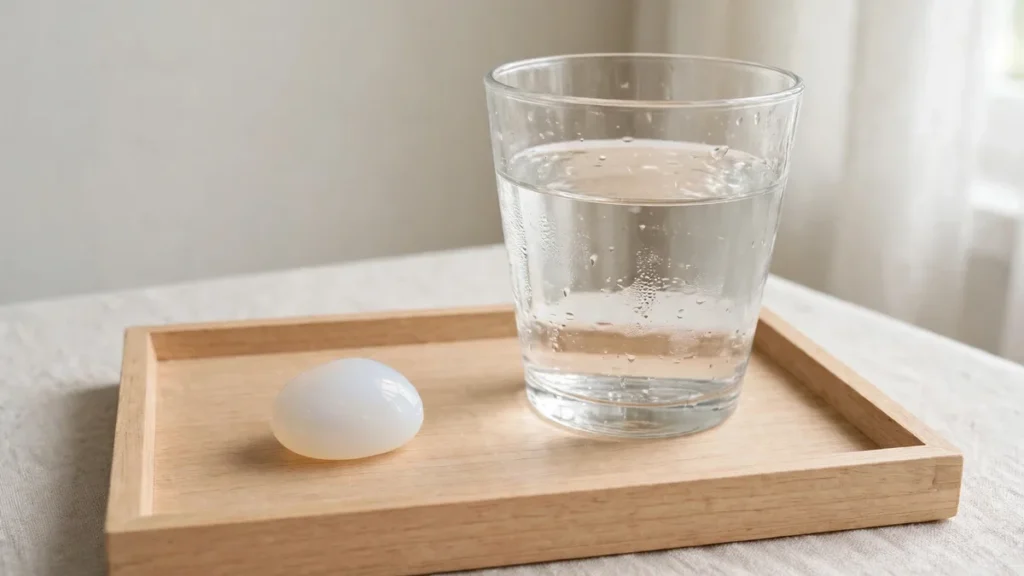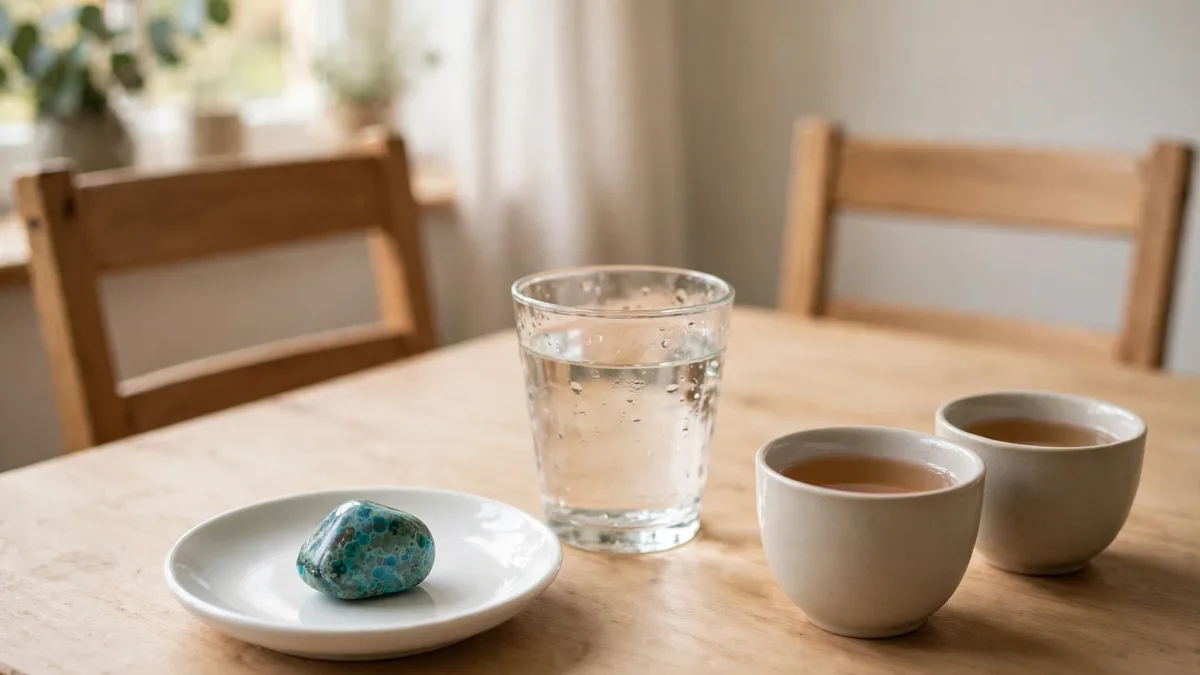
Some conversations are easy, and some are not. An easy talk flows on its own. A hard talk is the other kind: a talk about money, a talk with a friend who is upset, a talk avoided for weeks. On those days a small, steady habit can help you begin with a slower breath and a kinder voice.
Chrysocolla is a stone that suits those calm conversations. It is a blue-green stone, mottled with turquoise, teal and earthy brown, and its colours look like shallow sea water over sand. Hold it and it feels cool and smooth. Set it beside a glass of water where two chairs face each other, and it sits there like a small piece of calm sea, kept for the talk ahead.
This guide explains what chrysocolla is, how to choose one, how to keep it beside water, and how to build a short, gentle habit around the conversations that matter. The stone is display and handling only, never a treatment, and it will not make a hard talk easy on its own.
Key Takeaways
- Chrysocolla is a blue-green stone, mottled with turquoise, teal and brown.
- Its cool colours suit conversations that ask for patience.
- Chrysocolla is for display and handling only; it will not heal anything.
- The stone stays beside drinking water, never in it; this is the only safe way.
- A calm conversation needs very little: water, two chairs, one stone.
What Chrysocolla Is
Chrysocolla is a copper mineral, and its colour is its most striking quality. No two pieces look quite the same: some are mostly turquoise, some are deep teal, and many carry veins of brown or black through the blue-green.
It is most often sold as smooth polished tumbled pieces, beads or small carvings. A piece about the size of a plum is large enough to notice and small enough to fit on a tray beside a glass. Chrysocolla is a soft, porous stone, so handle it gently and never soak it.
Why Calm Conversations Matter
A calm conversation matters because most hard talks are not really about the words. They are about feeling heard, and about being given time. When a talk moves too fast, people stop listening and start defending. A slow talk lets each person finish a sentence, and that small courtesy changes everything.
The stone helps in an ordinary way: it gives the eyes somewhere quiet to rest while the ears work. A glass of water does the same for the hands, giving them something to hold. The same gentle pause runs through chrysocolla calm water for stressful weeks, where the stone and the glass mark a small pause in a crowded week.
Choosing a Chrysocolla Stone
Choose chrysocolla by looking at it, the way you would choose any beautiful object. Hold it in natural light and turn it slowly. Look for blue-green colour you can see clearly, a smooth polish with no sharp edges, and a surface that feels cool and dry.
Ask the seller what the material is, whether it has been treated or dyed, and how they describe its origin. Request a photograph of the actual piece when you buy online. Buy from a trusted seller, never from one who promises it will change your health or your mood.
Setting Up a Conversation Corner
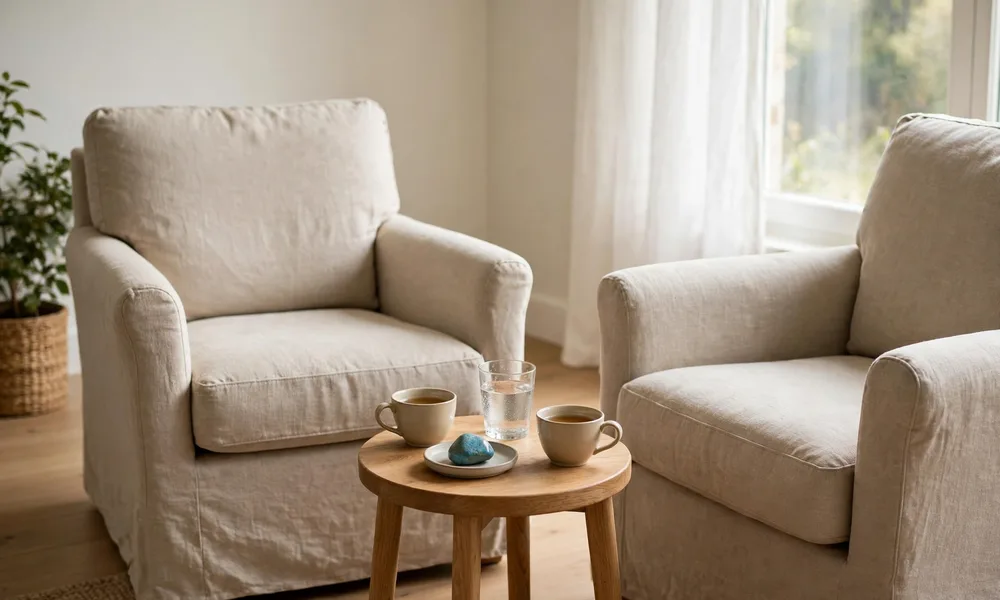
A conversation corner takes only a few minutes to set up. Choose a quiet spot with two chairs facing each other and a small table between them. Place a small dish or a folded linen cloth on the table first, and set the chrysocolla on it, turning it until the colours you like best face outward.
Keep the corner simple. One stone, two glasses of fresh water, and perhaps a small notebook are enough. Put the phone in another room, so the talk belongs to the two people in it.
Keeping It Beside Water
Chrysocolla is a soft, porous stone, so the rule matters even more here: stones stay beside water, never inside drinking water. Keep the stone on its dish beside the glass, where you can both see it.
This matters because a stone can carry dust into the water, can chip, and can be swallowed by accident if it is small. A porous stone can also shed particles when it soaks. A stone beside the glass gives you the same calm sight with none of the risk.

Before a Difficult Talk
Before a difficult talk, give yourself ten quiet minutes alone with the corner. Drink a glass of water slowly, and hold the stone for a moment if you like. Then write down, in a single short line, what you actually want to say, and in another line, what you hope to hear.
This is not a script. It is a way of finding the one honest sentence underneath the worry, so the talk starts from something true. A clear mind before a hard talk pairs well with fluorite study stones for calmer workdays, where a quiet stone helps the working hours move slowly.
Listening with the Stone Nearby
Listening is the harder half of any calm conversation, because it asks you to stop planning your reply. When the other person speaks, look at them, not at the stone. Take a sip of water when you feel the urge to interrupt.
If you lose the thread, say so plainly: "I want to understand this, can you say it once more?" That sentence is never a failure. It tells the other person their words matter enough to hear twice.

Speaking Gently and Clearly
When it is your turn to speak, speak gently and clearly, in short sentences. Say what you feel in plain words, and say what you need in one request. "I felt left out when the plan changed" is easier to hear than a long list of everything that went wrong, and it gives the other person something real to answer.
Pause after each point, and let the silence sit. Silence in a calm conversation is not empty; it is the space where the other person thinks. If the talk grows heated, take a sip of water together, and return to the one sentence you wrote down before you began.
Cleaning and Caring for the Stone
Cleaning chrysocolla is simple, but the stone is soft, so be gentle. Wipe it with a soft, dry cloth after handling, and wash it only briefly with lukewarm water and a drop of plain soap, rinsing well and drying straight away. Never soak it or scrub it.
Keep it on its dish, away from the edge, so it cannot roll off and chip. Keep it out of strong sunlight. A stone cared for gently will keep its blue-green calm for years.
What Chrysocolla Will Not Do
Be honest about what chrysocolla will not do. It will not heal anything: it will not cure an illness, fix a broken relationship, or settle an argument on its own. It is a beautiful copper mineral, and a mineral is all it is, and no honest seller should claim otherwise.
The quiet is the part that helps, in an ordinary way: a clear corner can steady a nervous talk, and one honest sentence can keep the conversation kinder. The stone keeps you company while you do that work. If someone is unwell, see a doctor, not a stone.
Buying Honestly
Buy chrysocolla honestly. A good seller will tell you the stone is a natural copper mineral, show you the piece before you pay, and never promise that it heals or changes your health. If a seller makes medical claims, walk away.
Prices vary with size and the brightness of the blue-green, and a tumbled piece costs very little.
Chrysocolla at a Glance
| Blue green stone | Calm talk | Stone care |
|---|---|---|
| Turquoise teal swirls | Two chairs facing | Wipe stone dry |
| Cool smooth surface | Glass beside stone | Never soak long |
| Fits in palm | One honest sentence | Shade from harsh sun |
| Soft porous mineral | Phone in other room | Dish beside glass |
Your Calm Conversations Checklist
- Clear the table, set the stone on its dish, and pour two glasses of water.
- Keep the phone in another room so the talk belongs to the two people.
- Write down one honest sentence before the talk begins.
- Keep the stone beside your glass of water, never inside it.
- Listen fully, sip water before you interrupt, and speak in short sentences.
- Remember the stone will not heal anything; the honest sentence is the part that helps.
Frequently Asked Questions
What is chrysocolla?
Chrysocolla is a blue-green copper mineral, mottled with turquoise, teal and earthy brown, sold as polished tumbled pieces, beads or small carvings. It is kept as a display and handling stone, never as a treatment.
Will chrysocolla make a difficult talk easier?
No stone can make a hard talk easy on its own. Chrysocolla can give you a quiet corner, a glass of water within reach, and a few unhurried minutes before you begin.
Can I put chrysocolla in my drinking water?
No. Chrysocolla is a soft, porous stone and should never be placed in drinking water. Keep the stone on its dish beside the glass, so the water stays plain and safe to drink.
How do I choose a good chrysocolla?
Look at the stone in natural light before you buy it, and choose one with blue-green colour you can see clearly. Pick a smooth polish with no sharp edges, and a trusted seller who says plainly what it is.
How do I clean chrysocolla?
Wipe it with a soft, dry cloth after handling, and wash it only briefly with lukewarm water and a drop of plain soap, rinsing well and drying straight away. Never soak it for long or scrub it.
Which stone suits a calm conversation?
A calm conversation suits a cool blue-green stone kept beside water through a slow, unhurried talk. One good example is blue calcite cool calm for tired afternoons, a soft pale blue stone for slow afternoons.
The Bottom Line
Chrysocolla is a blue-green copper mineral full of sea colour, and a calm conversation is two chairs, two glasses of water, and one honest sentence.
Put the stone on its dish, pour the water, and begin slowly.
A Note for Calm Conversations
Keep it slow, keep it kind, keep it honest. The talk will do the rest.