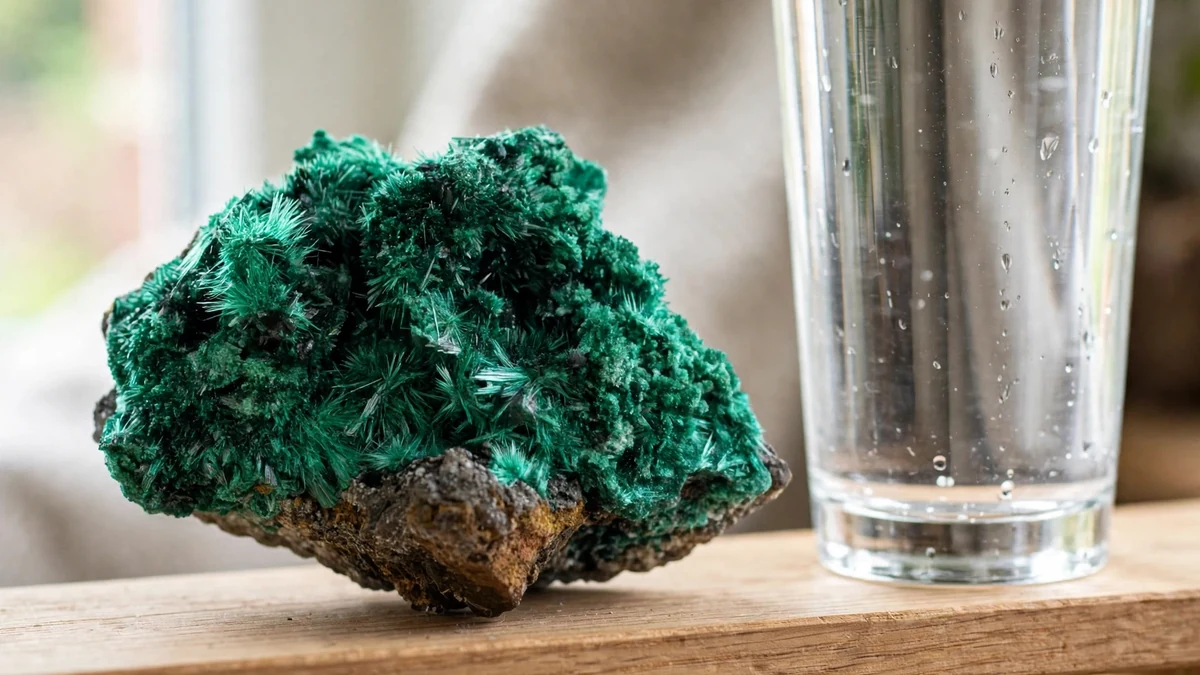
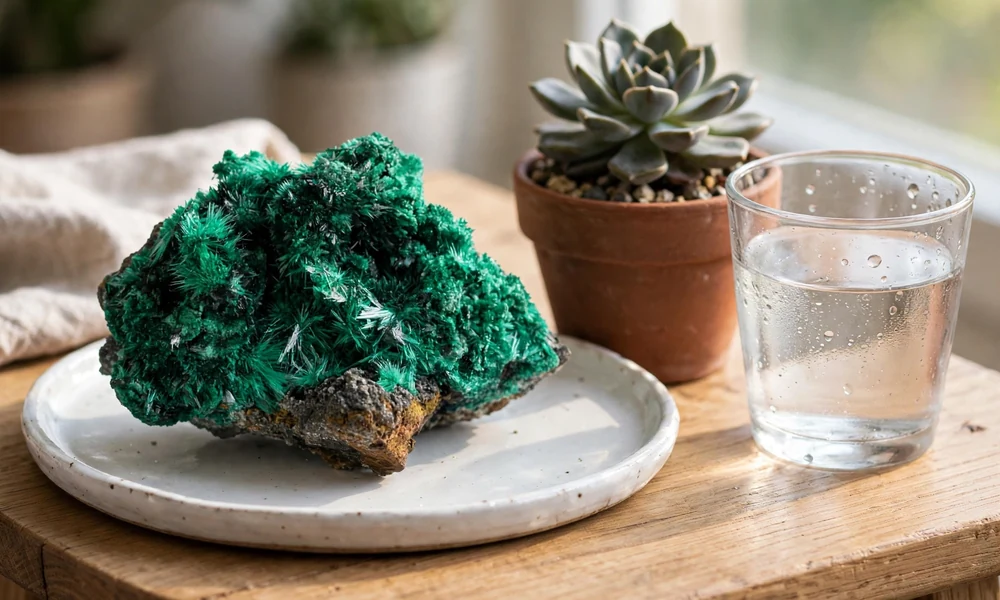
Brochantite is a quiet green stone with a fresh, spring-like colour. Its crystals grow in fine needles and soft velvety tufts, a green that feels light rather than heavy, like new leaves after rain, and set on a plain shelf beside a glass of water, it gives the eye a gentle place to rest.
A calm day needs very little: a clear shelf, a glass of water, and one stone that asks for nothing. Brochantite suits that kind of day because its colour is soft, its shape is small, and its care is simple — keep it dry, keep it still, and let it be.
This guide explains what brochantite is, how to choose a piece, how to display it safely, and how to care for it at home. Think of it as a stone to look at and to hold in the hand — nothing more, since it is not medicine and cannot make anyone well.
Key Takeaways
- Brochantite is a fresh green copper sulfate with fine needle-like crystals.
- Its soft green colour suits calm days and quiet shelves.
- Brochantite differs from malachite, azurite and chrome tourmaline.
- Brochantite is only a stone to look at and hold; it is not medicine.
- Brochantite must stay dry; it sits beside water, never inside it.
What Brochantite Is
Brochantite is a copper sulfate mineral, and the copper inside it gives the stone its fresh green colour. It grows in old copper ground that rain and air have worked on for years, where green crusts slowly build up, then sprout into fine needles and velvety tufts that catch the light.
A good piece feels light in the hand, with a soft, almost silky surface and no sharp edges, and the best pieces show clear, fresh green needles standing close together, with no dull brown patches or crumbly spots. On the Mohs scale brochantite sits near three and a half to four, which makes it a soft stone for a shelf: quartz would scratch it without effort, so it deserves a gentle touch and a safe place.
Why Fresh Green Suits Calm Days
Fresh green suits a calm day because it is a gentle colour that still feels alive — the green of new leaves, soft moss and quiet garden shade — so a fresh green stone feels restful in a room, not demanding. Set it on bare wood with pale books and a small plant nearby, and the single green stone gives the eye a quiet place to rest.
A calm day also suits brochantite because the stone asks for so little. A single piece on an empty stretch of shelf, a glass of water standing close by, and the display is done. Nothing here is loud, and nothing needs shifting or rearranging to look right.
Choosing a Brochantite Stone
Pick a brochantite stone by looking at it closely and trusting what you see: a good piece carries fresh, even green needles with a soft velvety shine, standing close together on a dark rock base. Hold it up to the light: the needles should catch the light evenly, with no grey patches or chalky dust.
Check the base before you buy: a firm dark rock base holds the crystals steady, while a crumbly base sheds needles at the first touch. Small pieces suit a calm shelf best, since a large piece crowds the space and asks for more room than a quiet day needs.
Displaying Brochantite at Home
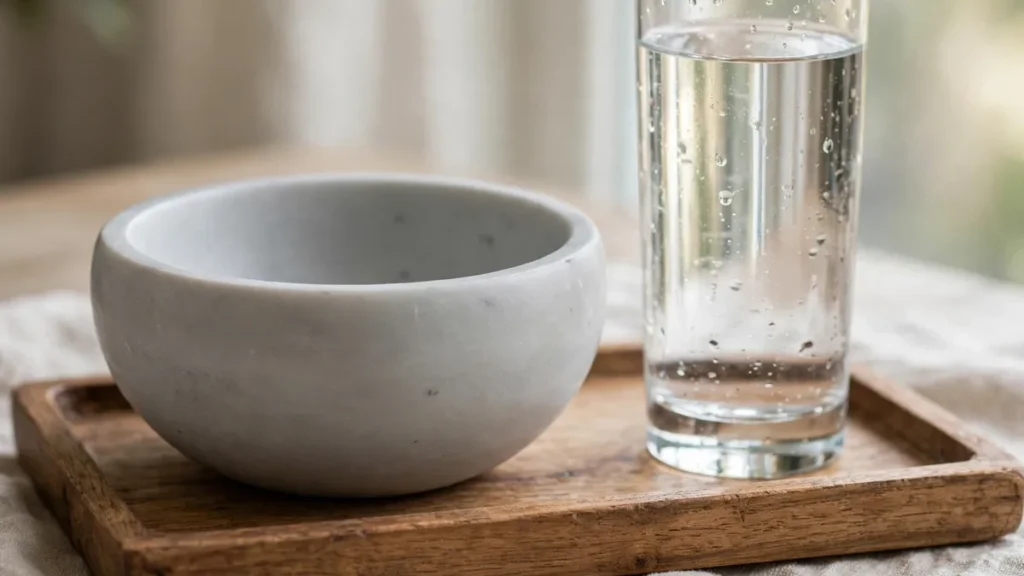
Display brochantite where it will be seen but never knocked: a shelf at eye level, away from the edge, with a little clear space around it. A white ceramic tray or pale linen cloth under the stone shows its green well.
Keep the stone away from windows that catch the afternoon sun, since strong light and heat dry the surface and dull the green, and away from the kitchen sink and the bathroom shelf, where steam and splashes threaten a stone that must stay dry.
A Quiet Morning with Brochantite and Water
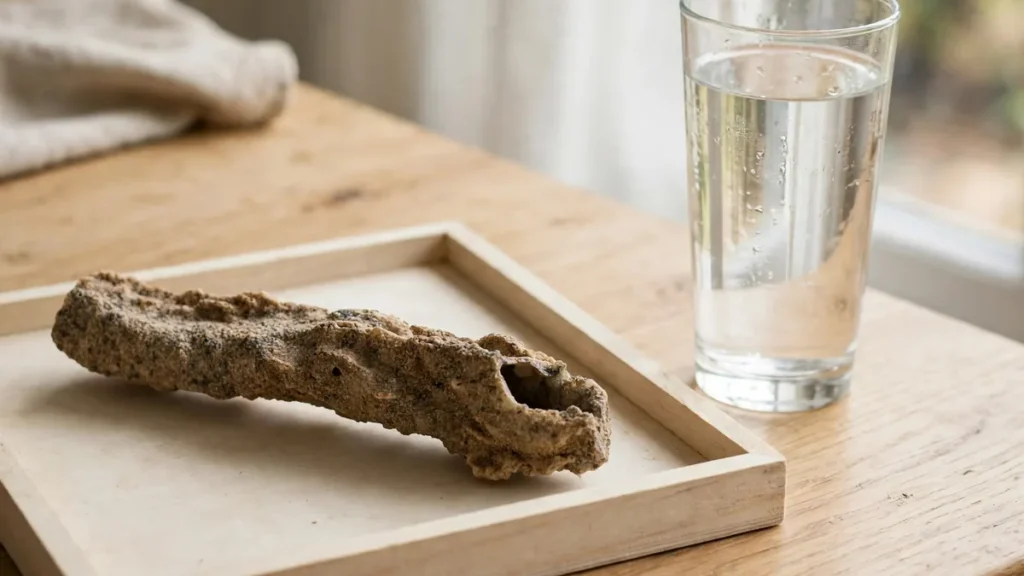
Start with the glass rather than the stone: pour a tumbler, set it on the far side of the table, and lay a pale cloth flat beside you. Drink half the glass slowly before you lift the stone from its shelf.
Set the stone on the cloth and look at it closely for a minute, turning it gently to catch the light. Wipe the shelf with a dry cloth, set the stone back in its place, and put the glass beside it — close enough to see, far enough that no drop can reach it. When the glass is empty, the morning is ready.

Brochantite at a Glance
| Fresh green | Copper sulfate | Keep it dry |
|---|---|---|
| Needles stand close | Forms on copper | Glass stays apart |
| Velvet soft shine | Mohs three point five | Dry cloth only |
| Small piece suits | Dark rock base | Shelf stays calm |
Brochantite and Malachite
For the bold green stone, see the malachite guide.
That guide sets a deep green copper stone with bold swirling bands on a shelf that gathers the whole room around it. Malachite is a copper carbonate, strong and dramatic, and one polished piece alone can carry a whole shelf.
Brochantite is the quieter cousin: a copper sulfate, not a carbonate, whose green is fresh and light where malachite is deep and bold. Malachite commands a bold shelf; brochantite rests on a calm one.
Brochantite and Azurite
For the deep blue stone, see the azurite guide.
That guide sets a rich dark blue mineral on a desk beside a notebook and a glass of water, marking the slow moment before work begins. Azurite is a copper carbonate too, and it must never go in drinking water; hands should be washed after handling it.
Brochantite shares the copper family but not the colour or the mood: azurite is midnight blue for focused work, brochantite fresh green for calm days. One anchors a working desk, the other rests on a quiet shelf.
Brochantite and Chrome Tourmaline
For a harder green stone, see the chrome tourmaline guide.
That guide covers a deep green tourmaline, a much harder stone that can take gentle washing and daily wear without worry, and can be handled freely and cleaned with water.
Brochantite cannot be treated that way. It is far softer, sitting near three and a half to four on the Mohs scale, and it must stay dry always. The tourmaline is a stone for wearing; brochantite is a stone for looking at.
Brochantite and Chrysocolla: Not the Same Green
Chrysocolla is another green stone from the copper family, and at first glance the two can look alike: both are green, both come from copper ground, and both suit a quiet shelf. The difference is in the surface — chrysocolla is smooth and glassy, often swirled with blue, while brochantite is velvety, with fine needles standing close together.
The care differs too. Chrysocolla is a little harder and takes gentle handling well, while brochantite is soft and sheds needles if it is knocked or rubbed. One is a smooth stone to hold, the other is a velvety stone to look at.
Neither stone replaces the other: chrysocolla for the hand, brochantite for the eye, each green in its own way.
Nine Neighbours in This Batch
Nine companions share this batch with brochantite, each keeping its own corner. On the table by the door, a compass points the way out, while a torch waits in the drawer for dark evenings and a geode sits unopened on the shelf.
The fireplace warms the room where piemontite keeps its soft colour, and the doorstep holds both a mat and a stone to mark the way home. A meteorite rests beside the books with the night sky in its iron, a doormat greets every return, and realgar glows orange at the far end of the row. Among the nine, brochantite alone brings the fresh green of a calm day.
Stones That Must Never Touch Water
More stones than brochantite need to stay dry, for reasons that differ from stone to stone. Apatite is one: once it gets wet it softens and starts to flake in the hand. Lepidolite is another, and the risk there is sharper, since its pale flakes hold lithium, which must never come near a drink.
Pyrite fails differently when damp air reaches it: the bright gold dulls, rust-coloured marks bloom, and a pale cloth can carry the stain for good. One wetting clouds angelite for good, with no way back to clear, while amber, ancient tree resin turned hard, goes milky when it soaks. The rule holds for every stone in this guide: keep it beside the glass, and never let one fall into drinking water.
Your Brochantite Checklist
- Choose a piece with fresh green needles and a firm dark base.
- Display it at eye level, away from the edge and the sun.
- Keep the glass of water beside it, never touching it.
- Wipe the shelf with a dry cloth; never wash the stone.
- Handle it gently with clean dry hands, and wash them after.
- If handling a stone leaves your skin sore or a rash appears, ease off and ask a doctor; a stone is a display piece, not a cure.

Frequently Asked Questions
Is brochantite safe to display at home?
Yes, as a display stone kept dry on a shelf. Handle it gently with clean dry hands, wash them after, and never put it in water or in a drink.
Can brochantite go in water?
No, never. Brochantite is a copper sulfate that must stay dry, so it always sits beside a glass of water, never inside one.
How do I clean brochantite?
Do not wash it. Wipe the shelf around it with a dry cloth, and brush dust from the stone with a soft dry brush, gently.
Where is the best place to keep brochantite?
On a shelf at eye level, away from sun, steam and splashes, with a little clear space around it — and out of the kitchen and the bathroom.
Is brochantite the same as malachite?
No. Both are green copper stones, but malachite is a banded copper carbonate for bold shelves, while brochantite is a fresh green copper sulfate with fine needles, made for calm days.
Can brochantite help me feel calmer?
A brochantite stone on a quiet shelf can make a room feel steadier, because its green gives the eye a gentle place to rest. No stone can mend health, so when low feelings linger for weeks, the person to ask is a doctor.

The Bottom Line
Brochantite suits calm days: fresh green needles, a quiet shelf, a glass of water beside it, and dry hands every time.
A Note for Calm Days
A glass of water, a green stone kept dry, and a shelf with room to breathe — that is all a calm day needs.