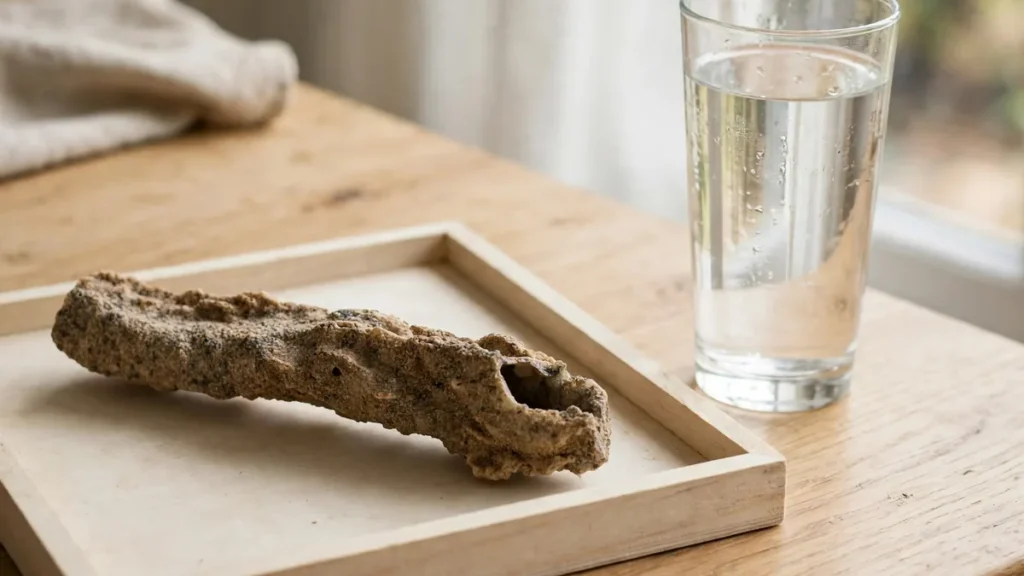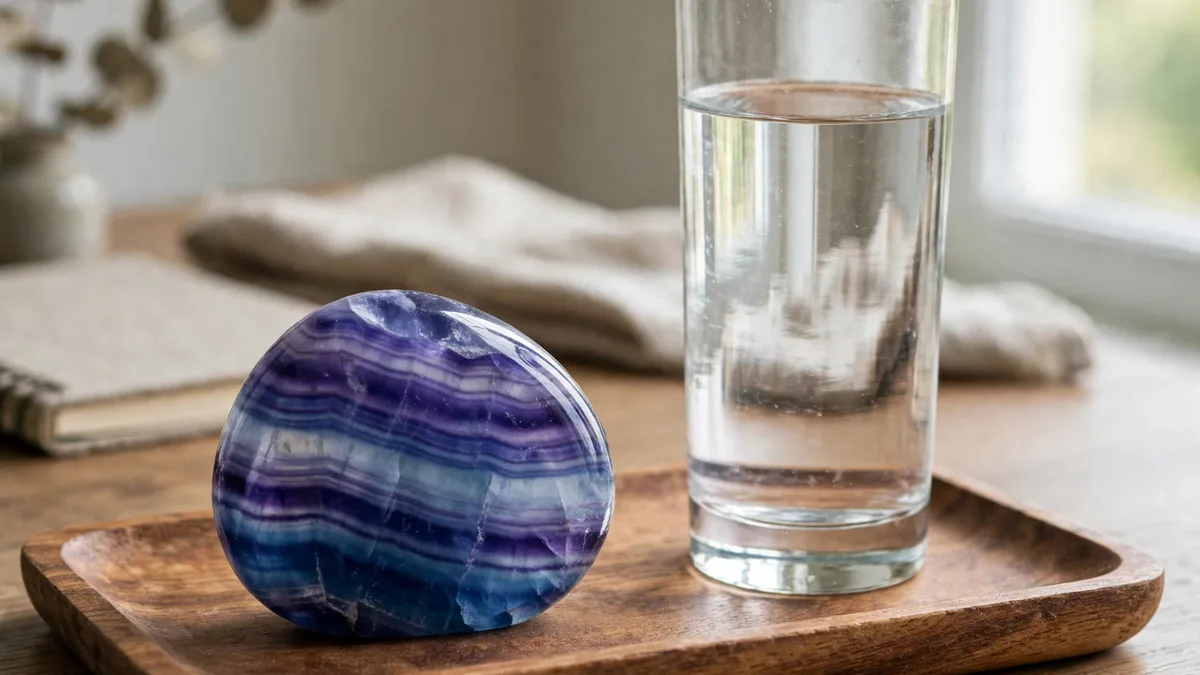
Under the hills of Derbyshire, in a handful of old mines, a stone grows that no other place on earth produces. Blue John is its name, and its bands of violet and deep blue, laid down layer by layer, have made it one of England's best-loved stones.
Blue John is fluorite, the same mineral as the rest of the fluorite family, but it is fluorite wearing two colours at once: violet and blue, banded together in one piece. It is a variety, not a separate mineral, and its home is a small corner of the Peak District.
This guide takes the stone in full: what it is, where its bands come from, how to pick a piece you like, and how to look after it beside a glass of water.
Key Takeaways
- Blue John is a banded purple-blue fluorite, mined only in Derbyshire.
- It is a variety of fluorite, not a separate mineral.
- Its bands of violet, blue and pale white run in straight layers.
- It is a soft stone, so it stays dry beside water, never in it.
- It is an object to look at and hold, and that is all it is.
What Blue John Is
Blue John is fluorite, a calcium fluoride mineral, in its banded purple-blue form. Pure fluorite is colourless, and the colours come from tiny traces caught inside the crystal as it grew underground. In Blue John those traces settled in layers, so one stone can hold a deep violet band beside a blue band.
It comes from a small place: the mines around Castleton in Derbyshire, in the Peak District, where it has been dug from veins in the limestone for centuries. The mines are small and the good stone is scarce, so most pieces on sale are modest in size.
Lift a polished piece and it greets the hand cool and smooth, its surface bright as glass. Tilt it, and violet gives way to blue as the light moves across the bands.
Why Banded Violet Suits Quiet Days
Banded violet never shouts. It rests on the tray without asking to be noticed, and on a slow day, with the house hushed and nothing on the calendar, that quiet is exactly right.
The bands give the eye somewhere to wander without leaving the tray. There is pleasure in tracing the stripes with your eyes, violet into blue into pale, without any need to hurry or decide anything.
A plain stone can disappear against a quiet room. Blue John does not: its bands catch each change of light and hold the eye, while asking nothing back.
Choosing a Blue John Piece
Look at a piece in ordinary daylight before you pay for it. The bands should run clear and straight, violet beside blue beside pale, with no muddy grey patches and no painted-looking colour sitting on the surface.
A plum-sized piece fits the hand, dusts in a moment, and moves easily from tray to shelf. Bigger pieces show the bands more boldly, but they cost far more, because good Blue John is scarce.
Ask where the piece was found, and leave at once if the seller promises it will heal you or change your mood. Polished pieces suit a tray, while rough pieces suit a shelf, and a small cluster shows the shape of the crystal best.

A Quiet Day with Blue John, Step by Step
Begin the evening before, by setting a wooden tray on the table with the stone at one end and an empty glass at the other.
In the morning, pour a fresh glass and take slow sips from it. Then lift the stone for a moment, notice how cool and heavy it feels, and turn it once to watch the bands move.
Set it back down, open your notebook or your book, and let the day carry on. When evening comes, wipe the tray, wash the glass, and leave the stone where it belongs.
Blue John Beside Water
A glass and a Blue John stone look fine side by side, yet each keeps its own end of the tray, with bare wood between them, keeping the drink clean and the stone dry.
The tray shows the stone; it never bathes it, and the stone never enters a glass, a jug or a basin. Once the stone sits where it belongs, rinse your hands with soap and water before you lift the glass.
If the glass spills, lift the stone away at once, pat it dry with a soft cloth, and set it back only when the tray is dry again.
Blue John at a Glance
| Banded violet-blue | Quiet days, dry tray | Never in water |
|---|---|---|
| Derbyshire fluorite | Cool, glassy, smooth | Dust with dry cloth |
| Violet, blue, pale | One stone, one glass | Hands washed after |
| Soft, Mohs four | Low light, hush | Keep it dry |
Blue John and Violet Fluorite
Violet fluorite: soft violet for quiet days studies a single pale shade, a gentle violet for slow hours on a tray beside a glass of water.
Blue John carries that same pale violet, but only as one stripe among several, next to deep blue and pale white. Where the violet guide stays with one soft colour, this guide follows a stone whose violet is one part of a banded pattern.
Blue John and Rainbow Fluorite
The complete guide to rainbow fluorite takes a stone that wears every colour at once, purple, green, blue and clear striping one piece in turn.
Blue John is narrower than that, and that is what makes it different. Rainbow fluorite gathers many colours from many places; Blue John keeps just two, violet and blue, from one small corner of Derbyshire. One is the family in miniature, the other is one local variety, studied in depth.
Blue John and Green Fluorite
Green fluorite: fresh green for clear mornings spends a clear morning with a single green stone, a glass of water, and a few quiet minutes before the day starts.
Blue John has no green in it at all: its stripes are violet and blue, cool where the green stone is fresh, and its ground is one Derbyshire mine. The green guide opens a morning; this guide keeps a banded stone for quiet days.

Blue John and the Other Fluorites
Five more members of the family sit beside the three above, and each one wears a single colour that Blue John does not. Black fluorite, id 5542, is the darkest of them all, charcoal to deep black. Blue fluorite, id 3610, is cool and watery, made for calm days.
Yellow fluorite, id 3598, glows warm and sunny for bright days. Purple fluorite, id 2914, wears deep violet for creative evenings, kept beside a sketchbook under lamplight. Pink fluorite, id 4750, is pale rose for tender days.
None of the eight is banded violet and blue together, and none comes from Derbyshire. That pairing of two colours in one stone, from one small place, is Blue John's alone.
Nine Neighbours in This Batch
Nine guides keep Blue John company in this batch. Four of them study stones: limonite, a warm brown mineral; ilmenite, dark and metallic; aurichalcite, pale and delicate; and adamite, a soft green stone.
Five of them belong to water and the home: rosemary, a fragrant herb; orchid, a delicate flower; placemat, a simple table setting; candle holder, a small flame kept safe; and jigsaw, a slow tabletop puzzle. Blue John is the only one of the ten that is a banded stone from a single English mine.
Stones That Must Never Touch Water
Water ruins some stones quietly, and a few familiar ones should never come near a drink at all. Give apatite a soak and its shine clouds over, never to return. Lepidolite keeps lithium locked in its pale flakes, which is reason enough to keep it far from any glass.
Leave pyrite damp and its bright metal face turns dark and dull. Angelite drinks water in and splits as it swells, and amber, tree resin hardened over ages rather than a mineral, goes milky after a long dip. None of them belongs in a glass or a jug, and Blue John rests dry beside the glass like all of them.
Your Blue John Checklist
- Study the bands in daylight, turning the piece as you look.
- Pick a bright, smooth face whose bands stand out clearly.
- Rest it on a dry tray, glass beside it, never inside it.
- Dust it with a soft dry cloth, and never let it soak.
- Keep it in its own soft pouch, apart from harder stones.
- For health worries, ask a doctor; a stone cures nothing.

Frequently Asked Questions
What exactly is Blue John?
Blue John is a banded purple-blue variety of fluorite, a calcium fluoride mineral, mined only around Castleton in Derbyshire, England. Its violet and blue bands grow in straight layers.
How is Blue John different from violet fluorite?
Violet fluorite is a single pale violet colour, soft and even, made for quiet days. Blue John bands violet together with deep blue and pale white in one stone, so it shows two colours, not one.
How is Blue John different from rainbow fluorite?
Rainbow fluorite holds many colours at once, purple, green, blue and clear. Blue John holds only violet and blue, banded together, and it comes from one small corner of Derbyshire alone.
Is Blue John safe to hold?
Most people can pick up a polished piece and hold it briefly without trouble. Set it down again when you are done, rinse your hands after touching it, and store it where children cannot reach it and food and drink stay clear of it.
Can Blue John go in water?
No, never. Fluorite is a soft stone, and soaking dulls its polish. Keep it dry on its tray, with the glass of water standing beside it, never touching it.
Where should Blue John live at home?
Give it a dry tray in a place the daylight reaches, a desk, a shelf, or a windowsill that never gets damp. Harder stones can scratch it, damp rooms can dull it, and strong sun can fade its bands.

The Bottom Line
Two colours, one Derbyshire stone, one dry tray: choose it in daylight, keep water in its own glass, and handle it gently.
A Note for Quiet Days
One banded stone, one dry tray, one glass of water standing apart: that is the whole quiet pleasure of Blue John.