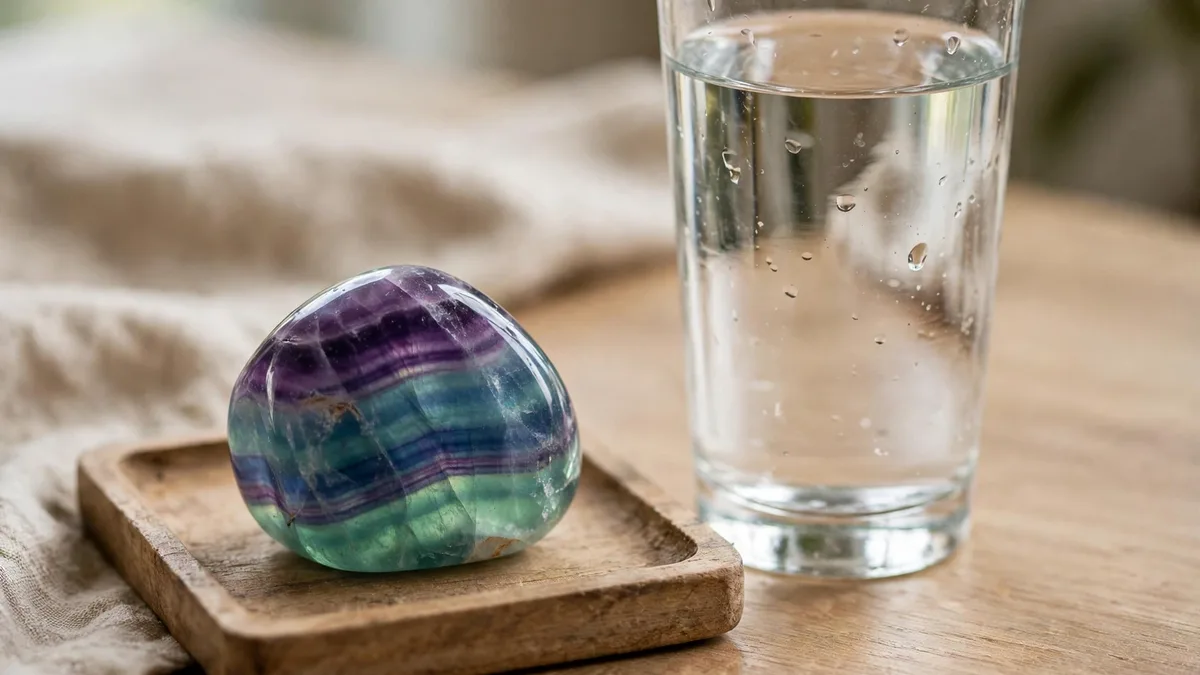
Rainbow fluorite is fluorite wearing all its colours at once. One polished piece can hold deep purple, fresh green, cool blue and clear bands side by side, each laid down in its own layer, so turning the stone is like watching a small sky change in the light.
No two pieces look alike, and that is half the pleasure. A band that runs wide in one piece may narrow to a thread in the next, and a piece that looks purple in shop light can turn green by the window. One stone shows the whole family at once.
This guide takes the stone in full: what it is made of, where its bands come from, the shapes it is sold in, how to choose one, and how to keep it safe beside a glass of water. It is a beautiful object for looking and holding, and nothing more: a stone cannot heal anything.
Key Takeaways
- Rainbow fluorite holds bands of purple, green, blue and clear in one stone.
- Pure fluorite is colourless; trace elements paint the bands.
- It is a soft stone, Mohs hardness 4, so handle it gently.
- Keep it dry beside water, never in drinking water.
- One banded piece shows the whole family at a glance.
What Rainbow Fluorite Is
Rainbow fluorite is the many-coloured face of a calcium fluoride mineral. On its own, fluorite has no colour to speak of; the purples, greens, blues and yellows are painted in by trace elements trapped in the crystal as it grows. In a rainbow piece those colours lie next to each other in stripes, so one stone carries a little sky inside it.
The rest of the family wears one colour each, and each one has its own guide on this site. Violet fluorite, id 5530, is pale violet for quiet days, softer than its deep violet sister. Black fluorite, id 5542, is the darkest of the family, charcoal to black. Green fluorite, id 2902, is fresh green for clear mornings, blue fluorite, id 3610, is cool and watery for calm days, and yellow fluorite, id 3598, is warm and sunny for bright days. Purple fluorite, id 2914, is deep violet for creative evenings, and pink fluorite, id 4750, is pale rose for tender days. Rainbow fluorite differs from all seven: not one colour but many, banded together in a single piece, and this guide covers that banded stone alone.
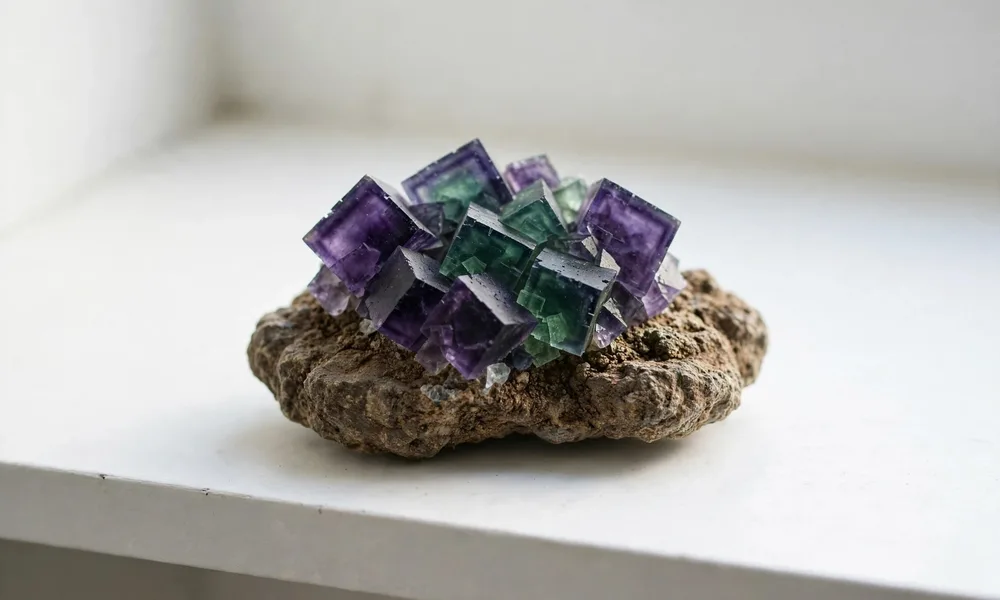
It forms as glassy cubes and octahedra, sold as a smooth tumbled piece or a small cluster on a rocky base. A polished piece shows the bands best; a cluster shows the shape best, its sharp cubes catching the light.
How the Bands Get Their Colours
The bands form slowly, as the crystal grows layer by layer. Each layer takes in slightly different trace elements from the water around it, and each mix paints it a different colour. When the water changes, the colour changes, leaving a sharp line where one band ends and the next begins.
That is why the bands are usually straight and parallel, like pages in a book, not swirled or mixed. Cut across the bands, a stone shows stripes; cut along them, it may show only one colour until turned. The clear bands are layers that grew almost pure, with barely any trace elements, glowing like glass between the colours.

Rainbow Fluorite in the Ground
Fluorite grows in veins and pockets inside rock, often beside quartz and calcite. Miners follow the veins underground, and the best banded pieces come from pockets where the crystal grew slowly.
Tumbled Stones and Clusters
A tumbled stone is the commonest form: a rough piece rolled smooth until its edges soften and its bands shine. Tumbled pieces fit the hand, sit neatly on a tray, and show the bands clearly in daylight — the best first piece, and the cheapest way to own the stone.
A cluster is a group of cubes still joined to their rocky base, left as the earth made them. Clusters cost more, because a fine one cannot be faked or repaired, and they suit a shelf better than a pocket. Look for sharp edges and glassy faces: dull, chipped cubes mean rough handling.
Choosing a Piece You Like
When you shop, ask to see the piece in daylight, not only under shop lamps. Pick bands that stand out clearly — purple next to green next to blue — and a face that shines instead of looking milky. Good colour glows through the stone like light through glass, never sitting on top like paint.
A good piece feels cool in the palm and carries a little weight, its bands coming alive as you rotate it. Lift it toward a window and watch the colours move: a stone that shifts as it turns is a lively one. Buy from a seller who names the stone plainly, not from one who claims it will alter your health or mood.
Keeping It Beside Water
Because this stone is soft, the journal's rule counts double here: drinking water stays in its glass, and the stone stays on its own tray next to it. Put the glass where you can reach it and the stone where you can see it, and you get the colour with no risk at all.
Rainbow Fluorite at a Glance
| Calcium fluoride | Banded many colours | Mohs hardness four |
|---|---|---|
| Purple green blue | Clear bands too | Tumbled or clustered |
| Keep stone dry | Glass beside it | Wipe dust off |
Fluorite Rainbow Colour
Fluorite rainbow colour for creative days builds a short creative habit around the stone: sketchbook open, glass poured, one small mark to start the morning. Its pages are about the making — sketching, writing, and letting a bright stone nudge the day into motion.
This guide walks a different road: a complete reference to the stone itself — its make-up, how the bands form, where it grows, the shapes it is sold in, and how to choose and care for a piece. The creative-days guide uses the stone to start a morning; this guide explains the stone so you can choose one wisely.
Violet Fluorite
Violet fluorite for soft violet quiet days looks closely at one pale colour: a soft violet mineral, lighter than the deep violet of its purple sister, its faint bands showing when the piece is turned. It is a stone for unhurried hours, kept on a tray beside a glass of water.
Rainbow fluorite holds that same pale violet as one band among many, beside green, blue and clear. Where the violet guide lingers on one gentle colour for a quiet day, this guide takes in the whole banded range: one a study of softness, the other of variety.
Green Fluorite
Green fluorite for fresh green clear mornings follows a fresh green stone through a clear morning: one glass of water, one green stone on a tray, and a few quiet minutes before the day. Its bands are pale green zones running through the stone like layers of morning light.
Rainbow fluorite carries that fresh green as one stripe between purple and blue, not as the whole stone. The green guide is a morning ritual built on one colour; this guide is a full account of a stone holding many colours in one piece. The green stone starts a morning; the rainbow stone shows a family.
Nine Neighbours in This Batch
Nine other guides share this batch with rainbow fluorite, each working a different corner of home and garden. The water-baking-tray guide washes a flat metal tray after the oven, the pumice guide explains a light grey stone full of tiny holes, and the conch guide turns a soft pink shell. The water-cookie-jar guide keeps biscuits fresh in a lidded jar, the water-terrarium guide builds a small glass garden for damp-loving plants, and the muscovite guide studies a soft silver stone in thin sheets.
Three more stand beside them: the water-bonsai guide tends a small tree in a shallow pot, the linarite guide asks whether a deep blue stone is safe at home, and the water-rolling-pin guide flattens dough for the oven. Rainbow fluorite is the only one of the ten holding many colours banded in a single stone.
Stones That Must Never Touch Water
Fluorite is a soft stone, so it never goes into water at all, and the same caution stretches across the shelf. A soak clouds apatite's polish for good; drying will not bring the shine back. Lepidolite carries lithium in its layers, so it stays away from any glass meant for drinking.
Pyrite left damp goes dark and loses its gleam, angelite swells and splits once water reaches it, and amber — hardened tree resin, not a mineral — clouds in water and stays that way. None of these belong in drinking water, and rainbow fluorite rests dry beside the glass.
Your Rainbow Fluorite Checklist
- Look at the bands in daylight before buying, turning the piece slowly.
- Choose a smooth, bright surface with bands you can see.
- Keep the stone on a dry tray beside a glass, never in it.
- Wipe dust off with a soft dry cloth; never soak the stone.
- Store it away from harder stones.
- If a stone chips and leaves a sharp edge, set it aside and ask a seller: a stone is an ornament, not a cure.

Frequently Asked Questions
Is rainbow fluorite safe to hold?
Yes, with clean, dry hands, held gently and set down carefully: a drop onto a hard floor can chip an edge.
Can rainbow fluorite go in water?
No, never: fluorite is soft and slightly soluble, so soaking dulls its polish and can soften its edges. Keep it dry on its tray, with the glass beside it.
What makes rainbow fluorite different from a single-colour piece?
A single-colour piece shows one colour through the whole stone, while a rainbow piece holds several colours in bands, grown layer by layer as each took in different trace elements.
How do I clean a rainbow fluorite stone?
Wipe it with a soft, dry cloth to lift dust — nothing more. Never use water, soap or polish, and never put it in an ultrasonic cleaner: it can crack a soft stone.
Where should rainbow fluorite live at home?
On a dry tray or a soft cloth, somewhere you can see it in daylight: a desk, a shelf, a windowsill that stays dry. Keep it away from harder stones and damp rooms like the bathroom.
Is a big rainbow fluorite piece better than a small one?
Not always: a small piece with bright bands beats a large one with dull or cloudy bands. Judge the bands first, the size second, and buy the smallest piece whose colours please you.

The Bottom Line
Rainbow fluorite gathers the whole family into one banded stone, and it stays beautiful when chosen in daylight, kept dry beside water, and handled gently.
A Note for Bright Days
Purple, green, blue and clear in one stone, dry on its tray beside a glass of water: the whole pleasure of rainbow fluorite.