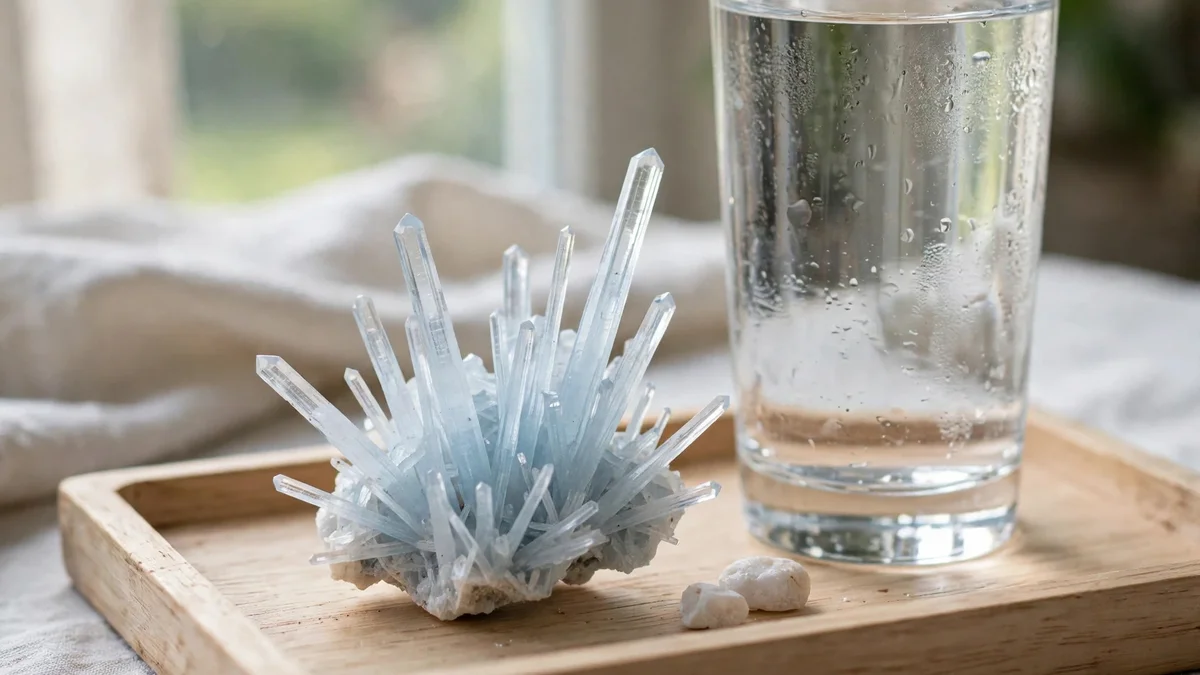
Most blue stones reach the shops as smooth pebbles or round beads. Jeremejevite arrives in none of those shapes. It grows as a spray of slender pointed prisms, pale blue as a morning sky.
The mineral takes its name from Pavel Jeremejev, a Russian mineralogist who described it in 1883, after small blue crystals turned up in the mountains of Siberia. Later finds in Namibia brought a few more pieces into the open, yet it remains one of the rarest blue stones a collector can hold.
This guide looks at jeremejevite: what the stone is, how to pick a sound piece, how to enjoy a bright day with it, and how to keep it dry beside a glass of water. It is a lovely thing to admire and to pick up for a moment, and that is all it is. It cannot alter your health or your fortune, and drinking water must stay well away from it.
Key Takeaways
- Jeremejevite is a rare pale blue borate mineral that grows in slender pointed prisms.
- Its soft blue suits bright days and tidy rooms.
- A good piece is small, pale, and clear, with clean points.
- The stone is for looking at and holding briefly only; it heals nothing.
- Keep drinking water in its own glass, and keep the stone dry.
What Jeremejevite Is
Jeremejevite is an aluminium borate, built from aluminium, boron, oxygen, and a little fluorine. It forms deep underground, where hot fluids move slowly through cracks in the rock, leaving long thin crystals as they cool. The crystals grow upright in little clusters, each a hexagonal prism with a pointed tip, and the finest blue pieces come from Namibia, where the colour runs from almost colourless to a soft sky blue.
Hold a piece up to a window and the light passes through the prisms, picking out the fine lines that run from base to tip. A crystal feels cool and light in the hand, smoother than it looks, with flat faces that return thin straight gleams rather than sparks. It scores between six and a half and seven and a half on the hardness scale, so it resists scratches well enough, but the crystals are thin and brittle, and a knock can snap a point clean off.
Picking a Jeremejevite Piece
Shop for a jeremejevite piece outdoors in natural light, rolling it gently in your palm. Seek a blue that holds steady while the crystal turns, pale and see-through all the way down, with tips intact and keen instead of nicked. A good cluster shows clean flat faces, unbroken tips, and no cloudy patches across the prisms.
A thumb-length cluster is plenty. Ask the seller where the stone was found and whether the blue is natural, and walk away from anyone who promises it will change your health, because no stone can do that.

A Bright Day with Jeremejevite
A bright day with jeremejevite asks for very little. Spread a light cloth across your desk, place the crystal near one corner where sunshine can touch it, and put a glass of water near the other corner, with empty cloth in the middle. Take a seat, sip the water unhurriedly, and trace the slender lines running down the prisms with your eyes.
When the glass is empty, lift the crystal once and set it back on its tray. The stone does nothing on its own; the bright day comes from the slow pace you give yourself and the light falling across the tray.
Jeremejevite Beside Water
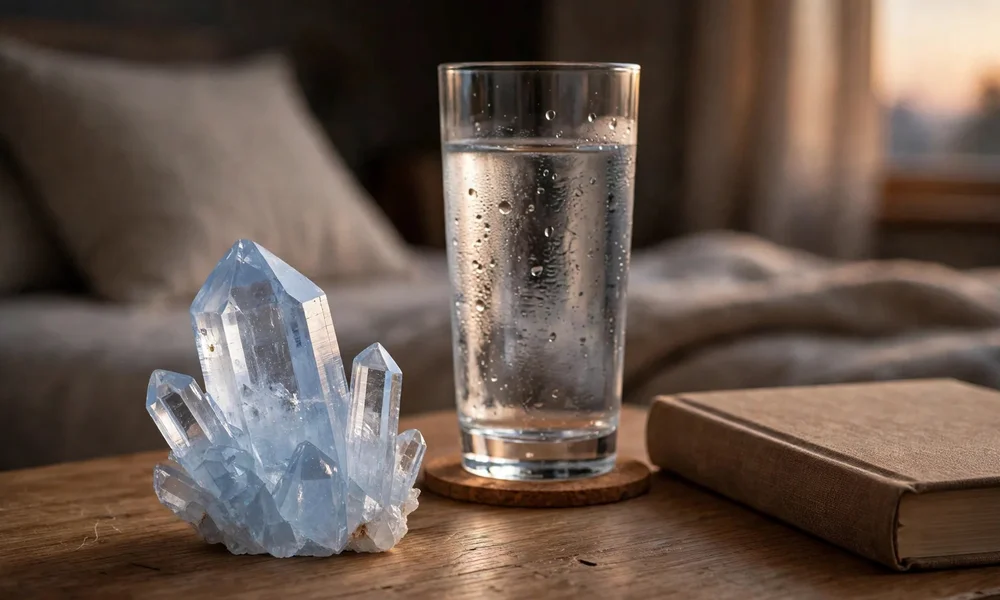
Water and jeremejevite make a handsome pair on one tray, though the pair must never touch. Put the glass to the left and the stone to the right, leaving empty cloth in the middle. The drink remains clean, and the crystal remains free of damp.
Never lower the stone into a tumbler, a pitcher, or a tub, and never tip water across its surface. If a splash reaches it, pat the prisms dry straight away with a soft cloth. The stone stays beside the water, and the water stays in its own glass.
Jeremejevite at a Glance
| Pale blue prisms | Bright tray, desk | Dry hands only |
|---|---|---|
| Rare borate stone | Clear window light | Glass kept apart |
| Slender pointed tips | One accent, plain | Never in drinks |
| Cool, light, brittle | Tidy shelf, tray | Never soak stone |
| Namibian blue | Bright days | Dust weekly |

Jeremejevite and Euclase
Euclase for calm days is the nearest neighbour to jeremejevite in this journal, and the two are easy to confuse at a glance. Both are pale blue minerals that grow as long prisms, and both suit a quiet tray beside a glass of water.
The difference is in the shape and the temper. Euclase grows as a single long prism, and it splits easily along its length, so it asks for a gentle hand. Jeremejevite grows as a cluster of slender pointed prisms, and its danger is a snapped point rather than a split.
Jeremejevite and Blue Agate
Blue agate for calm days is a softly banded blue stone, chilled against the fingers and easy on the sight, its face marked by slender pale streaks like waves on a quiet pool. It is chalcedony, built up in thin sheets over an immense stretch of time, and it is sold as smooth burnished pebbles.
Jeremejevite is nothing like a pebble. It is a cluster of pointed prisms with flat faces and sharp tips, and its blue is clear and glassy where blue agate is milky and banded.
Jeremejevite and Blue Topaz
Blue topaz for bright days is a clear blue gem, cool in the palm, coloured like a bright sky over fresh water, with a bright glass-like gleam. Faceted pieces flash blue from every face, and the stone is common enough to find in most shops.
Jeremejevite shares the bright-day mood but not the form. Blue topaz is cut into smooth faceted gems or rounded tumbled stones, while jeremejevite is left as it grew, a spray of slender prisms with pointed tips. Blue topaz is found anywhere; jeremejevite is a stone most shops never see.
Jeremejevite and the Other Blue Stones
The blue family is wide, and no member of it resembles jeremejevite in shape, shade, or slender form. Blue quartz: pale tumbled quartz. Maxixe beryl: pale blue beryl. Benitoite: deep blue stone in sharp triangles. Covellite: deep indigo copper mineral. Shattuckite: soft blue mineral flecked with green. Blue jade: pale sky-blue jade. Blue sapphire: deep blue corundum, faceted. Turquoise: bright blue stone, dark veins. Peruvian opal: milky blue opal from the Andes. Hemimorphite: light blue stone, bubbly clusters. Blue chalcedony: milky pale blue chalcedony. Blue calcite: soft pale blue calcite. Blue lace agate: lacy pale blue bands. Aquamarine: pale sea-blue beryl. Blue pearl: round pearl, colour of clear sky. Blue amber: fossil tree resin, quiet blue. Blue obsidian: usually man-made glass. Blue jasper: opaque blue jasper. Cobalt spinel: deep blue spinel. Teal sapphire: blue-green sapphire. Blue coral: pale blue coral. Blue spinel: cool blue spinel. Gem silica: bright blue-green stone. Blue onyx: cool blue onyx. Star sapphire: deep blue sapphire showing a star. Blue fluorite: cool blue fluorite, soft glow. Blue zircon: bright blue zircon. Paraiba tourmaline: bright blue-green tourmaline. Blue tigers eye: deep blue tigers eye. Dumortierite: deep blue stone. Lapis lazuli: deep blue stone, gold flecks. Indicolite: deep blue tourmaline. Abalone: blue-green shell. Cavansite: bright blue bursts. Sodalite: deep blue stone. Amazonite: blue-green stone. Blue kyanite: clear blue stone. Iolite: violet-blue stone. Azurite malachite: deep green-blue stone. Chrysocolla: blue-green stone. Blue goldstone: deep blue glass, copper sparkles. Blue aventurine: deep blue quartz. Blue opal: pale blue opal. Azurite: deep blue stone. None of these is a spray of slender pale blue prisms, and that shape belongs to jeremejevite alone.
Keeping Jeremejevite at Home
Jeremejevite suits a sunny, orderly nook: a ledge beside the dawn window, an open stretch of desktop, or a little bowl atop the drawers. Keep the tray away from taps and steam, and out of reach of young children. Dust it every seven days using a gentle, arid rag, with no soap or spritz. While it is off display, store it by itself in its own little soft pouch, away from keys and harder gems that could snap a point.

Stones That Must Stay Away from Water
Certain stones hide things that no drink should ever carry. Malachite holds copper in its green bands, so it stays far from every glass and every soak. Hematite must stay out of drinking water too, and so must apatite and pyrite. Lepidolite carries lithium, so it never goes into water either. Angelite loses its finish when it gets wet, and amber turns cloudy after a soak and never belongs in drinking water. Jeremejevite is a borate mineral, so it rests beside the glass and never inside it.
Your Bright Days Checklist
- Lay the crystal on a dry cloth, glass set some distance away.
- Drink the water unhurriedly, taking your time.
- Lift the crystal, sense its cool tips, then set it down again.
- Return the crystal to its tray ahead of washing your hands.
- Buy from a seller who tells you the stone's origin.
- If a health worry appears, consult your own doctor, never a stone.
Frequently Asked Questions
What is jeremejevite?
Jeremejevite is a rare pale blue borate mineral that grows in slender pointed prisms, and the finest blue pieces come from Namibia.
Where does jeremejevite come from?
The first pieces were described from Siberia in 1883, and later finds came from Namibia, where the stones show the clearest pale blue.
How is jeremejevite different from euclase?
Euclase grows as one long prism that splits along its length, while jeremejevite grows as a cluster of pointed prisms whose tips can snap.
How is jeremejevite different from blue topaz?
Blue topaz is cut into smooth faceted gems, while jeremejevite is left as it grew, a spray of pointed prisms, and it is far rarer.
Is jeremejevite safe to hold?
Holding a small piece briefly troubles almost nobody, since everything stays sealed inside the crystal. Set it aside once finished and wash your hands.
Where should I keep jeremejevite at home?
A sunny arid shelf, an uncluttered desk edge, or a little dish all suit it. Store the stone far from the glass, shielded from bumps, and away from humid rooms.
The Bottom Line
Jeremejevite fits bright days: a rare pale blue spray of pointed prisms, a glass of water nearby, and the stone kept dry.
A Note for Bright Days
Slender prisms, a dry stone, a full glass — a bright day asks for nothing more.


