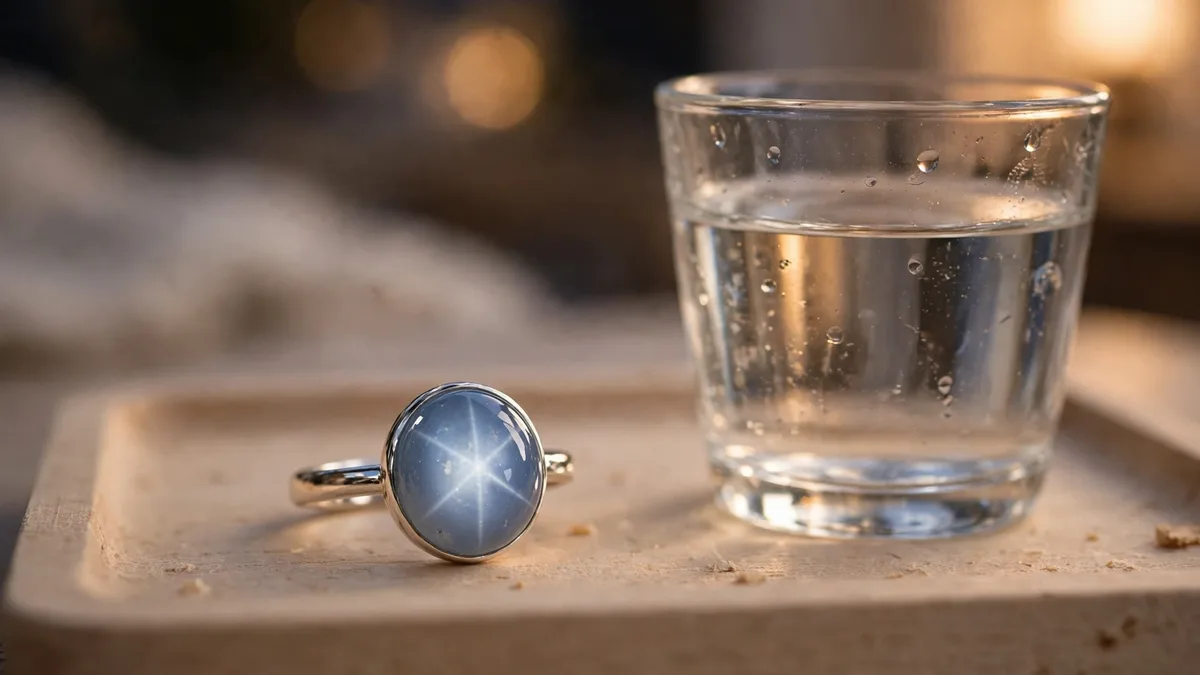
Some evenings ask for quiet more than anything else. The light is low, the house is still, and there is nowhere you need to rush to. On an evening like that, a bright faceted stone feels too busy, and a pale white stone fades away.
Star sapphire is a stone for quiet evenings like these: a soft blue sapphire with a star inside it, a pale six-rayed star that glides across the dome of the stone as you turn it in the light.
This guide is a spotlight on star sapphire: what the stone is, how the star appears, how to choose a piece, and how to display it in the evening. The stone is for display and jewellery only, never a treatment, and it will not heal anything.
Key Takeaways
- Star sapphire is a soft blue sapphire with a six-rayed star.
- The star, called asterism, moves across the domed stone.
- Its soft blue colour suits quiet evenings and low light.
- Star sapphire differs from blue, pink and yellow sapphire.
- Star sapphire is for display and jewellery only; it will not heal anything.
What Star Sapphire Is
Star sapphire is sapphire, a corundum mineral, in its star form. Like all sapphires it is aluminium oxide, coloured blue by tiny traces of iron and titanium inside the crystal, and it is one of the hardest gemstones in the world, scoring 9 on the Mohs scale, second only to diamond. That hardness means it keeps its polish and feels cool and solid in the hand.
A star sapphire is cut as a cabochon, a smooth dome with no facets, because the dome is what lets the star show. The colour is a soft blue, paler and milkier than a deep blue faceted sapphire, like the blue of a clear evening sky just before the stars come out.
The Star Inside the Stone
The star is the whole reason for this stone, and it has a name: asterism. Inside a star sapphire are millions of tiny needle-like crystals of rutile, arranged in three directions, and when light falls on the domed surface these needles reflect it back as three bright lines crossing at the centre. The three lines make a six-rayed star, and the star seems to float just under the surface of the stone.
Move the stone slowly under a lamp and the star glides across the dome, brightening and softening as it goes. A good star is sharp, centred and even, with six straight rays of roughly equal length. The star is not painted on; it is the stone itself.
Why Soft Blue Suits Quiet Evenings
Soft blue suits quiet evenings because it is the colour of the hour itself. Deep navy can feel dark and heavy once the lamps are lit, and soft pink can feel too gentle in the last of the daylight, but soft blue sits glowing between the two. It looks its best in low light, when the evening is slow and nothing is hurrying.
The star adds something no plain stone can offer: a small point of light that moves as you turn the stone, like a star sliding across a quiet sky.
Choosing a Star Sapphire Stone
Choosing a star sapphire is mostly a matter of looking closely under a lamp and trusting your eye. A good piece shows a soft, even blue with a star that is sharp, centred and easy to see under one lamp, not a star you have to hunt for in bright sunlight, and not a stone so dark that the star disappears into the blue. The dome should be smooth and high, with no flat spots or rough pits, and the colour should stay soft and bright even in low light.
A palm-sized cabochon is enough for a quiet-evening tray, and a small ring or pendant stone works well too. If a piece feels pleasant in your hand and its star moves cleanly as you turn it, it is the right one. Buy from a trusted seller, never one who promises it will change your health.

A Quiet Evening with Star Sapphire
A quiet evening with star sapphire takes only a few minutes to begin: place the stone on its tray, fill a clear glass with fresh water, and set it beside the stone. When you sit down with your book or your evening tea, drink the water slowly, in small sips, and then pick up the stone and turn it under the lamp so the star glides across its dome.
Star Sapphire Beside Water
Water belongs beside the stone, never around it: set a clear glass of fresh drinking water next to the stone on the tray. They share a tray, not a glass. Never place the stone inside drinking water, and never soak it, because a stone has no place in a drink, and even a hard stone should stay dry.
If the glass spills, lift the stone away and dry it at once with a soft cloth.
Keeping Star Sapphire Safe
Star sapphire needs only gentle care, and it is worth stating plainly: the stone is for display and jewellery only. Never put it in drinking water, never soak it, and never use it in a bath or a foot soak. Wash your hands with soap and water after handling the stone, and keep it away from small children and pets.
Dust the stone weekly with a soft, dry cloth, never soap or polish, and never scrub it. A ring or pendant can be wiped the same way.

Star Sapphire at a Glance
| Soft blue stone | Quiet evenings | Display only |
|---|---|---|
| Six-rayed star | Low lamplight | Never in water |
| Smooth domed cabochon | Tray and dish | Dust with dry cloth |
| Cool in hand | Water, light, star | Wash hands after |
Star Sapphire and Blue Sapphire
Star sapphire and blue sapphire are the same mineral in two very different forms. Blue sapphire is a deep blue faceted stone, sharp and bright, the colour of still water at dusk, and it suits evening rest at the bedside table.
Star sapphire is a soft blue cabochon, milky and gentle, with a star that moves across its dome, and it suits quiet evenings at the tray, where the star gives you something small and lovely to watch. Where sapphire calm water for deep rest keeps a deep blue faceted stone for deep rest, this guide keeps a soft blue star stone for quiet evenings. One stone is faceted and deep; the other is domed, soft and starred.
Star Sapphire and Pink Sapphire
Star sapphire and pink sapphire share the corundum family and the same hard, cool feel, but they are different stones to look at. Pink sapphire is a clear soft pink faceted stone, bright and lively, with facets that throw back small flashes of pink light, and it suits tender days at the desk.
Star sapphire is a soft blue cabochon with a star that glides across its dome, and it suits quiet evenings in low light rather than tender days in daylight. Where pink sapphire soft pink for tender days keeps a clear pink faceted stone for tender days, this guide keeps a soft blue star stone for quiet evenings.
Star Sapphire and Yellow Sapphire
Star sapphire and yellow sapphire sit at opposite ends of the colour scale. Yellow sapphire is a warm yellow faceted stone, sunny and clear, with a glow like morning light held still, and it suits bright days in strong daylight.
Star sapphire is a soft blue cabochon with a star, milky and calm, and it suits quiet evenings when the light is low and the day is slowing down. Where yellow sapphire warm yellow for bright days keeps a warm sunny stone for bright days, this guide keeps a soft blue star stone for quiet evenings.
Stones That Must Never Touch Water
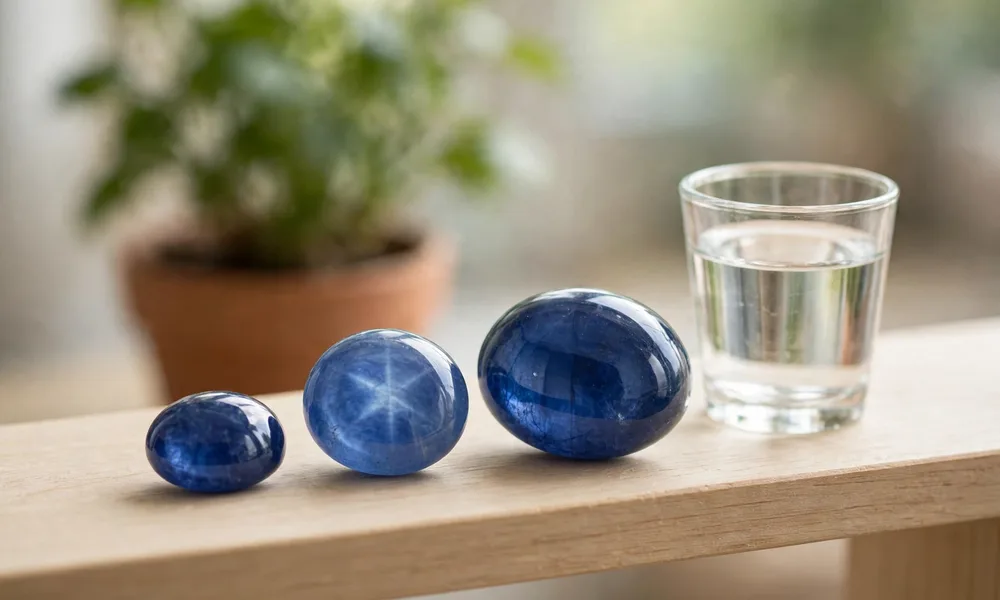
Not every stone is safe beside water, and some must never touch water at all. Malachite must never go in water or in elixirs, because it can release harmful substances. Hematite must never go in drinking water, and apatite, lepidolite — which contains lithium — pyrite, angelite and amber must never go in drinking water or in soaks either.
The rule stays the same for star sapphire: display it on a tray, keep a glass of water beside it, and never let the two meet.
Your Quiet Evenings Checklist
- Set the stone on a tray beside a clear glass of water.
- Drink a glass of fresh water slowly while the evening begins.
- Hold the stone under a lamp and watch the star glide.
- Keep the stone beside water, never inside drinking water or soaks.
- Dust the stone dry weekly, and wash your hands after handling it.
- Remember the stone will not heal anything; see a doctor for health problems.

Frequently Asked Questions
What is star sapphire?
Star sapphire is a soft blue sapphire cut as a smooth domed cabochon, with a six-rayed star that appears across its surface when light falls on it.
What makes the star appear?
The star, called asterism, comes from tiny needle-like rutile crystals inside the stone, arranged in three directions, which reflect light as three lines.
Is star sapphire safe to handle?
Yes, star sapphire is safe to hold and display if you wash your hands with soap and water after handling it. It is for display and jewellery only, never in drinking water, never in soaks.
Can I put star sapphire in drinking water?
No, never. The stone belongs beside a glass of water, not inside it. Keep a glass of water beside the stone on the tray, and never soak the stone.
Will star sapphire heal anything?
No. Star sapphire will not heal anything. It is a beautiful object for display and jewellery, and the calm comes from the pause, the water and the quiet evening.
How is star sapphire different from blue sapphire?
Blue sapphire is a deep blue faceted stone for evening rest, while star sapphire is a soft blue domed stone with a moving six-rayed star for quiet evenings.
The Bottom Line
Star sapphire brings soft blue and a small star to quiet evenings: a domed stone, held beside a glass of fresh water, its star gliding under the lamp. Keep it beside water, never in it, wash your hands after handling, and dust it dry.
A Note for Quiet Evenings
Keep it blue, keep it dry, keep it quiet. A small soft blue stone, a glass of water, and a star that moves can carry an evening well.


