A bold day rarely announces itself the night before. It arrives with a circled date on the calendar or a decision put off for a month. Your hands want something solid to hold for a minute before you go.
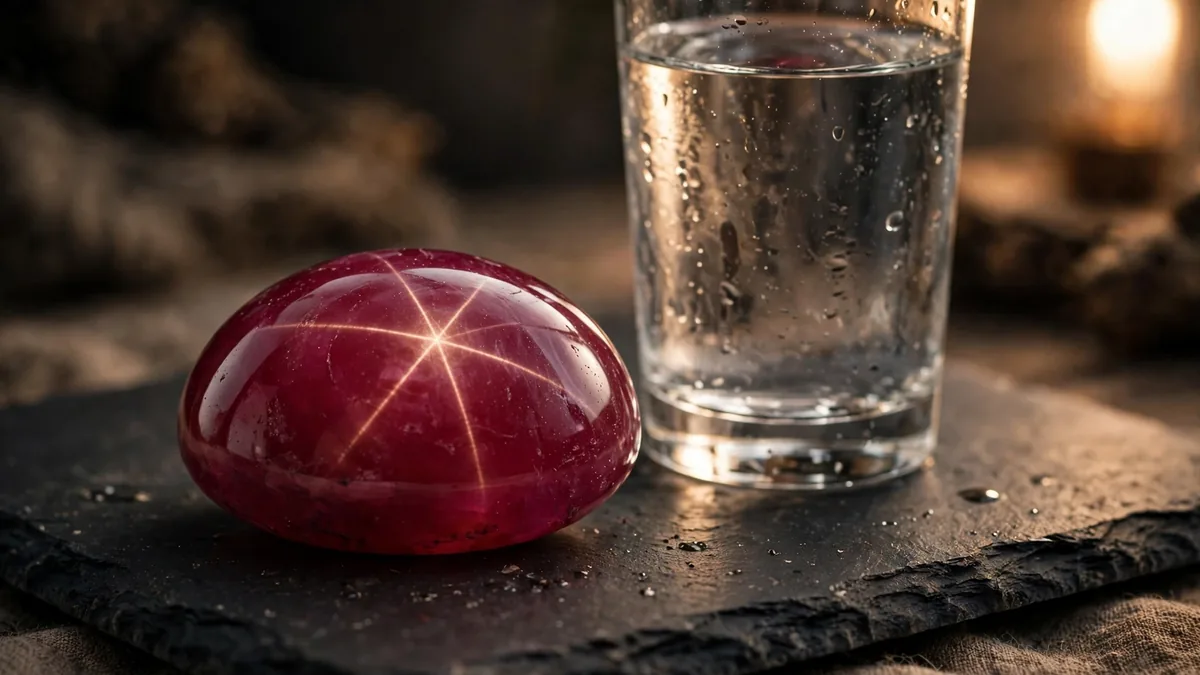
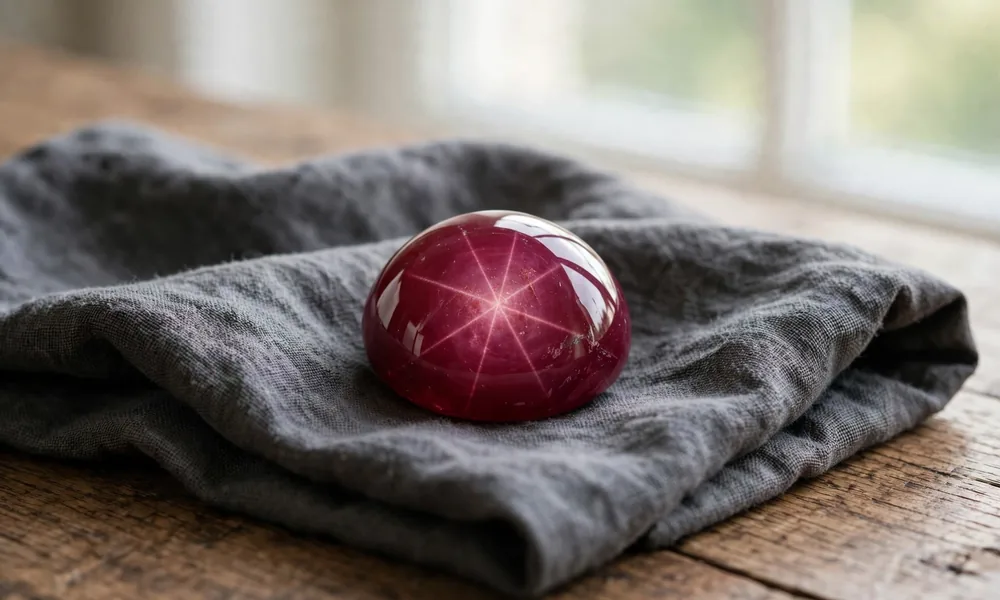
A star ruby is a good stone for that minute. It is a deep red ruby cut into a smooth dome, and when one lamp shines on it, a star of six pale rays opens across the red. The star slides as the dome turns, slow and bright.
This guide looks at star ruby in plain words: what it is, where its star comes from, how to tell a strong piece from a weak one, and how to spend a bold day with it resting dry beside a glass of water. A ruby is for looking at only, never for dropping into a drink.
Key Takeaways
- Star ruby is a deep red ruby cut as a smooth dome.
- Its star has six pale rays.
- The star needs one strong light; under flat light it looks plain red.
- It is the only ruby here with a star.
- Keep drinking water in its own glass, and keep the stone dry.
What Star Ruby Is
Star ruby is ruby, the deep red variety of corundum, coloured by tiny traces of chromium. What makes it a star ruby is the cut: instead of flat faces, the stone is shaped into a smooth, rounded dome. A piece about the size of a broad bean shows the star clearly.
Inside the stone, fine needle-like crystals of rutile lie in three directions, crossing one another. You cannot see these needles one by one; you see what they do together, catching light and gathering it into a star. The dome feels cool when you first pick it up, heavy for its size, and smooth under the thumb.
The Six-Ray Star
The star has a name: asterism. It appears when one strong light falls on the curved dome: light off the three sets of needles inside throws back one bright line each, so three lines cross at the centre and make six rays. Move the stone and the star moves with it, gliding over the red.
One lamp is enough: a desk lamp, a torch, or a shaft of sun will wake it. Under flat ceiling light the star fades, which is why a seller should always show it under one lamp before you pay. A star that looks painted on, too sharp and too perfect, is a warning sign: a natural star is soft at the edges.
Choosing a Star Ruby Piece
First look at it in daylight: the red should stay deep and warm, not slide towards brown or pink. Then ask for one lamp: a good star appears at once, six rays reaching the dome's edge, with a bright point where they meet.
The dome should be even and smooth, with no flat patch and no scratch. A ray that stops halfway, or a star that only shows under the brightest bulb, is a poor piece: leave it behind. Ask whether the stone is natural or made in a laboratory, and walk away from anyone who promises it will change your health, because no ruby can do that.
A Bold Day with Star Ruby
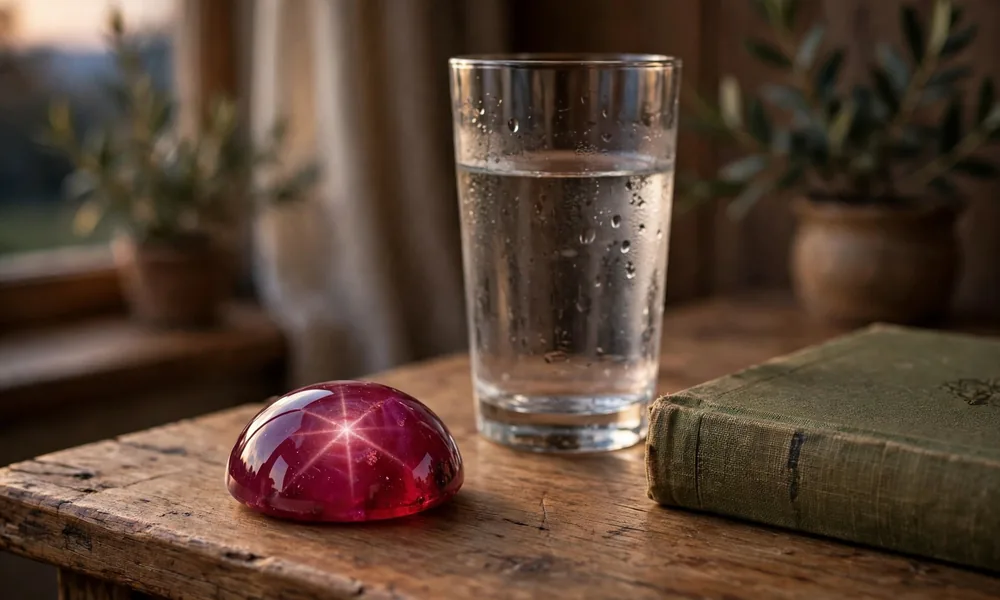
A bold day with star ruby begins at the kitchen table. Set the dome on a dark tray near the window, a tall glass of cool water a hand's width away, and switch on one lamp. Watch the star open across the red while you think through the first step of the day.
Drink the water at your own pace and look at the star once more before you leave. The stone stays on its tray while you are out. A bold day is not made by a stone; it is made by the step you take, and the star is only a bright mark at the start of it.
Star Ruby Beside Water
Water and star ruby sit well together on one tray, yet that is the nearest they should ever come. Keep the glass at one end and the dome at the other, with dry cloth between them, so the drink stays clean and the stone stays dry. A ruby left sitting in water gains nothing, and a damp dome can lose its shine.
If a splash reaches the stone, dry it at once with a soft cloth. Never lower the dome into a glass, a jug, or a bath. Wash your hands once you have handled the stone, and keep it away from food and small children.
Star Ruby at a Glance
| Deep red dome | Bold days | Display only |
|---|---|---|
| Six-ray star | One lamp | Dry cloth wipe |
| Smooth, cool, heavy | Brave first steps | Glass kept apart |
| Broad-bean sized piece | Morning light, lamps | Never in drinks |

Star Ruby and Ruby
Ruby glow rituals for confident evenings is the nearest live ruby guide, and it keeps a different hour. That guide builds an evening ritual around plain ruby: a faceted red stone, a deep red lip, low warm light, and quiet minutes before going out. Plain ruby sparkles from its cut faces and holds its red best in low light.
Star ruby belongs to the morning instead: a smooth dome whose pleasure is the star that wakes under one lamp. Plain ruby has no star at all, and star ruby has no evening ritual of lips and candles: one glitters in the evening, the other draws a star in the morning.
Star Ruby and Ruby Zoisite
Ruby zoisite pink green for bold days keeps a stone that holds two colours at once. Ruby zoisite is vivid pink-red ruby set inside deep green zoisite, like bright flowers in a dark garden. Its beauty is the patchwork of pink and green, different on every piece.
Star ruby holds only one colour, deep red, and its beauty is the star that crosses it. Both suit bold days and rest dry beside a glass of water, but one is a garden of two colours and the other is a single red dome with a star.
Star Ruby and Star Garnet
Star garnet deep red for bold days is the closest star cousin star ruby has. Star garnet is a deep red garnet, most often almandine, cut as a smooth dome, and its star has four pale rays.
Star ruby answers with six: three sets of needles give three lines and six rays, while garnet's fibres give two lines and four. They are different minerals too: ruby is hard, bright corundum, while garnet is softer and darker. Count the rays and you will never mix them up: four for garnet, six for ruby.
Star Ruby and the Other Red Stones
Beyond the nearest three, the red stones of this journal each carry their own look. Rubellite is a vivid pink-red tourmaline, bright as summer berries in strong sun. It suits bold days too, but it has no dome and no star, and its pink-red is brighter than star ruby's deep red.
Red spinel is a warm red spinel, clear and lively, like a ripe cherry in bright light, and also faceted, with no star. Both glitter from their cuts; only the dome draws a star.

Where Star Ruby Rests and How It Stays Clean
Star ruby likes a spot where one lamp can reach it. A low shelf by the front door, or a dressing-table corner where the lamp stands, both work, as long as the dome is easy to see and clear of elbows.
Care is simple. Wipe the dome once a week with a dry, soft cloth, stroking lightly along the curve. Keep soap, sprays, and polishing creams away, and never hold the dome under a running tap. Off display, give it its own compartment in a jewellery box, wrapped in soft cotton, away from keys and harder gems.
Stones That Must Never Touch Water
A few stones hold things that must never meet a drink, so learn their names before you set out a tray. Malachite wears green bands that hide copper, and copper has no place in a cup. Hematite turns to rust when it stays damp, so it must never sit in drinking water.
Apatite crumbles in a bath, lepidolite hides lithium, and pyrite breaks down when damp. Angelite slowly melts away in water, and amber is old tree resin, so a soak leaves it cloudy. Keep all of them far from food and drink, and keep star ruby the same way.
Your Bold Days Checklist
- Set the dome on a dry tray with the glass a little way off.
- Switch on one lamp and watch the six rays cross the red.
- Drink the water at your own pace while you plan the first step.
- Wipe the dome dry and wrap it in soft cotton after.
- Buy only where the seller shows the star under a lamp first.
- If a health question troubles you, ask a doctor.
Frequently Asked Questions
What is star ruby?
Star ruby is a deep red ruby, the red variety of corundum, cut into a smooth dome rather than a faceted gem. Fine needles inside catch the light into a six-ray star.
How does the six-ray star appear?
The star needs one strong light on the curved dome. Light off the needles inside gathers into three lines crossing at one point, making six rays.
How is star ruby different from ordinary ruby?
Ordinary ruby is a faceted gem that sparkles from flat faces and suits evening light, with no star at all. Star ruby is a smooth dome with a six-ray star that wakes under one lamp.
How is star ruby different from star garnet?
Both are deep red domes with a star, but garnet shows four rays and ruby shows six. They are different minerals too: ruby is corundum, while star garnet is usually almandine, with a darker red.
Is star ruby safe to hold?
Most people can hold a smooth dome for a little while. Afterwards, slip it into its cotton wrap, clean your hands with soap, and leave it on a high shelf.
Where should I keep star ruby at home?
A low shelf by the front door or a dressing-table corner both work. Keep the dome dry, away from taps and steam, and wrapped in soft cotton when put away.
The Bottom Line
Star ruby suits bold days: one deep red dome in lamplight, a six-ray star moving across it, water in its own glass nearby, and the stone kept dry.
A Note for Bold Days
One lamp, one star, one brave first step — a bold day asks for nothing more.