
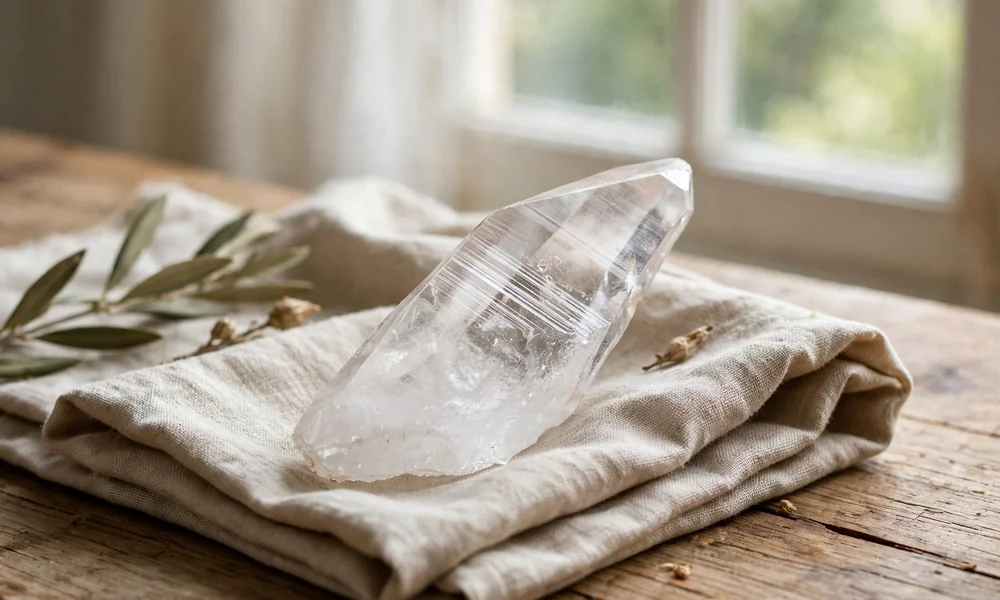
A lemurian quartz point looks, at first glance, like any other clear crystal: a tall six-sided tower of glassy stone, catching the window light. Look closer, and the difference appears along the sides, where fine horizontal lines run across the faces like the rungs of a tiny ladder.
Those ladder lines are the whole reason collectors seek this stone out. They grew into the crystal while it formed underground, and no two points carry quite the same pattern. On a quiet day, when there is time to look properly, a lemurian point rewards a slow eye the way a plain crystal cannot.
This guide stays with what can be seen and held: what lemurian quartz is and where it comes from, how it stands apart from the other quartz stones already in this journal, what to notice when picking a piece, and where it sits best at home beside a glass of water. What follows is only what can be seen, held and kept dry.
Key Takeaways
- Lemurian quartz is a clear quartz point marked with fine horizontal ladder lines.
- Its clear light and lined faces suit quiet days, slow mornings and soft daylight.
- The stone is for looking at and holding briefly; it will not heal anything.
- Keep the point dry beside the glass, never inside it, and wash hands after holding it.
- One good point on a plain tray is enough.
What Lemurian Quartz Is
Lemurian quartz is quartz, the mineral built from silicon and oxygen, grown into long six-sided points. What sets it apart is the surface: fine horizontal striations cross the faces in even rows, like lines ruled across glass, and running a fingertip lightly down a face finds a faint ridged rhythm instead of a smooth slide.
Most good pieces come from Minas Gerais in Brazil, where quartz grows slowly in open pockets of rock, and smaller numbers arrive from Colombia. Sellers often leave the points unpolished, because polishing would rub the ladder lines away.
The name comes from an old story that these crystals were seeded long ago by a lost people called the Lemurians, who left messages in the lines. That story is a tale told by sellers, not a fact about the stone.
Why Clear Light Suits Quiet Days
Clear light suits a quiet day because it asks nothing of the eyes. A pale room, a window with soft sun, a glass of water catching a bright edge: everything in it is plain, and the mind can rest without being pulled toward colour or pattern.
A lemurian point fits that mood because its beauty is small and slow: the ladder lines only show when the light is right, so the stone gives a reason to pause and look again.
Lemurian Quartz and Clear Quartz
Clear quartz: a study in light follows the simplest quartz of all: a clear, glassy stone that grows in six-sided points, with smooth flat faces and nothing written on them.
Lemurian quartz is that same mineral with one extra mark. Where clear quartz stays smooth from base to tip, lemurian quartz carries its ladder lines across every face, so the two stones look like siblings, one plain and one lined. Both are hard, glassy and clear, but only the lemurian point gives the eye those fine ruled lines to follow.
Choosing a Lemurian Quartz Piece
Hold the point in your open palm by a window and tilt it until the daylight slides across one face. The ladder lines should read as even, unbroken rows, visible without squinting, and the crystal behind them should stay clear rather than cloudy all the way through.
The base should sit flat without rocking, and the tip should be whole, not chipped. Ask the seller where the piece was dug and whether the lines are natural growth, and step away from any seller who starts promising health effects.
A Quiet Morning with Lemurian Quartz
Begin before the house is properly awake: set a folded linen cloth on the dressing table, lay the point near the front where the first light will reach it, and put a glass of water at the far end, out of reach.
Sip the water slowly as the room warms, turning the point once in your hand so the lines catch the light in turn.
Lemurian Quartz Beside Water
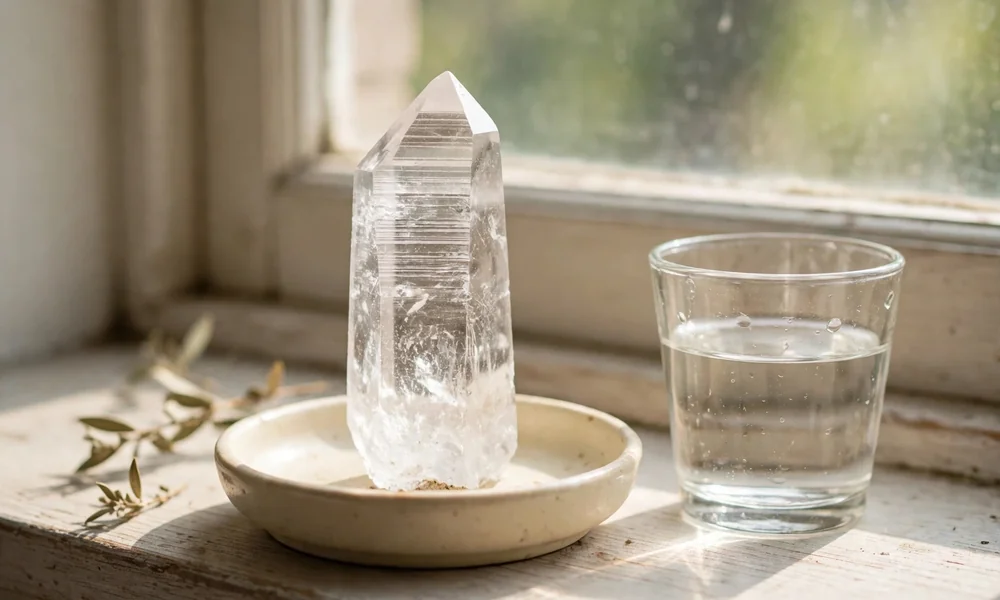
Water and lemurian quartz share a tray only when they keep their distance: put the tumbler on one side and the point on the other, with a clear strip of bare wood between them.
The point never goes into a glass, a jug or a bath, and it is never rinsed under a tap. Dust it with a soft dry cloth once a week.
Lemurian Quartz at a Glance
| Clear lined point | Tray, shelf, desk | Dry hands only |
|---|---|---|
| Quartz, silicon dioxide | Quiet days, soft light | Glass kept apart |
| Hard, glassy, clear | One point, plain tray | Never in drinks |
| Brazil, Colombia finds | Linen, wood, daylight | Dust dry weekly |
Lemurian Quartz and Rose Quartz
Rose quartz soft pink for tender evenings follows the best-known pink stone of all, a soft milky quartz coloured by tiny traces of titanium and manganese, usually sold as a smooth tumbled piece for a bedside table in the evening light.
Lemurian quartz carries no pink at all: it is clear and cool, lined with fine rows, while rose quartz is pink, smooth and cloudy, and the two suit different hours.
Lemurian Quartz and Elestial Quartz
Elestial quartz clear light for quiet days follows a clear quartz that grew in etched, skeletal layers, like tiny stairs, with a surface of little ledges and hollows that look almost carved.
Lemurian quartz is lined, not stepped: its rows run straight and even across flat faces, while elestial quartz folds into hollows and ledges. Both are clear quartz for quiet days, yet a glance tells them apart: ruled lines on one, a staircase of glass on the other.
Lemurian Quartz Among the Other Stones in This Batch
Quartz wears more outfits than any other mineral family on these shelves, and lemurian quartz still stands apart from them all. Blue quartz is pale and cool, tangerine quartz is warm orange, and lemon quartz is pale yellow, three plain colours, none of them lined. Strawberry quartz is soft pink, fire quartz is warm red, and garden quartz holds green inside like a small garden.
Smoky quartz is soft grey-brown and smooth, rutilated quartz threads plain clear crystal with fine golden needles, and spirit quartz grows as a violet cluster of many small points. Super seven holds several minerals in one deep-coloured stone, druzy quartz glitters with a skin of tiny crystals, and phantom quartz keeps ghostly layers inside it. Tourmalinated quartz carries dark threads. No other quartz here carries the fine ruled ladder lines of a lemurian point.
Four other stones share this batch with lemurian quartz, and each one keeps its own distance from it. Nosean is soft blue, a calm blue stone where lemurian quartz is clear. Wavellite is fresh green, green through and through where lemurian quartz holds no colour at all. Sulphur is warm yellow, bright and powdery where lemurian quartz is glassy and hard. Wollastonite is clear white, white and soft-looking where lemurian quartz is glass-clear with ruled lines.
The water guides in this batch take a different kind of rest: one opens a parasol against the sun, one pulls on gloves for soft hands, one lights a lantern for a calm evening, one hangs fairy lights for a calm night, and one wears a sun hat to stay cool.
Where Lemurian Quartz Rests at Home
Set it where it can be seen without being jostled: a high shelf near the morning window, the far end of a desk, or a ledge above the worktop. Keep that spot clear of taps, kettles and steam, and out of reach of small hands and pets.
When the point is not on show, rest it on its own inside a soft cloth bag, away from keys and harder stones.
Stones That Must Never Touch Water
Start from the plainest rule: a drink is for drinking, and no stone goes in it. Copper sits in the green bands of malachite, so that stone stays far from every glass and jug. Angelite softens and dulls in water, amber clouds after a soak, and apatite breaks apart when it stays wet.
Pyrite stains and dulls if it stays damp, hematite rusts the same way, and lepidolite carries lithium in its flakes, which is one more reason to keep every cup well away. Lemurian quartz asks for the same care: keep it dry, keep it out of every drink, and wash your hands once you have held it.
Your Quiet Days Checklist
- Lay the lemurian point on a dry tray, with the glass on its own side.
- Sip your water slowly, with no rush, while the light moves across the lines.
- Tilt the point once and watch the ladder rows catch the daylight in turn.
- Set the point down on its tray, then rinse your hands with soap and water.
- Buy from a seller who names the country plainly when you ask where it was dug.
- If a health worry stays with you, ask a doctor — a clear stone holds no answers.
A tray, a glass, and a lined point resting dry: that is all of it.
Frequently Asked Questions
What is lemurian quartz, in plain words?
Lemurian quartz is a clear quartz point marked with fine horizontal ladder lines across its faces, grown that way underground, usually from Brazil.
How is lemurian quartz different from clear quartz?
A clear quartz point is smooth from base to tip, with flat, clean faces. A lemurian point is the same mineral, yet fine ruled lines cross each of its faces.
Can I put lemurian quartz in my drinking water?
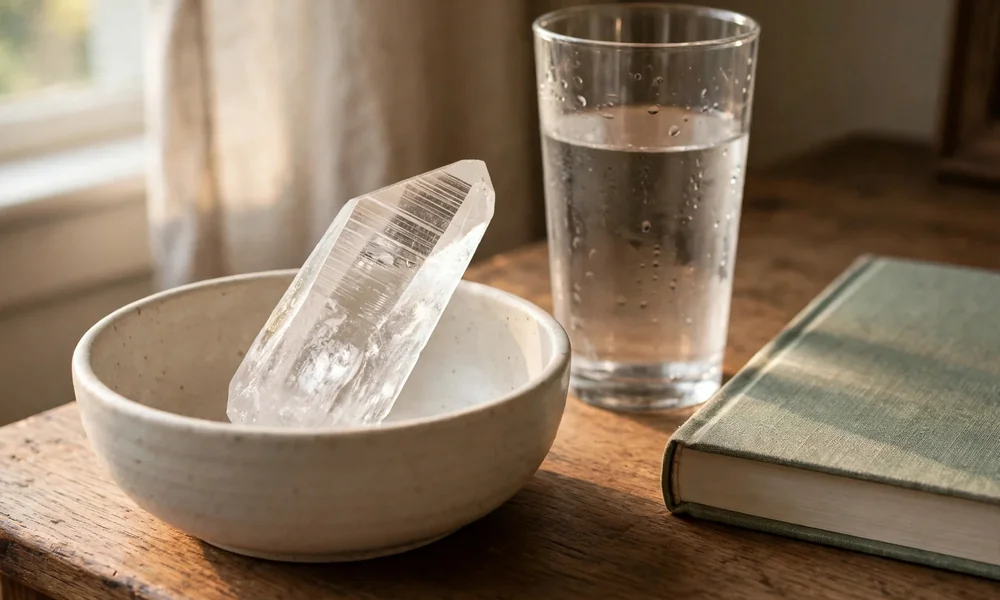
No. Keep the point beside the glass, never in it. A drink stays a drink, and a stone that sits in one can lose its shine.
How do I pick a good lemurian quartz piece?
Look for even, unbroken ladder lines in daylight, a clear body behind them, and a flat base that sits without rocking.
Is it all right to hold lemurian quartz for a short while?
A grown person can pick up a small dry point for a moment to look at the lines closely, then put it back and wash their hands.
Where should lemurian quartz live at home?
Give it a dry place in soft daylight, such as a shelf by the morning window, far from water, steam, small hands and pets.

The Bottom Line
One lined point, a glass of water kept apart, and a quiet day with light enough to see the rows: lemurian quartz asks for little.
A Note for Quiet Days
Clear stone, ruled lines, and an unhurried morning: lemurian quartz keeps its pattern until the light is right.


