
Most quartz arrives looking finished: smooth faces, clean edges, a point that could have been drawn with a ruler. Elestial quartz arrives looking unfinished in the loveliest way. Its faces are stepped and etched, as if tiny stairs had been carved into the crystal while it grew, and the light catches each little ledge in turn. It is still quartz, clear and glassy at heart, but it grew in layers that folded back on themselves, leaving a surface full of small hollows and ridges.
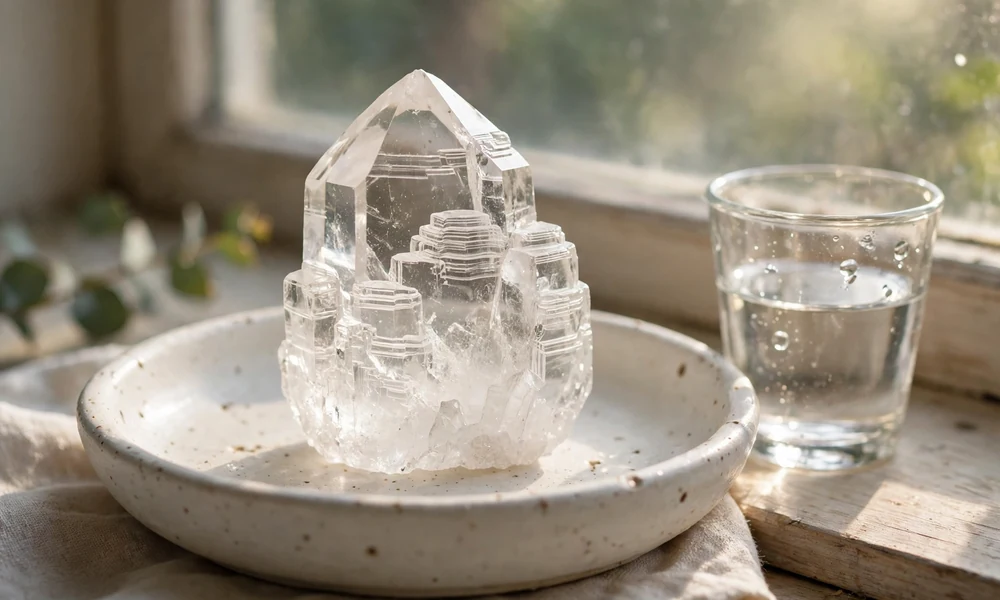
A quiet day suits this stone. It does not flash or glow, and it asks for no ceremony. Set it where the morning light can reach it, pour a glass of water for yourself, and let the two sit side by side on the same tray. The stone gives the eye something slow to follow, and the water gives the morning a calm start.
Elestial quartz promises nothing beyond what you can see. It will not steady a rough day or mend sleep, and it will never go into a drink. What it offers is a clear, etched piece of the earth to look at and hold for a little while, and that is the whole of it.
Key Takeaways
- Elestial quartz is a clear quartz that grew in etched, skeletal layers, like tiny stairs.
- Its stepped faces suit quiet days, slow mornings, and rooms with soft daylight.
- The stone is for looking at and holding briefly; it heals nothing and changes nothing.
- Keep the stone dry beside the glass, never inside it, and wash your hands after handling it.
- Small etched pieces are the usual way to enjoy elestial quartz, and a plain tray is all it needs.
What Elestial Quartz Is
Elestial quartz is quartz that grew the hard way. While most quartz points grow outward in smooth, flat faces, elestial quartz grew in thin layers that stacked, folded, and etched themselves into steps. The result is a skeletal crystal: clear through the middle, with a surface of little ledges, hollows, and ridged patterns that look almost carved.
Good pieces come from Brazil and Madagascar. No two pieces match: one may show wide, clear steps across a broad face, while another hides its layers in a tight cluster of small points. The name comes from the look of the stone, which seems to hold tiny stairways and hollows inside its clear body. It is honest quartz, not a coated or dyed stone, and its etched surface is the work of nature, not a workshop.
Picking an Elestial Quartz Piece
Choose an elestial quartz piece in plain daylight, holding it at arm's length first and then close up. The etching should read clearly from both distances: wide steps you can see across the room, and fine ridges that appear when you bring the piece nearer. Run a fingertip lightly across one face and feel for the steps. Ask the seller where the piece was found and whether anything was added to its colour. Check the base for chips, since the thin layered edges can be brittle, and buy the smallest piece whose etching pleases you.
A Quiet Day with Elestial Quartz
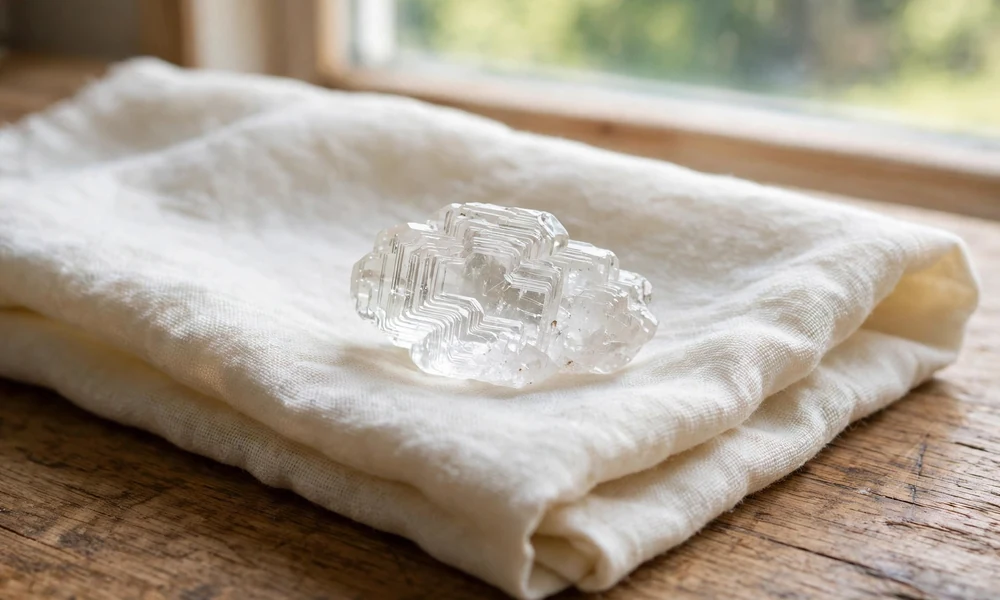
A quiet day with elestial quartz begins before the house wakes properly. Lay a folded linen cloth on the dressing table, set the stone near the front edge where the light will find it, and put a glass of water at the far end, out of reach of an elbow. Drink the water in slow sips while the room warms up. The stone fits a slow morning because it rewards a second look: move it to the windowsill for an hour in the afternoon, where the sun can pick out the ridges, and bring it back to its tray before evening.
Elestial Quartz Beside Water
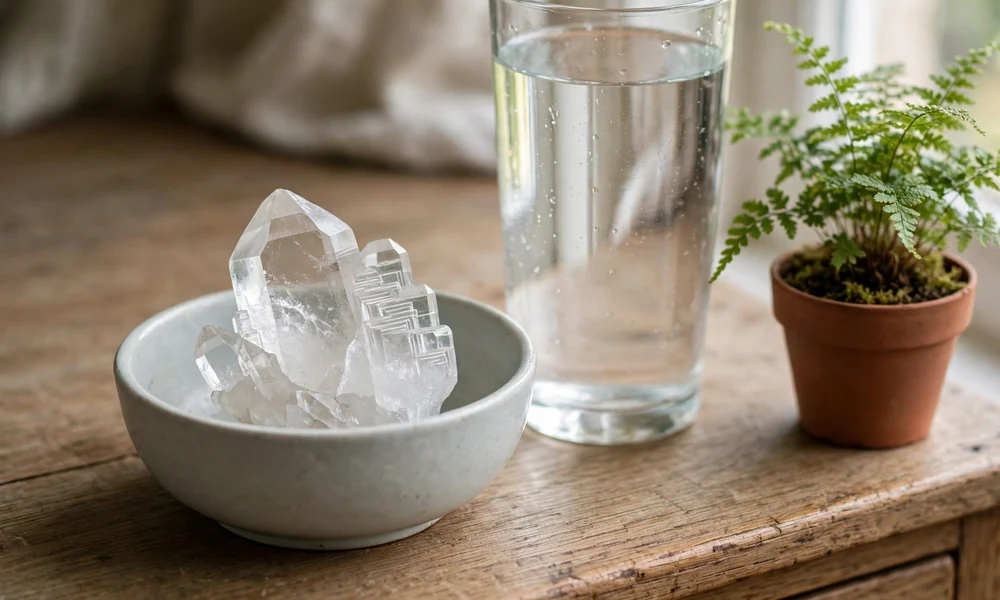
Water and elestial quartz look fine together, yet they stay apart on the tray. Set the tumbler on one side and the stone on the other, with a clear strip of bare wood between them. Wash your hands after you have handled the stone, and only then pick up your drink. The stone never enters a glass, a jug, or a bath, and no water is poured over it to clean it.
Elestial Quartz at a Glance
| Clear etched steps | Pale tray, window | Dry hands only |
|---|---|---|
| Skeletal quartz growth | Quiet days, light | Glass kept apart |
| Brazil, Madagascar finds | One accent, plain | Never in drinks |
| Cool, stepped, glassy | Clear morning light | Never soak stone |
| Small pieces usual | Tidy shelf, tray | Dust dry weekly |
Elestial Quartz and Clear Quartz
Clear quartz for fresh starts is the plainest member of the family: a clear, glassy mineral that grows in six-sided points, catching bright light and throwing it back in small flashes.
Elestial quartz is clear quartz that took a different road while growing. Where clear quartz stays smooth and straight, elestial quartz folds into steps and hollows. One is a clean window; the other is a staircase made of glass.
Elestial Quartz and Rose Quartz
Rose quartz for tender evenings is a pale pink quartz, sold mostly as a smooth tumbled piece or a small palm stone, and it spends its life on bedside tables in the evening light.
Elestial quartz carries no pink at all. It is clear, cool, and cut through with steps, while rose quartz is pink, smooth, and soft to look at. One suits tender evenings; the other suits clear, quiet mornings.
Elestial Quartz and Aqua Aura Quartz
Aqua aura quartz for bright days is clear quartz coated in a workshop with a fine mist of gold vapour, which turns it a soft blue-green. The colour is lovely, and the guide that covers it says plainly that the coating comes from a workshop, not from nature.
Elestial quartz wears no coating at all. Its pattern was etched while it grew underground, and its colour is the clear glass of plain quartz.
Elestial Quartz and the Other Quartz Stones
Quartz wears more outfits than any other mineral family on these shelves, and elestial still stands out among them. Smoky quartz is soft grey-brown and smooth, rutilated smoky quartz carries fine golden needles through that grey-brown, and rutilated quartz threads plain clear crystal with gold. Angel aura quartz is clear quartz with a thin coating that throws soft rainbow flashes, and blue quartz is a pale soft blue, smooth and cool. Spirit quartz grows as a violet cluster of many small points, fire quartz is warm red, super seven is deep in colour with several minerals inside, druzy quartz sparkles with a crust of tiny crystals, lemon quartz is pale yellow, garden quartz holds green inside like a small garden, phantom quartz shows ghostly layers within, tangerine quartz is warm orange, strawberry quartz is soft pink, and tourmalinated quartz carries dark threads. None of them grows in the stepped, skeletal layers that mark elestial quartz.
Elestial Quartz and the Other Stones in This Batch
This batch brings four more stones, and each one keeps its own distance from elestial quartz. Kornerupine is a fresh green stone for calm days, green through and through where elestial is clear. Smoky citrine is warm brown and steady, a colour that sits low and warm while elestial stays cool and glassy. Magnesite is clear white for quiet days, white and soft-looking where elestial is glass-clear with hard steps. Dragon blood jasper is deep green for bold days, opaque and patterned with red, the opposite of a clear etched crystal.
Keeping Elestial Quartz at Home
Give elestial quartz a bright, tidy corner where it can be seen without being knocked: the end of a desk, a shelf by the morning window, or a small dish on the drawers. Water stays far from that corner, so pick a spot well away from the sink, the kettle, and any steamy bathroom air, and high enough that small hands cannot reach it. Once a week, brush the dust off with a soft, dry cloth; soap and sprays stay in the cupboard. When the stone is not on show, tuck it on its own inside a soft pouch, away from keys and harder stones, so its thin layered edges stay whole.
Stones That Must Stay Away from Water
A few stones hide something unkind inside them, so the rule that covers them all is simple: no stone ever touches a drink. Malachite wears green bands rich in copper, a metal no drink should carry, so it stays far from glasses and jugs. Hematite is kept out of drinking water too, and so are apatite and pyrite. Lepidolite holds lithium inside it, so it stays dry and away from drinks. Angelite goes dull and soft when it gets wet, and amber, hardened sap from ancient trees, goes cloudy when soaked and has no place in a drink.
Your Quiet Days Checklist
- Set the stone on a dry tray, glass on its own side.
- Sip your water slowly, with no rush.
- Turn the piece slowly and watch the light move across the steps.
- Put the stone back on its tray, then wash your hands.
- Buy from a seller who says plainly where the piece was found.
- If something about your health worries you, ask your doctor — a stone cannot answer that.

Frequently Asked Questions
What is elestial quartz?
Elestial quartz is a clear quartz crystal that grew in thin, etched layers, giving it stepped, skeletal faces like tiny stairs.
Where does elestial quartz come from?
Good elestial quartz comes from Brazil and Madagascar, where quartz grows slowly in open pockets.
Why does elestial quartz look etched?
The crystal grew in layers that stacked and folded back on themselves instead of forming smooth flat faces.
How is elestial quartz different from clear quartz?
Clear quartz grows in smooth six-sided points with flat, clean faces. Elestial quartz is the same mineral, but its faces are stepped and etched.
Is elestial quartz safe to hold?
Holding a small polished piece for a short while is fine for nearly everyone, because a dry stone gives off nothing to the skin.
Where should I keep elestial quartz at home?
Pick a dry corner with daylight: the end of a desk, a shelf by the window, or a dish on the drawers. Keep it clear of the glass, clear of knocks, and clear of steam.
The Bottom Line
Elestial quartz fits quiet days: a clear, etched stone that catches light in small steps, a glass of water nearby, and the stone kept dry.
A Note for Quiet Days
One clear stone, a staircase of light, a dry tray, a full glass — a quiet day asks for nothing more.


